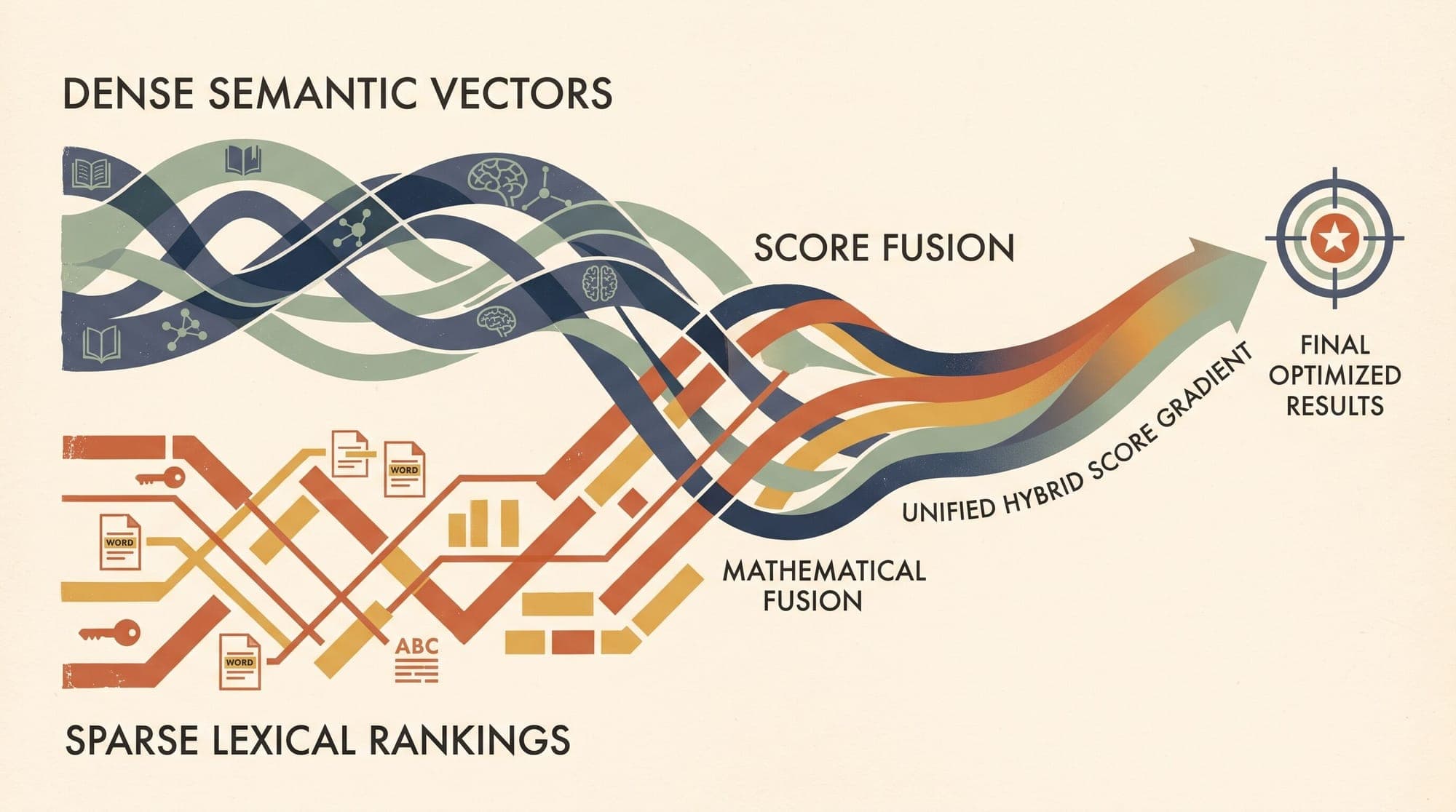
Combining lexical search and dense vector retrieval is the standard architecture for modern enterprise retrieval-augmented generation (RAG). Lexical algorithms like BM25 excel at exact token matching, code identifiers, and acronyms, while dense embeddings capture semantic context and paraphrased intent.
However, merging these two disparate retrieval streams into a single, coherent ranking presents a fundamental mathematical challenge: lexical engines and vector indices operate in completely incommensurate score spaces.
+-------------------------------------------------------------------------+
|                       Hybrid Retrieval Architecture                     |
|                                                                         |
|   Query: "CVE-2024-38077 memory corruption in Windows Remote Access"     |
|         |                                            |                  |
|         v                                            v                  |
|   +---------------+                            +---------------+        |
|   |  Lexical BM25 |                            | Dense Vector  |        |
|   | (Unbounded)   |                            | (Cosine 0..1) |        |
|   +---------------+                            +---------------+        |
|         | Scores: 18.4, 14.1, 8.2                    | Scores: 0.89, 0.74, 0.71
|         +---------------------+----------------------+                  |
|                               |                                         |
|                               v                                         |
|                    +--------------------+                               |
|                    | Score Fusion Layer |                               |
|                    | (RRF / RSF / DBSF) |                               |
|                    +--------------------+                               |
|                               |                                         |
|                               v                                         |
|                    +--------------------+                               |
|                    | Final Ranked List  |                               |
|                    +--------------------+                               |
+-------------------------------------------------------------------------+
A BM25 score is an unbounded positive real number ($0, \infty)$) shaped by term frequency, inverse document frequency, and document length normalization factors defined by the [Okapi BM25 specification. Dense retrieval similarity scores (such as cosine similarity or inner product) are constrained to or . Naive linear combinations such as fail because the lexical term dominates the scalar sum regardless of semantic relevance.
Production search systems resolve this via three primary score fusion strategies: Reciprocal Rank Fusion (RRF), Relative Score Fusion (RSF), and Distribution-Based Score Fusion (DBSF). Each approach imposes distinct trade-offs across rank preservation, outlier resilience, and computational latency.
1. Reciprocal Rank Fusion (RRF)
Reciprocal Rank Fusion, formalized by Cormack, Clarke, and Buettcher (SIGIR 2009), sidesteps score incommensurability entirely by discarding raw similarity scores and evaluating only positional rank order.
+-------------------------------------------------------------------------+
|                  Reciprocal Rank Fusion (RRF) Mechanics                 |
|                                                                         |
|   Formula:  RRF(d) = Σ [ w_m / (k + rank_m(d)) ]                        |
|                                                                         |
|   Example with k = 60:                                                  |
|   - Retriever A Rank 1: 1 / (60 + 1) = 0.01639                          |
|   - Retriever B Rank 1: 1 / (60 + 1) = 0.01639                          |
|   - Document in both at Rank 1: 0.01639 + 0.01639 = 0.03278             |
|                                                                         |
|   - Retriever A Rank 10: 1 / (60 + 10) = 0.01428                        |
|   - Delta between Rank 1 and Rank 10: only 0.00211                      |
+-------------------------------------------------------------------------+
For a document appearing in a set of retrieval result lists , the fused score is calculated as:
Where:
- is the 1-indexed rank of document in retriever .
- is the retriever weight (typically for equal weighting).
- is a smoothing constant, historically set to .
The Role of the Smoothing Constant
The hyperparameter acts as a damper on top-rank dominance:
- At , rank 1 receives a score of , while rank 2 drops sharply to (a 50% penalty).
- At , rank 1 receives , and rank 2 receives (a 1.6% differential).
Setting ensures that a document appearing at rank 5 across both BM25 and vector lists () ranks higher than a document appearing at rank 1 in only one list and completely absent from the other ().
Operational Strengths and Weaknesses
Strengths:
- Zero Score Calibration: Works identically across arbitrary scoring algorithms, including BM25, SPLADE, dense embeddings, and fuzzy string distance.
- Scale Invariance: Unaffected by differences in index size, term sparsity, or vector distance metrics.
Failure Mode: Confidence Cliffs. RRF is entirely blind to score margins. If a dense vector query produces a near-perfect match with cosine similarity at rank 1 and a distant match with similarity at rank 2, RRF applies the exact same penalty step as if rank 1 scored and rank 2 scored . When one retrieval modality is highly confident and the other returns low-relevance noise, RRF artificially elevates low-confidence consensus over high-confidence unilateral hits.
2. Relative Score Fusion (RSF)
Relative Score Fusion (also known as Min-Max Normalized Score Fusion) normalizes the raw scores of each retriever to a common interval before computing a weighted sum, as documented in engines like Bleve Search and OpenSearch Search Pipelines.
+-------------------------------------------------------------------------+
|                    Relative Score Fusion (RSF) Flow                     |
|                                                                         |
|   1. Calculate Min and Max per retriever result list:                   |
|      S_norm(d) = ( S(d) - S_min ) / ( S_max - S_min )                   |
|                                                                         |
|   2. Compute Weighted Combination:                                      |
|      S_RSF(d) = w_lex * S_norm_lex(d) + w_vec * S_norm_vec(d)           |
+-------------------------------------------------------------------------+
For each retriever list , individual scores are normalized:
The fused score is then computed via weighted addition:

Operational Strengths and Weaknesses
Strengths:
- Confidence Preservation: If the top vector match significantly outscores subsequent results, that margin of confidence is preserved through normalization and influences final ranking.
- Parametric Control: Weights directly adjust the influence of lexical versus semantic signals (for example, setting for code search).
Failure Mode: Outlier Compression. Min-max normalization is vulnerable to solitary score outliers. In lexical retrieval, an exact multi-token match in a short field can produce an extreme BM25 score (such as ), while the remaining candidates cluster tightly between and .
In this scenario, and . Rank 2 (score ) is compressed to . The entire lower tail of viable lexical candidates is flattened near zero, nullifying the lexical signal across the rest of the candidate pool.
3. Distribution-Based Score Fusion (DBSF)
Distribution-Based Score Fusion mitigates min-max outlier compression by applying statistical normalization based on the sample distribution of returned scores, as implemented in engines like Qdrant.
+-------------------------------------------------------------------------+
|                 Distribution-Based Score Fusion (DBSF)                  |
|                                                                         |
|   1. Compute sample mean (μ) and standard deviation (σ) per list:       |
|      μ = (1/N) Σ S(d),    σ = sqrt( (1/N) Σ (S(d) - μ)^2 )              |
|                                                                         |
|   2. Standardize to z-scores:                                           |
|      z(d) = ( S(d) - μ ) / σ                                            |
|                                                                         |
|   3. Map to [0, 1] using 3-sigma clamping:                              |
|      S_DBSF(d) = clip( (z(d) + 3) / 6, 0.0, 1.0 )                       |
+-------------------------------------------------------------------------+
DBSF assumes retrieval scores approximate a continuous distribution within a single query execution window. For candidate set returned by retriever :
- Compute sample mean and sample standard deviation :
- Compute the standard score .
- Map to a bounded interval via boundary clamping (or a logistic sigmoid function):
Operational Strengths and Weaknesses
Strengths:
- Outlier Immunity: A single extreme BM25 score does not compress the remaining distribution; candidates 1 standard deviation above the mean retain proportional separation ().
- Variance Alignment: Retains confidence gaps when a retriever is selective, while smoothly compressing flat, uninformative score distributions.
Failure Mode: Small Sample Instability. If candidate retrieval windows are constrained (e.g., documents fetched per shard), sample variance becomes unstable. If all retrieved candidates have nearly identical scores, , leading to numerical division errors or erratic score inflation. DBSF implementations require fallback guards (setting or reverting to uniform scoring when variance falls below a minimum threshold).
Comparative Architectural Trade-Offs
| Dimension | Reciprocal Rank Fusion (RRF) | Relative Score Fusion (RSF) | Distribution-Based Score Fusion (DBSF) | | :--- | :--- | :--- | :--- | | Primary Input | Ordinal ranks () | Cardinal scores () | Cardinal scores () | | Score Calibration Required | None | Low (requires linear scale) | Medium (requires stable variance) | | Outlier Resilience | Complete | Poor (causes compression) | High ( truncation) | | Confidence Preservation | Zero | High (linear) | High (statistical) | | Time Complexity | (sorting) | (min-max scan) | (two-pass stats) | | Minimum Candidate Window | | | recommended | | Memory Overhead | Low (rank table) | Minimal (scalar registers) | Minimal (running moments) |
Production Latency Economics and Pipeline Placement
In distributed architectures, score fusion occurs at the query coordinator node after scatter-gather execution across shard replicas.
+-------------------------------------------------------------------------+
|                 Distributed Retrieval and Fusion Pipeline               |
|                                                                         |
|   Client Query                                                          |
|        |                                                                |
|        v                                                                |
|   [Query Coordinator]                                                   |
|        |                                                                |
|        +---- Scatter (k_fetch = 100) ----+                              |
|        |                                 |                              |
|        v                                 v                              |
|   [BM25 Shard Replicas]            [Vector HNSW Shards]                 |
|        |                                 |                              |
|        +---- Gather Candidates ----------+                              |
|        |                                                                |
|        v                                                                |
|   [Fusion Engine: RRF / RSF / DBSF] (Latency: < 1.2ms)                  |
|        | (Prune to Top 50)                                              |
|        v                                                                |
|   [Cross-Encoder Reranker]          (Latency: 15-45ms)                  |
|        | (Prune to Top 5)                                               |
|        v                                                                |
|   [LLM Context Injection]                                               |
+-------------------------------------------------------------------------+
1. Candidate Window Sizing ()
To ensure high recall before reranking, the coordinator fetches candidates from each retriever (typically ).
- If is too low (), RRF penalizes non-overlapping items excessively, and DBSF suffers from sample variance instability.
- In-memory fusion computation across candidates consumes under milliseconds on standard x86-64 vCPU cores, representing less than of total retrieval latency.
2. Fusion as a Pre-Filter for Cross-Encoders
Score fusion is rarely the terminal ranking stage in frontier RAG pipelines. Instead, fusion algorithms serve as an ultra-low-latency pruning step to narrow candidates down to a top- window () for GPU-bound cross-encoder reranking (e.g., BGE-Reranker-Large or Cohere Rerank 3).
- When paired with a cross-encoder, RRF is frequently preferred because its lack of score sensitivity prevents early false-negative pruning while maintaining high recall.
- When latency budgets forbid a secondary neural reranker ( hard SLA), DBSF provides superior precision by incorporating score confidence without suffering from min-max compression.
Selection Guide for Production Systems
- Deploy Reciprocal Rank Fusion (RRF) when:
- Combining three or more heterogeneous retrieval systems (e.g., BM25 + Dense HNSW + Sparse SPLADE + Graph traversal).
- Score distributions across collections vary widely across time or query types.
- An downstream cross-encoder reranker is present to resolve fine-grained relevance scoring.
- Deploy Relative Score Fusion (RSF) when:
- Combining well-bounded, predictable scoring functions (e.g., two dense embedding models trained under cosine loss).
- Domain-specific search tasks require strict manual weighting between keywords and concepts.
- Deploy Distribution-Based Score Fusion (DBSF) when:
- Operating in low-latency environments where a cross-encoder cannot be deployed.
- Retaining score confidence margins is critical to avoid false positives on ambiguous queries.
- Candidate retrieval windows per query exceed 30 documents ().
Sources
- Cormack, G. V., Clarke, C. L. A., & Büttcher, S. (2009). Reciprocal Rank Fusion outperforms Condorcet and individual rank learning methods. Proceedings of the 32nd International ACM SIGIR Conference on Research and Development in Information Retrieval (SIGIR '09), 758–759. ACM Digital Library / Google Research
- Robertson, S., & Zaragoza, H. (2009). The Probabilistic Relevance Framework: BM25 and Beyond. Foundations and Trends in Information Retrieval, 3(4), 333–389. Now Publishers
- Qdrant Documentation. Hybrid and Multi-Stage Queries: Reciprocal Rank Fusion and Distribution-Based Score Fusion. Qdrant Docs
- OpenSearch Documentation. Hybrid Search: Normalization Processor. OpenSearch Docs
- Bleve Documentation. Score Fusion Strategies: RRF and RSF Specification. Bleve Search GitHub