RAG35 articles

RAG

Articles

  • Sparse-Dense Hybrid Retrieval in Production: Learned Lexical Weights, SPLADE vs. BGE-M3, Inverted Index Pruning, and Serving Economics

    Modern Retrieval-Augmented Generation (RAG) and enterprise search architectures increasingly encounter the operational limits of pure dense vector search. Dense bi-encoders project text passages into continuous latent spaces (typically 768 to 3,072 dimensions). While dense representations excel at conceptual matching and paraphrasing, they systematically struggle with exact keyword precision, rare alphanumeric tokens, product SKUs, and domain-specific jargon. Furthermore, serving dense vectors a

    1 min
  • Hallucination Detection and Faithfulness Verification in Production RAG: Architecture, NLI Claim Decomposition, and Runtime Guardrail Economics

    Retrieval-Augmented Generation (RAG) is commonly deployed under the assumption that grounding generation in retrieved passages eliminates factual inaccuracies. In practice, grounding provides an evidence boundary but does not guarantee factual fidelity. Production language models regularly synthesize claims absent from the retrieved context (extrinsic hallucinations) or directly assert statements conflicting with retrieved premises (intrinsic contradictions). As enterprise RAG pipelines scale i

    1 min
  • Embedding Model Fine-Tuning in Production: Hard Negative Mining, Synthetic Data Pipelines, and Contrastive Distillation

    Production retrieval-augmented generation (RAG) and semantic search architectures frequently suffer from domain mismatch when relying on general-purpose embedding models. Off-the-shelf bi-encoders trained on broad web corpora often experience a 15% to 30% degradation in retrieval metrics such as NDCG@10 and MRR@10 when deployed on specialized enterprise corpora, including proprietary codebases, internal API schemas, clinical trials, and technical documentation. While downstream cross-encoder re

    1 min
  • Retrieval-Augmented Fine-Tuning (RAFT) in Production: Architecture, Synthetic Distractor Pipelines, and Evaluation

    Standard approaches to enterprise domain adaptation typically force a choice between two paradigms: Supervised Fine-Tuning (SFT) or Retrieval-Augmented Generation (RAG). SFT bakes domain knowledge directly into model weights, functioning like a closed-book exam. When facts change or precise source attribution is required, SFT models often hallucinate or fail to incorporate updated context. Conversely, standard RAG operates like an open-book exam without prior preparation. The base model reads re

    1 min
  • Fine-Tuning vs. RAG in Production: Knowledge Injection, Task Adaptation, Latency Economics, and Hybrid Architecture Trade-Offs

    Fine-Tuning vs. RAG in Production: Knowledge Injection, Task Adaptation, Latency Economics, and Hybrid Architecture Trade-Offs When adapting large language models to domain-specific enterprise workloads, engineering teams face a fundamental architectural choice: modify the model's parametric weights via fine-tuning, or supply dynamic context at inference time via Retrieval-Augmented Generation (RAG). While early discussions often framed this decision as a binary trade-off, empirical evaluation

    1 min
  • Listwise Reranking in Production: Comparing Pointwise, Pairwise, and Listwise LLM Architectures, Sliding-Window Permutations, and Serving Economics

    Information retrieval systems in production Retrieval-Augmented Generation (RAG) and enterprise search have transitioned through multiple reranking paradigms. While first-stage retrieval (dense vector embeddings and sparse lexical BM25/SPLADE) retrieves candidate sets of 50 to 200 documents in under 20 milliseconds, the precision of downstream generation depends heavily on the reranking stage. Traditional neural rerankers evaluate candidates through pointwise scoring or pairwise classification.

    1 min
  • Embedding Inversion in Production RAG: Architecture, Reconstruction Risks, and Vector Defense Strategies

    In enterprise Retrieval-Augmented Generation (RAG) pipelines, architecture teams frequently treat dense vector embeddings as an opaque, pseudo-anonymized representation of proprietary data. The underlying assumption has been that projecting raw text into high-dimensional geometric spaces (such as 768-, 1024-, or 1536-dimensional float vectors) acts as a one-way mathematical hash. Under this assumption, vector databases like Pinecone, Qdrant, Milvus, and pgvector are often deployed with weaker ac

    1 min
  • Distributed Vector Search and Sharding Architecture in Production: Horizontal Partitioning, Scatter-Gather Tail Latency, Filter-Aware Routing, and Dynamic Rebalancing

    Scaling vector search beyond tens of millions of high-dimensional embeddings inevitably hits a physical boundary: the single-node memory wall. Because graph-based approximate nearest neighbor (ANN) algorithms such as Hierarchical Navigable Small World (HNSW) require random memory access patterns across graph vertices and high-dimensional vectors, keeping embeddings and index structures in RAM is critical for sub-20ms query latencies. A collection of 100 million 1,536-dimensional float32 vectors

    1 min
  • Fine-Grained Access Control in Enterprise RAG: Pre-Filtering vs. Post-Filtering, Zanzibar ReBAC Models, and Zero-Trust Retrieval Architecture

    Deploying Retrieval-Augmented Generation (RAG) across enterprise knowledge repositories introduces a security boundary that simple vector search was never designed to enforce. In corporate environments spanning Google Workspace, Microsoft SharePoint, Notion, Confluence, and internal ticket systems, access permissions are dynamic, hierarchical, and deeply nested. Attempting to enforce security at the prompt generation layer by instructing language models to ignore unauthorized context is fundame

    1 min
  • Multi-Vector Late Interaction in Production: PLAID Indexing, Residual Compression, and Serving Architectures

    Multi-Vector Late Interaction in Production: PLAID Indexing, Residual Compression, and Serving Architectures Dense single-vector embeddings and cross-encoder rerankers represent the two traditional extremes of neural information retrieval. Single-vector models collapse entire documents into a single dense representation (typically 768 to 3,072 dimensions), losing token-level nuance, lexical precision, and localized facts. Cross-encoders preserve token interactions across the entire input sequen

    1 min
  • Hybrid Search Score Fusion in Production: Reciprocal Rank Fusion vs. Relative Score Fusion vs. Distribution-Based Score Fusion

    Combining lexical search and dense vector retrieval is the standard architecture for modern enterprise retrieval-augmented generation (RAG). Lexical algorithms like BM25 excel at exact token matching, code identifiers, and acronyms, while dense embeddings capture semantic context and paraphrased intent. However, merging these two disparate retrieval streams into a single, coherent ranking presents a fundamental mathematical challenge: lexical engines and vector indices operate in completely inc

    1 min
  • Cross-Encoder Rerankers in Production RAG: Architecture, Score Calibration, Latency Budgets, and Model Trade-Offs

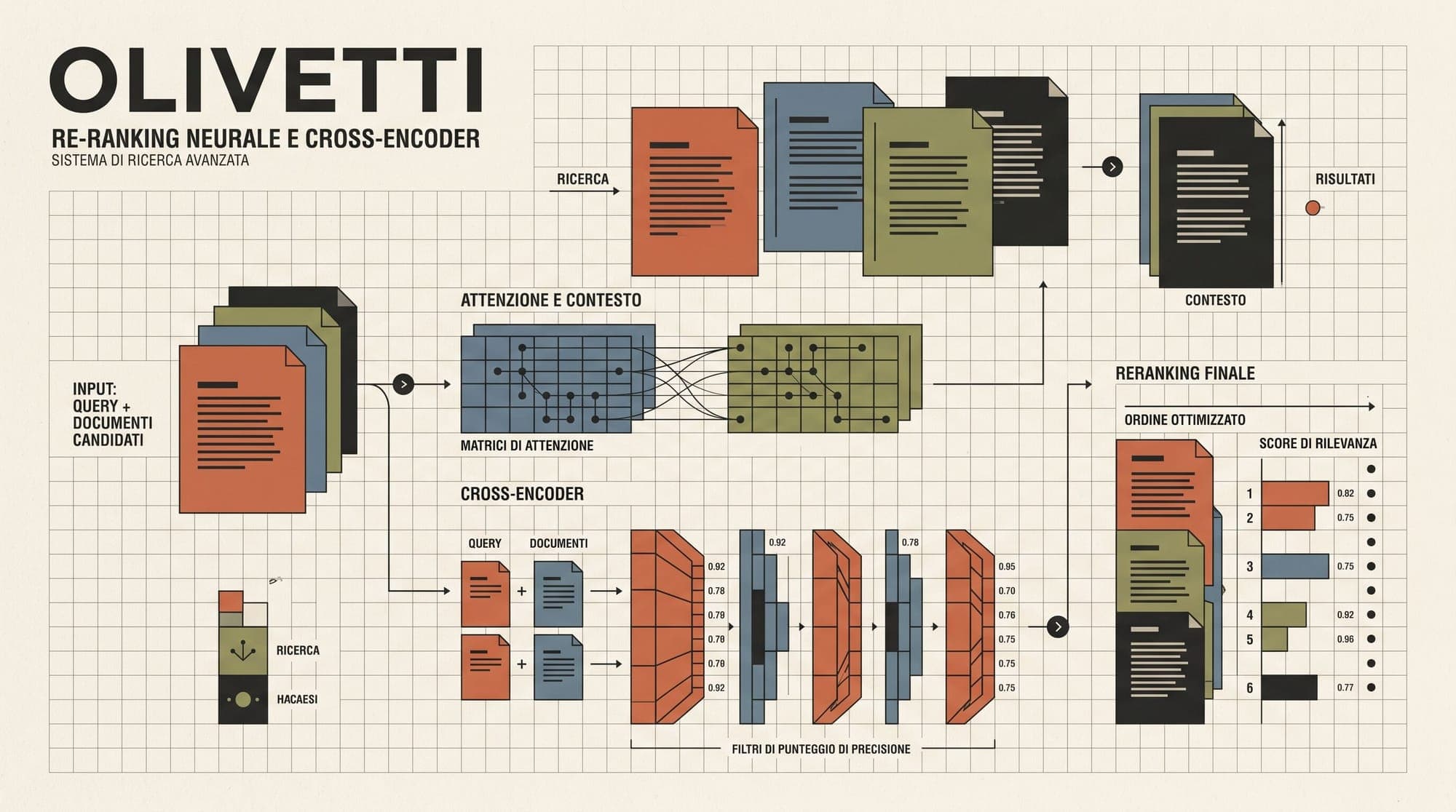
    Retrieval-Augmented Generation (RAG) systems in production frequently suffer from a fundamental precision failure: vector search surfaces the correct chunk somewhere in the top 50 candidates, but fails to place it in the top 3 positions required for high-fidelity LLM synthesis. When irrelevant or tangential chunks lead the context window, generation quality degrades through hallucinations, lost-in-the-middle context neglect, and inflated inference costs. Cross-encoder rerankers serve as the sta

    1 min
  • Embedded Vector Databases in Production: Comparing LanceDB, sqlite-vec, DuckDB-VSS, and Chroma

    Dedicated, client-server vector databases like Milvus, Qdrant clusters, and Pinecone dominate enterprise discussions around retrieval-augmented generation (RAG). However, production engineering reality increasingly favors a different topology: embedded, in-process vector engines. Running vector search directly inside the application process eliminates network round-trip overhead (typically 15-50ms over cross-datacenter or cloud VPC hops), removes dedicated database infrastructure management, an

    1 min
  • Hierarchical Tree Retrieval in Production RAG: Architecture, Recursive Clustering, and Serving Economics for RAPTOR

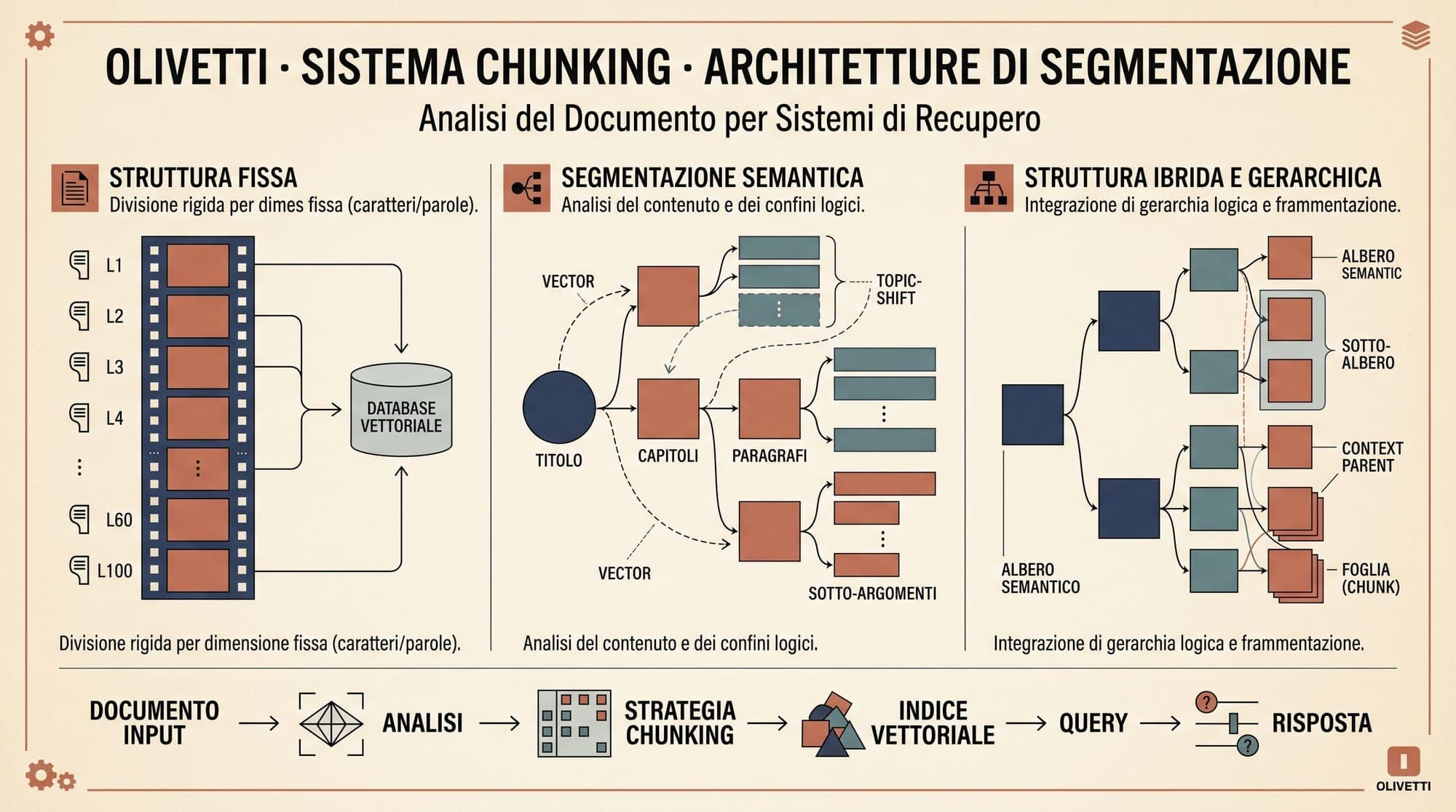
    Production Retrieval-Augmented Generation (RAG) pipelines routinely hit a fundamental structural ceiling: flat chunk retrieval. Standard retrieval architectures segment ingested documents into uniform, contiguous chunks (typically 100 to 512 tokens), embed them in a vector space, and fetch top-k nearest neighbors based on cosine similarity. This design functions well for granular, needle-in-a-haystack fact lookups ("What was the Q3 gross margin for EMEA?"). However, it fails on thematic, holist

    1 min
  • Embedding Model Migration in Production: Dual-Indexing, Vector Adapters, and Zero-Downtime Re-Indexing Architectures

    Upgrading embedding models in production retrieval-augmented generation (RAG) and semantic search platforms is often mischaracterized as a routine model bump. When engineering teams replace a legacy embedding model such as OpenAI text-embedding-ada-002 or BAAI bge-large with a modern successor like text-embedding-3-large or Cohere embed-v3, the underlying mathematical coordinate space changes entirely. Because dense vectors generated by distinct neural networks live on incompatible manifolds, v

    1 min
  • Binary Quantization and Two-Stage Rescoring in Production Vector Search: Architecture, Hamming Filtering, and Memory Economics

    Binary Quantization and Two-Stage Rescoring in Production Vector Search: Architecture, Hamming Filtering, and Memory Economics High-dimensional vector embeddings form the foundation of modern retrieval-augmented generation (RAG) and semantic search architectures. However, as vector databases scale past tens of millions of records, standard full-precision representations run directly into physical memory constraints. Standard 32-bit floating-point (float32) embeddings spanning 768 to 3072 dimens

    1 min
  • Speculative RAG in Production: Architecture, Multi-Perspective Sampling, and Draft Verification Trade-Offs

    Standard Retrieval-Augmented Generation (RAG) pipelines face an escalating trade-off between retrieval recall and inference latency. To ensure sufficient coverage for ambiguous or complex knowledge-intensive queries, production systems commonly ingest between 10 and 20 candidate passages per query. However, concatenating large document sets directly into the prompt context of a large language model introduces severe bottlenecks: quadratic attention scaling during the prefill phase, elevated Time

    1 min
  • Dynamic Context Assembly and Token Budget Allocation in Production: Priority Packing, Prefix Cache Alignment, and Degradation Fallbacks

    In production large language model systems, prompt construction is frequently treated as simple string concatenation. Engineers assemble system instructions, tool schemas, retrieved document snippets, memory state, and multi-turn conversational history using template strings. In low-throughput prototypes, this approach functions adequately. In high-throughput production systems and multi-agent workflows, naive assembly introduces critical failure modes: abrupt context window overflows triggering

    1 min
  • Multimodal RAG in Production: Video Chunking, Cross-Modal Embeddings, and Temporal Retrieval Architecture

    Multimodal RAG in Production: Video Chunking, Cross-Modal Embeddings, and Temporal Retrieval Architecture Enterprise adoption of large language models is rapidly expanding beyond static text corpora into rich video, audio, and visual archives. Recorded meetings, technical webinars, security camera feeds, product walkthroughs, and surgical recordings hold critical institutional knowledge. However, querying multi-hour video and audio streams presents severe architectural challenges. While modern

    1 min
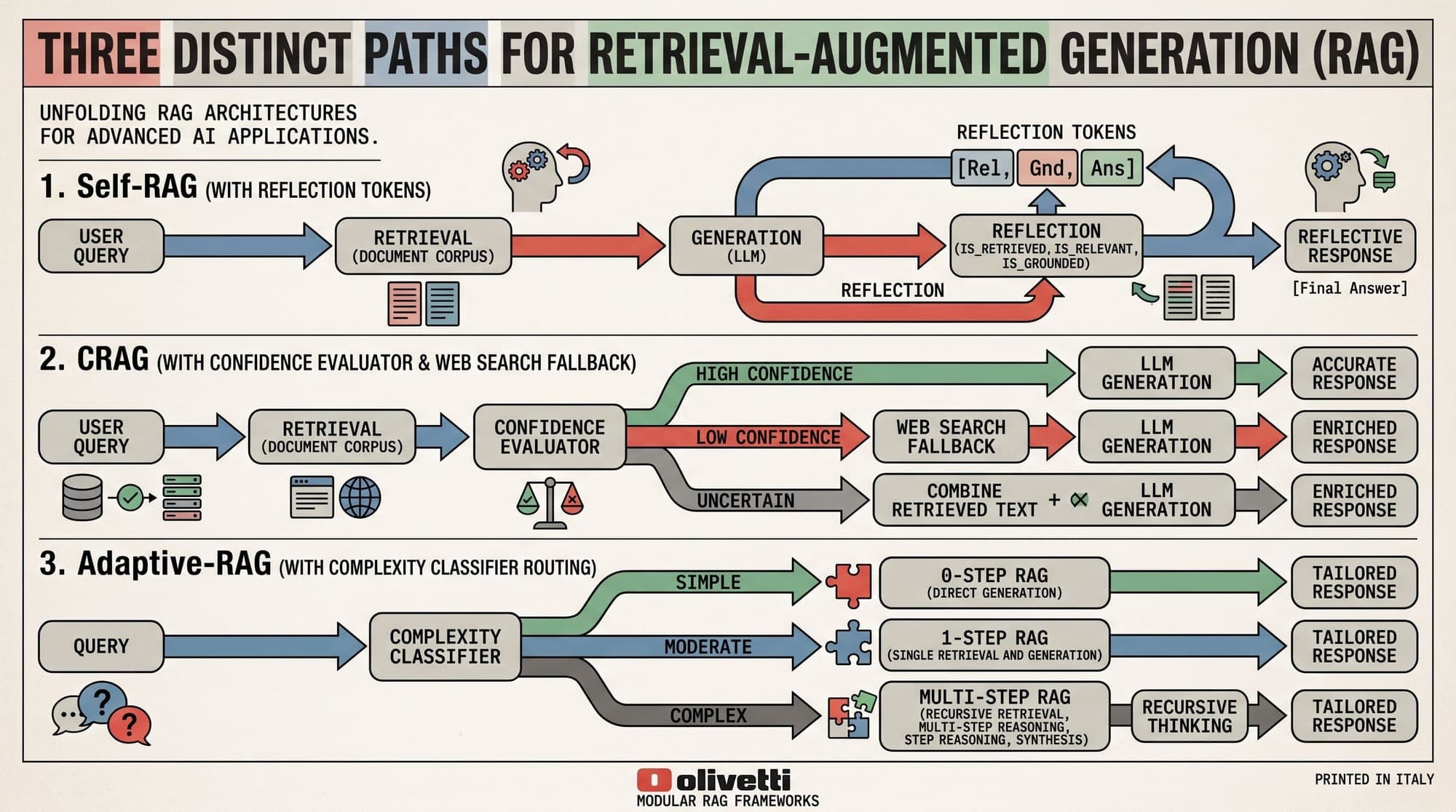
  • Corrective RAG and Adaptive Retrieval in Production: Architecture, Confidence Scoring, and Web Fallback Loops

    Standard retrieval-augmented generation (RAG) pipelines follow a rigid, feed-forward paradigm: embed the query, fetch top-$k$ chunks via vector or hybrid search, inject the raw chunks into the prompt context, and sample a completion. While functional for homogeneous corpora with high semantic overlap, this naive retrieve-and-generate approach degrades rapidly in production environments. When a vector index returns irrelevant, noisy, or out-of-domain chunks, the generator inevitably suffers from

    1 min