Engineering53 articles

Engineering

Articles

  • Dynamic Tool Synthesis in Production AI Agents: Architecture, AST Validation, Sandboxed Execution, and Lifecycle Governance

    Dynamic Tool Synthesis in Production AI Agents: Architecture, AST Validation, Sandboxed Execution, and Lifecycle Governance Standard tool-augmented AI agents rely on pre-configured, static API registries. Developers define a fixed set of JSON schemas, OpenAPI specifications, or Python wrapper functions at build time, and the language model selects from this catalog during execution. While sufficient for narrow, deterministic tasks, static registries encounter severe operational bottlenecks in o

    1 min
  • Long-Term User Personalization in Production LLMs: Architecture, Dynamic Profiling, and Privacy Boundaries

    Standard conversational AI deployments treat each user session as an isolated interaction or rely on naive sliding-window context histories. While extending context windows allows models to process thousands of tokens from previous turns, stuffing raw conversational history into prompt contexts introduces severe serving inefficiencies, inflates token economics, and fails to synthesize stable user profiles over time. Deploying long-term personalization in production large language model (LLM) ap

    1 min
  • Fill-in-the-Middle (FIM) and Inline Code Completion in Production: Architecture, Prefix-Suffix Context Windows, Speculative Decoding, and Sub-50ms Serving Latencies

    Fill-in-the-Middle (FIM) and Inline Code Completion in Production: Architecture, Prefix-Suffix Context Windows, Speculative Decoding, and Sub-50ms Serving Latencies Inline code completion is the most latency-sensitive deployment of large language models in production software engineering. Unlike conversational assistants or background agentic batch jobs, inline code completion operates directly inside an active editor typing loop. Developers type at speeds ranging from 40 to 120 words per minut

    1 min
  • Sparse-Dense Hybrid Retrieval in Production: Learned Lexical Weights, SPLADE vs. BGE-M3, Inverted Index Pruning, and Serving Economics

    Modern Retrieval-Augmented Generation (RAG) and enterprise search architectures increasingly encounter the operational limits of pure dense vector search. Dense bi-encoders project text passages into continuous latent spaces (typically 768 to 3,072 dimensions). While dense representations excel at conceptual matching and paraphrasing, they systematically struggle with exact keyword precision, rare alphanumeric tokens, product SKUs, and domain-specific jargon. Furthermore, serving dense vectors a

    1 min
  • Low-Precision Quantization Kernels in Production: Comparing Marlin, ExLlamaV2, FlashInfer, and BitBLAS

    Low-Precision Quantization Kernels in Production: Comparing Marlin, ExLlamaV2, FlashInfer, and BitBLAS Architecture, Memory Bandwidth, and Decoding Throughput Autoregressive large language model (LLM) serving operates under two distinct compute regimes: a compute-bound prefill phase and a memory-bandwidth-bound decode phase. While processing the initial prompt involves matrix-matrix multiplications (GEMM) with high arithmetic intensity, generating tokens one by one requires matrix-vector multip

    1 min
  • Agent Task Planning and Decomposition in Production: Plan-and-Solve vs. ReAct, Hierarchical Task Graphs, and Dynamic Replanning Architectures

    Autonomous AI agents deployed in production environments frequently fail when tasks require long-horizon reasoning across dozens of sequential tool calls. While single-turn tool calling is well-handled by modern frontier models, multi-step workflows introduce compounding failure modes: plan drift, unrecoverable tool exceptions, context window saturation, and premature task termination. Building resilient agent systems requires moving beyond simple prompt-driven loops. Production engineering has

    1 min
  • Token Healing and Partial Token Alignment in Production LLM Serving: Architecture, Prefix Trie Rollback, and Serving Trade-Offs

    Modern large language models operate on discrete subword tokens generated by greedy compression algorithms like Byte-Pair Encoding (BPE), WordPiece, or Unigram. While subword tokenization enables high compression rates and fixed vocabulary sizes, it introduces a structural defect at the interface between raw user text and autoregressive inference: the partial token problem, commonly known as the prompt boundary problem. When a user prompt terminates mid-token or at a punctuation boundary that c

    1 min
  • Fine-Tuning vs. RAG in Production: Knowledge Injection, Task Adaptation, Latency Economics, and Hybrid Architecture Trade-Offs

    Fine-Tuning vs. RAG in Production: Knowledge Injection, Task Adaptation, Latency Economics, and Hybrid Architecture Trade-Offs When adapting large language models to domain-specific enterprise workloads, engineering teams face a fundamental architectural choice: modify the model's parametric weights via fine-tuning, or supply dynamic context at inference time via Retrieval-Augmented Generation (RAG). While early discussions often framed this decision as a binary trade-off, empirical evaluation

    1 min
  • Prefix-Tree KV Cache Management in Production: RadixAttention, Tree-Structured LRU Eviction, and Token-Level Sharing in SGLang and vLLM

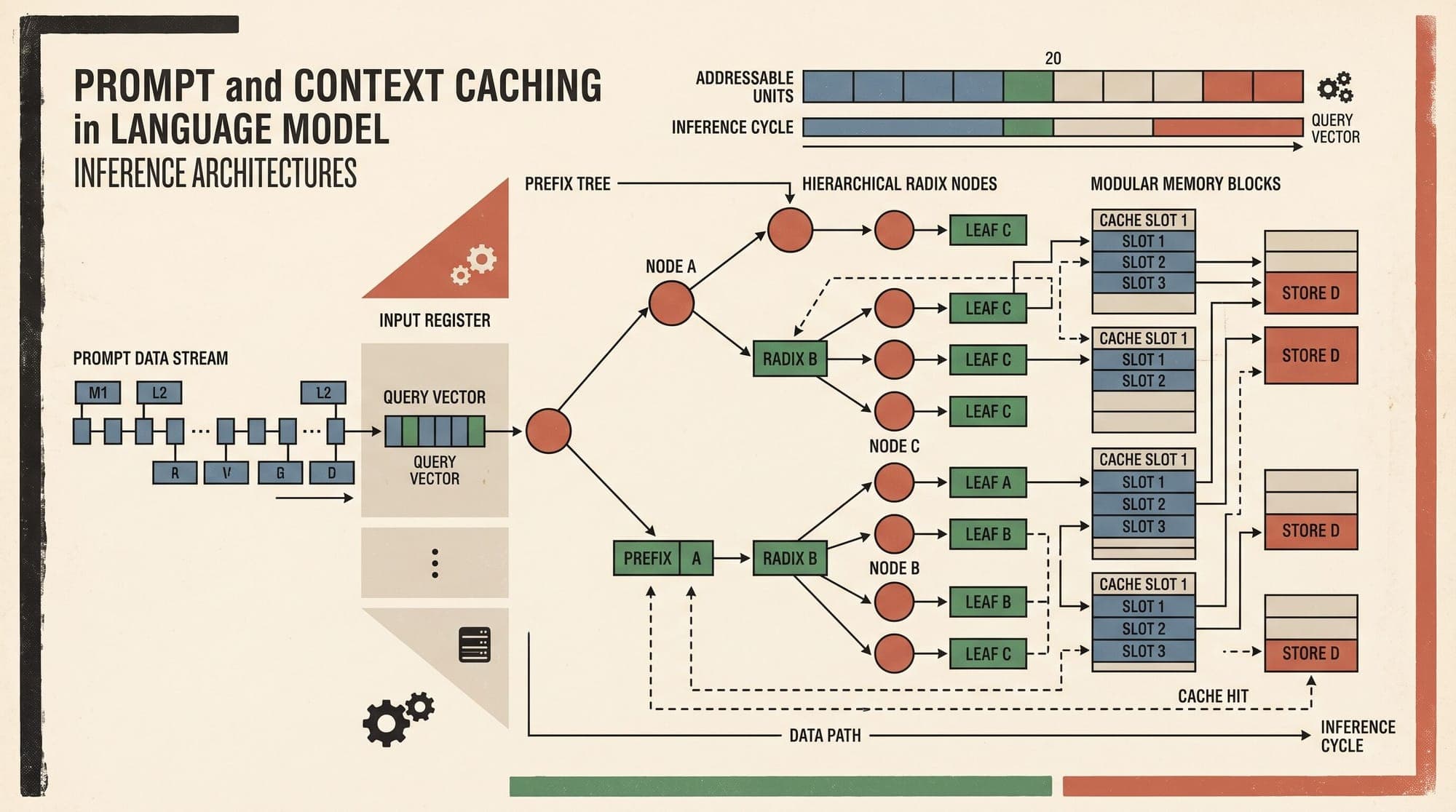
    Prefix-Tree KV Cache Management in Production: RadixAttention, Tree-Structured LRU Eviction, and Token-Level Sharing in SGLang and vLLM Autoregressive large language model inference is heavily constrained by memory bandwidth and the computational overhead of the prefill phase. For workloads such as multi-turn conversations, autonomous agent tool loops, few-shot prompt evaluations, and tree-search decoding, consecutive requests often share substantial token prefixes. In a standard multi-turn ses

    1 min
  • GPU Cluster Storage in Production: GPUDirect Storage, NVMe-oF, Parallel File Systems, and Checkpointing Throughput

    Training frontier large language models and serving hundred-billion parameter checkpoints places extreme demands on storage subsystems. While compute clusters frequently deploy thousands of GPUs connected via high-bandwidth interconnects like NVLink and InfiniBand, storage architectures often become severe bottlenecks during two critical operational phases: distributed checkpointing and cold-start model weight loading. A standard 70-billion parameter model in BF16 precision generates approximat

    1 min
  • Multi-Vector Late Interaction in Production: PLAID Indexing, Residual Compression, and Serving Architectures

    Multi-Vector Late Interaction in Production: PLAID Indexing, Residual Compression, and Serving Architectures Dense single-vector embeddings and cross-encoder rerankers represent the two traditional extremes of neural information retrieval. Single-vector models collapse entire documents into a single dense representation (typically 768 to 3,072 dimensions), losing token-level nuance, lexical precision, and localized facts. Cross-encoders preserve token interactions across the entire input sequen

    1 min
  • Zero-Downtime Model Updates in Production LLM Serving: In-Place Weight Transfer, CUDA IPC vs. NCCL Syncing, and Traffic Draining Architectures

    Zero-Downtime Model Updates in Production LLM Serving: In-Place Weight Transfer, CUDA IPC vs. NCCL Syncing, and Traffic Draining Architectures In high-throughput LLM serving infrastructure, updating model checkpoints presents a severe operational dilemma. Traditional microservice deployment patterns such as blue-green deployments or rolling pod restarts fail to scale economically when applied to multi-GPU LLM clusters. Tearing down a serving instance to load a newly fine-tuned checkpoint or pol

    1 min
  • LLM Load Shedding and Overload Control in Production: Adaptive Admission, Preemption Economics, and Graceful Degradation

    LLM Load Shedding and Overload Control in Production: Adaptive Admission, Preemption Economics, and Graceful Degradation Standard web services rely on well-established overload protection patterns: reverse proxies monitor CPU utilization, memory thresholds, or static queue depths and reject excess HTTP requests with 429 Too Many Requests or 503 Service Unavailable status codes. When applied naively to Large Language Model (LLM) serving infrastructure, these conventional heuristics fail catastro

    1 min
  • Language Server Protocol (LSP) in AI Coding Agents: Architecture, Symbol Indexing, and Compiler Diagnostic Feedback Loops

    Language Server Protocol (LSP) in AI Coding Agents: Architecture, Symbol Indexing, and Compiler Diagnostic Feedback Loops Autonomous coding agents frequently fail at multi-file refactoring and codebase navigation when relying solely on string-matching heuristics or raw file ingestion. Text-based search tools such as ripgrep locate literal tokens but cannot resolve type hierarchies, overloaded function names, or cross-module call graphs. In contrast, feeding entire directories into large languag

    1 min
  • Grammar-Constrained Decoding in Production: Finite State Automata, Pushdown Parsers, and Asynchronous Bitmasking

    Autoregressive language models generate text by sampling from a probability distribution over a discrete vocabulary at each step. While unconstrained sampling succeeds across open-ended text tasks, it offers no syntactic guarantees when producing machine-readable formats such as JSON, SQL, or structured tool calls. In automated agent loops, a single missing quotation mark, unbalanced bracket, or unescaped control character breaks downstream parser execution, forcing expensive retry round-trips.

    1 min
  • Hierarchical Tree Retrieval in Production RAG: Architecture, Recursive Clustering, and Serving Economics for RAPTOR

    Production Retrieval-Augmented Generation (RAG) pipelines routinely hit a fundamental structural ceiling: flat chunk retrieval. Standard retrieval architectures segment ingested documents into uniform, contiguous chunks (typically 100 to 512 tokens), embed them in a vector space, and fetch top-k nearest neighbors based on cosine similarity. This design functions well for granular, needle-in-a-haystack fact lookups ("What was the Q3 gross margin for EMEA?"). However, it fails on thematic, holist

    1 min
  • Circuit Breakers and Graceful Degradation in Production AI Systems: Architecture, Failure State Machines, Fallback Cascades, and Dead-Letter Queues

    Circuit Breakers and Graceful Degradation in Production AI Systems: Architecture, Failure State Machines, Fallback Cascades, and Dead-Letter Queues Running LLM inference and multi-agent workflows in production introduces failure dynamics distinct from traditional microservice architectures. While standard REST APIs typically fail with deterministic status codes and predictable latency profiles, generative AI applications face multi-dimensional failure vectors: provider outages, regional rate li

    1 min
  • Tool-Call Caching in Production AI Agents: Architecture, State Invalidation, and Latency Economics

    In multi-turn agentic architectures such as ReAct, plan-and-solve swarms, and autonomous coding runtimes, large language models spend significant time waiting on external tool execution. While prompt caching and prefix KV-cache reuse have reduced inference costs for repeated prompt contexts, they do not optimize the downstream execution layer. When an agent queries a database, scrapes a webpage, executes a sandboxed bash command, or retrieves embeddings, external tool latency frequently accounts

    1 min
  • Asynchronous Batch Inference in Production: Architecture, Queue Scheduling, and Cost Arbitrage

    Asynchronous Batch Inference in Production: Architecture, Queue Scheduling, and Cost Arbitrage Interactive AI applications require low Time-to-First-Token (TTFT) and high inter-token generation speed to maintain responsive user experiences. Achieving sub-second latency targets forces infrastructure teams to overprovision GPU capacity to absorb peak demand spikes. However, non-interactive production workloads (such as historical document processing, embedding generation, nightly model evaluation

    1 min
  • Vision-Language Model Serving in Production: Visual Token Pruning, Encoder Caching, Dynamic Resolution, and Inference Economics

    Deploying Vision-Language Models (VLMs) into high-concurrency production environments introduces a distinct set of systems bottlenecks that text-only large language models do not exhibit. While text models ingest prompts with compact token densities, visual inputs require processing high-dimensional pixel arrays through vision encoders, expanding a single image into hundreds or thousands of visual tokens before autoregressive generation begins. In production architectures running models such as

    1 min