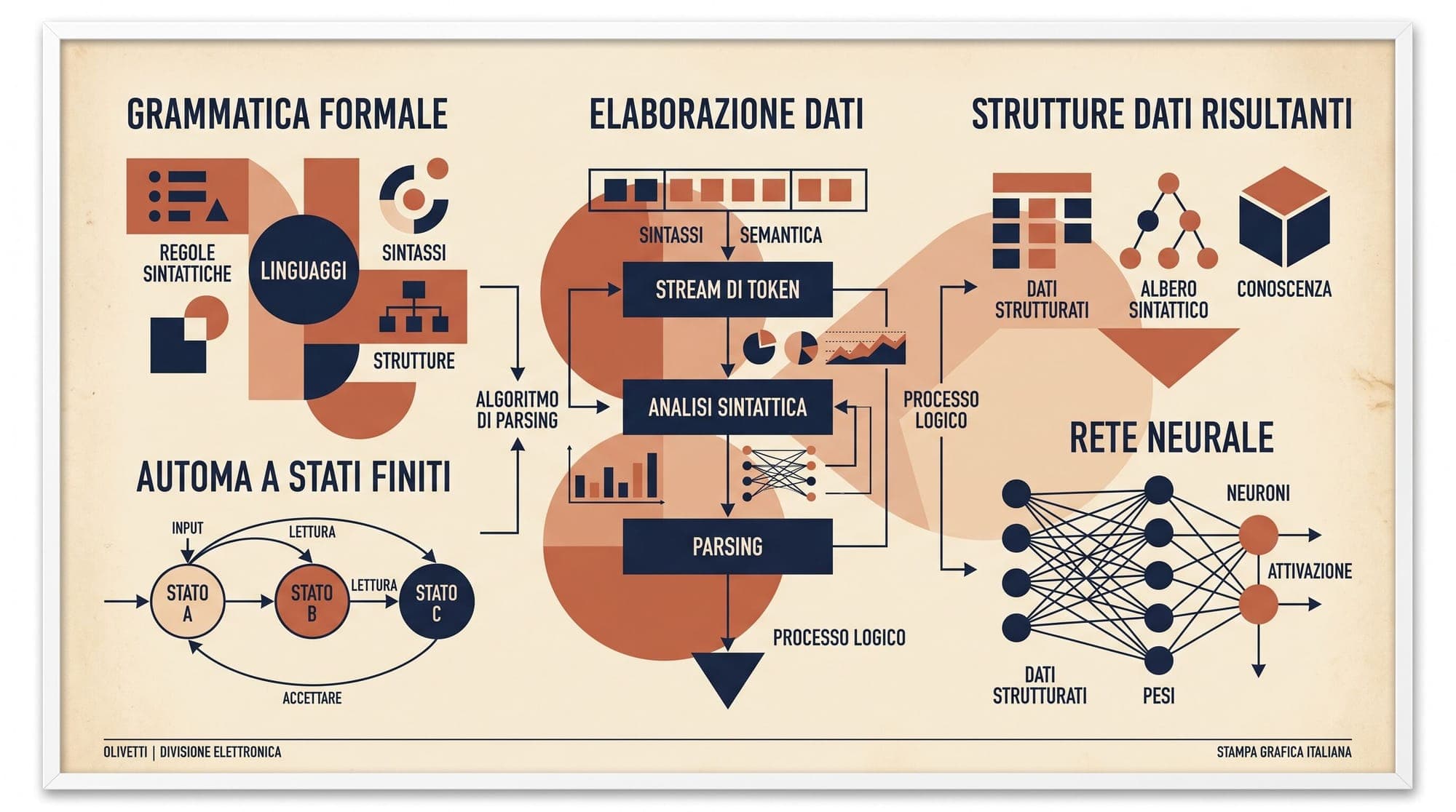
Large language models generate text autoregressively by sampling from an unconstrained probability distribution over tens of thousands of vocabulary tokens. While this flexibility powers open-ended generation, enterprise AI systems, automated agent pipelines, and database ingestion engines require strictly deterministic structured outputs. A single misplaced comma, an unquoted key, or an hallucinated enumeration value can break downstream JSON parsers, causing cascade failures across production workflows.
To enforce schema adherence, the AI engineering ecosystem has split into two fundamentally different architectural paradigms: client-side validation and retry wrappers, and server-side constrained decoding via token-level logit masking.
Here is an architectural comparison of the leading engines: Outlines, XGrammar, llguidance, and Instructor; examining their underlying finite-state machines, pushdown automata, latency profiles, and production serving economics across high-concurrency inference engines like vLLM and SGLang.

The Spectrum of Structured Generation
Enforcing structured output from an LLM can occur at three distinct stages in the request lifecycle:
- Prompt Engineering and Few-Shot Demonstration: Instructing the model in the system prompt to return JSON. This approach provides zero deterministic structural guarantees and suffers from high failure rates on complex nested schemas.
- Client-Side Schema Validation and Reflection (Instructor, BAML): Sending requests via standard provider APIs (such as OpenAI tool calling), validating outputs against Pydantic models on the client, and issuing retry requests with validation error context when parsing fails.
- Server-Side Constrained Decoding (Outlines, XGrammar, llguidance): Modifying the model logit vector directly during sampling. At every decoding step, invalid tokens that violate the target grammar receive a logit value of negative infinity, making structural violations mathematically impossible.
While client-side retry frameworks remain popular for closed-source APIs, high-throughput enterprise pipelines running self-hosted models increasingly rely on server-side constrained decoding to eliminate latency jitter and guarantee 100% syntactic compliance.
Outlines: Regular Expression Indexing and Deterministic Finite Automata
Outlines, introduced by Willard and Louf, pioneered production constrained decoding by mapping schema constraints into Deterministic Finite Automata (DFA).
Architecture and State Compilation
Outlines converts regular expressions and simplified JSON schemas into an FSM. Before or during the initial request, Outlines computes an index mapping each automaton state to the exact subset of vocabulary tokens that represent valid transitions.
During the autoregressive decoding step:
- The inference engine looks up the current FSM state.
- The pre-computed boolean token mask for that state is retrieved.
- Invalid tokens are masked in the logits tensor before the sampling kernel executes.
- The sampled token advances the FSM to the next state.
Trade-offs and Production Bottlenecks
- Runtime Efficiency: Once compiled, per-step decoding overhead is minimal because the valid token set is pre-indexed.
- Compilation Latency: Pre-computing state-to-token transition matrices across large vocabularies (e.g., 128,000 tokens in modern open-weight architectures) is computationally expensive. Schema compilation in Outlines can introduce startup delays ranging from several hundred milliseconds to tens of seconds.
- Expressiveness Limits: Because pure DFAs only recognize regular languages, Outlines cannot naturally parse arbitrary context-free grammars with recursive nesting without auxiliary stack structures.
XGrammar: Context-Free Grammars and Pre-Computed Mask Caching
Developed by MLC and adopted as the default grammar backend in SGLang and supported in vLLM, XGrammar addresses the computational overhead of constrained decoding for dynamic agentic workloads.
Pushdown Automata and Character-Trie Acceleration
Instead of compiling exhaustive state-to-token matrices across the entire vocabulary, XGrammar uses a stack-based pushdown automaton capable of processing full Context-Free Grammars (CFGs) and JSON Schemas.
Key architectural innovations in XGrammar include:
- Vocabulary Partitioning: Separating tokens into single-character tokens and multi-character string tokens to optimize transition checks.
- Adaptive Token Mask Caching: Pre-computing masks for frequent structural transitions while evaluating dynamic values on-the-fly.
- Engine Integration: Deep integration with SGLang RadixAttention and vLLM continuous batching schedulers, allowing grammar state caching across recurring function call signatures.
Performance Characteristics
According to benchmarks published by SqueezeBits and MLC AI, XGrammar shifts compilation overhead to a one-time setup step (typically 20 to 50 milliseconds for standard schemas) and reduces per-token decoding overhead to near zero. On predictable enterprise workloads with repeated schemas, XGrammar achieves the highest generation throughput. However, when every request presents an entirely unique or deeply nested dynamic schema, frequent CPU-GPU synchronization during mask generation can cause throughput stalls.
llguidance: Lazy Automata and Zero-Startup Grammar Execution
Maintained by Microsoft and Guidance AI, llguidance represents a lazy evaluation paradigm for constrained decoding.
Lazy Lexer Construction
Unlike Outlines (which pre-computes entire FSM state tables) and XGrammar (which pre-caches common CFG masks), llguidance builds its lexer automata lazily. It evaluates token constraints on-the-fly at each decoding step using an optimized C++ and Rust parser core.
Key Architectural Strengths
- Near-Zero Startup Latency: llguidance eliminates the compilation phase entirely, allowing the model to begin prefill and first-token generation with sub-millisecond startup overhead.
- Low Memory Footprint: By avoiding massive pre-computed transition tables, llguidance maintains a minimal memory footprint in host RAM.
- Dynamic Workload Stability: On workloads where every API call introduces a different dynamic schema or complex grammar, llguidance delivers steady, predictable decoding throughput without the compilation spikes observed in FSM-based engines.
Trade-offs
The trade-off is a consistent CPU compute cost of approximately 50 microseconds per token across the active batch. In high-concurrency environments running hundreds of parallel streams on a single host CPU, cumulative parser CPU cycles can become a secondary bottleneck if CPU cores are oversubscribed.
Instructor: Client-Side Orchestration and Semantic Validation
Instructor occupies a different tier of the stack. Rather than operating inside the inference engine kernel, Instructor wraps LLM client libraries (OpenAI, Anthropic, Google, Mistral, Ollama) using Pydantic validation schemas.
Architecture and Validation Feedback Loops
Instructor leverages provider-native tool calling or JSON mode to elicit structured text, then executes client-side validation:
- The model output is parsed into a Pydantic schema.
- If validation succeeds (including custom field validators and cross-field logic), the typed object is returned.
- If validation fails, Instructor automatically captures the Pydantic error trace, appends it as a corrective message to the conversation history, and prompts the model to repair the output.
Where Instructor Excels
Constrained decoding engines only enforce syntax (e.g., ensuring a field is an integer or matching a regex). They cannot enforce semantic business rules, such as verifying that an account ID exists in an external PostgreSQL database or that an end date occurs after a start date. Instructor handles complex semantic validation, dynamic Python logic assertions, and multi-model fallbacks seamlessly across both proprietary and open-source APIs.
Production Constraints
- Latency Jitter: When a model fails schema validation, the resulting retry round-trip multiplies end-to-end latency by 2x to 3x and burns additional prompt tokens.
- Probabilistic Guarantees: On smaller open-weight models (such as 7B and 8B parameter models), unconstrained sampling may fail multiple validation attempts consecutively, leading to request timeouts.
Architectural Decision Matrix for Production Systems
Selecting the right structured output framework depends on hosting topology, schema variability, and latency requirements:
1. High-Throughput Self-Hosted Inference (vLLM / SGLang with Static Schemas)
- Recommended Engine: XGrammar
- Rationale: When schemas are known in advance or repeated frequently across API requests (e.g., fixed tool calling signatures in AI agents), XGrammar's compiled mask caching provides maximum generation tokens per second with near-zero runtime CPU overhead.
2. Dynamic Agent Workloads with One-Off Schemas
- Recommended Engine: llguidance
- Rationale: When agents generate arbitrary, ephemeral schemas per turn, llguidance avoids the compilation spikes and CPU-GPU synchronization pauses of pre-computed FSM approaches, ensuring instant Time to First Token (TTFT).
3. Multi-Provider Applications and Complex Business Logic
- Recommended Engine: Instructor
- Rationale: For systems orchestrating closed-source commercial APIs or requiring deep semantic validation (database lookups, cross-field integrity checks, custom Python validator logic), Instructor provides type safety and error correction across all major foundation model providers.
4. Hybrid Production Topology
- Recommended Pattern: Use server-side constrained decoding (XGrammar or llguidance) inside your inference engine to guarantee 100% syntactic JSON compliance, paired with client-side Pydantic models (Instructor) to enforce high-level domain constraints without wasting tokens on basic syntax repair.
Sources
- XGrammar-2: Fast and Customizable Structured Generation for Tool Calling and Agents (MLC AI)
- XGrammar-2: Efficient Dynamic Structured Generation Engine for Agentic LLMs (arXiv:2601.04426)
- Guided Decoding Performance on vLLM and SGLang (SqueezeBits Tech Blog)
- Generating Structured Outputs from Language Models: Benchmark and Evaluation (arXiv:2501.10868)
- Outlines: Structured Text Generation with Large Language Models (GitHub)
- llguidance: Fast Structured Outputs for LLMs (Guidance AI / Microsoft GitHub)
- Instructor: Structured Extraction in Python (GitHub)
- Structured Output and Function Calling on GPU Cloud (Spheron Network)