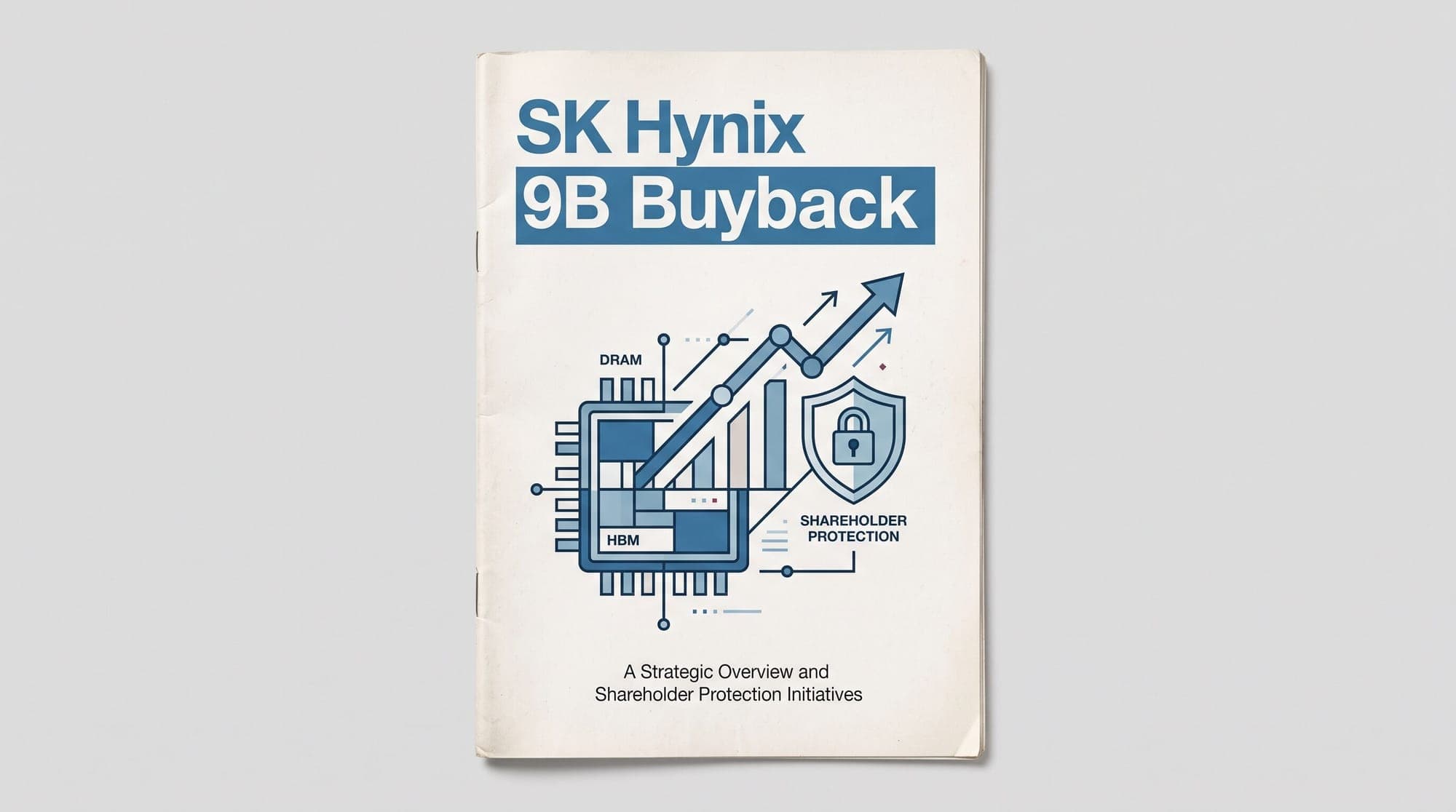
SK Hynix Announces 9 Billion Share Buyback to Calm AI Spending Worries

SK Hynix announced Wednesday it will buy back and cancel 40 trillion won ($28.61 billion) worth of treasury shares, allocating more than 50 percent of free cash flow generated between 2025 and 2027 to shareholder returns. The buyback, to be executed between August 20 and November 19, represents roughly 24 million shares. The company also said it would pursue an expansion of its total shareholder return target from the previous "within 50 percent of cumulative FCF" to "over 50 percent of cumulat

1 min
SK Hynix Announces 9 Billion Share Buyback to Calm AI Spending Worries

SK Hynix announced Wednesday it will buy back and cancel 40 trillion won ($28.61 billion) worth of treasury shares, allocating more than 50 percent of free cash flow generated between 2025 and 2027 to shareholder returns.

The buyback, to be executed between August 20 and November 19, represents roughly 24 million shares. The company also said it would pursue an expansion of its total shareholder return target from the previous "within 50 percent of cumulative FCF" to "over 50 percent of cumulative FCF" through share repurchases, cancellations, and dividends. Additional payout options, including special dividends, are under consideration, with details expected alongside third-quarter earnings in late October.

The move comes amid growing investor pressure on SK Hynix and Samsung Electronics to return excess cash after both chipmakers reported record profits driven by booming demand for AI memory chips, particularly high-bandwidth memory (HBM) supplied to Nvidia and Google. SK Hynix shares had declined in recent weeks amid concerns about the durability of AI spending, despite the company's dominant position in the HBM market.

SK Hynix said its "intrinsic value — underpinned by its business competitiveness, robust cash generation capability, and mid-to-long-term growth potential — is not fully reflected in its current stock price." The buyback follows the company's $26.5 billion U.S. ADR listing completed in July, which was more than seven times oversubscribed.

Sources

  • Reuters, "SK Hynix to buy back, cancel $29 billion worth of treasury shares," August 19, 2026
  • Bloomberg, "SK Hynix Announces $28.6 Billion Share Buyback on AI Boom," August 19, 2026

Written by

More to read

  • Token Healing and Partial Token Alignment in Production LLM Serving: Architecture, Prefix Trie Rollback, and Serving Trade-Offs

    Modern large language models operate on discrete subword tokens generated by greedy compression algorithms like Byte-Pair Encoding (BPE), WordPiece, or Unigram. While subword tokenization enables high compression rates and fixed vocabulary sizes, it introduces a structural defect at the interface between raw user text and autoregressive inference: the partial token problem, commonly known as the prompt boundary problem. When a user prompt terminates mid-token or at a punctuation boundary that c

    1 min
  • Flow Matching for Generative Modeling: How Continuous Normalizing Flows and Optimal Transport Paths Replace Diffusion SDEs

    Flow Matching for Generative Modeling: How Continuous Normalizing Flows and Optimal Transport Paths Replace Diffusion SDEs Generative modeling underwent a structural shift with the introduction of Flow Matching (FM), formulated independently by Lipman et al. (2022), Albergo and Vanden-Eijnden (2022), and Liu et al. (2022). While Denoising Diffusion Probabilistic Models (DDPM) and score-based Stochastic Differential Equations (SDEs) established state-of-the-art sample quality across vision and a

    1 min
  • Retrieval-Augmented Fine-Tuning (RAFT) in Production: Architecture, Synthetic Distractor Pipelines, and Evaluation

    Standard approaches to enterprise domain adaptation typically force a choice between two paradigms: Supervised Fine-Tuning (SFT) or Retrieval-Augmented Generation (RAG). SFT bakes domain knowledge directly into model weights, functioning like a closed-book exam. When facts change or precise source attribution is required, SFT models often hallucinate or fail to incorporate updated context. Conversely, standard RAG operates like an open-book exam without prior preparation. The base model reads re

    1 min