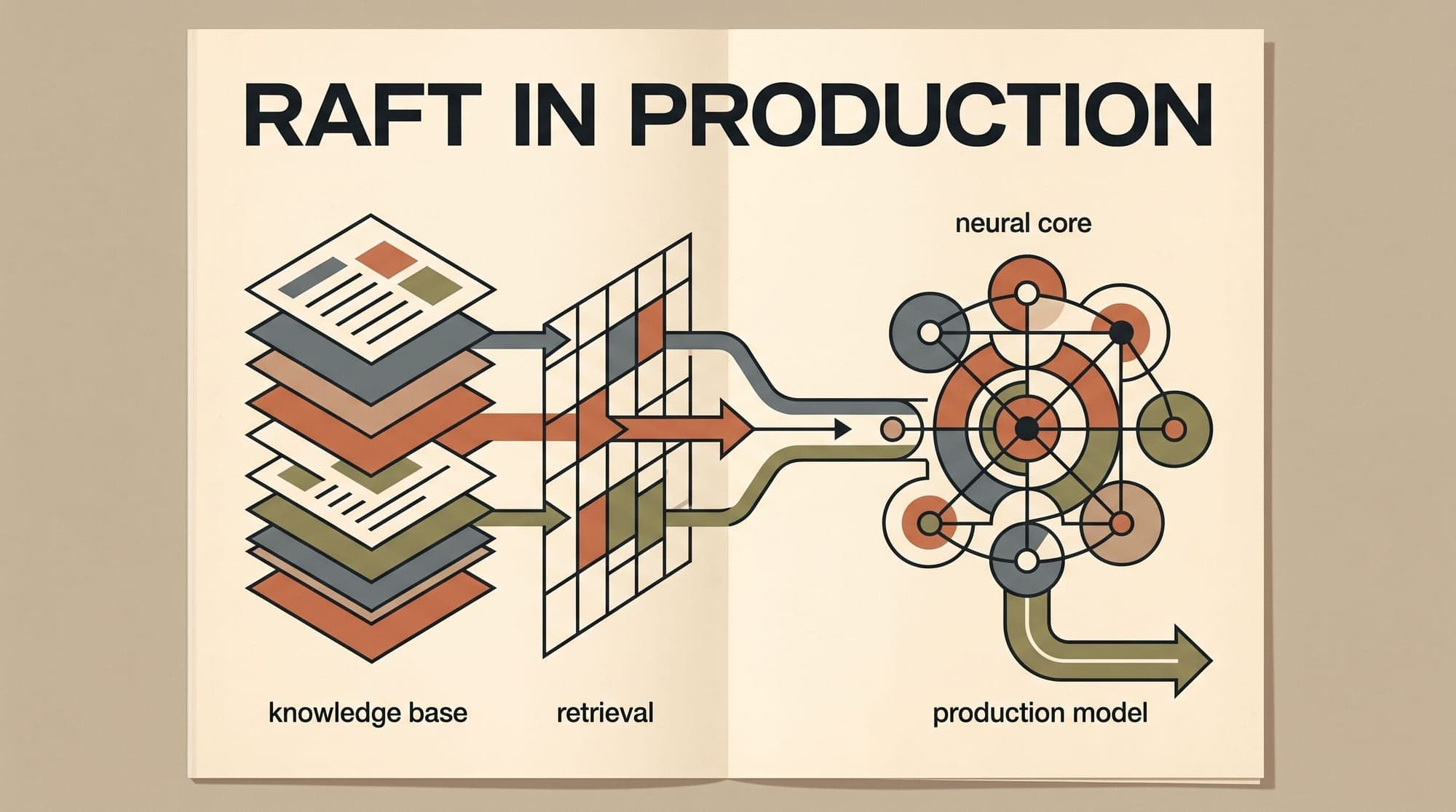
Standard approaches to enterprise domain adaptation typically force a choice between two paradigms: Supervised Fine-Tuning (SFT) or Retrieval-Augmented Generation (RAG). SFT bakes domain knowledge directly into model weights, functioning like a closed-book exam. When facts change or precise source attribution is required, SFT models often hallucinate or fail to incorporate updated context. Conversely, standard RAG operates like an open-book exam without prior preparation. The base model reads retrieved documents at inference time, but it frequently falters when handling noisy, irrelevant passages or subtle domain-specific terminology.
To bridge this operational gap, researchers at UC Berkeley introduced Retrieval-Augmented Fine-Tuning (RAFT) (Zhang et al., 2024). RAFT trains models specifically for the open-book setting: teaching them to identify relevant passages, ignore misleading distractor documents, and generate verifiable answers supported by verbatim citations.
The Failure Modes of Isolated RAG and SFT
Deploying foundation models on specialized enterprise corpora exposes structural weaknesses in standard adaptation workflows:
- Distractor Sensitivity in Zero-Shot RAG: Production retrievers frequently return irrelevant or partially matching chunks alongside the true answer. Generalist foundation models often get misled by these distractor documents, incorporating irrelevant noise into their output.
- Context Blindness in Supervised Fine-Tuning: Models trained purely on Question-Answer pairs () learn to rely strictly on parametric memory. When deployed in a RAG pipeline (), they frequently ignore the retrieved context , relying instead on potentially outdated or generalized weights.
- Citation Hallucination: Foundation models prompted to cite sources often generate plausible-looking but fabricated references or misattribute claims to incorrect chunks.
RAFT addresses these failure modes by restructuring the post-training data pipeline so that the model learns domain facts while simultaneously practicing document extraction under imperfect retrieval conditions.

Mathematical Formulation and Training Structure
In RAFT, each training instance consists of a tuple: a question , a set of retrieved documents , and a Chain-of-Thought (CoT) answer .
The document set contains two distinct classes of context:
- **Oracle Document ($D^$)*: The specific passage from the domain corpus that contains the factual evidence required to answer .
- Distractor Documents (): Passages that do not contain the answer. These can be randomly sampled corpus chunks or "hard negatives" (chunks with high semantic similarity to that lack the target fact).
The Dual-Split Data Mixture
To prevent the model from over-relying on the constant presence of an oracle document, RAFT partitions the fine-tuning dataset into two subsets governed by a hyperparameter :
- Oracle Present (, typically ): The input prompt includes the oracle document mixed with distractor documents. The model learns to filter out irrelevant information and extract the ground-truth evidence.
- Oracle Absent (, typically ): The input prompt contains only distractor documents. The target answer is generated using parametric domain knowledge without citing the distractors. This trains the model to fall back safely on its internal representations when the retriever fails completely.
Verbatim Chain-of-Thought Formatting
Standard instruction tuning trains models on direct answers. RAFT enforces a structured Chain-of-Thought format where the model must extract exact quotes before stating conclusions:
## Relevant Context:
[Document 2]

## Verbatim Quotes:
"The maximum operational pressure for Valve Assembly B-12 is 450 PSI under standard thermal conditions."

## Reasoning:
The query asks for the pressure limit of Valve Assembly B-12. Document 2 specifies this threshold as 450 PSI. Documents 1 and 3 discuss Assembly A-09 and are irrelevant.

## Final Answer:
450 PSI.
This structural constraint forces the model to attend to exact token spans in the retrieved context, dramatically reducing hallucinations and enabling deterministic validation of citations.
Production Pipeline Implementation
Building an enterprise RAFT pipeline involves five sequential stages, from raw document ingestion to model serving:
[ Domain Documents ]
         │
         ▼
[ Chunking & Indexing ]
         │
         ▼
[ Synthetic QA Generation ] ── (Teacher LLM: GPT-4o / Claude 3.5 Sonnet)
         │
         ▼
[ Distractor Mining ] ─────── (Dense Vector Search / Hybrid BM25)
         │
         ▼
[ Verbatim CoT Synthesis ] ── (Teacher LLM + Ground Truth Verification)
         │
         ▼
[ Parameter-Efficient SFT ] ─ (LoRA / QLoRA / Full Tuning with Loss Masking)
         │
         ▼
[ Inference Deployment ] ──── (vLLM / SGLang with Prefix Caching)
1. Synthetic QA Generation
From raw enterprise documents (PDFs, technical specs, internal wikis), clean text chunks of 300-500 tokens are extracted. A frontier teacher model generates diverse questions conditioned on each chunk, ensuring queries mirror real-world ambiguity and phrasing variation.
2. Distractor Document Mining
For each generated question , the production retrieval system (dense vector index or hybrid search) retrieves top- candidates (e.g., ). The original chunk is designated as the Oracle . The remaining top-scoring chunks that do not contain the answer serve as hard distractor documents.
3. Verbatim CoT Synthesis
A teacher model generates the ground-truth Chain-of-Thought response $A^$ by conditioning on the Question and Oracle Document. Strict prompting constraints enforce that extracted evidence must match character-for-character with spans in $D^$.
4. Loss Masking and Training Optimization
During fine-tuning, standard cross-entropy loss is applied exclusively to the output tokens (the CoT reasoning and final answer). The input prompt tokens (comprising system instructions, the question, and the raw document context) are masked out ().
# Standard Loss Masking in PyTorch / HuggingFace Transformers
def tokenize_raft_sample(tokenizer, sample, max_length=4096):
    prompt = format_prompt(sample["question"], sample["documents"])
    target = sample["chain_of_thought_answer"]

    prompt_ids = tokenizer.encode(prompt, add_special_tokens=False)
    target_ids = tokenizer.encode(target, add_special_tokens=False) + [tokenizer.eos_token_id]

    input_ids = (prompt_ids + target_ids)[:max_length]
    # Mask prompt tokens so loss is computed only on target generation
    labels = ([-100] * len(prompt_ids) + target_ids)[:max_length]
    attention_mask = [1] * len(input_ids)

    return {
        "input_ids": input_ids,
        "labels": labels,
        "attention_mask": attention_mask
    }
Empirical Performance and Evaluation
In benchmark evaluations conducted by UC Berkeley across medical (PubMedQA), multi-hop reasoning (HotpotQA), and software API documentation (TorchHub, TensorFlow Hub), RAFT demonstrated consistent performance gains over both standard SFT and zero-shot RAG baselines.
| Benchmark Dataset | LLaMA-2-7B (Zero-Shot RAG) | LLaMA-2-7B (Domain SFT + RAG) | LLaMA-2-7B (RAFT) | | :--- | :--- | :--- | :--- | | PubMedQA | 69.4% | 71.2% | 74.0% | | HotpotQA | 33.7% | 34.1% | 42.3% | | TorchHub | 52.8% | 55.4% | 68.2% | | TensorFlow Hub | 62.4% | 65.1% | 73.8% |
Evaluation metrics reported by Zhang et al. (2024) under 5-document retrieval conditions ().
Key Evaluation Takeaways
- Robustness to Distractor Documents: When distractor count increases from 1 to 5, standard RAG models experience accuracy degradation of 8-15%. RAFT-trained models maintain near-constant accuracy because their weights have been optimized to ignore irrelevant context.
- Top-1 vs. Top-K Reliance: Standard models degrade sharply if the relevant document is not the first ranked chunk. RAFT models demonstrate invariant extraction performance regardless of document ordering in the prompt.
- Smaller Model Efficiency: A 7B parameter model adapted via RAFT consistently matches or exceeds the domain accuracy of a 70B zero-shot model paired with standard RAG, reducing inference compute costs by up to 75%.
Production Trade-offs and Best Practices
When architecting a domain-specific LLM deployment, teams should evaluate the operational requirements across training cost, latency, and data volatility:
- Static vs. Dynamic Knowledge: RAFT is most effective for stable domain fundamentals (syntax, documentation structure, standard operating procedures) combined with dynamic document retrieval for live operational data.
- Context Window Utilization: Training with multiple distractor documents requires context windows of 4,096 to 16,384 tokens. Teams should utilize FlashAttention-2 or FlashAttention-3 and prefix-caching engines (such as vLLM or SGLang) to avoid redundant prompt prefill computation during inference.
- Hyperparameter Tuning (): For corpora where the retriever has high precision (Precision@5 > 90%), set . For noisy environments with lower retrieval precision, lower to to increase closed-book and fallback resilience.