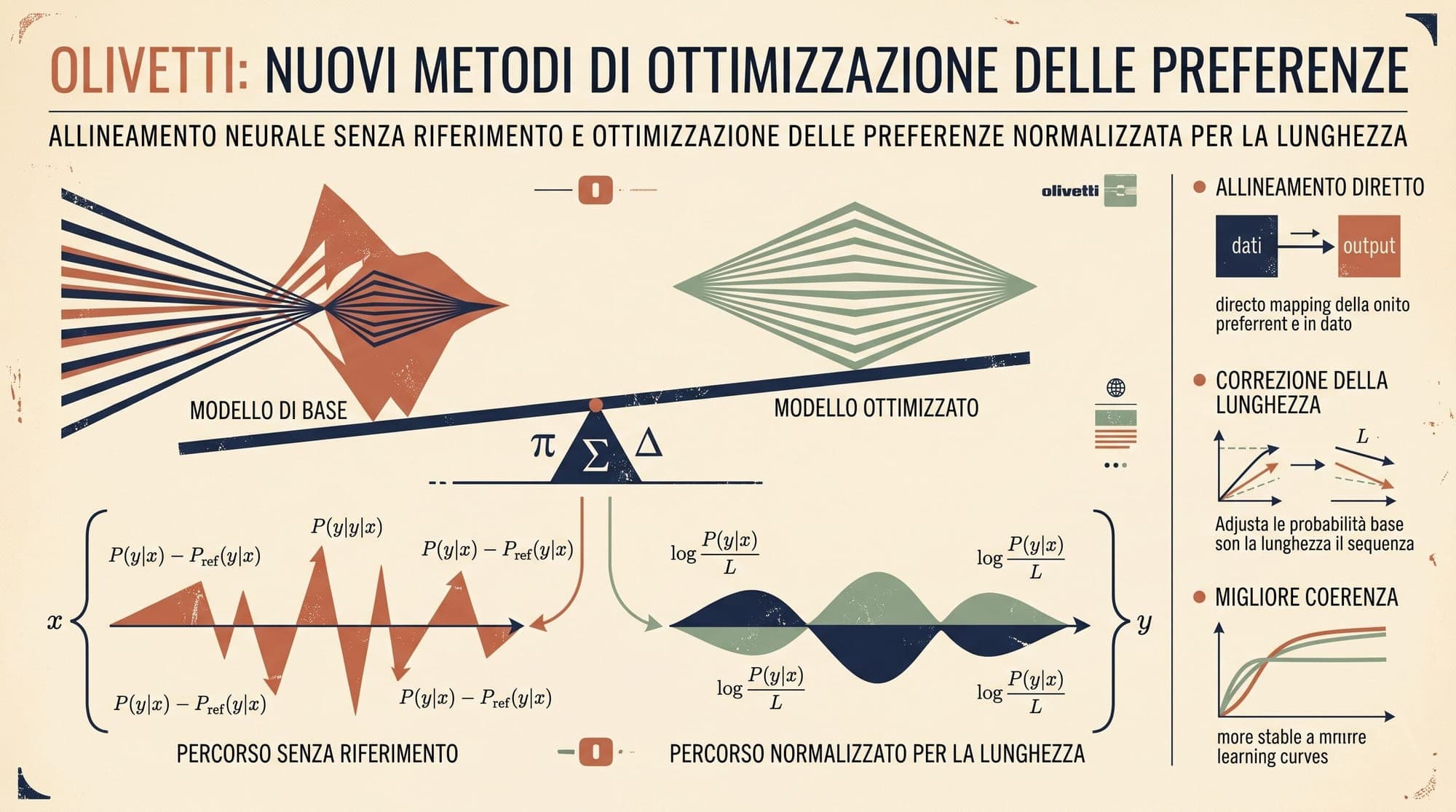
Aligning large language models with human preferences has evolved rapidly from complex multi-stage reinforcement learning pipelines toward direct, offline optimization objectives. While Direct Preference Optimization (DPO) eliminated the requirement for training a separate reward model and executing online policy rollouts, it introduced architectural and operational challenges of its own: the necessity of maintaining an active reference policy in GPU memory, an unnormalized log-probability formulation prone to length exploitation, and the absence of an explicit reward margin between winning and losing completions.
Simple Preference Optimization (SimPO), introduced by researchers at Princeton University and the University of Virginia, addresses these structural limitations by replacing the reference-dependent implicit reward with a length-normalized sequence log-likelihood paired with an explicit target margin.

Shortcomings of Direct Preference Optimization
To understand the design choices behind SimPO, one must examine the mathematical mechanics and operational friction points of standard DPO.
In the standard RLHF formulation, policy optimization seeks to maximize expected reward subject to a Kullback-Leibler (KL) divergence penalty against a base reference model :
DPO reparameterizes the ground-truth reward function in closed form as:
Substituting this expression into the Bradley-Terry preference model yields the canonical DPO loss:
While effective, this formulation imposes three operational penalties in practice:
- Memory and Compute Overhead: Evaluating and requires keeping a frozen copy of the reference model in GPU memory throughout training, consuming identical parameter memory and executing forward passes that roughly double activation footprints.
- Length Bias Exploitation: The sequence log-probability accumulates linearly across token length. When the policy shifts per-token probabilities, the aggregate sum scales with response length . As a consequence, DPO frequently defaults to generating verbose responses because longer sequences produce larger unnormalized log-ratio swings.
- Margin Degeneracy: The standard Bradley-Terry formulation only requires that the implicit reward of exceeds that of . When the model assigns high probabilities to both completions without sufficient separation, the loss can saturate prematurely without enforcing a defined decision boundary.
Mathematical Formulation of SimPO
SimPO removes the reference model entirely and alters both the reward calculation and the pairwise preference objective.
Length-Normalized Implicit Reward
Instead of taking the log ratio against a reference policy, SimPO defines the reward metric directly as the average per-token log-likelihood under the active policy :
Here, acts as a constant scaling factor controlling the sensitivity of the reward metric, while represents the exact sequence length of the completion in tokens. By dividing by , the reward directly reflects the model's geometric mean token confidence, aligning the training objective with length-invariant sequence scoring used in generation and evaluation.
Target Reward Margin Formulation
To prevent reward saturation and guarantee distinct separation between preferred and non-preferred completions, SimPO introduces a fixed non-negative target margin hyperparameter into the Bradley-Terry comparison:
Under this formulation, the model is not merely rewarded for assigning a higher score to than ; it is penalized until the length-normalized reward gap strictly exceeds the margin threshold .
The Unified SimPO Objective
Combining the length-normalized reward definition with the margin-augmented preference probability yields the complete SimPO loss function:
The objective is fully self-contained, requiring only the active model parameters and the training dataset .
Gradient Dynamics and Optimization Mechanics
To analyze how SimPO updates transformer weights, consider the gradient of with respect to .
Let $\Delta r(x, y_w, y_l) = \frac{\beta}{|y_w|} \log \pi_\theta(y_w \mid x) - \frac{\beta}{|y_l|} \log \pi_\theta(y_l \mid x) - \gamma$. Taking the derivative:
This gradient structure reveals two crucial operational dynamics:
1. Dynamic Weighting and Error Scaling
The scalar multiplier functions as an adaptive error signal:
- When $\frac{\beta}{|y_w|} \log \pi_\theta(y_w \mid x) - \frac{\beta}{|y_l|} \log \pi_\theta(y_l \mid x) \gg \gamma$, the condition is satisfied, and the weighting term approaches zero. Gradients vanish for already well-separated pairs, preventing unnecessary updates on easy examples.
- When the condition is violated, or when receives a higher length-normalized likelihood than , the term approaches one, pushing maximal gradient updates to shift parameter weights.
2. Length-Invariant Directional Pushing
The parameter update vector is driven by:
In standard DPO, unnormalized gradients allow long completions to dominate the update magnitude. In SimPO, each gradient term is scaled inversely by its respective token length ( and ). As a result, each token in a short answer receives an equivalent per-token gradient magnitude to each token in a long answer, neutralizing length exploitation at the gradient level.
Algorithmic Comparison: SimPO vs. Alternative Alignment Objectives
The table below contrasts SimPO with prominent offline preference optimization methods:
| Method | Reference Model Required | Reward Definition | Length Normalization | Target Margin Formulation | | :--- | :--- | :--- | :--- | :--- | | DPO (Rafailov et al., 2023) | Yes | | None | No () | | IPO (Azar et al., 2023) | Yes | | None | Squared Gap | | KTO (Ethayarajh et al., 2024) | Yes | Implicit per-sample utility | None | Unpaired reference point | | ORPO (Hong et al., 2024) | No | Odds ratio | Implicit in odds | No explicit | | SimPO (Meng et al., 2024) | No | | Exact () | Explicit constant |
Computational and Empirical Characteristics
Removing the reference policy yields immediate hardware and runtime efficiencies in production distributed training pipelines:
- GPU Memory Reduction: Eliminating the second model instance reduces parameter memory and eliminates forward activation tensors for , freeing substantial VRAM for expanded micro-batch sizes or extended context windows.
- Throughput Gains: Training runs execute approximately 15% to 20% faster per optimization step compared to DPO due to the removal of reference policy forward passes during each micro-batch.
- Benchmark Performance: In empirical evaluations across AlpacaEval 2 and Arena-Hard-Auto, models aligned with SimPO consistently matched or exceeded the length-controlled win rates of DPO baselines while exhibiting significantly lower average response length inflation.
Hyperparameter Selection and Practical Tuning
Implementing SimPO requires tuning two primary hyperparameters:
- Scaling Factor : Typically configured in the range of to . Because the implicit reward is normalized by sequence length , in SimPO is scaled significantly higher than in DPO (where is standard) to maintain adequate gradient magnitude.
- Target Margin : Typically configured between and . A higher enforces more aggressive separation between winning and losing completions, though excessive values can induce optimization instability similar to high learning rates.
SimPO is supported natively across major open-source alignment and fine-tuning frameworks, including Hugging Face TRL, Axolotl, and LLaMA-Factory.
Sources
- SimPO: Simple Preference Optimization with a Reference-Free Reward (Meng et al., NeurIPS 2024 / arXiv:2405.14734)
- Direct Preference Optimization: Your Language Model is Secretly a Reward Model (Rafailov et al., NeurIPS 2023 / arXiv:2305.18290)
- A General Theoretical Paradigm to Understand Learning from Human Preferences (IPO) (Azar et al., 2023 / arXiv:2310.12036)
- KTO: Model Alignment as Prospect Theoretic Optimization (Ethayarajh et al., 2024 / arXiv:2402.01306)
- ORPO: Monolithic Preference Optimization without Reference Model (Hong et al., 2024 / arXiv:2403.08295)
- Training language models to follow instructions with human feedback (Ouyang et al., 2022 / arXiv:2203.02155)