LLM342 articles

LLM

Articles

  • Identity Preference Optimization (IPO): How Exact Loss Inversion Prevents Overfitting in Direct Alignment

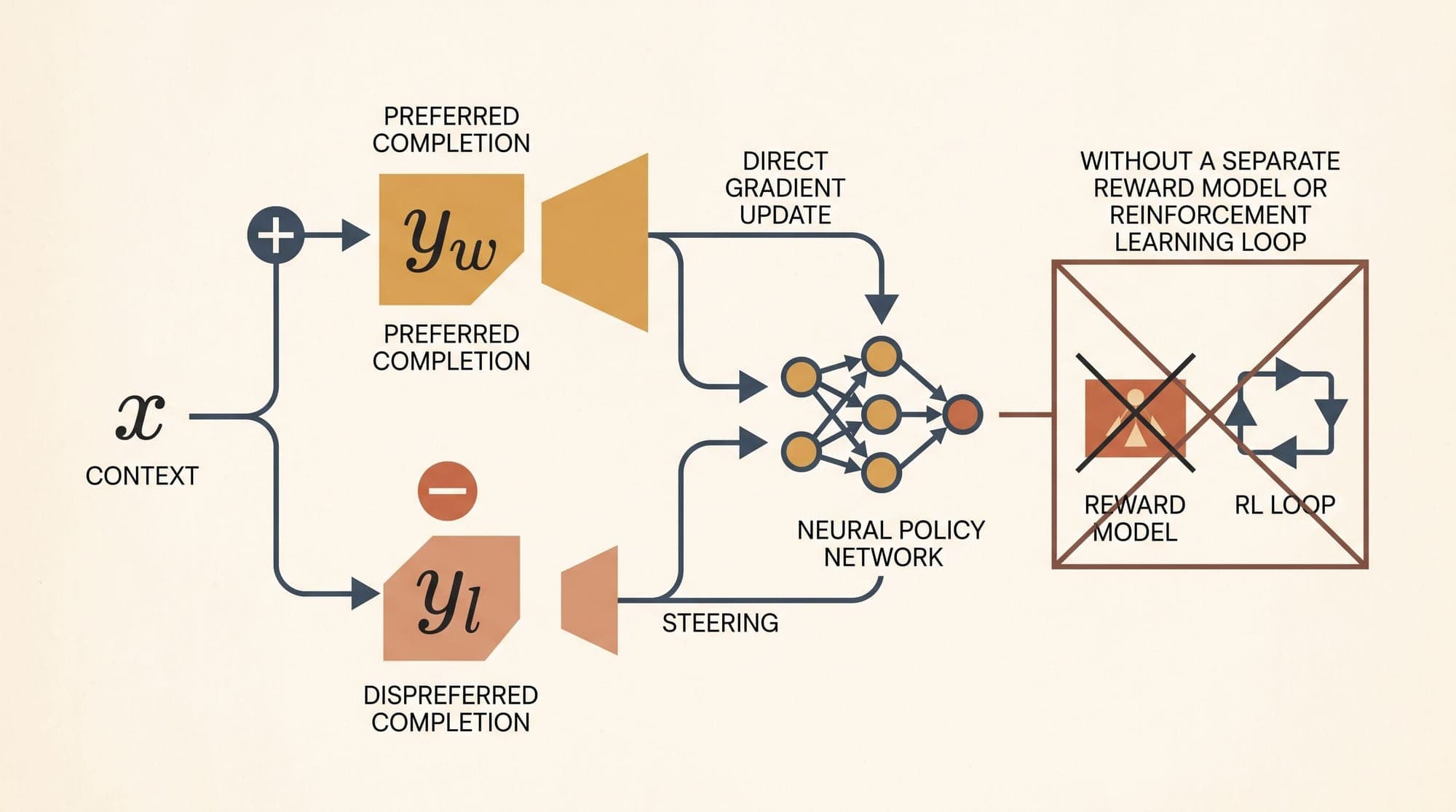
    The post-training alignment of large language models underwent a structural shift with the introduction of Direct Preference Optimization (Rafailov et al., 2023). By reparameterizing the closed-form optimal policy under a Kullback-Leibler (KL) constrained Reinforcement Learning from Human Feedback (RLHF) objective, DPO eliminated the need to fit an explicit reward model or maintain complex actor-critic rollout loops. However, standard DPO introduces a distinct mathematical pathology: under dete

    1 min
  • Infinite Agentic Loops in Production: Architecture, Feedback Topologies, and Bound Verification

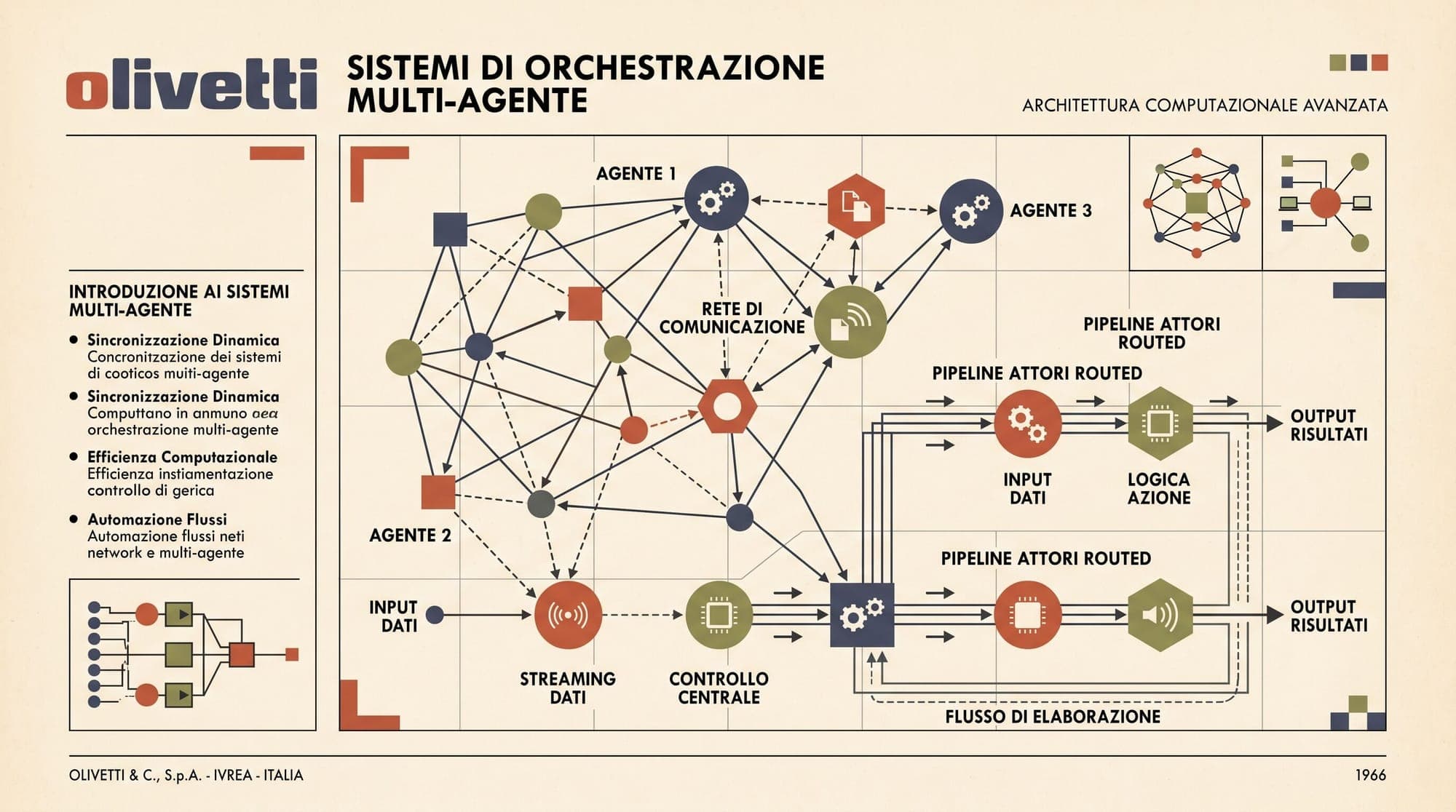
    Autonomous AI agents have transitioned software architectures from static, single-turn request-response patterns into stateful, iterative execution loops. Built around foundational paradigms such as ReAct (Yao et al., 2022) and implemented across frameworks including LangGraph, CrewAI, AutoGen, and the OpenAI Agents SDK, agents repeatedly perceive environmental state, reason over intermediate goals, dispatch tool invocations, observe execution outputs, and append new observations back into their

    1 min
  • Noise-Contrastive Estimation and InfoNCE: How Partition Function Estimation and Mutual Information Lower Bounds Power Modern AI

    Noise-Contrastive Estimation and InfoNCE: How Partition Function Elimination and Mutual Information Lower Bounds Power Modern AI In statistical machine learning and generative modeling, evaluating the exact probability of an observed event frequently requires calculating a normalizing constant known as the partition function. For continuous spaces or discrete spaces with high cardinality, such as a natural language vocabulary spanning over one hundred thousand tokens or high-dimensional pixel d

    1 min
  • Agent Task Planning and Decomposition in Production: Plan-and-Solve vs. ReAct, Hierarchical Task Graphs, and Dynamic Replanning Architectures

    Autonomous AI agents deployed in production environments frequently fail when tasks require long-horizon reasoning across dozens of sequential tool calls. While single-turn tool calling is well-handled by modern frontier models, multi-step workflows introduce compounding failure modes: plan drift, unrecoverable tool exceptions, context window saturation, and premature task termination. Building resilient agent systems requires moving beyond simple prompt-driven loops. Production engineering has

    1 min
  • Performers and FAVOR+: How Positive Orthogonal Random Features Linearize Transformer Attention

    The quadratic complexity of standard self-attention has remained a central computational ceiling in Transformer architectures. Because standard attention computes pairwise similarity across all token pairs in a sequence of length $L$, memory consumption and compute scale as $O(L^2)$. For long contexts, high-resolution visual tokens, and biological sequence modeling, this quadratic bottleneck forces strict sequence truncation or aggressive hardware partitioning. In Rethinking Attention with Perf

    1 min
  • Nvidia Expands Nemotron Open-Weight Push to Counter Chinese Labs Under B Poolside Deal

    Nvidia Expands Nemotron Open-Weight Push to Counter Chinese Labs Under $6B Poolside Deal Nvidia plans to use the infrastructure and engineering team acquired through its $6 billion deal with AI startup Poolside to build frontier open-weight models under its Nemotron family, according to reporting from the Wall Street Journal. The initiative aims to counter the rapid global adoption of Chinese open-weight systems like DeepSeek-V3, Moonshot AI's Kimi K3, and Alibaba's Qwen series, while offering

    1 min
  • Distributed RLHF Frameworks in Production: Comparing OpenRLHF, verl, and TRL Architecture, Ray Resource Scheduling, and Rollout-Training Co-Location

    Post-training alignment has shifted from offline preference tuning to large-scale, online reinforcement learning. Modern post-training loops for reasoning models, agentic workflows, and conversational alignment require coordinating multiple distinct neural network roles simultaneously. Under standard Proximal Policy Optimization (PPO), an RL infrastructure pipeline must manage up to four distinct model instances: the Actor (the active policy undergoing gradient updates), the Critic (the value mo

    1 min
  • Forward KL vs. Reverse KL Divergence: Mode Covering, Mode Seeking, and the Alignment Dynamics of Large Language Models

    Forward KL vs. Reverse KL Divergence: Mode Covering, Mode Seeking, and the Alignment Dynamics of Large Language Models Every phase of modern large language model development, from multi-trillion token pre-training to reinforcement learning from human feedback (RLHF) and student model distillation, fundamentally revolves around minimizing statistical distance between probability distributions. The primary mathematical tool utilized for this purpose is the Kullback-Leibler (KL) divergence, introd

    1 min
  • Token Healing and Partial Token Alignment in Production LLM Serving: Architecture, Prefix Trie Rollback, and Serving Trade-Offs

    Modern large language models operate on discrete subword tokens generated by greedy compression algorithms like Byte-Pair Encoding (BPE), WordPiece, or Unigram. While subword tokenization enables high compression rates and fixed vocabulary sizes, it introduces a structural defect at the interface between raw user text and autoregressive inference: the partial token problem, commonly known as the prompt boundary problem. When a user prompt terminates mid-token or at a punctuation boundary that c

    1 min
  • Retrieval-Augmented Fine-Tuning (RAFT) in Production: Architecture, Synthetic Distractor Pipelines, and Evaluation

    Standard approaches to enterprise domain adaptation typically force a choice between two paradigms: Supervised Fine-Tuning (SFT) or Retrieval-Augmented Generation (RAG). SFT bakes domain knowledge directly into model weights, functioning like a closed-book exam. When facts change or precise source attribution is required, SFT models often hallucinate or fail to incorporate updated context. Conversely, standard RAG operates like an open-book exam without prior preparation. The base model reads re

    1 min
  • Fine-Tuning vs. RAG in Production: Knowledge Injection, Task Adaptation, Latency Economics, and Hybrid Architecture Trade-Offs

    Fine-Tuning vs. RAG in Production: Knowledge Injection, Task Adaptation, Latency Economics, and Hybrid Architecture Trade-Offs When adapting large language models to domain-specific enterprise workloads, engineering teams face a fundamental architectural choice: modify the model's parametric weights via fine-tuning, or supply dynamic context at inference time via Retrieval-Augmented Generation (RAG). While early discussions often framed this decision as a binary trade-off, empirical evaluation

    1 min
  • Score-Based Generative Modeling via Stochastic Differential Equations: How Continuous SDEs and Score Matching Unify Diffusion Models

    Diffusion and score-based models represent one of the foundational paradigms of modern generative artificial intelligence, underpinning systems across image synthesis, video generation, audio modeling, and continuous multimodal representations. For years, generative diffusion was approached from two distinct perspectives: discrete-step denoising diffusion probabilistic models (DDPM) pioneered by Sohl-Dickstein et al. and Ho et al., and score matching with Langevin dynamics (SMLD / NCSN) introduc

    1 min
  • The Lottery Ticket Hypothesis in Large Language Models: How Sparse Subnetworks and Iterative Magnitude Pruning Retain Transformer Capacity

    The Lottery Ticket Hypothesis in Large Language Models: How Sparse Subnetworks and Iterative Magnitude Pruning Retain Transformer Capacity Modern large language models operate under extreme overparameterization. Frontier architectures allocate tens or hundreds of billions of parameters to achieve low perplexity and robust generalization across reasoning, code generation, and factual retrieval. Yet empirical pruning consistently demonstrates that post-training models can lose 30% to 50% of their

    1 min
  • Enterprises Curb AI Agent Autonomy Amid 40% Project Cancellation Projections

    Enterprises deploying agentic artificial intelligence are shifting architectures away from open-ended autonomy toward bounded, verifiable execution as projects encounter governance, security, and financial bottlenecks in production environments. Data from industry research firms highlights a widening divergence between model capability and operational control. According to projections from Gartner, more than 40% of current agentic AI initiatives are projected to be canceled by the end of 2027.

    1 min
  • Function Calling Evaluation in Production: AST Matching, Executable Sandboxes, and Multi-Turn Benchmark Architecture

    Production AI systems increasingly rely on Large Language Models not merely as conversational generators, but as deterministic execution routers that select and invoke external software tools. While general-purpose LLM evaluations such as MMLU or Chatbot Arena measure semantic fluency and broad reasoning, they provide little insight into whether a model can reliably format API parameters, adhere to strict JSON schemas, or maintain consistency across multi-step execution graphs. In real-world ag

    1 min
  • Prefix-Tree KV Cache Management in Production: RadixAttention, Tree-Structured LRU Eviction, and Token-Level Sharing in SGLang and vLLM

    Prefix-Tree KV Cache Management in Production: RadixAttention, Tree-Structured LRU Eviction, and Token-Level Sharing in SGLang and vLLM Autoregressive large language model inference is heavily constrained by memory bandwidth and the computational overhead of the prefill phase. For workloads such as multi-turn conversations, autonomous agent tool loops, few-shot prompt evaluations, and tree-search decoding, consecutive requests often share substantial token prefixes. In a standard multi-turn ses

    1 min
  • Inherent Releases Faraday: 27B Scientific Agent Outperforms Frontier Models on Paper Replication

    London-based AI research startup Inherent has released Faraday, an autonomous AI agent engineered to independently reproduce published scientific research without prior exposure to target solutions. Founded by former Google DeepMind researchers Louis Kirsch, Kaloyan Aleksiev, Tantum Collins, and Edward Hughes, the lab launched Faraday weeks after securing a $50 million seed round. According to benchmark results published by the lab, Faraday outperformed significantly larger frontier systems, in

    1 min
  • LLM 0.33 Adds Template Chaining, Per-Call Embedding Keys, and Server Tool Logging

    Simon Willison has released llm 0.33, an update to the open-source command-line tool and Python library for interacting with large language models. The release introduces template composition, stateless per-call embedding credentials, and server-side tool execution visibility in logs, alongside an upgrade to the OpenAI Python 3.x client and httpx2. Template Composition and Parameter Decoupling The primary workflow enhancement in version 0.33 is the ability to repeat the -t or --template flag

    1 min
  • GPU Cluster Storage in Production: GPUDirect Storage, NVMe-oF, Parallel File Systems, and Checkpointing Throughput

    Training frontier large language models and serving hundred-billion parameter checkpoints places extreme demands on storage subsystems. While compute clusters frequently deploy thousands of GPUs connected via high-bandwidth interconnects like NVLink and InfiniBand, storage architectures often become severe bottlenecks during two critical operational phases: distributed checkpointing and cold-start model weight loading. A standard 70-billion parameter model in BF16 precision generates approximat

    1 min
  • Embedding Inversion in Production RAG: Architecture, Reconstruction Risks, and Vector Defense Strategies

    In enterprise Retrieval-Augmented Generation (RAG) pipelines, architecture teams frequently treat dense vector embeddings as an opaque, pseudo-anonymized representation of proprietary data. The underlying assumption has been that projecting raw text into high-dimensional geometric spaces (such as 768-, 1024-, or 1536-dimensional float vectors) acts as a one-way mathematical hash. Under this assumption, vector databases like Pinecone, Qdrant, Milvus, and pgvector are often deployed with weaker ac

    1 min