Standard post-training alignment pipelines rely on frozen reward models trained on static human feedback datasets. While Reinforcement Learning from Human Feedback (RLHF) and Direct Preference Optimization (DPO) effectively steer model outputs toward human preferences, they face a fundamental scalability bottleneck: human annotators cannot evaluate superhuman reasoning or generate labels at the scale required for continuous self-improvement.
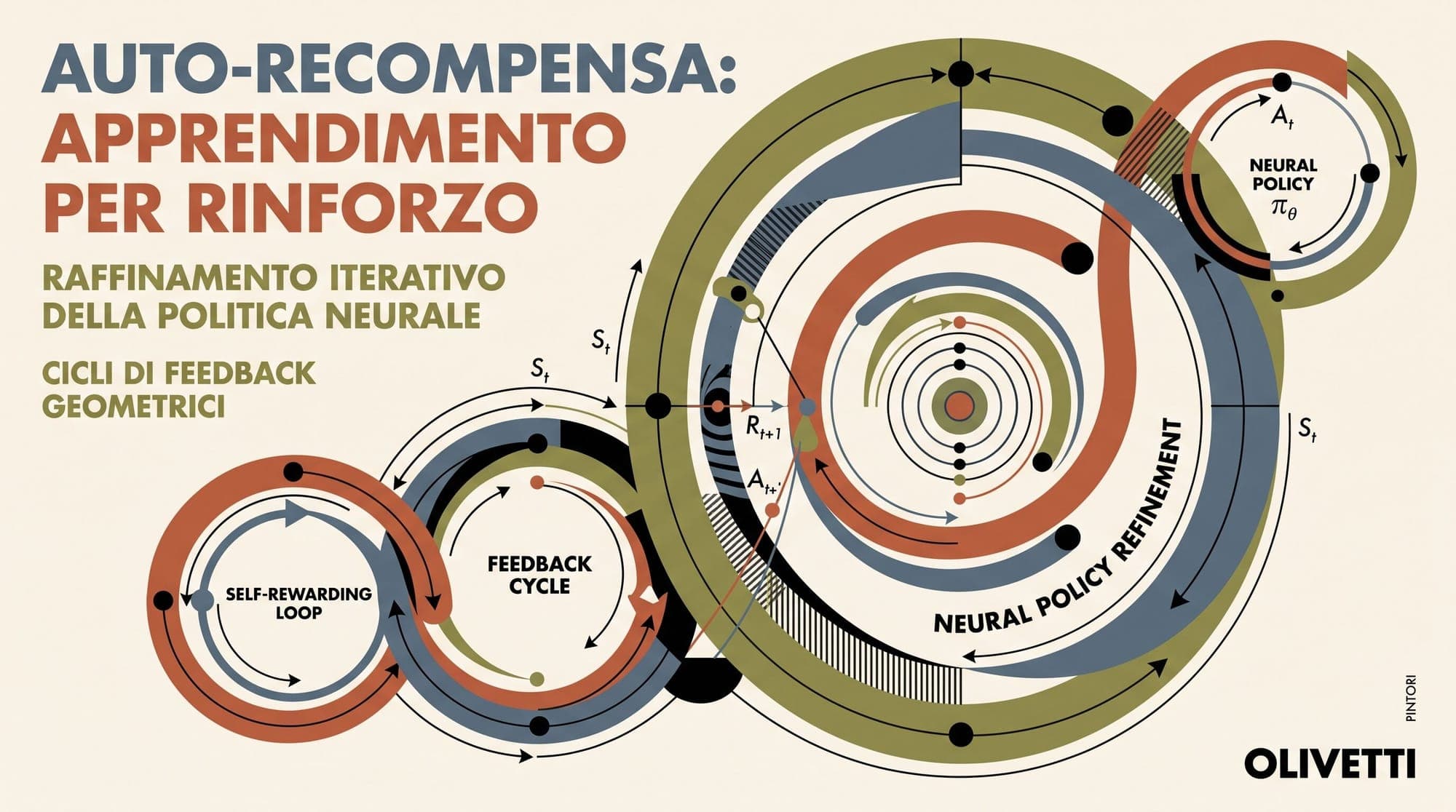
Self-Rewarding Language Models, introduced by Meta AI and NYU researchers (Yuan et al., 2024), eliminate the need for an external frozen reward model. Instead of decoupling the instruction-following agent from an external reward model, a single model simultaneously acts as both the generative worker and the evaluator (LLM-as-a-Judge). By generating its own preference pairs and training iteratively on self-judged responses via Direct Preference Optimization, the model improves both its generative policy and its evaluation capability across successive training iterations.

The Dual Capability: Instruction Following and LLM-as-a-Judge
At the core of the self-rewarding architecture is the realization that instruction-following and reward modeling are complementary tasks that can share the same parametric representations.
During initialization (), the base model is fine-tuned on two distinct instruction sets via Supervised Fine-Tuning (SFT):
- Instruction Following Data (IFT): Standard instruction-response pairs covering general tasks, reasoning, and coding.
- Evaluation Fine-Tuning Data (EFT): Input prompts containing evaluation rubrics, an original instruction, and a candidate response. The model is trained to output a structured chain-of-thought evaluation rationale followed by a discrete numeric score (typically on an additive 1 to 5 scale).
Training on EFT teaches the language model the structured syntax and scoring logic required to evaluate candidate completions accurately.
The Iterative Self-Alignment Loop
Once the seed model possesses baseline instruction-following and evaluation skills, training proceeds in discrete iterative stages :
1. Candidate Generation
For each prompt sampled from an unannotated instruction pool, the current checkpoint samples independent candidate responses: Sampling typically uses temperature decoding () to encourage diversity in solution paths, formatting, and stylistic variants.
2. Self-Evaluation and Scoring
The model is prompted in its LLM-as-a-Judge mode to evaluate each candidate response with respect to the input prompt : The prompt structure requires the model to generate a critique explaining strengths, factual errors, or stylistic deficiencies before outputting its final score.
3. Preference Pair Construction
From the set of scored completions for prompt , the system identifies the highest-scoring candidate (winning completion) and the lowest-scoring candidate (losing completion): Pairs where are discarded to prevent ambiguous reward signals from corrupting gradient updates.
4. Policy Update via Iterative DPO
The model is fine-tuned on the newly curated synthetic dataset using the DPO objective: Here, serves as the reference policy, and the resulting trained weights become the next checkpoint .
The Bootstrapping Dynamic: Improving Policy and Judge Simultaneously
The central theoretical advantage of self-rewarding language models is the co-evolution of generation and evaluation:
- Instruction Following Improvement: As the policy updates, it assigns higher probability to high-quality reasoning and structured completions. On standard benchmarks such as AlpacaEval 2.0, successive iterations () demonstrate monotonically increasing win rates against baseline models.
- Reward Accuracy Improvement: Because instruction following and evaluation share representation layers, improving general reasoning directly boosts the model's ability to spot hallucinations and logical flaws when acting as a judge. Evaluation accuracy against human gold-standard preferences increases across iterations without requiring additional human labels.
Key Failure Modes and Mitigation Strategies
While self-rewarding loops offer an autonomous path toward alignment scaling, unconstrained iterative self-play exposes several failure modes:
- Length Bias Exploitation: LLM-as-a-Judge prompts are vulnerable to length bias, systematically awarding higher scores to verbose completions. Without length normalization or debiasing regularizers, the iterative loop can devolve into generating increasingly bloated responses.
- Mode Collapse and Degeneracy: If candidate diversity is too small, the model may repeatedly sample near-identical candidates, driving the DPO loss to optimize over superficial formatting differences rather than substantive reasoning.
- Reward Hacking in Self-Judgments: A model may learn to generate responses that trigger its own specific heuristic scoring triggers rather than true factual correctness. Guardrail checks, external rule-based filters, and multi-prompt consensus evaluation help anchor the self-judging mechanism against drift.