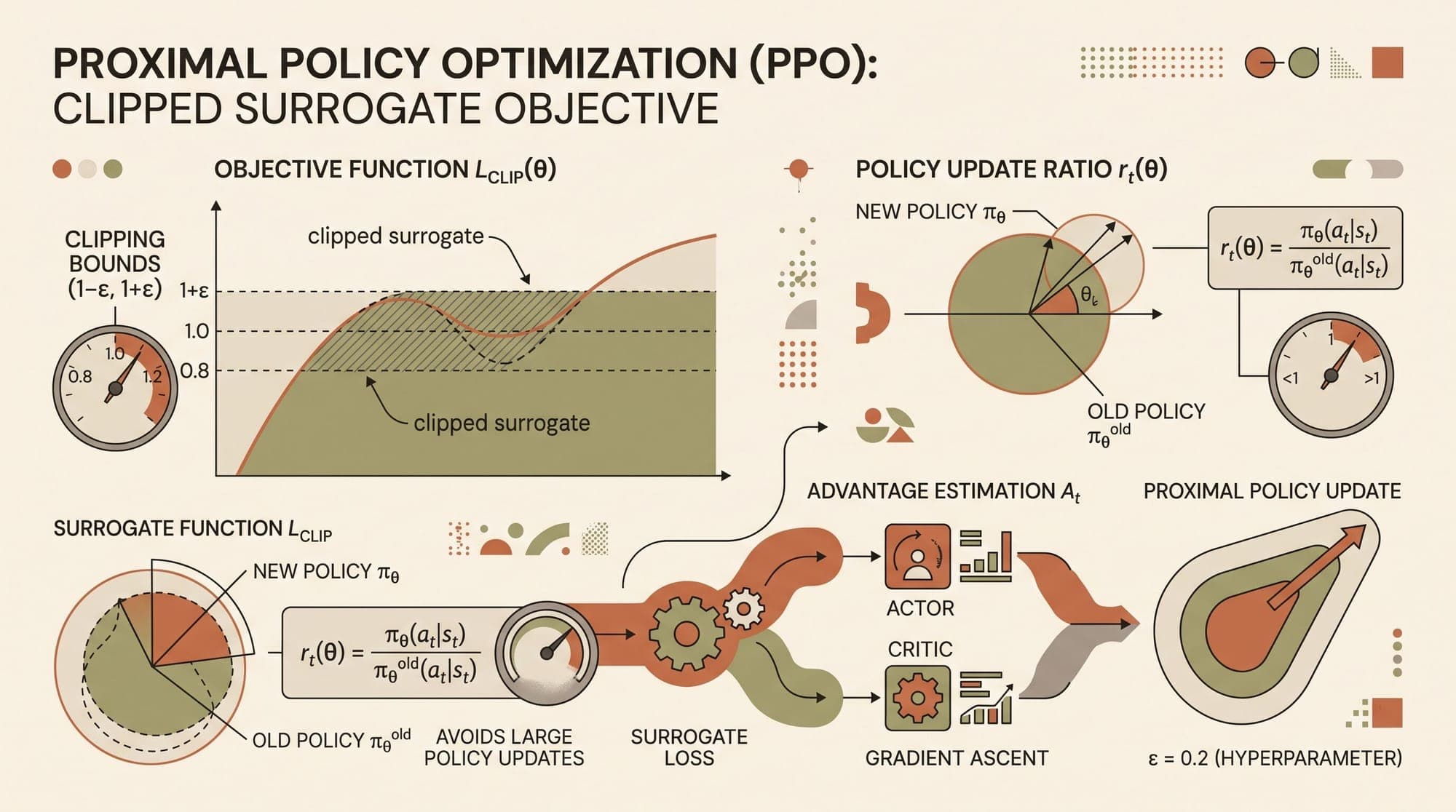
Proximal Policy Optimization (PPO) in LLM Post-Training: Mathematical Foundations of Clipped Surrogate Objectives, Generalized Advantage Estimation, Value Network Architectures, and Adaptive KL Penalties
Proximal Policy Optimization (PPO) in LLM Post-Training: Mathematical Foundations of Clipped Surrogate Objectives, Generalized Advantage Estimation, Value Network Architectures, and Adaptive KL Penalties Reinforcement Learning from Human Feedback (RLHF) established modern alignment for instruction-following foundation models. While pre-training optimizes autoregressive language models to minimize next-token prediction loss over massive text corpora, standard cross-entropy loss cannot directly o
1 min