Standard conversational AI deployments treat each user session as an isolated interaction or rely on naive sliding-window context histories. While extending context windows allows models to process thousands of tokens from previous turns, stuffing raw conversational history into prompt contexts introduces severe serving inefficiencies, inflates token economics, and fails to synthesize stable user profiles over time.
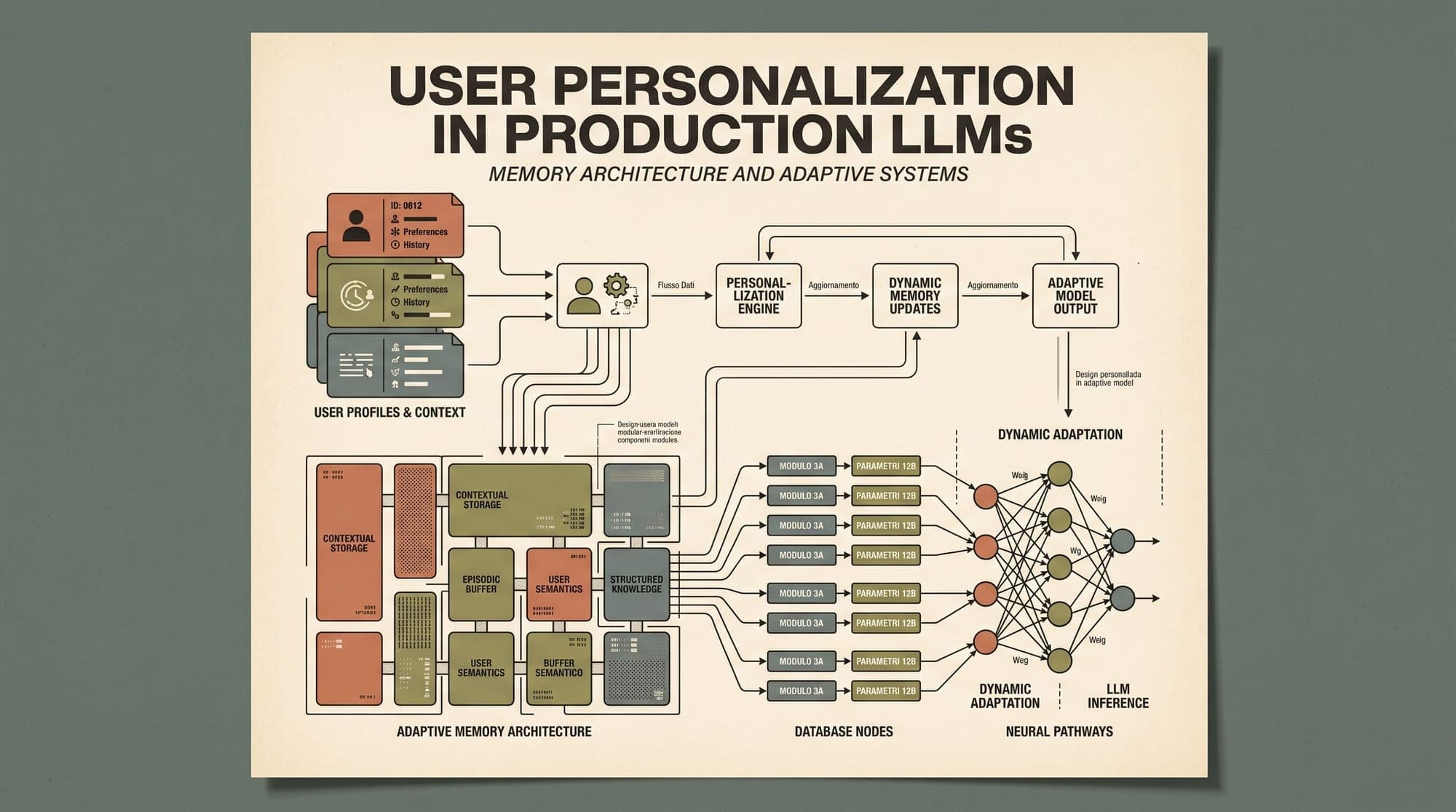
Deploying long-term personalization in production large language model (LLM) applications requires moving beyond raw transcript retrieval. Production personalization systems decouple real-time session inference from asynchronous user profiling, organizing user state into hierarchical memory tiers that balance retrieval accuracy, serving latency, and data privacy.
The Limits of Naive Context Concatenation
Injecting raw historical message logs directly into system prompts creates three distinct operational failure modes:
- Context Window Bloat and Serving Latency: Appending historical transcripts consumes thousands of prompt tokens per request, directly increasing Time to First Token (TTFT) and inference costs.
- Prefix Cache Invalidation: Naive retrieval of varying conversational logs shifts prompt prefixes dynamically on every turn, preventing modern inference engines like vLLM and SGLang from reusing KV cache blocks.
- Contradiction and Drift: As user preferences, workflows, and projects change over weeks or months, raw historical logs contain outdated instructions that compete directly with current user requests.
Resolving these issues requires an active user modeling system that continuously extracts, reconciles, and stores structured representations of user traits, constraints, and historical context.
The Three-Tier Memory Architecture
Production personalization architectures organize user information across three distinct abstraction layers, as demonstrated in systems like O-Mem and MemoryBank.

1. Persona and Profile Layer (Structured State)
The persona layer stores structured, high-signal attributes that govern general interaction behavior. Implemented typically in relational databases or key-value stores (such as PostgreSQL or Redis), this layer captures:
- Hard Constraints: Strict negative constraints (for example: "never output code in JavaScript", "do not use marketing metaphors").
- Domain Background: Technical expertise levels, primary programming languages, and industry context.
- Communication Style: Output conciseness, formatting preferences, and tone guidelines.
Because persona attributes are compact (typically under 300 tokens when serialized as JSON or YAML), they can be deterministically formatted and slotted into system prompts without triggering expensive vector search.
2. Episodic and Interaction Memory (Vectorized Semantic Store)
The episodic layer captures historical events, specific project decisions, and conversational snippets across previous sessions. Implemented in vector databases (such as Qdrant, Milvus, or pgvector), episodic memories are indexed with metadata:
- Semantic Embeddings: Dense vector representations of past problem-solving sessions and technical discussions.
- Temporal Timestamps: Creation and last-accessed timestamps used for recency decay.
- Entity Tags: Key topics, project names, and tool identifiers that enable hybrid search filtering.
Episodic memory is retrieved dynamically via cue-triggered similarity search only when incoming user queries match historical project contexts.
3. Working Memory (Active Session Buffer)
Working memory maintains the short-term conversational context of the immediate session. It manages multi-turn dialogue state, pending tool outputs, and transient user corrections within the active execution window before being summarized or flushed upon session termination.
Asynchronous Preference Extraction and Profile Synthesis
Extracting user traits synchronously during the primary request path introduces unacceptable latency overheads. Production architectures execute user profiling asynchronously in background worker queues following session turns.
+-------------------------------------------------------------------+
|                        Client Request Path                        |
|                                                                   |
|   User Query  -->  Context Assembler  -->  Inference Engine (LLM) |
|                           ^                                       |
|                           | (Injected Profile)                    |
+---------------------------|---------------------------------------+
                            |
+---------------------------|---------------------------------------+
|                 Asynchronous Profiling Pipeline                   |
|                                                                   |
|   Session Turns  -->  Message Queue  -->  Extraction LLM          |
|                                                  |                |
|                                                  v                |
|   Profile DB  <--  Conflict Resolver  <--  Delta Extraction       |
+-------------------------------------------------------------------+
Delta Extraction and Fact Distillation
Following a completed user interaction, an asynchronous extractor model evaluates dialogue turns to isolate new factual statements and behavioral signals. As formalized in the PersonaMem benchmark (COLM 2025), extraction separates two categories of signal:
- Explicit Directives: Direct statements where the user specifies a rule or fact (such as "I have migrated our backend from Go to Rust").
- Implicit Traits: Latent patterns inferred from recurring query topics, vocabulary choices, and feedback signals (such as repeated requests to clarify mathematical derivations).
Temporal Conflict Resolution and Decay
When an extraction pipeline detects a new preference that contradicts existing profile attributes, the system must reconcile state:
- Timestamped Overrides: Explicit new statements take absolute precedence over older historical attributes in the same domain.
- Recency Decay Scoring: For implicit preferences, relevance scores decay exponentially over time unless reinforced by subsequent interactions:
Score(t) = Base_Weight * exp(-lambda * (t_current - t_last_seen))
- Semantic Invalidation: When a major environment change is declared (such as changing operating systems or cloud providers), dependent memory nodes in the episodic index are tagged with invalidation flags or pruned from active retrieval pools.
Prefix Caching Alignment and Context Assembly Economics
In high-throughput multi-tenant serving environments, how personalized context is injected into prompts directly dictates GPU memory efficiency and serving costs.
Prefix Cache Preservation
Modern LLM engines utilize radix trees to cache KV activations for identical prompt prefixes. If dynamic user profiles are injected at the very beginning of the system prompt, each unique user invalidates the shared base system prompt cache, causing a full prefill computation on every request.
To maximize KV cache hit rates:
- Static Base Prompt: Position immutable developer instructions, tool schemas, and core safety guidelines at token index 0.
- Personalized Context Slot: Append the user profile downstream of the static instructions immediately before the dynamic conversation history.
[Tokens 0 - 1500]   : Immutable System Instructions & Tool Definitions (Shared KV Cache)
[Tokens 1501 - 1800]: Injected User Profile & Persona Attributes (User-Specific Cache)
[Tokens 1801 - N]   : Retrieved Episodic Context & Active Session Turns (Dynamic)
Domain-Scoped Profile Pruning
Injecting a user's entire profile indiscriminately introduces context noise and increases token consumption. Production context assemblers route queries through lightweight domain classifiers, selecting only relevant attribute partitions (such as passing coding preferences to code generation tasks while omitting personal schedule constraints).
Empirical Evaluation and Benchmarks
Evaluating long-term personalization requires measuring not only whether a model recalls user traits, but whether it applies them appropriately without over-generalizing.
Key benchmarks established for evaluating LLM personalization include:
- PersonaMem (COLM 2025): Evaluates dynamic user profiling, tracking preference evolution across multi-session dialogues, and measuring whether models avoid applying outdated constraints. Frontier models without dedicated memory architectures frequently score around 50% on dynamic evolution tracking tasks.
- LongMemEval: Measures single-session recall, multi-session knowledge updates, and cross-session temporal reasoning.
- BenchPreS: Evaluates context-aware preference selectivity, measuring both Appropriate Application Rates and Misapplication Rates (where models inappropriately force user preferences into unrelated queries).
- LoCoMo: Evaluates long-context memory retrieval across structured dialogues and episodic event logs.
Privacy Boundaries, Tenant Isolation, and Compliance
Personalization systems store sensitive user data that requires rigorous isolation and compliance guardrails, as explored in the MemPrivacy framework.
Multi-Tenant Storage Partitioning
All profile stores, episodic vector indexes, and graph memory representations must enforce hard tenant isolation keys. Database queries must enforce strict row-level security policies (WHERE tenant_id = :tenant_id AND user_id = :user_id) to prevent cross-tenant vector contamination during similarity search.
Pre-Ingestion PII Filtering
Before unstructured session turns are passed to memory extraction models or vector databases, sensitive data (such as API keys, credit card numbers, and health records) must be scrubbed using deterministic entity recognition pipelines (such as Microsoft Presidio).
Right to Be Forgotten (Granular Deletion)
Under GDPR and CCPA regulations, systems must support complete deletion of user data upon request. Production memory architectures maintain bidirectional index mappings between user identifiers and vector embeddings, enabling atomic purging of:
- Structured key-value profile records.
- Episodic vector embeddings and metadata payloads.
- Intermediate background extraction queues and cached summaries.
Sources
- Jiang, B., et al. (2025). Know Me, Respond to Me: Benchmarking LLMs for Dynamic User Profiling and Personalized Responses at Scale (PersonaMem). COLM 2025.
- Wang, P., et al. (2025). O-Mem: Omni Memory System for Personalized, Long Horizon, Self-Evolving Agents. arXiv:2511.13593.
- Zhong, W., et al. (2023). MemoryBank: Enhancing Large Language Models with Long-Term Memory. arXiv:2305.10250.
- Zheng, L., et al. (2023). Efficient Memory Management for Large Language Model Serving with PagedAttention (vLLM). SOSP 2023.
- Zheng, L., et al. (2023). SGLang: Efficient Execution of Structured Language Model Programs. arXiv:2312.07104.
- MemPrivacy: Privacy-Preserving Personalized Memory for LLM Agents. arXiv:2605.09530.
- Microsoft Presidio: Data Protection and De-Identification SDK.