As regulatory frameworks such as Article 50 of the EU AI Act enforce machine-generated content provenance, text watermarking has transitioned from academic theory to a core component of production LLM serving stacks. Unlike post-hoc classifiers that evaluate perplexity or burstiness and suffer from high false-positive rates on formal or non-native writing, generation-time watermarks embed imperceptible statistical or cryptographic signals directly into the token sampling process.
When engineered correctly, watermarking requires no model retraining, adds negligible serving latency, and enables high-confidence provenance verification from token sequences as short as 50 to 100 words.
The Architectural Mechanics of Logit Biasing
The primary statistical watermarking paradigm, introduced by Kirchenbauer et al. (2023), operates during the autoregressive sampling loop. At generation step , the inference engine hashes the preceding context tokens using a pseudo-random function (PRF) parameterized by a secret key :
import hashlib

def get_green_list(prefix_tokens: list[int], secret_key: bytes, vocab_size: int, gamma: float = 0.5) -> set[int]:
    # Hash the preceding context window (e.g., k=1 or k=2 tokens)
    context_bytes = b"".join(tok.to_bytes(4, byteorder="big") for tok in prefix_tokens[-2:])
    seed = int.from_bytes(hashlib.sha256(secret_key + context_bytes).digest()[:8], byteorder="big")

    # Deterministically partition vocabulary into green and red lists
    import random
    rng = random.Random(seed)
    vocab_indices = list(range(vocab_size))
    rng.shuffle(vocab_indices)

    green_size = int(gamma * vocab_size)
    return set(vocab_indices[:green_size])
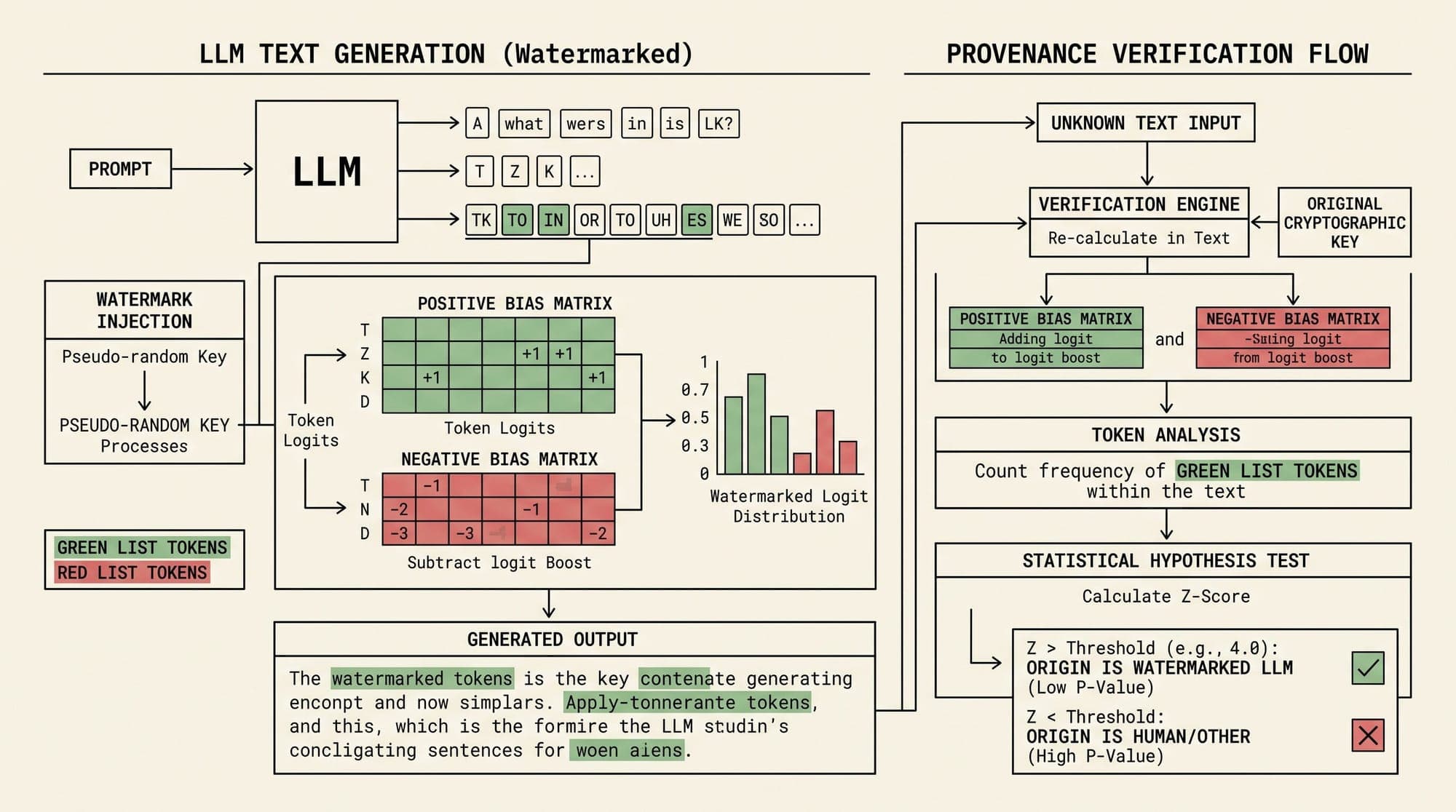
The vocabulary is partitioned into a "green list" of size (typically ) and a "red list" of size . The engine then adds a constant positive bias to the unnormalized logits of all green-list tokens before softmax normalization:
When sampling from the modified distribution, the model disproportionately selects green tokens. For human-authored or unwatermarked text, the count of green tokens follows a standard binomial distribution , where is the total token count. For watermarked text generated with logit bias , the expected green token proportion rises significantly above .

Verification and Statistical Hypothesis Testing
Watermark detection does not require access to the generative model weights, token probabilities, or full prompts. The verifier only requires the secret key , the hashing window size , and the candidate text.
To evaluate whether a sequence of tokens was produced by the watermarked model, the verifier computes the observed count of green tokens and calculates the standard one-tailed -score under the null hypothesis :
The resulting -value quantifies the probability that human text generated this green-token concentration purely by chance:
Where is the standard normal cumulative distribution function.
- At , (1 in 31,500 false positive rate).
- At , (less than 1 in 1 billion false positive rate).
In production pipelines, setting a threshold of prevents false accusations against human writers while reliably flagging watermarked completions containing 100 or more tokens.
Distortion-Free and Cryptographic Schemes
While logit biasing is computationally simple, adding a rigid bias introduces distribution distortion. In low-entropy generation tasks (such as code generation, mathematical proofs, or API schema formatting), biasing logits toward arbitrary green tokens can force the model to select suboptimal syntax or incorrect variable names.
To address this distortion-accuracy trade-off, modern architectures employ distortion-free watermarking:
Gumbel-Max Cryptographic Watermarks
Formulated by Aaronson and Christ (2023) and expanded by Kuditipudi et al. (2023), this scheme uses pseudo-random number generators to draw standard uniform variables for every vocabulary token , keyed on previous tokens. Tokens are sampled via the Gumbel-Max reparameterization trick:
Because the marginal distribution of matches the model's true softmax distribution exactly, the watermark is mathematically distortion-free. The sequence contains no measurable degradation in perplexity or task accuracy, yet retains deterministic correlations with the pseudo-random seed stream.
DeepMind SynthID-Text Tournament Sampling
Published in Nature by Dathathri et al. (2024), Google DeepMind's SynthID-Text uses tournament sampling. Instead of altering logits globally, the sampler computes pseudo-random scoring values (-values) across candidate subsets in an elimination tree. By maintaining calibrated token probabilities while guiding selections through structured tournament rounds, SynthID preserves quality across production systems such as Gemini without degrading response formatting.
Production Serving Integration and Latency Overhead
Implementing watermarking at scale requires embedding logic into the model's inference loop without stalling token throughput.
Inference Engine Logits Processors
In serving engines like vLLM, SGLang, and TensorRT-LLM, watermarking runs as a custom fused logits processor immediately prior to top- / top- filtering and sampling.
class ProductionWatermarkLogitsProcessor:
    def __init__(self, key: bytes, gamma: float = 0.5, delta: float = 2.0, window_size: int = 2):
        self.key = key
        self.gamma = gamma
        self.delta = delta
        self.window_size = window_size

    def __call__(self, input_ids: list[int], scores: "torch.Tensor") -> "torch.Tensor":
        if len(input_ids) < self.window_size:
            return scores

        green_tokens = get_green_list(input_ids, self.key, scores.shape[-1], self.gamma)
        # Apply in-place vectorized tensor addition
        scores[list(green_tokens)] += self.delta
        return scores
Operational Characteristics
- Compute and Latency Tax: The PRF hashing and indexing overhead consumes less than 0.2 milliseconds per token generation step on modern GPU hardware (such as Nvidia H100s or L40Ss), adding under 0.5% total latency to end-to-end decode time.
- VRAM Footprint: Watermarking requires zero additional KV cache memory and zero parameter sharding modifications.
- Key Hierarchy and Rotation: Production deployments use HMAC-SHA256 with key rotation schedules. A master key derives tenant-specific or model-specific subkeys, allowing organizations to verify outputs without exposing the master signing infrastructure.
Evasion Vectors and Defense Limits
Watermarking is not an absolute cryptographic lock; it is a statistical signal designed for provenance verification. In production environments, systems must account for common evasion vectors:
- Paraphrasing Attacks: Running watermarked text through a separate, unwatermarked model (or a local small language model) rewires sentence structures and token choices, breaking the -gram hashing chains and lowering the detected -score.
- Token Insertion and Deletion: Manually modifying every third or fourth word disrupts -gram context hashes, causing the verifier to evaluate tokens against incorrect green lists.
- Translation Round-Tripping: Translating text from English to German and back to English completely resets token boundaries while preserving semantic meaning.
To improve robustness, production architectures use larger hashing windows ( or ), semantic token hashing (where words with similar embeddings share partition assignments), and ensemble verification that couples statistical watermarks with cryptographic metadata logging.
Sources
- A Watermark for Large Language Models (Kirchenbauer et al., 2023)
- Scalable Watermarking for Identifying Large Language Model Outputs (Nature / Dathathri et al., 2024)
- Watermarking of Large Language Models (Aaronson and Christ, 2023)
- Robust Distortion-Free Watermarks for Language Models (Kuditipudi et al., 2023)
- EU Artificial Intelligence Act: Article 50 Transparency Obligations
- SynthID-Text Tools and Architecture (Google AI Developer Documentation)