LLM Inference on AMD ROCm in Production: MI300X Architecture, Triton Kernel Parity, and vLLM Serving Benchmarks
Serving frontier large language models in enterprise production has historically been synonymous with NVIDIA CUDA infrastructure. However, the deployment of AMD Instinct MI300X accelerators across tier-one hyperscalers and neoclouds has established a viable alternative for high-throughput inference fleets.
With 192 GB of high-bandwidth memory (HBM3) and 5.3 TB/s of peak theoretical memory bandwidth per Open Accelerator Module (OAM), the MI300X directly addresses the primary physical bottlenecks of generative inference: memory capacity limits for large model weights and memory bandwidth ceilings during autoregressive token generation.
Achieving high goodput on AMD silicon requires understanding the interaction between CDNA 3 microarchitecture, the ROCm software stack, OpenAI Triton compiler integration, and attention backends within modern serving engines such as vLLM.

Hardware Architecture: CDNA 3 and the Memory Advantage
The MI300X is built using 3.5D packaging that integrates eight Accelerated Compute Dies (XCDs) and four I/O Dies (IODs) with eight 24 GB HBM3 stacks. This topology provides distinct operational advantages over comparable architectures:
- Memory Capacity: 192 GB of unified HBM3 allows 70B parameter models (such as Llama 3.3 70B) to run in full 16-bit precision unquantized (~140 GB VRAM allocation) on a single accelerator. This eliminates multi-GPU tensor parallelism communication overhead entirely for mid-sized foundation models.
- Memory Bandwidth: Autoregressive decode is strictly memory-bandwidth bound. Each token generation step requires loading the entire active model weights from HBM to compute units. At 5.3 TB/s peak bandwidth (compared to 3.35 TB/s on NVIDIA H100 SXM), the theoretical single-stream generation ceiling increases proportionally with lower per-token latency.
- FP8 Matrix Cores: The CDNA 3 architecture includes Matrix Fused Multiply-Add (MFMA) instructions delivering 2,614 TFLOPS of FP8 compute per accelerator, supporting OCP standard FP8 formats (E4M3 and E5M2) with hardware-accelerated mixed-precision GEMMs.
- Infinity Fabric Interconnect: Within an 8-GPU baseboard, AMD Infinity Fabric (xGMI) provides 896 GB/s aggregate bi-directional peer-to-peer bandwidth across 7 links per GPU, supporting ring and mesh collective communication topologies.
Software Stack Evolution: From HIP Transpilation to Native Triton
Early ROCm deployments relied heavily on HIP (Heterogeneous-Compute Interface for Portability), source-to-source transpiling CUDA C++ codebases to run on AMD runtimes. While functional, direct transpilation frequently suffered from microarchitectural mismatches:
- Wavefront Dimensions: AMD CDNA architectures execute instructions in 64-thread wavefronts, whereas NVIDIA GPUs utilize 32-thread warps. Naive transpilation of warp-synchronous primitives (such as
__shfl_xor_sync) often introduced branch divergence, thread masking, and suboptimal compute unit occupancy. - Local Data Share (LDS) Sizing: Each CDNA 3 compute unit provides 64 KB of Local Data Share (scratchpad memory). CUDA kernels optimized for 48 KB or 96 KB shared memory blocks required manual retuning of tile sizes to avoid register spills.
The adoption of OpenAI Triton as an intermediate compilation layer has eliminated the need for manual C++ porting for most LLM operations. The Triton AMDGPU LLVM backend compiles Python DSL kernel specifications directly into AMDGPU machine code (GCN ISA).
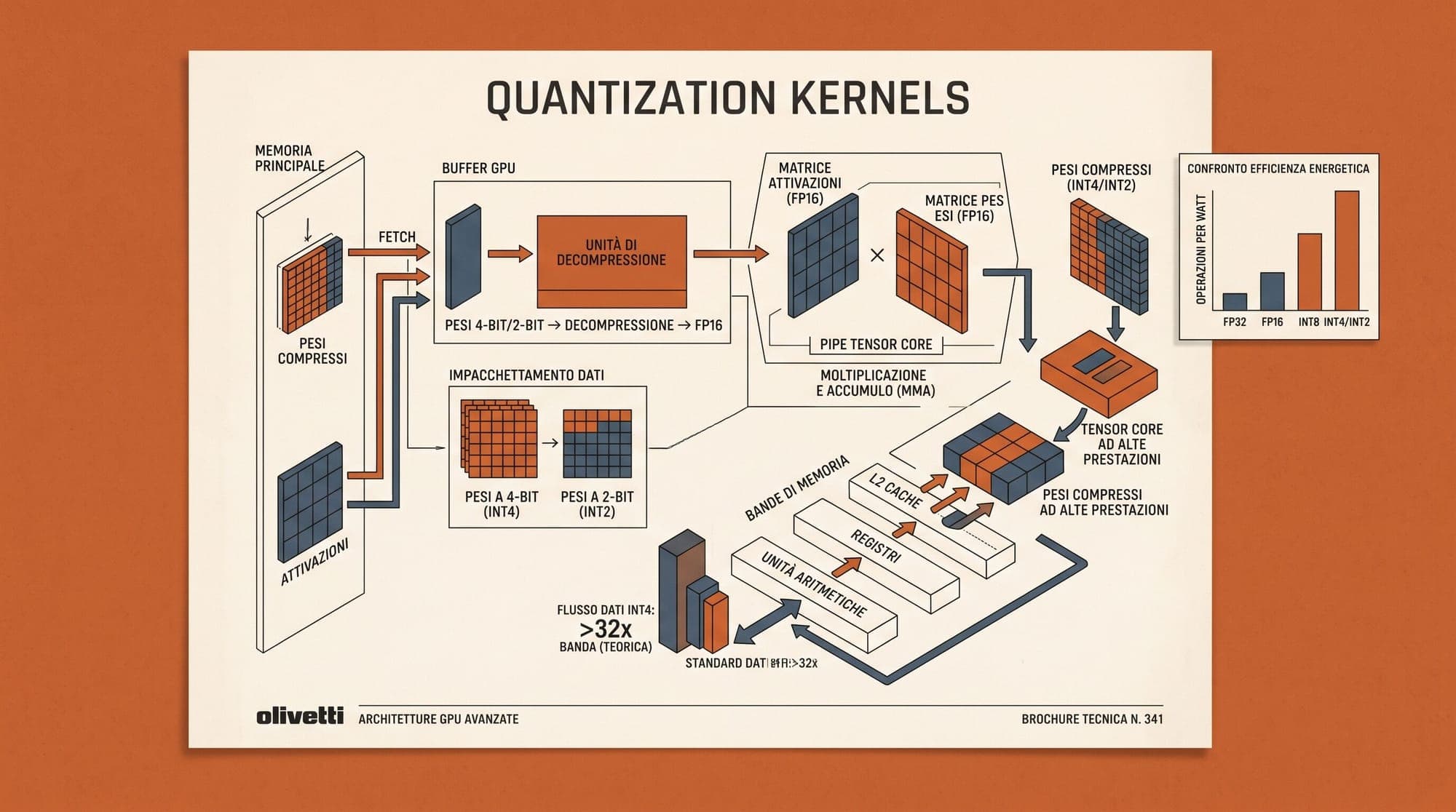
Through Triton, key operator kernels such as RMSNorm, SwiGLU activation, dynamic quantization, and rotary position embeddings (RoPE) achieve performance parity with hand-tuned CUDA implementations without vendor-specific dialect rewrites.
Attention Backend Architecture in vLLM on ROCm
The performance of an LLM serving engine depends on its attention kernel implementation. In vLLM on ROCm, attention execution has evolved across three distinct generations:
- Legacy HIP Attention (
ROCM_ATTN): Early vLLM implementations used generic C++ PagedAttention kernels. These lacked fused memory layouts and suffered from heavy register pressure during the decode phase. - Triton Unified Attention (
TRITON_ATTN): Implements block-tiled FlashAttention-2 algorithms directly in Triton. By auto-tuningBLOCK_M,BLOCK_N, andBLOCK_Khyperparameters to match CDNA 3 LDS bank configurations, Triton Unified Attention improved throughput significantly across standard multi-head attention (MHA) and grouped-query attention (GQA) workloads. - AITER Attention (
ROCM_AITER_FAandROCM_AITER_MLA): AMD's AI Tensor Engine (AITER) provides specialized assembly-level and Composable Kernel (CK) backends. For standard MHA/GQA, AITER FA delivers 2.7x to 4.4x higher token throughput compared to legacy HIP attention.
Serving Multi-Head Latent Attention (MLA)
Models utilizing Multi-Head Latent Attention (such as DeepSeek-V3 and DeepSeek-R1) compress Key-Value caches into low-rank latent vectors.
During autoregressive decode, uncompressing latent vectors inside high-occupancy Triton kernels can create register pressure bottlenecks. AMD AITER provides dedicated assembly decode kernels (ROCM_AITER_MLA) that execute fused matrix-vector multiplications directly against latent KV blocks, yielding 1.2x to 1.5x throughput gains over standard Triton MLA implementations.
Production Tuning and Deployment Best Practices
Deploying high-throughput vLLM clusters on MI300X infrastructure requires specific OS-level and runtime configuration adjustments:
# 1. Disable OS-level NUMA auto-balancing to prevent latency jitter
echo 0 | sudo tee /proc/sys/kernel/numa_balancing

# 2. Configure ROCm memory allocation and SDMA transfer engines
export HSA_ENABLE_SDMA=1
export HIP_FORCE_DEV_KERNARG=1
export NCCL_COMM_BLOCKING=0
export RCCL_MSCCL_ENABLE=1

# 3. Launch vLLM with optimized AITER and FlashAttention backends
vllm serve meta-llama/Llama-3.3-70B-Instruct \
  --tensor-parallel-size 1 \
  --gpu-memory-utilization 0.92 \
  --max-model-len 8192 \
  --kv-cache-dtype fp8 \
  --dtype bfloat16 \
  --trust-remote-code
Key configuration parameters to optimize include:
- NUMA Node Pinning: Each MI300X OAM module connects to specific host CPU sockets via PCIe Gen 5 x16 links. Ensure vLLM worker processes are bound to the corresponding host NUMA node using
numactl --cpunodebindandnumactl --membindto eliminate inter-socket PCIe latency penalties. - Pre-Compilation and Triton Caching: Triton compiles and auto-tunes kernels on first execution. In production Kubernetes pods, perform a synthetic warm-up pass (
benchmarks/benchmark_throughput.py) during container initialization or pre-bake the Triton cache (~/.triton/cache) into immutable container images to prevent tail-latency spikes on first user requests. - RCCL Tuning: Distributed serving across multiple MI300X nodes utilizes RCCL (ROCm Communication Collectives Library). Enable MSCCL (Microsoft Collective Communication Library) algorithms via
RCCL_MSCCL_ENABLE=1to optimize all-reduce ring execution over InfiniBand or RoCEv2 fabrics.
Serving Economics and Infrastructure Sizing
The large single-GPU memory footprint alters cluster topology and hardware utilization economics:
- Tensor Parallelism Reduction: Reducing tensor parallelism from TP=4 on 80 GB GPUs to TP=1 on 192 GB GPUs eliminates inter-GPU synchronization barriers during decode. This reduces Time-to-First-Token (TTFT) variance and frees GPU compute cycles for higher batch concurrency.
- Long-Context KV Cache Footprint: For 32K to 128K context windows, KV cache allocations frequently exceed model weight sizes. An 8x MI300X node provides 1.5 TB of total HBM3, allowing high concurrent request capacity at deep context lengths without early preemption or CPU cache offloading.
- Quantized Serving: Pairing FP8 model weights with FP8 KV caches via ROCm-native quantization tools (such as AMD Quark) doubles the effective batch capacity per OAM module while preserving CDNA 3 MFMA tensor throughput.
As compiler-driven kernel generation continues to replace proprietary hardware-specific assembly, AMD ROCm and CDNA 3 architectures offer a viable, high-performance path for large-scale LLM inference deployments.
Sources
- AMD Instinct MI300X Accelerator Technical Specifications (AMD)
- Beyond Porting: How vLLM Orchestrates High-Performance Inference on AMD ROCm (vLLM Blog)
- LLM Inference Performance Validation on AMD Instinct MI300X (AMD ROCm Documentation)
- Accelerated LLM Inference on AMD Instinct GPUs with vLLM 0.9.x (AMD ROCm Blogs)
- OpenAI Triton AMDGPU Backend Architecture (Triton GitHub Repository)