Information retrieval systems have long wrestled with a fundamental tension between computational efficiency and semantic expressiveness. Traditional dense bi-encoders like DPR compress an entire passage into a single dense vector, allowing sub-linear approximate nearest neighbor (ANN) search over millions of documents. However, forcing multi-sentence passages into a single vector representation creates an information bottleneck that discards fine-grained token-level nuances, entities, and keyword relationships.
Conversely, cross-encoders feed the full concatenation of query and document tokens into an attention model, evaluating all token-to-token interactions across all transformer layers. While cross-encoders achieve state-of-the-art ranking precision, their computational cost scales quadratically with sequence length and requires evaluating every candidate passage through deep neural layers at runtime. This renders exhaustive cross-encoder search across million-scale corpora computationally intractable.
Late interaction, introduced by Omar Khattab and Matei Zaharia in the original ColBERT paper, bridges this divide. By decoupling document encoding from query execution while preserving token-level contextualized representations, late interaction achieves ranking precision competitive with cross-encoders while executing orders of magnitude faster.

The Single-Vector Bottleneck
To understand why late interaction matters, consider how single-vector dense bi-encoders operate. Given a passage containing hundreds of tokens, a typical encoder maps the sequence to a single vector:
where is typically 768 or 1536 dimensions.
This single vector must simultaneously represent every fact, entity, qualification, and numerical value in the passage. In retrieval-augmented generation (RAG) and search settings, this pooling operation leads to several well-documented failure modes:
- Entity Dilution: When a document covers multiple entities or subtopics, the pooled embedding represents an average semantic centroid, dampening the signal for specific entities.
- Lexical Mismatch: Single-vector models struggle with exact token matches (part numbers, error codes, rare names) because semantic proximity in embedding space does not guarantee exact lexical identity.
- Asymmetric Granularity: A short query targeting a single sentence inside a 500-token document often fails to score high similarity against the document's global topic vector.
Cross-encoders resolve this by computing cross-attention over all token pairs at every transformer layer:
Because every query token directly attends to every document token, cross-encoders capture subtle conditional relationships. However, because query and document must be concatenated before processing, documents cannot be pre-indexed as standalone vectors. A query searching 10 million passages would require running 10 million full transformer forward passes.
The Mechanics of Late Interaction and MaxSim
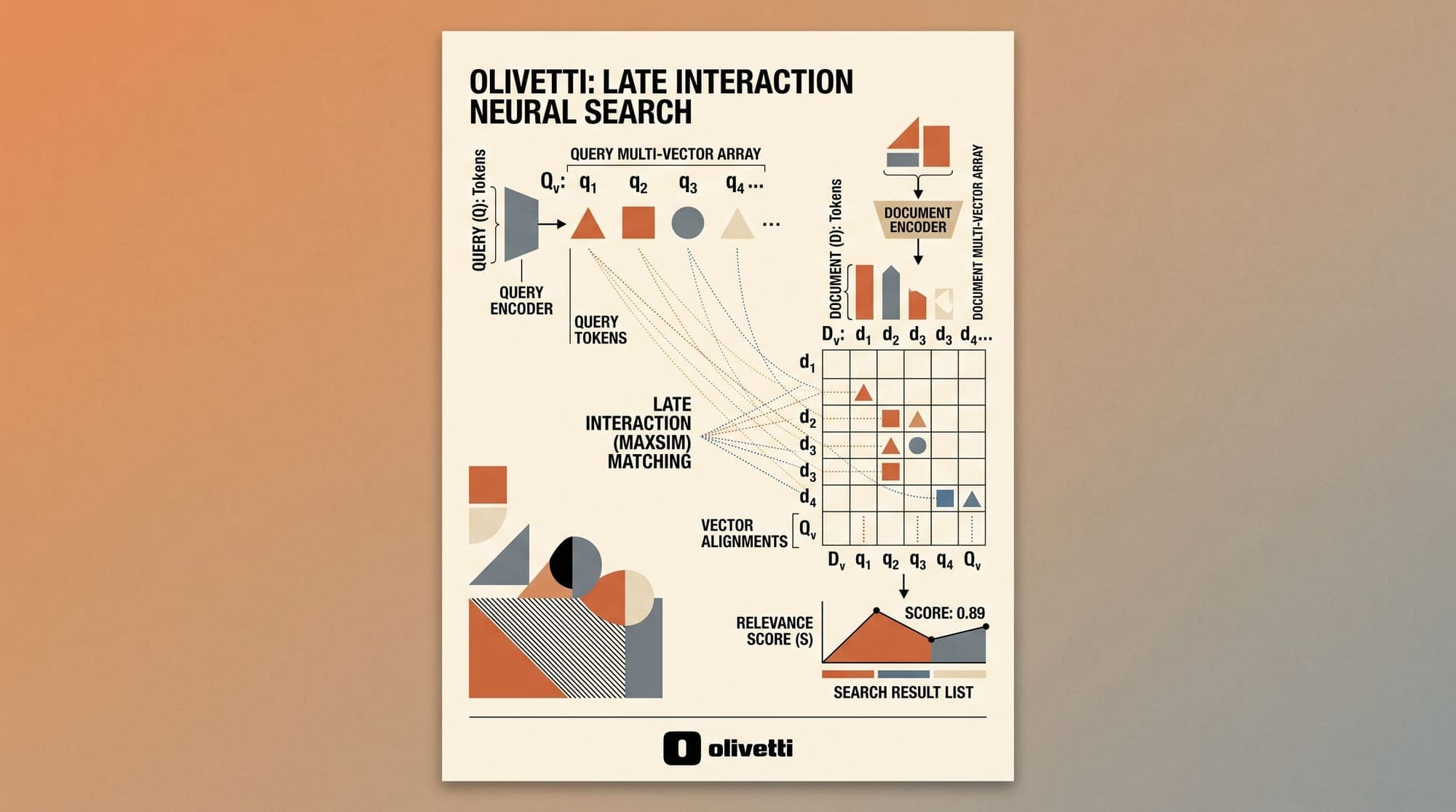
ColBERT resolves this trade-off by delaying token interaction until after contextualized representations are generated independently.
1. Contextualized Token Encoding
Documents are processed offline through a BERT-style encoder that generates a separate low-dimensional vector (typically ) for every token in the passage:
Queries are encoded at runtime through the same underlying model architecture:
ColBERT differentiates query and document inputs by prepending distinct control tokens (such as [Q] and [D]). For queries, the sequence is padded with [MASK] tokens up to a fixed length (typically ). This padding mechanism allows query tokens to undergo soft query expansion through self-attention across the mask tokens before any document comparison takes place.
2. The MaxSim Relevance Operator
Once query and document token matrices are generated, the overall relevance score is computed via the MaxSim operator. For each query token vector , the model finds the maximum inner product (cosine similarity) across all document token vectors , and sums these maximum values across all query tokens:
This formulation provides distinct mathematical advantages:
- Soft Alignment: Each query token independently seeks its strongest semantic counterpart in the document. A query mentioning "voltage regulator" matches the specific tokens discussing voltage regulation, regardless of where they appear in the passage.
- Order Invariance with Contextual Preservation: Because each token vector has already absorbed local sentence context via bidirectional self-attention during the encoding phase, the token matches retain syntactic context without requiring rigid positional alignments across the document.
- Additive Scoring: The summation over query tokens ensures that documents containing matches for all query terms accumulate higher total scores than documents matching only a single term strongly.
ColBERTv2: Mitigating the Storage Footprint with Residual Quantization
While ColBERTv1 delivered cross-encoder quality at bi-encoder retrieval speeds, it introduced a significant practical drawback: storage overhead. Storing 128-dimensional 32-bit floating-point vectors for every token across millions of passages expanded index sizes by 10x to 100x compared to single-vector dense indexes.
In ColBERTv2, Keshav Santhanam and collaborators solved this storage bottleneck through centroid-based residual quantization and denoised supervision.
Centroid Clustering and Residual Encoding
ColBERTv2 organizes the continuous embedding space of token vectors using -means clustering, typically identifying centroids across the training corpus.
During document indexing, each token vector is mapped to its nearest centroid . Instead of storing the full 128-dimensional vector, the index stores:
- A 16-bit integer ID referencing the nearest centroid .
- A quantized residual vector , where each dimension is compressed into 1 or 2 bits.
During query evaluation, the token vector is reconstructed via:
This combination of centroid assignment and extreme residual quantization reduces the storage requirement per token vector to roughly 16 to 32 bytes (down from 512 bytes in float32). On standard retrieval benchmarks like MS MARCO, ColBERTv2 shrunk index sizes from over 150 GB to 16 GB to 25 GB while retaining over 99% of uncompressed retrieval quality.
PLAID: Sub-10ms End-to-End Retrieval
Even with compressed vector representations, computing MaxSim scores across millions of document token bags would still exhaust query latency budgets if executed naively.
To achieve production-grade search latencies, the Stanford team developed PLAID (Performance-optimized Late Interaction with Asymmetric Information Distribution). PLAID structures retrieval as a multi-stage pruning pipeline that operates directly over the centroid index:
- Centroid-Based Candidate Identification: For each query token vector , PLAID identifies the top- closest centroids. Using an inverted index mapping centroids to document IDs, PLAID collects an initial pool of candidate documents containing tokens mapped to these active centroids.
- Coarse MaxSim Filtering: Candidate documents are ranked using only centroid-to-query dot products, skipping residual decompression entirely. This filters the candidate pool down from tens of thousands of passages to a few hundred top candidates.
- Exact Residual Re-ranking: PLAID dequantizes the residual vectors only for the top candidate documents and computes exact MaxSim scores using hardware-accelerated SIMD kernels.
By restricting expensive vector decompression and dot products to pruned candidate subsets, PLAID delivers end-to-end multi-vector search in under 10 milliseconds per query on standard commodity hardware.
Visual Late Interaction: ColPali
The late interaction paradigm has recently expanded beyond text. In 2024, researchers introduced ColPali, applying ColBERT's late interaction mechanisms directly to Vision-Language Models (VLMs) like PaliGemma.
Traditional document retrieval pipelines for PDFs and scanned files rely on complex, error-prone workflows: optical character recognition (OCR), layout parsers, table extractors, text chunkers, and dense text embedders. Any failure in layout segmentation or text extraction permanently corrupts the retrieval index.
ColPali bypasses text extraction entirely:
- Visual Patch Tokenization: High-resolution page images are fed directly into a vision transformer (such as SigLIP), generating a grid of visual patch embeddings (e.g., 1024 visual tokens per page).
- Language Model Projection: The visual patch tokens are projected into the embedding space of a language model (e.g., Gemma 2B) to produce contextualized visual token representations.
- MaxSim Visual Matching: When a user issues a text query, the query text tokens interact directly with the page's visual patch tokens using the standard MaxSim operator:
On the ViDoRe (Visual Document Retrieval) benchmark, ColPali outperformed multi-stage text extraction pipelines on document collections rich in charts, tables, diagrams, and complex multi-column typography.
Architectural Trade-Offs and Production Deployment
Late interaction provides distinct engineering trade-offs compared to single-vector retrieval:
Advantages
- High Retrieval Recall: Matches the precision of cross-encoder rerankers without runtime cross-attention overhead.
- Explainable Alignment: MaxSim produces explicit token-level alignment heatmaps, showing exactly which document tokens matched each query term.
- Robust Out-of-Domain Generalization: Because it avoids semantic pooling collapse, late interaction exhibits significantly higher zero-shot transfer performance across specialized domains (medical, legal, technical) than dense bi-encoders.
Constraints
- Index Footprint: Even with ColBERTv2 compression, multi-vector indexes require roughly 5x to 10x more storage than quantized single-vector indexes.
- Engineering Complexity: Requires specialized retrieval engines (such as PLAID, Vespa ColBERT integration, Qdrant multi-vector support, or RAGatouille) rather than standard flat ANN vector databases.
For enterprise RAG applications involving complex PDF structures, dense technical documentation, code repositories, or high-consequence search, late interaction represents one of the most effective retrieval architectures available.
Sources
- ColBERT: Efficient and Effective Passage Search via Contextualized Late Interaction over BERT (Khattab & Zaharia, SIGIR 2020)
- ColBERTv2: Effective and Efficient Retrieval via Lightweight Late Interaction (Santhanam et al., NAACL 2022)
- PLAID: An Efficient Engine for Late Interaction Retrieval (Santhanam et al., ACM CIKM 2022)
- ColPali: Efficient Document Retrieval with Vision Language Models (Faysse et al., 2024)