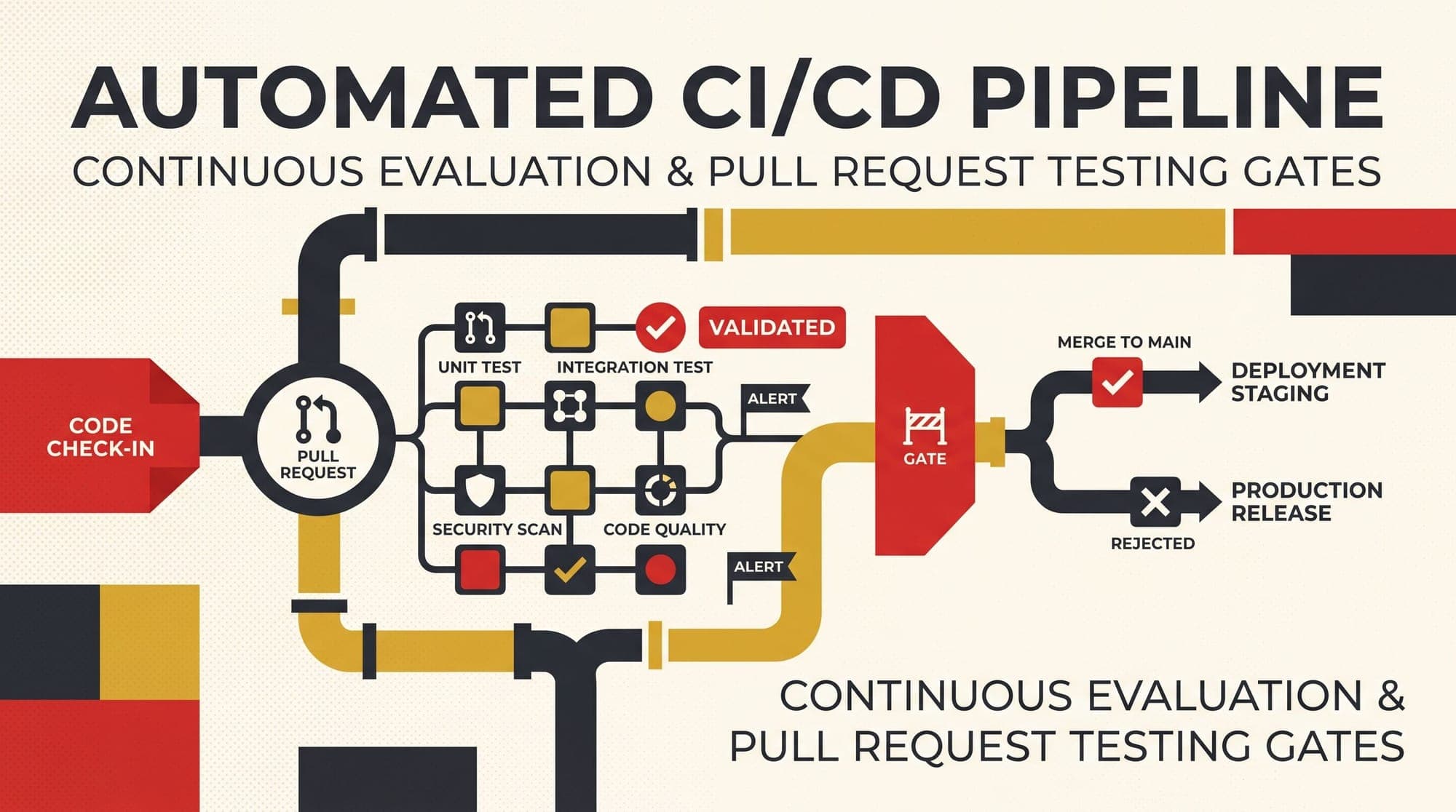
Deploying generative AI applications into production environments requires a fundamental shift in software quality assurance. Traditional continuous integration (CI) workflows rely on deterministic assertions: given a fixed input, a function must return an exact expected output. Large language models (LLMs) break this paradigm because their outputs vary across runs, token probabilities drift with prompt alterations, and natural language responses cannot be validated with binary equality checks.
Without automated evaluation in the development lifecycle, minor modifications to system prompts, context retrieval strategies, or model parameters frequently cause silent regressions across unmonitored edge cases. Implementing automated evaluation within continuous integration and continuous deployment (CI/CD) pipelines establishes reproducible quality gates that prevent defective prompt iterations, security vulnerabilities, and cost inflation from reaching production systems.
The Three-Tier Assertion Hierarchy
Automating regression testing in CI pipelines requires balancing execution speed, infrastructure cost, and evaluation precision. A single evaluation mechanism is insufficient; production teams implement a three-tier assertion hierarchy ranging from instantaneous deterministic validations to comprehensive model-graded judgments.

Tier 1: Deterministic Syntax and Budget Constraints
Tier 1 assertions execute locally without calling external language models, completing in less than 10 milliseconds per test case. These checks validate structural integrity and operational boundaries:
- JSON Schema Validation: Ensures structured outputs parse correctly against predefined Pydantic models or JSON schemas.
- Regex and Substring Matching: Confirms that mandatory entities, reference citations, or disclaimer notices appear in generated outputs while forbidden terms or leaked delimiters are excluded.
- Token and Latency Caps: Rejects completions exceeding allocated token lengths or response time thresholds, protecting downstream applications from memory exhaustion and latency spikes.
Tier 2: Heuristic and Embedding Semantic Metrics
When testing open-ended generative responses, exact keyword matching produces false negatives. Tier 2 metrics compute statistical and geometric similarity against reference text using localized computational packages:
- Token Overlap Metrics: Algorithms such as ROUGE-L and BLEU score n-gram overlap between generated responses and reference targets, measuring lexical fidelity in extraction tasks.
- Embedding Cosine Similarity: Small bi-encoder embedding models transform model outputs and reference answers into dense vectors to calculate cosine similarity. A similarity score dropping below a calibrated threshold (e.g. 0.82) flags semantic drift.
- Levenshtein Distance and Edit Ratios: Measure string mutation distance to detect unintentional formatting drift in code generation and structured text pipelines.
Tier 3: Model-Graded Assertions and Rubric Scoring
For subjective quality criteria such as factual faithfulness, conversational tone, and context grounding, pipelines leverage secondary LLMs as evaluators (LLM-as-a-judge):
- Faithfulness and Hallucination Scoring: Evaluates whether statements made in the output are strictly supported by the retrieved context snippets in retrieval-augmented generation (RAG) architectures.
- G-Eval Frameworks: Deploys chain-of-thought prompt templates to score responses on multi-point numerical scales across explicit rubrics (coherence, relevance, conciseness).
- Pairwise Preference Testing: Submits both baseline outputs and candidate outputs to a judge model to compute win-rate and tie-rate deltas without relying on fixed reference texts.
Golden Dataset Curation and Maintenance
Automated evaluations are only as reliable as the benchmark datasets driving them. A golden dataset consists of curated input prompts paired with expected contexts, reference completions, and assertion criteria.
Dataset Stratification
A robust evaluation suite divides test cases into stratified tiers:
- Core Functionality (70%): Standard user queries representing normal operational traffic and primary business workflows.
- Edge Cases and Ambiguity (20%): Complex queries, multi-hop reasoning tasks, incomplete prompts, and dialectical phrasing designed to test model robustness.
- Adversarial Red-Teaming (10%): Prompt injection payloads, jailbreak attempts, system prompt extraction vectors, and sensitive data requests to ensure guardrail enforcement.
Versioning and Immutability
Golden datasets must be versioned alongside codebase modifications. Storing datasets in Git LFS, Hugging Face Datasets, or data versioning tools ensures that pull requests are evaluated against fixed, reproducible benchmarks rather than moving targets. When product requirements change, dataset updates must be submitted and reviewed as dedicated commits.
Differential Regression Testing
Evaluating absolute scores in isolation often conceals regressions; a model configuration that improves overall accuracy by 2% might simultaneously break 15% of previously working critical edge cases. Differential regression testing compares candidate pull requests directly against the baseline commit of the target branch.
# scripts/eval_differential.py
import json
import sys

def evaluate_diff(baseline_path: str, candidate_path: str, max_regression_pct: float = 2.0):
    with open(baseline_path, "r") as f:
        base_runs = json.load(f)
    with open(candidate_path, "r") as f:
        cand_runs = json.load(f)

    regressions = []
    improvements = []
    ties = []

    for item_id, base_data in base_runs.items():
        if item_id not in cand_runs:
            continue
        cand_data = cand_runs[item_id]

        base_score = base_data["score"]
        cand_score = cand_data["score"]
        score_delta = cand_score - base_score

        if score_delta < -0.05:
            regressions.append({"id": item_id, "delta": score_delta, "base": base_score, "cand": cand_score})
        elif score_delta > 0.05:
            improvements.append({"id": item_id, "delta": score_delta, "base": base_score, "cand": cand_score})
        else:
            ties.append(item_id)

    total_cases = len(base_runs)
    regression_rate = (len(regressions) / total_cases) * 100

    print(f"Evaluated {total_cases} cases: {len(improvements)} improved, {len(ties)} tied, {len(regressions)} regressed.")
    print(f"Regression Rate: {regression_rate:.2f}% (Threshold: {max_regression_pct}%)")

    if regression_rate > max_regression_pct:
        print("ERROR: Regression threshold exceeded. Blocking merge.", file=sys.stderr)
        sys.exit(1)

if __name__ == "__main__":
    evaluate_diff("eval/baseline_results.json", "eval/candidate_results.json")
Differential analysis identifies negative semantic flips where previously passed tests fail under new prompt formulations, providing granular visibility into behavioral regressions.
Pipeline Economics and Flakiness Mitigation
Executing full evaluation suites across hundreds of test cases on every code push introduces prohibitive latency and API expenses. Production teams employ optimization techniques to maintain fast feedback loops:
Temperature and Seed Standardization
LLM non-determinism introduces flaky test runs where assertions pass or fail randomly across identical commits. Setting the inference temperature=0 and defining a fixed random seed removes sampling variability for factual regression suites. When testing creative or non-deterministic capabilities, pipelines run test items 3 to 5 times and apply majority voting over assertion outcomes.
Tiered Pipeline Triggers
CI configurations restrict execution scope based on workflow events:
- Pre-Commit and Quick PR Gates: Executes Tier 1 syntax assertions and a sampled subset of 25 to 50 critical golden cases on every commit touching prompt templates or model configurations.
- Full Pull Request Review: Runs the full 500-item golden dataset across Tier 2 and Tier 3 assertions before permitting merges into staging branches.
- Nightly Comprehensive Benchmarks: Executes multi-thousand item evaluation suites, stress testing, and adversarial red-teaming scans during off-peak hours.
Response Caching
Evaluating prompt changes often leaves non-prompt code identical. Caching prompt completions and embedding lookups against hashed input configurations eliminates redundant API calls when re-running test pipelines after minor non-functional code changes.
Implementing GitHub Actions Quality Gates
Integrating evaluation frameworks such as Promptfoo, DeepEval, or custom pytest harnesses into CI/CD workflows automates test execution and posts actionable summaries directly into developer pull requests.
name: LLM Regression Evaluation Gate

on:
  pull_request:
    paths:
      - 'prompts/**'
      - 'config/models.yaml'
      - 'src/retrieval/**'
      - 'eval/**'

jobs:
  run-evals:
    runs-on: ubuntu-latest
    steps:
      - name: Checkout Repository
        uses: actions/checkout@v4
        with:
          fetch-depth: 0

      - name: Set up Python
        uses: actions/setup-python@v5
        with:
          python-version: '3.11'
          cache: 'pip'

      - name: Install Dependencies
        run: |
          python -m pip install --upgrade pip
          pip install -r eval/requirements.txt

      - name: Run Baseline Evaluation
        env:
          OPENAI_API_KEY: ${{ secrets.OPENAI_API_KEY }}
        run: |
          git checkout ${{ github.base_ref }}
          python eval/run_suite.py --dataset eval/golden_dataset.jsonl --output eval/baseline.json

      - name: Run Candidate Evaluation
        env:
          OPENAI_API_KEY: ${{ secrets.OPENAI_API_KEY }}
        run: |
          git checkout ${{ github.head_ref }}
          python eval/run_suite.py --dataset eval/golden_dataset.jsonl --output eval/candidate.json

      - name: Evaluate Differential Gate
        id: eval_gate
        run: |
          python eval/compare_results.py \
            --baseline eval/baseline.json \
            --candidate eval/candidate.json \
            --max-regression-pct 2.0 \
            --markdown-out eval/summary.md

      - name: Post PR Evaluation Summary
        if: always()
        uses: actions/github-script@v7
        with:
          github-token: ${{ secrets.GITHUB_TOKEN }}
          script: |
            const fs = require('fs');
            if (fs.existsSync('eval/summary.md')) {
              const body = fs.readFileSync('eval/summary.md', 'utf8');
              github.rest.issues.createComment({
                issue_number: context.issue.number,
                owner: context.repo.owner,
                repo: context.repo.repo,
                body: body
              });
            }
When an engineer modifies a prompt or changes retrieval parameters, this workflow computes the baseline against the target branch, evaluates the candidate modifications, calculates score variances, comments the granular breakdown on the pull request, and exits with a non-zero status code if regression thresholds are violated.
Sources
- Evidently AI: CI/CD for LLM Applications and GitHub Actions
- Promptfoo: CI/CD Integration for LLM Evaluation and Security
- Langfuse: Golden Dataset Evaluation for LLM Regression Testing
- Arize AI: CI/CD for LLM Applications: Experiments, Regression Tests, and Release Gates
- Galtea: Automated LLM Evaluation: Building a CI/CD Quality Gate