Deploying autonomous AI agents that generate and execute code introduces a critical infrastructure challenge: executing untrusted, model-generated shell commands, Python scripts, and system binaries without compromising the host infrastructure or leaking multi-tenant data.
As agentic systems move from single-turn code generation to multi-turn iterative problem solving (such as SWE-bench workflows, automated debugging, and repository refactoring), sandbox requirements have evolved. Sandboxes must provide strict security boundaries against malicious code, deliver sub-150 millisecond cold starts, maintain stateful file trees across multi-step execution loops, and remain cost-efficient under high concurrency.
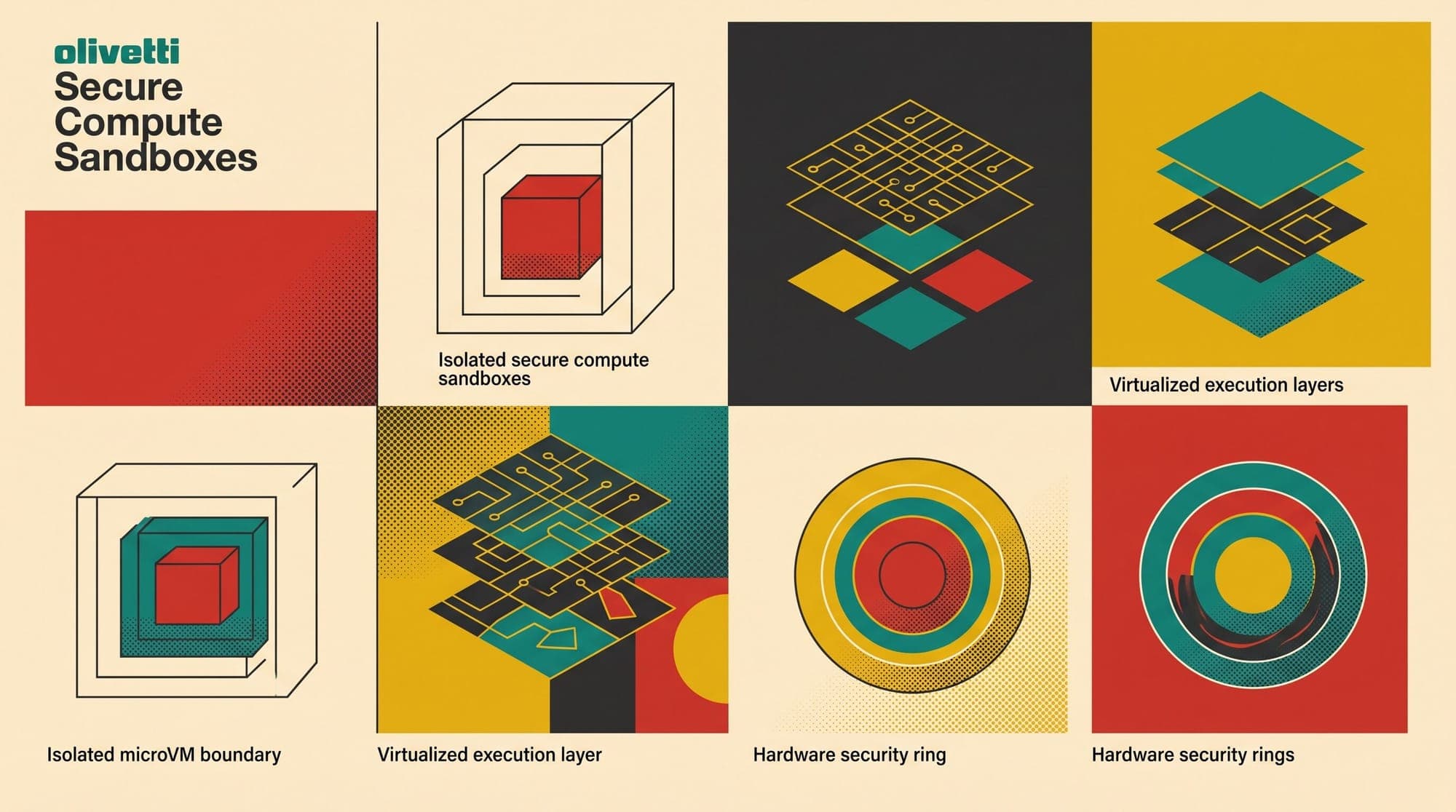
Four primary runtime isolation technologies dominate production agent infrastructure: standard OCI/Docker containers with security profiles, user-space kernel syscall interception (gVisor), hardware-virtualized microVMs (Firecracker), and capability-based bytecode engines (WebAssembly). Each represents distinct trade-offs across security boundaries, execution overhead, ecosystem compatibility, and state snapshotting.

The Execution Threat Model for Autonomous AI Agents
When an LLM agent generates arbitrary Python code or Bash commands, the runtime faces four distinct classes of security and operational threats:
- Host Kernel Privilege Escalation and Container Escapes: Standard Linux containers share the host operating system kernel. Vulnerabilities in kernel subsystems or container runtimes (such as runc CVE-2024-21626, which allowed file-descriptor leaks to overwrite host binaries) enable untrusted code to break out of namespace boundaries and gain root access on the host node.
- Resource Exhaustion and Denial of Service: Recursive fork loops, unconstrained memory allocation, or unbounded disk writes can destabilize the host daemon or degrade neighboring tenant workloads if cgroups v2 limits are misconfigured.
- Network Exfiltration and Cloud Metadata Probing: Autonomous agents given internet access can inadvertently or maliciously query internal VPC endpoints, probe cloud metadata services (such as AWS IMDS at
169.254.169.254), or exfiltrate sensitive environment variables to external endpoints. - State Persistence Across Multi-Turn Iterations: AI coding agents do not execute in isolation. An agent typically inspects a codebase, installs dependencies (
pip install,npm install), writes test cases, executes tests, and refactors files across 5 to 30 sequential turns. Re-initializing a blank environment on every step introduces latency and destroys intermediate filesystem state.
+----------------------------------------------------------------------------------------------------+
|                                     CONTAINMENT COMPARISON                                         |
+-----------------------------------+-----------------------------------+----------------------------+
| Technology                        | Isolation Boundary                | Kernel Layer               |
+-----------------------------------+-----------------------------------+----------------------------+
| Docker (runc)                     | Linux Namespaces + cgroups v2     | Shared Host Linux Kernel   |
| gVisor (runsc)                    | Sentry (Go user-space kernel)     | Virtualized Syscall Layer  |
| Firecracker (KVM)                 | Hardware Virtualization (microVM) | Dedicated Guest Linux OS   |
| WebAssembly (Wasmtime/WASI)       | Memory-safe Bytecode Sandbox      | Host Capability Interface  |
+-----------------------------------+-----------------------------------+----------------------------+
Architectural Comparison of Sandbox Isolation Technologies
1. Docker and OCI Containers (runc / containerd)
Standard containers rely on Linux kernel primitives: namespaces (pid, mount, net, ipc, uts, user) to isolate process visibility, and cgroups (control groups) to constrain CPU, memory, and I/O resources.
- Security Boundary: Shared host kernel. While
seccomp-bpffilters can block dangerous syscalls andAppArmororSELinuxrestrict file paths, the attack surface remains broad. Any unpatched kernel zero-day or local privilege escalation vulnerability in the shared Linux kernel exposes the entire physical node. - Cold Start and Overhead: 200ms to 500ms startup times when pulling local images. Near-zero CPU and memory virtualization overhead.
- Verdict for Untrusted Agent Execution: Inadequate as a standalone multi-tenant boundary for untrusted LLM-generated code.
2. gVisor (runsc)
Developed by Google, gVisor implements a user-space application kernel called Sentry that intercepts and handles application system calls, isolating the workload from the host kernel.
- Architecture: The Sentry implements over 300 Linux syscalls in memory-safe Go. When an application issues a syscall, Sentry processes it directly in user space rather than passing it to the host kernel. File system access is mediated by a separate isolated process called Gofer over an internal 9P/LXP transport protocol.
- Virtualization Backend: Runs using either
ptrace(intercepting syscalls via debugging hooks) or the KVM virtualization driver (kvmplatform) for lower overhead. - GPU Compatibility: Through gVisor nvproxy, gVisor parses and validates NVIDIA driver ioctl syscalls, enabling GPU passthrough for AI workloads with user-space filtering.
- Performance Profile: Startup time ranges from 10ms to 50ms. However, syscall-intensive and I/O-heavy workloads (such as unpacking thousands of tiny files during
npm installor running high-frequency compiler cycles) experience a 10% to 30% performance penalty due to user-space context switches.
3. Firecracker MicroVMs
Developed by Amazon Web Services for AWS Lambda and Fargate, and open-sourced under Apache 2.0, Firecracker is a minimalist Virtual Machine Monitor (VMM) written in Rust that runs on the Linux Kernel-based Virtual Machine (KVM).
- Architecture: Unlike heavyweight hypervisors like QEMU (which contains millions of lines of C code and emulates legacy PCI buses, IDE controllers, and ACPI tables), Firecracker contains approximately 50,000 lines of Rust. It strips all non-essential virtual devices, providing only four minimal paravirtualized devices:
virtio-net,virtio-block,virtio-vsock, and a minimal serial console. - Security Boundary: Full hardware-enforced virtualization (Intel VT-x / AMD-V). Each agent session executes inside an independent Linux kernel. A security compromise inside the guest cannot escape to the host without breaking both the guest kernel and KVM hypervisor boundaries.
- Resource Footprint: Base VMM memory footprint is under 5 MiB per microVM. Cold boot time to guest
/sbin/initis 125 milliseconds or less. - Snapshot and Restore: Firecracker supports saving a running microVM state (vCPU registers, device state, and dirty memory pages) to disk and resuming execution in 5ms to 30ms. Platforms like E2B leverage this mechanism to create pre-warmed, pre-configured execution environments for agent tasks.
4. WebAssembly Runtimes (Wasmtime / WASI)
WebAssembly (Wasm) provides a memory-safe, stack-based bytecode execution environment governed by the WebAssembly System Interface (WASI).
- Security Boundary: Sandboxed linear memory space with a capability-based security model. A Wasm module has zero access to host memory, files, sockets, or system calls unless explicitly granted by the host runtime (such as Wasmtime).
- Performance Profile: Near-instantaneous instantiation (sub-5 milliseconds) with minimal memory overhead (under 10 MiB per runtime instance).
- Limitations for General Coding Agents: Wasm requires programs to be compiled specifically to the
wasm32-wasitarget. While Python interpreters can run inside Wasm via Pyodide or CPython-WASI, they cannot natively execute arbitrary pre-compiled Linux C-extensions, fork child processes, or run standard Bash shell scripts and package managers.
Performance and Isolation Metrics
+----------------------------------------------------------------------------------------------------+
| BENCHMARK METRIC        | DOCKER (RUNC)       | GVISOR (RUNSC)      | FIRECRACKER       | WASMTIME |
+-------------------------+---------------------+---------------------+-------------------+----------+
| Isolation Boundary      | Namespaces/cgroups  | User-space Syscalls | Hardware KVM      | Bytecode |
| Guest OS Kernel         | Shared Host Kernel  | Emulated (Sentry)   | Dedicated Kernel  | None     |
| Cold Boot Latency       | 200ms - 500ms       | 10ms - 50ms         | 50ms - 125ms      | < 5ms    |
| Snapshot Resume Latency | N/A (Full container)| 50ms - 100ms        | 5ms - 30ms        | < 1ms    |
| Base Memory Overhead    | ~15 - 30 MiB        | ~25 - 40 MiB        | < 5 MiB (VMM)     | < 10 MiB |
| Syscall / I/O Overhead  | < 1% (Native)       | 10% - 30%           | < 3% (virtio)     | Near-0   |
| Arbitrary Linux Binaries| Full Support        | Full (~300 syscalls)| Full Native       | No (WASI)|
| Multi-Tenant Security   | Weak                | High                | Maximum           | Maximum  |
| GPU Acceleration        | Native              | Yes (nvproxy)       | PCIe Passthrough  | Limited  |
+----------------------------------------------------------------------------------------------------+
Multi-Turn Agent Statefulness and Snapshotting Architecture
In practical agent workflows, managing state across multiple tool-calling turns is an engineering bottleneck. If an agent executes sequential commands to inspect a repository, install dependencies, and run test suites, three state management strategies exist:
- Stateless Execution (Ephemeral Container per Turn): Re-initializing an isolated sandbox on every tool invocation. Discarding state between turns forces the agent to re-clone codebases and re-install packages on every step, compounding latency.
- Long-Lived Connected Daemon (Persistent Session): Keeping a single sandbox running over a persistent WebSocket or gRPC connection for the duration of the multi-turn session. While this preserves state, idle sessions consume CPU and memory continuously.
- MicroVM Snapshot and Copy-on-Write Forking: Production sandboxes take advantage of Copy-on-Write (CoW) memory snapshots to combine instantaneous turn execution with state persistence.
+-------------------------------------------------------------------------------+
| FIRECRACKER COPY-ON-WRITE MEMORY FORKING                                      |
|                                                                               |
|   +-----------------------------------------------------------------------+   |
|   | Golden Base Image (Linux Kernel + Python 3.12 + Standard Agent Tools) |   |
|   | Base Memory Snapshot (Read-Only Template mmap)                        |   |
|   +-----------------------------------+-----------------------------------+   |
|                                       |                                       |
|                  +--------------------+--------------------+                  |
|                  | (Private CoW Memory Fork)               | (Private CoW Fork)|
|                  v                                         v                  |
|   +-------------------------------+         +-----------------------------+   |
|   | Agent Session A (Tenant 1)    |         | Agent Session B (Tenant 2)  |   |
|   | - Turn 1: Write app.py        |         | - Turn 1: pip install pytest|   |
|   | - Private Dirty Pages Only    |         | - Private Dirty Pages Only  |   |
|   +-------------------------------+         +-----------------------------+   |
+-------------------------------------------------------------------------------+
Copy-on-Write Memory Mechanics
To achieve sub-30ms response times without keeping thousands of idle VMs loaded in memory, production agent execution engines employ Copy-on-Write (CoW) memory snapshotting:
- Golden Image Creation: A base Linux microVM boots, pre-installs common runtimes (Python 3.12, Node.js, git, compilers), and initializes a background agent runner daemon.
- Memory Dump: Firecracker pauses guest vCPUs and dumps the guest physical memory to a read-only memory file alongside a device state JSON descriptor.
- Instantaneous Forking: When an incoming agent execution session begins, the host maps the base memory file using
mmap()withMAP_PRIVATE. Multiple tenant VMs share the exact same read-only physical memory pages. - Isolated Writes: As the agent writes files or allocates variables, Linux kernel page tables mark dirty pages and allocate private memory blocks exclusively for that tenant instance.
- Session Destruction: Once the multi-turn session completes or times out, unmapping the memory instantly frees resources with zero garbage collection overhead.
Production Security Topology: Network Isolation and Egress Controls
Isolating CPU and memory is only half of the sandbox requirement; untrusted code execution requires strict network perimeter controls.
+-------------------------------------------------------------------------------+
| HOST NODE                                                                     |
|                                                                               |
|   +--------------------------+         +----------------------------------+   |
|   | Agent microVM (Tenant A) |         | Agent microVM (Tenant B)         |   |
|   | IP: 172.16.0.2           |         | IP: 172.16.1.2                   |   |
|   +-------------+------------+         +----------------+-----------------+   |
|                 | (tap0)                                | (tap1)              |
|                 v                                       v                     |
|   +-------------+---------------------------------------+-----------------+   |
|   | eBPF / iptables Traffic Filter                                        |   |
|   |   - DROP dst 169.254.169.254 (Cloud IMDS / Metadata)                  |   |
|   |   - DROP dst 10.0.0.0/8, 172.16.0.0/12, 192.168.0.0/16 (Internal VPC) |   |
|   |   - RATE-LIMIT outbound TCP connections to port 80/443                |   |
|   +-------------------------------------+---------------------------------+   |
|                                         |                                     |
+-----------------------------------------|-------------------------------------+
                                          v
External Internet Gateway- Dedicated TAP Interfaces: Each Firecracker microVM attaches to a unique host TAP virtual network interface.
- Metadata Service Blocking: An explicit iptables/eBPF rule drops all traffic destined for link-local addresses (
169.254.0.0/16), preventing agents from reading IAM instance credentials or cluster topology data. - VPC Isolation: Traffic destined for private RFC 1918 subnets (
10.0.0.0/8,172.16.0.0/12,192.168.0.0/16) is rejected, ensuring the agent cannot scan internal databases or orchestrator control planes. - DNS Filtering: Agent DNS requests route through a logging DNS proxy that enforces domain blocklists and rate-limits domain resolution to prevent DNS tunneling exfiltration.
Engineering Decision Guide: Choosing the Right Sandbox
- Choose Firecracker MicroVMs when:
- Executing arbitrary, multi-tenant, untrusted Bash or Python scripts.
- Building multi-turn coding agents that require full Linux compatibility (
apt,pip, background daemons). - Requiring sub-30ms fast-resume through memory snapshotting.
- Examples: SWE-bench test evaluation runners, general AI software engineering agents (e.g. E2B).
- Choose gVisor (
runsc) when:
- Running inside existing Kubernetes clusters where managing raw KVM device nodes (
/dev/kvm) is operationally complex. - Needing filtered GPU acceleration for sandboxed inference or model fine-tuning via
nvproxy. - Examples: Serverless batch compute platforms (e.g. Modal Sandboxes).
- Choose WebAssembly (Wasmtime / WASI) when:
- Executing deterministic, stateless data transformations, parsing routines, or structured tool plugins.
- Needing ultra-low latency (<5ms) and high tenant density without running a complete Linux operating system.
- Code can be constrained to pre-compiled modules without native OS dependencies.
- Avoid Plain Docker / OCI Containers when:
- Code generated by LLMs comes from unverified users or public internet queries. Container boundaries alone are insufficient to guarantee multi-tenant security on shared physical infrastructure.
Sources
- Firecracker: Lightweight Virtualization for Serverless Applications (USENIX NSDI 2020)
- gVisor Architecture and Security Guide (Google)
- gVisor GPU Passthrough with nvproxy Documentation
- National Vulnerability Database: runc File Descriptor Leak (CVE-2024-21626)
- WebAssembly System Interface (WASI) Specification
- E2B Agent Sandbox Architecture and Snapshot Management
- Modal Sandboxes Isolation and Execution Model