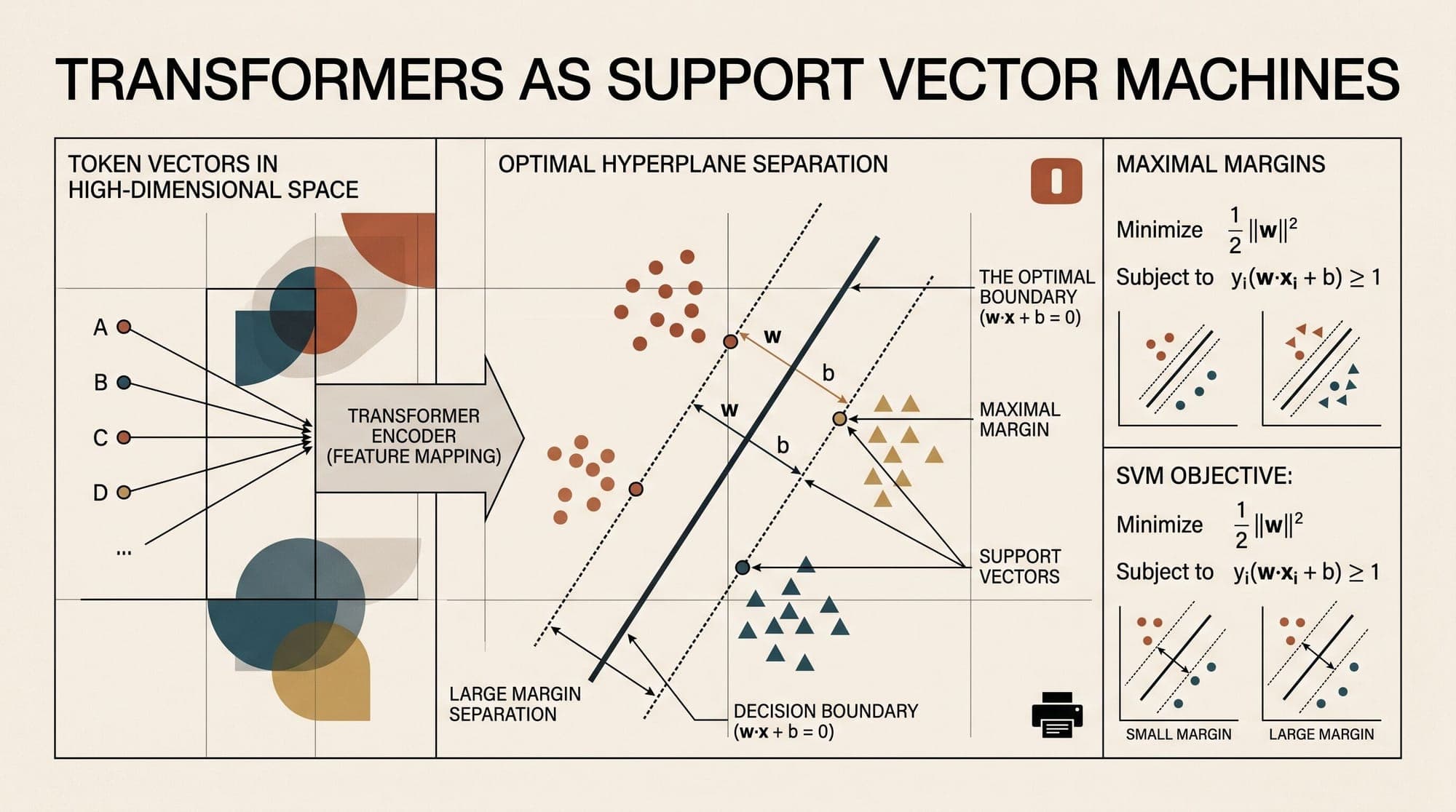
Understanding why overparameterized deep neural networks generalize well despite possessing sufficient capacity to memorize training data remains a fundamental question in theoretical machine learning. In classical linear models trained on separable data under exponential-tailed losses (such as logistic or cross-entropy loss), gradient descent exhibits an implicit bias: parameter iterates diverge in norm while their directions asymptotically converge to the maximum-margin hyperplane, known as the hard-margin Support Vector Machine (Soudry et al., 2018; Rosset et al., 2003).
In transformer architectures (Vaswani et al., 2017), the self-attention mechanism computes pairwise token interactions through scaled dot products normalized by a row-wise softmax operator. Because softmax computes normalized exponentials over token inner products, its mathematical structure directly mirrors the exponential weighting of logistic loss.
Recent foundational theoretical work by Tarzanagh et al. (2023) and Ali et al. (2024) formalizes this connection: when self-attention and cross-attention layers are trained via gradient descent, the optimization dynamics converge directionally to an exact hard-margin Support Vector Machine (Att-SVM). This optimization framework proves that self-attention acts as a margin-maximizing token separator, explains why trained attention maps converge to sparse, spiky selections, and reveals the mathematical difference between unconstrained matrix parameterizations and standard low-rank key-query factorizations.

1. Formalizing the Attention Optimization Problem
Consider an input sequence X in R^(T x d) comprising T tokens of embedding dimension d, and a query anchor token z in R^d. In standard self-attention, z corresponds to an input token (such as the first token x_1 or a classification token x_CLS), whereas in cross-attention, z originates from a separate sequence.
The core attention operation transforms query-key interactions into output representations through trainable key and query projection matrices K, Q in R^(d x m) and a value projection matrix V in R^(d x v):
f(X, z) = h( X^T * S( X * K * Q^T * z ) )where:
- S(.) denotes the row-wise softmax operator: S(u)_t = exp(u_t) / sum_tau exp(u_tau).
- h(.) represents the downstream prediction head that subsumes the value weights V.
- The combined bilinear key-query interaction is governed by the composite parameter matrix **W := K * Q^T** in R^(d x d).
Given a training dataset of n labeled sequences {(Y_i, X_i, z_i)}_{i=1}^n with binary labels Y_i in {-1, +1}, empirical risk minimization (ERM) over a strictly decreasing, Lipschitz-continuous loss function l(.) (such as logistic loss l(u) = log(1 + exp(-u)) or exponential loss l(u) = exp(-u)) is formulated under two distinct parameterizations:
- Direct Matrix Parameterization (W-ERM):
L(W) = (1/n) * sum_{i=1}^n l( Y_i * h( X_i^T * S( X_i * W * z_i ) ) )
- Factored Key-Query Parameterization (KQ-ERM):
L(K, Q) = (1/n) * sum_{i=1}^n l( Y_i * h( X_i^T * S( X_i * K * Q^T * z_i ) ) )
For a fixed linear prediction head h(x) = v^T * x with weights v in R^d, the output of the attention layer is a convex combination of input token representations:
v^T * X_i^T * S( X_i * W * z_i ) = sum_{t=1}^T s_{it} * (v^T * x_{it})where s_{it} = exp(x_{it}^T * W * z_i) / sum_{tau=1}^T exp(x_{i,tau}^T * W * z_i).
Because the attention output is bounded within the convex hull of the individual token representations {x_{it}}_{t=1}^T, minimizing a decreasing loss function requires the model to route maximal probability mass toward the token that maximizes downstream classification alignment.
2. Token Scores, Optimality, and the Attention SVM
To analyze which tokens the attention layer selects, Tarzanagh et al. (2023) define the concepts of token scores and token optimality:
Definition: Token Score and Optimal Tokens
Given a linear prediction head v in R^d and label Y_i in {-1, +1}, the token score gamma_{it} of token x_{it} in sequence X_i is defined as:
gamma_{it} = Y_i * (v^T * x_{it})The optimal token index opt_i for sequence X_i is the token achieving the highest classification margin:
opt_i = argmax_{t in [T]} gamma_{it}If token scores across non-optimal tokens are strictly lower than the optimal token (gamma_{it} < gamma_{i,opt_i} for all t != opt_i), the global minimum of the empirical risk can only be reached if the softmax probability distribution saturates to a one-hot indicator vector:
s_{i,opt_i} -> 1 and s_{it} -> 0 (for all t != opt_i)For the softmax distribution to converge to a one-hot delta distribution, the pre-softmax logit differences must diverge to infinity:
x_{i,opt_i}^T * W * z_i - x_{it}^T * W * z_i -> +infinity (for all t != opt_i)Normalizing this condition leads directly to the linear separation constraints of a hard-margin Support Vector Machine.
       Token Feature Space (Sequence X_i)
  -------------------------------------------------------------
       o  Non-optimal token (x_it)
       o  Non-optimal token (x_it')
                \
                 \   Separating Hyperplane: (x_opt - x_t)^T * W * z_i = 1
                  \  ================================================ Margin
                   \
                    *  OPTIMAL TOKEN (x_i,opt) -> Selected by Softmax
  -------------------------------------------------------------
The Attention SVM Formulation (Att-SVM)
For direct W-parameterization, the directional limit of margin maximization is formalized as the following convex quadratic program:
W_mm = argmin_{W in R^(d x d)} ||W||_F
subject to: (x_{i,opt_i} - x_{it})^T * W * z_i >= 1,  for all t != opt_i, i in [n]
where:
- ||W||_F = sqrt(trace(W^T * W)) is the Frobenius norm.
- **(x_{i,opt_i} - x_{it}) * z_i^T** acts as the rank-1 feature matrix for each pairwise token constraint.
- Constraints enforce that the optimal token logit exceeds all competing token logits by a normalized geometric margin of at least 1.
3. Frobenius vs. Nuclear Norm: The Low-Rank Bias of Key-Query Factorization
One of the most consequential findings in transformer optimization theory is that the mathematical form of the implicit regularizer depends directly on whether attention is parameterized as a monolithic matrix W or as factored key-query matrices K * Q^T.
Theorem: Implicit Regularization of Parameterizations (Tarzanagh et al., 2023)
Let the regularization path be defined under norm bound R > 0 as:
- W_bar_R = argmin_{||W||_F <= R} L(W)
- (K_bar_R, Q_bar_R) = argmin_{||K||_F^2 + ||Q||_F^2 <= 2R} L(K, Q)
As R -> infinity, the regularization paths exhibit distinct asymptotic limits:
- W-Parameterization exhibits Frobenius Norm Bias:
`` lim_{R -> inf} (W_bar_R / R) = W_mm / ||W_mm||_F `` The parameter direction converges to the minimum Frobenius norm solution of Att-SVM.
- (K, Q)-Parameterization exhibits Nuclear Norm Bias:
The composite matrix (K_bar_R * Q_bar_R^T) / R converges in direction to the solution set of the Nuclear-Norm Attention SVM (Att-SVM_star): `` W__mm in argmin_{rank(W) <= m} ||W||_ subject to: (x_{i,opt_i} - x_{it})^T * W * z_i >= 1, for all t != opt_i, i in [n] `` where ||W||_* = sum_{j=1}^d sigma_j(W) is the nuclear norm (sum of singular values).
Why Factorization Induces Low-Rank Attention
The nuclear norm is the convex envelope of matrix rank on the unit spectral ball (Fazel, 2002; Recht et al., 2010). The variational identity:
||W||_* = min_{K, Q: W = K * Q^T} (1/2) * ( ||K||_F^2 + ||Q||_F^2 )proves that optimizing separate Key and Query projection matrices with L2 weight decay or gradient descent does not merely bound parameter magnitude: it acts as a spectral sparsity regularizer.
Standard transformer attention architectures parameterized with (K, Q) have an inherent structural bias toward low-rank bilinear transformations, concentrating variance into a small number of dominant singular vectors while pruning redundant attention channels.
Structural Comparison of Parameterizations
- Monolithic Parameterization (W):
- Optimization Variable: W in R^(d x d)
- Implicit Regularizer: Frobenius Norm ||W||_F
- Singular Value Spectrum: Isotropic / Dense singular values
- Optimization Landscape: Convex in W for linear constraints
- Asymptotic Convergence: Unique global W_mm
- Factored Parameterization (K, Q):
- Optimization Variable: K, Q in R^(d x m)
- Implicit Regularizer: Nuclear Norm ||W||_* (Trace Norm)
- Singular Value Spectrum: Sparse singular values (Low-Rank)
- Optimization Landscape: Non-convex bilinear factorization
- Asymptotic Convergence: KKT points / Global W_*_mm
4. Overparameterization and Landscape Geometry
In classical optimization, non-convex objectives with bilinear terms can suffer from spurious local minima and saddle points. In transformer attention, however, overparameterization changes the geometry of the loss surface.
1. SVM Feasibility and Dimension Thresholds
For the hard-margin Att-SVM to admit a valid solution, there must exist a matrix W capable of simultaneously satisfying the (T-1)n linear separation constraints.
Tarzanagh et al. (2023) prove that if the token embedding dimension satisfies:
d >= max(T - 1, n)then for almost all generic token configurations {(X_i, z_i)}_{i=1}^n, the hard-margin Att-SVM is strictly feasible. In modern LLM architectures where embedding dimensions range from d = 2,048 to d = 12,288, this feasibility condition is easily met across standard sequence lengths and local micro-batches.
2. Elimination of Stationary Points
When token embeddings are sufficiently overparameterized, a phenomenon occurs analogous to overparameterized linear SVMs (Hsu et al., 2021; Montanari et al., 2021): all non-optimal tokens become active support vectors on the margin:
(x_{i,opt_i} - x_{it})^T * W_mm * z_i = 1, for all t != opt_i, i in [n]Under this support-vector condition:
- No Finite Stationary Points: There is no finite parameter matrix W where the gradient vanishes (grad L(W) != 0 for all ||W||_F < inf).
- Norm Divergence: For any step size eta <= 1 / L_W, gradient descent iterates diverge in norm: lim_{k -> inf} ||W(k)||_F = inf.
- Directional Convergence: The normalized iterate sequence W(k) / ||W(k)||_F converges directly to the max-margin direction W_mm / ||W_mm||_F.
Overparameterization acts as an optimization catalyst: by expanding the dimensional degrees of freedom, it eliminates spurious local traps and aligns gradient descent trajectories directly with the max-margin token-separating hyperplane.
5. Non-Linear Prediction Heads and Multi-Token Composition
While a linear prediction head h(x) = v^T * x forces the attention layer to collapse toward a single optimal token per sequence (rank-1 hard attention), real-world transformer layers are followed by non-linear Multi-Layer Perceptrons (MLPs) and feedforward blocks with activation functions such as GeLU or SwiGLU.
When the prediction head h(.) is non-linear, downstream classification often requires composing multiple tokens simultaneously (such as combining a subject token with a verb modifier).
  +-------------------------------------------------------------------------+
  |                   GENERALIZED SVM EQUIVALENCE                           |
  |                                                                         |
  |   Attention Weight Matrix W = W_dir (Directional) + W_fin (Finite)      |
  |                                                                         |
  |   1. Directional Component (W_dir / ||W|| -> W_SVMeq):                  |
  |      Acts as a hard SVM gate that assigns 0 probability to irrelevant   |
  |      background tokens (non-support tokens).                            |
  |                                                                         |
  |   2. Finite Component (W_fin):                                          |
  |      Modulates the precise softmax weighting between the remaining      |
  |      active support tokens to satisfy non-linear MLP requirements.      |
  +-------------------------------------------------------------------------+
Under non-linear heads, the attention weight matrix W decomposes into two distinct functional regimes:
- The Directional Component (W_SVMeq): A max-margin direction that acts as a support-vector filter, driving the softmax probabilities of irrelevant distractor tokens to zero (s_{it} -> 0).
- The Finite Modulating Component: A bounded sub-matrix that coordinates the exact non-zero probability ratios among the subset of retained active tokens.
Numerical experiments across multi-layer networks confirm that even with non-linear MLP heads, the directional component of gradient descent maintains a correlation of over 0.99 with the generalized SVM-equivalent solution.
6. Implications for Mechanistic Interpretability and Systems Serving
The equivalence between self-attention optimization and Support Vector Machines provides theoretical grounding for several empirical phenomena in LLM research:
1. The Emergence of Attention Sinks and Token Sparsity
Mechanistic interpretability studies frequently observe that attention distributions in deep transformers become extremely sparse, with individual attention heads allocating over 95% of their probability mass to 1 to 3 tokens (Voita et al., 2019; Xiao et al., 2023). The Att-SVM framework proves that this sparsity is not an arbitrary training artifact, but the mathematical consequence of margin maximization under exponential-tailed loss functions.
2. Theoretical Validation for Low-Rank KV Compression
The nuclear-norm implicit bias of (K, Q) factorization provides formal justification for low-rank Key-Value cache compression techniques, such as Multi-Head Latent Attention (MLA) in DeepSeek-V2/V3 (DeepSeek-AI, 2024). Because gradient descent naturally regularizes key-query interactions toward low-rank subspaces, projecting keys and queries through low-rank latent bottlenecks preserves the underlying max-margin geometry.
3. Support Vector Token Pruning in Inference Engines
In production serving frameworks (such as vLLM, SGLang, and FlashInfer), identifying and evicting non-essential KV cache entries is critical for long-context throughput. Viewing attention through the lens of SVM support vectors indicates that tokens with negligible margin contributions can be safely pruned without destabilizing downstream representation geometry.
7. Summary: The Transformer as a Hierarchy of SVMs
- Classical Hard-Margin SVM:
- Separation Target: Binary class labels (Y_i in {-1, +1})
- Feature Vectors: Data instances x_i in R^d
- Margin Formulation: Y_i * (w^T * x_i + b) >= 1
- Loss Driving Bias: Logistic Loss log(1 + exp(-u))
- Implicit Regularizer: L2 Euclidean Norm ||w||_2
- Geometric Effect: Maximizes decision boundary margin
- Self-Attention Layer (Att-SVM):
- Separation Target: Optimal vs. Non-optimal context tokens
- Feature Vectors: Token outer-product differences (x_{i,opt_i} - x_{it}) * z_i^T
- Margin Formulation: (x_{i,opt_i} - x_{it})^T * W * z_i >= 1
- Loss Driving Bias: Cross-Entropy with Softmax Normalizer
- Implicit Regularizer: Nuclear Norm ||K * Q^T||_* / Frobenius Norm ||W||_F
- Geometric Effect: Maximizes score separation of target tokens
By formalizing self-attention as a margin-maximizing classification engine over sequence tokens, the SVM equivalence bridges classical statistical learning theory with modern generative architectures, providing an analytical toolkit for understanding how transformers learn, generalize, and select information.
Sources
- Transformers as Support Vector Machines (Tarzanagh, Li, Thrampoulidis, & Oymak, NeurIPS 2023 / arXiv:2308.16898)
- The Implicit Bias of Multi-Head Self-Attention (Ali, Dobriban, & Hassani, ICML 2024 / arXiv:2402.05738)
- The Implicit Bias of Gradient Descent on Separable Data (Soudry, Hoffer, Nacson, Gunasekar, & Srebro, JMLR 2018 / arXiv:1710.10345)
- Margin Maximizing Properties of Boosting and Maximum Likelihood with Softmax (Rosset, Zhu, & Hastie, NeurIPS 2003)
- Guaranteed Minimum-Rank Solutions of Linear Matrix Equations via Nuclear Norm Minimization (Recht, Fazel, & Parrilo, SIAM Review 2010 / arXiv:0706.4138)
- Analyzing Multi-Head Self-Attention: Specialized Heads Do the Heavy Lifting, the Rest Can Be Pruned (Voita, Talbot, Moiseev, Sennrich, & Titov, ACL 2019 / arXiv:1905.09418)
- DeepSeek-V2: A Strong, Economical, and Efficient Mixture-of-Experts Language Model (DeepSeek-AI, 2024 / arXiv:2405.04434)