Autoregressive language models often fail when forced to predict answers to multi-step reasoning problems in a single forward pass. Intermediate chain-of-thought generation allows models to allocate additional compute to difficult reasoning steps before emitting a final prediction. However, obtaining high-quality intermediate reasoning traces has traditionally presented a difficult trade-off: either rely on small prompt-based few-shot demonstrations that underperform fine-tuned models, or construct massive datasets of human-annotated step-by-step solutions at prohibitive expense.
The Self-Taught Reasoner (STaR), introduced by Zelikman et al. (2022), established an iterative framework enabling language models to bootstrap their own reasoning capabilities using small prompt seeds and verification oracles. By combining forward rationale generation, rejection filtering on ground-truth answers, and a backward reasoning mechanism termed rationalization, STaR allows a base language model to convert unstructured question-answer datasets into high-quality supervised reasoning corpora.

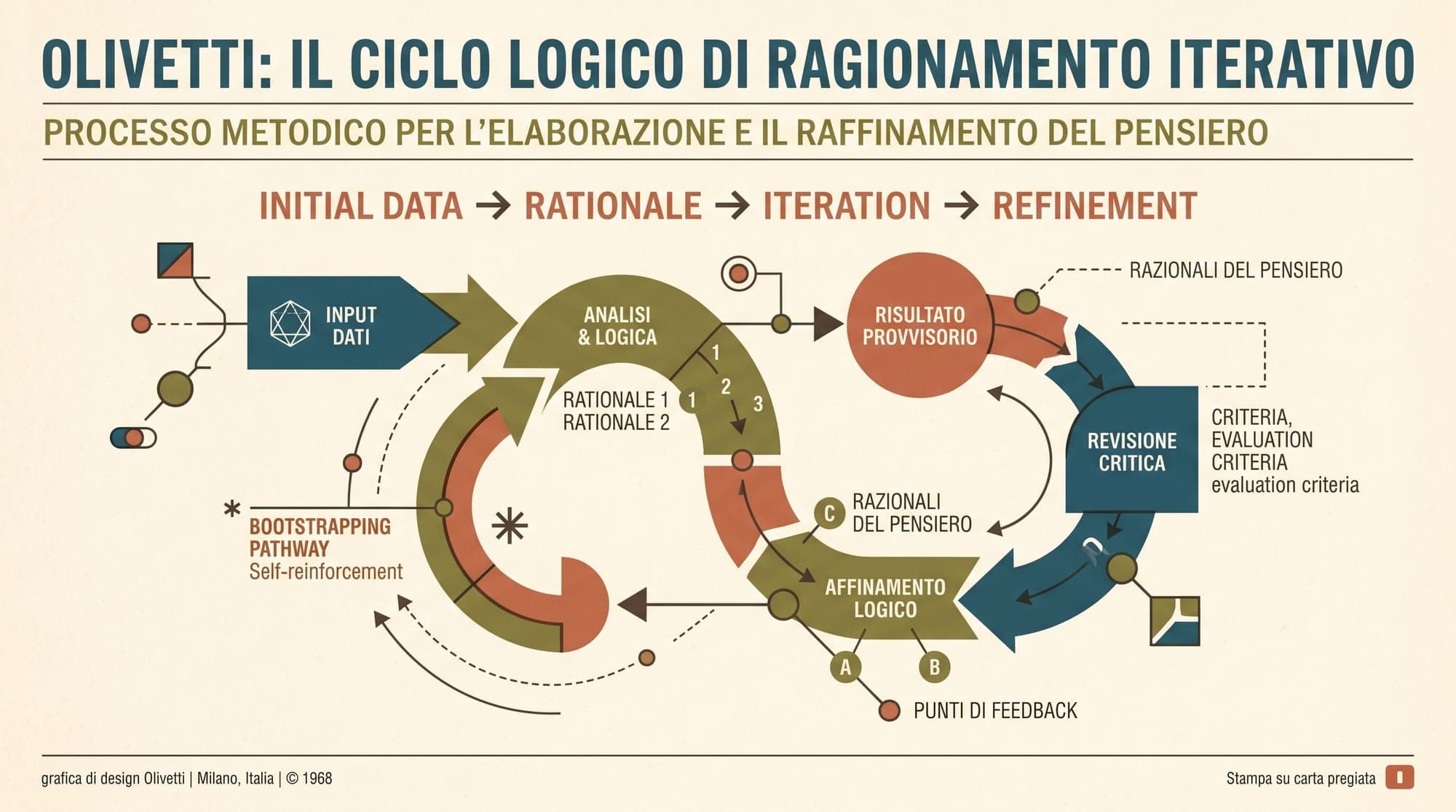
The Core Bootstrapping Loop
The STaR framework operates on a dataset of input queries and ground-truth targets, accompanied by an initial prompt seed containing a small number (typically under ten) of human-authored examples with intermediate rationales.
The bootstrapping algorithm proceeds across discrete outer-loop iterations:
- Rationale Generation: For every instance in the dataset, the current model is prompted with the few-shot seed concatenated to the input query, generating an intermediate rationale followed by a predicted answer.
- Rejection Filtering: Generated solutions are evaluated against ground truth. The framework discards all incorrect trajectories and retains only those where the final answer matches the target.
- Supervised Fine-Tuning: The initial base model checkpoint is fine-tuned on the filtered dataset via standard cross-entropy loss over the rationale and answer tokens. Resetting to the base pretrained model rather than continually fine-tuning the previous checkpoint prevents catastrophic forgetting and runaway representation drift.
As the model improves, its rationale generation capacity expands, allowing it to solve a wider subset of the training distribution in subsequent iterations.
The Rationalization Mechanism
Standard rationale generation bootstrapping encounters an empirical ceiling: when a model cannot solve a problem from prompt context alone, it generates no correct trajectories, yielding zero training signal for that instance. This causes iterative improvement to saturate quickly on complex problem distributions.
To bypass this barrier, STaR introduces rationalization, a technique inspired by backward reasoning and explainable machine learning (Rajani et al., 2019). For every problem where the forward pass fails, the algorithm provides the correct answer directly in the prompt as a hint.
Conditioned on the true destination, the model performs post-hoc justification, deducing intermediate logical steps required to reach the known conclusion. If the generated rationale successfully justifies the target answer, the example is added to the rationalized dataset.
Crucially, when updating the model, the hint token is stripped from the prompt. The model is supervised on the query, rationale, and answer as if it had discovered the rationale unassisted. The final training set for the iteration is the union of correctly generated forward rationales and valid rationalized traces, forcing the model to learn reasoning patterns for problems it could not previously solve.
Mathematical Formulation and Policy Gradient Dynamics
STaR can be interpreted as an approximate policy gradient optimization method operating over a discrete latent variable formulation (Zelikman et al., 2022). Treating the rationale as a latent trajectory, the marginal likelihood of generating an answer given an input under model parameters is the sum over all possible intermediate rationale paths.
Defining an indicator reward function that evaluates whether the predicted answer matches the ground truth, the expected reward objective across the dataset represents the policy value. Applying the standard REINFORCE log-derivative score function identity yields a policy gradient where the indicator function zeros out the gradient for all incorrect paths.
This formulation reveals that STaR's rejection filtering step directly corresponds to policy gradient filtering. STaR approximates this policy gradient by:
- Drawing greedy or temperature-sampled trajectories to construct a low-variance empirical estimate of successful paths.
- Taking multiple gradient updates via supervised cross-entropy on the filtered subset.
This places STaR within the broader family of Expert Iteration (ExIt) algorithms (Anthony et al., 2017), where the model acts as both apprentice generator and search-guided policy improver.
Quiet-STaR: Generalizing Beyond Task-Specific Datasets
The original STaR architecture required discrete question-answer pairs with verifiable targets. To generalize self-taught reasoning to unstructured natural text, Zelikman et al. (2024) introduced Quiet-STaR.
Quiet-STaR trains language models to generate internal thoughts at every token position during pre-training:
- Meta-Tokens: Special tokens delimiting the start and end of thought sequences encapsulate latent thinking without polluting the standard text stream.
- Parallel Thought Generation: At each token position, the model generates parallel candidate thought sequences of fixed length using cached key-value states.
- Future Prediction Utility: The model evaluates how much an internal thought improves the log-likelihood of predicting subsequent true tokens compared to an unaugmented baseline.
- REINFORCE with Baseline: A policy gradient update rewards thought generation that systematically lowers cross-entropy loss on future text, coupled with an interpolation head to smoothly blend thought-conditioned and base predictions.
Quiet-STaR demonstrates that explicit reasoning can emerge as an intrinsic compression mechanism for general language modeling, boosting downstream zero-shot accuracy on tasks like GSM8K and CommonsenseQA without task-specific fine-tuning.
Failure Modes and Architectural Bottlenecks
While effective, self-taught reasoning frameworks exhibit several operational failure modes:
- False-Positive Rationales: In multiple-choice benchmarks (such as CommonsenseQA), models frequently arrive at the correct target option through hallucinated facts or logically invalid deductions. Supervised fine-tuning on these degenerate traces reinforces spurious correlations.
- Cold-Start Requirements: Bootstrapping relies on non-zero initial reasoning capabilities in the base checkpoint. Small models (below approximately 6 billion parameters) or poorly calibrated base models produce near-zero valid rationales in early iterations, causing the loop to stall.
- Rationale Drift and Mode Collapse: Without diversity regularization or entropy bonuses, iterative self-training often collapses onto repetitive syntactic templates, reducing exploratory capacity on out-of-distribution reasoning tasks.
Modern post-training paradigms, including Reinforcement Learning with Verifiable Rewards (RLVR) and large-scale reasoning architectures, trace their conceptual lineage directly to STaR's verification-filtered generation loops.
Sources
- STaR: Bootstrapping Reasoning With Reasoning (Zelikman et al., 2022)
- Quiet-STaR: Language Models Can Teach Themselves to Think Before Speaking (Zelikman et al., 2024)
- Thinking Fast and Slow with Deep Learning and Tree Search (Anthony et al., 2017)
- Explain Yourself! Leveraging Language Models for Commonsense Reasoning (Rajani et al., 2019)
- Chain-of-Thought Prompting Elicits Reasoning in Large Language Models (Wei et al., 2022)