Reasoning10 articles

Reasoning

Articles

  • Monte Carlo Tree Search in Large Language Models: How Selection, Expansion, Simulation, and Backpropagation Guide Deliberate Reasoning

    Standard autoregressive language models generate text token by token via left-to-right greedy decoding or stochastic sampling. While this System 1 approach suffices for fluency and single-turn synthesis, it struggles with complex mathematical reasoning, multi-step logical deduction, and long-horizon planning. Because autoregressive decoders lack native backtracking mechanisms, an error introduced at step t persists and compounds across all subsequent steps t+1 through T. To overcome this struct

    1 min
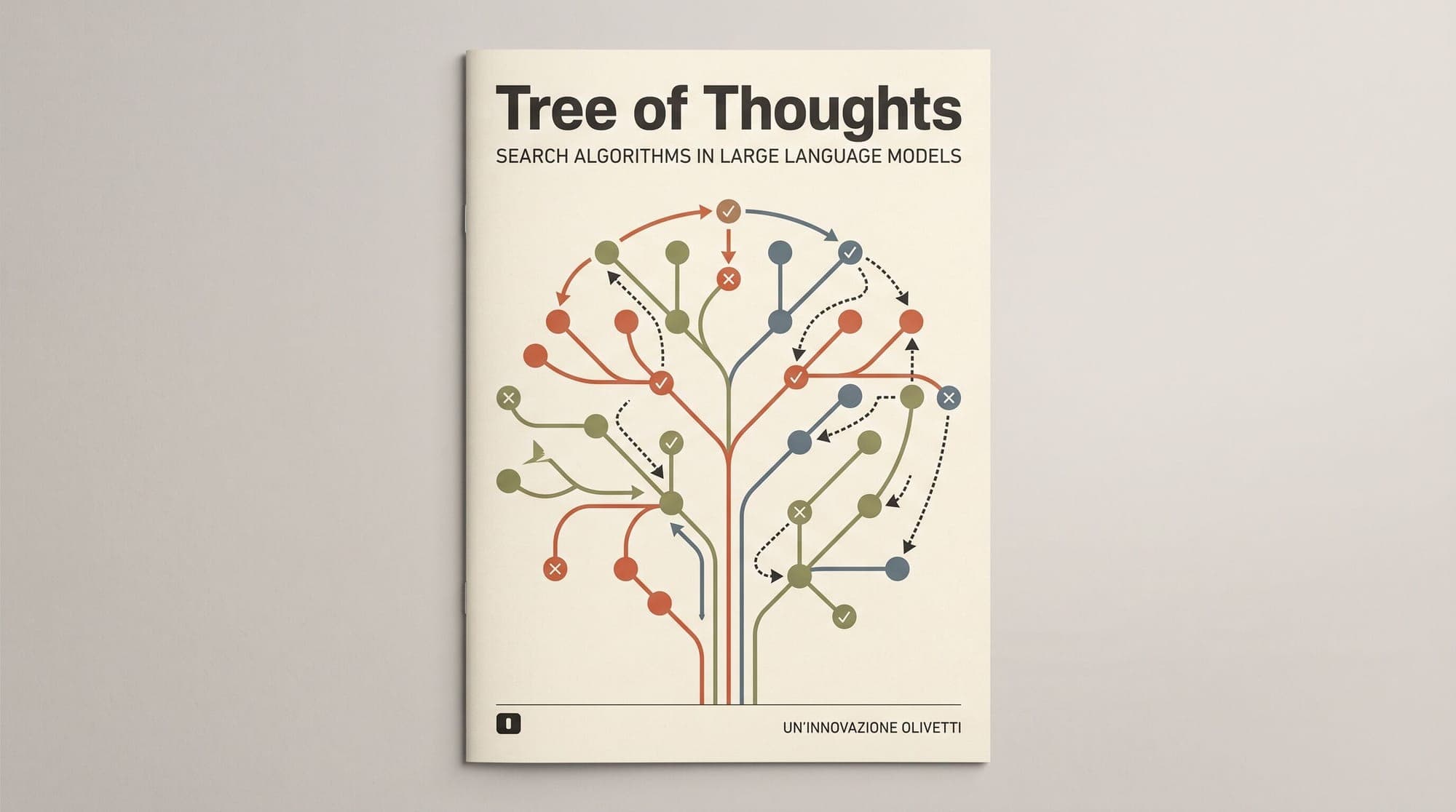
  • Tree of Thoughts in Large Language Models: How Search Trees, State Evaluation, and Backtracking Expand Deliberate Reasoning

    Standard autoregressive large language models generate text sequentially from left to right. At each step $t$, the network samples the next token according to a conditional probability distribution over the vocabulary: P(w_t | w_1, w_2, ..., w_{t-1}) While Chain-of-Thought (CoT) prompting (Wei et al., 2022) encourages models to output intermediate reasoning steps, the underlying computational process remains a linear path through token space. If the model makes an early logical error or choose

    1 min
  • Chain-of-Thought Reasoning in Large Language Models: How Intermediate Rationales Expand Computational Expressivity and Transformer Capacity

    Autoregressive large language models operate by predicting the next token in a sequence conditioned on preceding context. When presented with complex multi-step problems in mathematics, symbolic manipulation, algorithmic planning, or formal logic, standard standard models tasked with providing immediate answers often fail. This failure stems from a fundamental structural constraint: a model forced to output a final answer immediately must compress the entire multi-step derivation into a single f

    1 min
  • ReAct in Large Language Models: How Interleaving Reasoning and Action Traces Built the Foundation of AI Agents

    ReAct in Large Language Models: How Interleaving Reasoning and Action Traces Built the Foundation of AI Agents Before autonomous agents could interact reliably with APIs, search engines, and bash environments, large language models (LLMs) operated in one of two disconnected paradigms: internal reasoning without external interaction, or external action generation without internal deliberation. In pure reasoning paradigms such as Chain-of-Thought (CoT) prompting, models generate intermediate natu

    1 min
  • Self-Consistency Decoding: How Sampling Diverse Reasoning Paths Eliminates Single-Trajectory Fragility in LLMs

    Self-Consistency Decoding: How Sampling Diverse Reasoning Paths Eliminates Single-Trajectory Fragility in LLMs Standard inference pipelines in large language models rely on greedy decoding or low-temperature sampling to generate answers. For tasks requiring direct factual recall or basic classification, greedy token selection generates fluent and accurate outputs. However, when large models are tasked with complex multi-step reasoning, greedy generation exhibits severe structural fragility. In

    1 min
  • Reinforcement Learning with Verifiable Rewards: How Programmatic Oracles Eliminate Reward Hacking in LLM Reasoning

    Post-training paradigms for large language models have undergone a fundamental architectural shift. While the initial wave of alignment relied on Reinforcement Learning from Human Feedback (RLHF) and direct preference optimization (DPO), frontier reasoning systems increasingly depend on Reinforcement Learning with Verifiable Rewards (RLVR). Traditional RLHF relies on neural reward models trained on human pairwise comparisons. These neural proxies suffer from reward overoptimization, vulnerabili

    1 min
  • GLM-5.3 Scores 60 on Artificial Analysis Intelligence Index, Matching Kimi K3

    Independent AI evaluation platform Artificial Analysis has published its benchmark results for Z.ai's GLM-5.3, awarding the reasoning model a score of 60 on its Intelligence Index v4.1.1. The result places GLM-5.3 level with Moonshot AI's Kimi K3 and three points behind frontier leader Claude Opus 5 (63). The evaluation tested GLM-5.3 at its maximum reasoning effort configuration across a nine-part battery that measures agentic tool execution, terminal coding, graduate-level scientific problem-

    1 min
  • Process Reward Models: How Step-by-Step Supervision and Search Drive LLM Reasoning

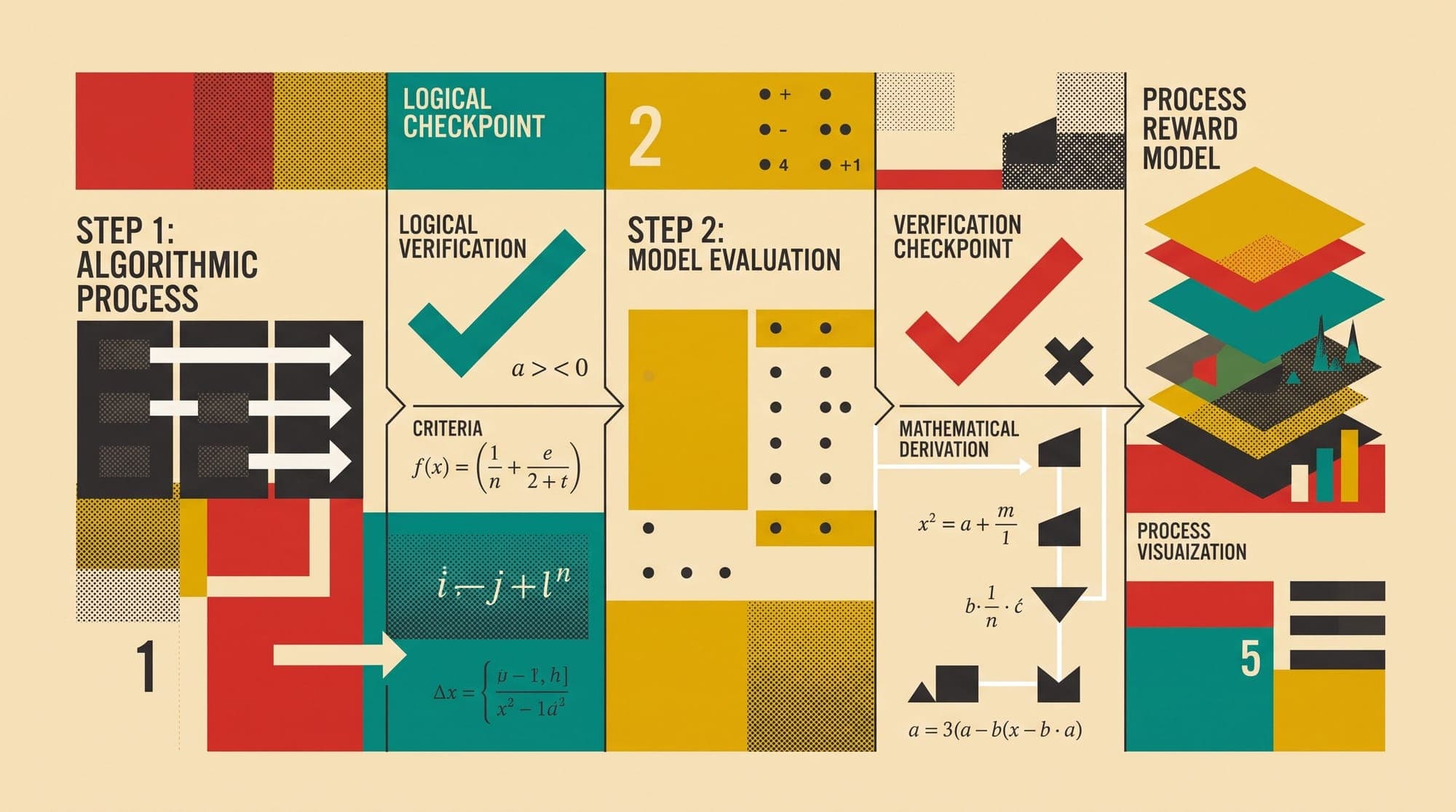
    When large language models tackle complex multi-step reasoning (such as formal mathematics, algorithm synthesis, or multi-hop logic), evaluating only the final answer creates a severe credit assignment bottleneck. An outcome-based verifier can confirm whether a final numerical result is correct, but it cannot determine whether the underlying derivation was logically sound or reached the right answer through compounding hallucinations and lucky cancellations. Process Reward Models (PRMs) resolve

    1 min
  • Test-Time Compute Scaling in Large Language Models: How Search, Verification, and Reasoning Chains Trade Latency for Accuracy

    Large language model performance has historically been dictated by pre-training compute scaling laws. As formalised by Kaplan et al. and Chinchilla scaling, increasing model parameters, dataset size, and pre-training FLOPs yielded predictable reductions in cross-entropy loss. During inference, however, computation remained strictly linear and deterministic: one forward pass per generated token. The emergence of inference-time reasoning architectures has introduced a third scaling axis: test-tim

    1 min
  • Study finds RL for reasoning changes only a few tokens, and you can copy the effect

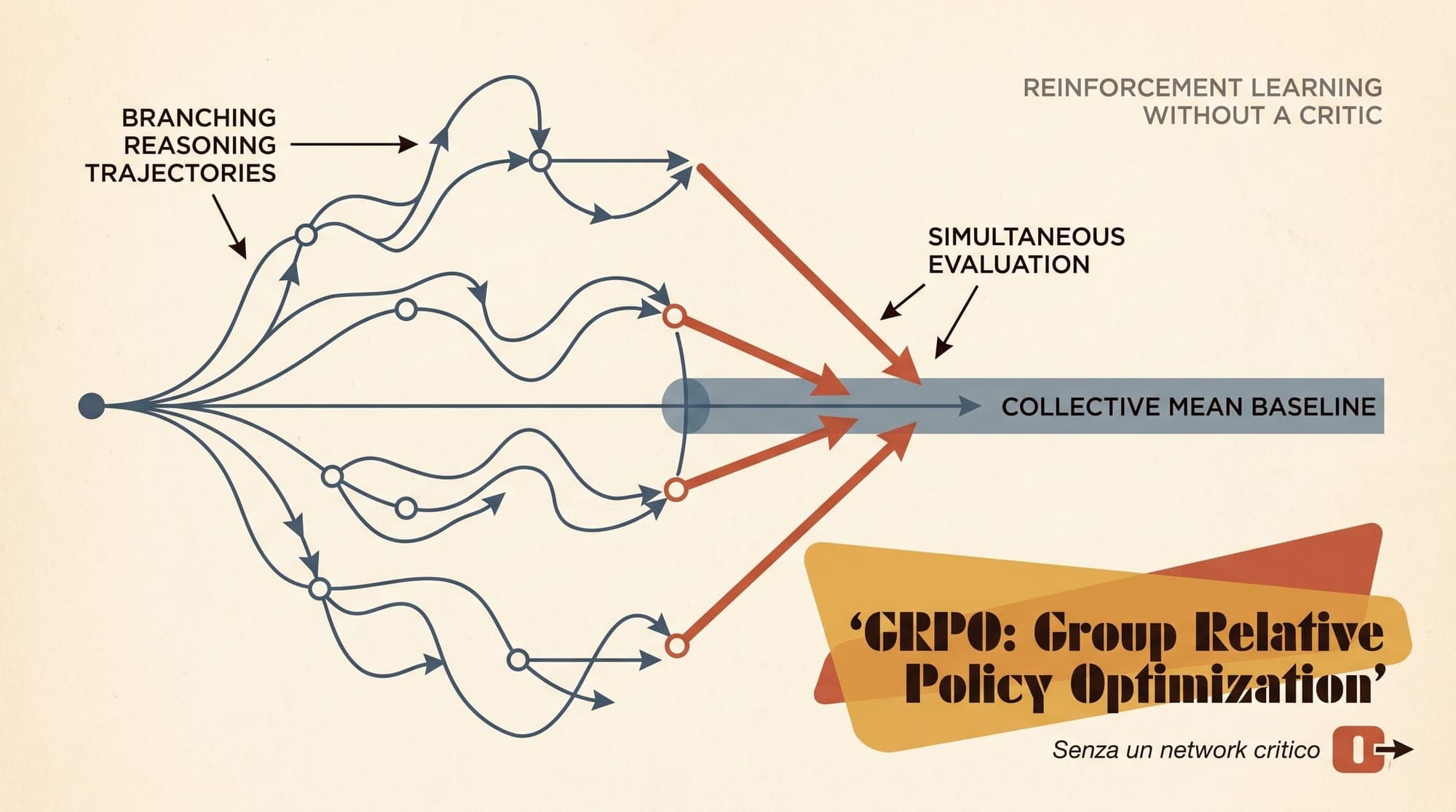
    A new analysis of reinforcement learning for LLM reasoning suggests the field's biggest gains come from a surprisingly small change. RL is not rewriting how models think. It is nudging a tiny slice of the output. What the researchers measured Across several model families and common methods like GRPO and PPO, reinforcement learning reranks only 1.0 to 4.1 percent of tokens. The token it promotes is almost always already one of the base model's top five choices. Training, in other words, pushe

    1 min