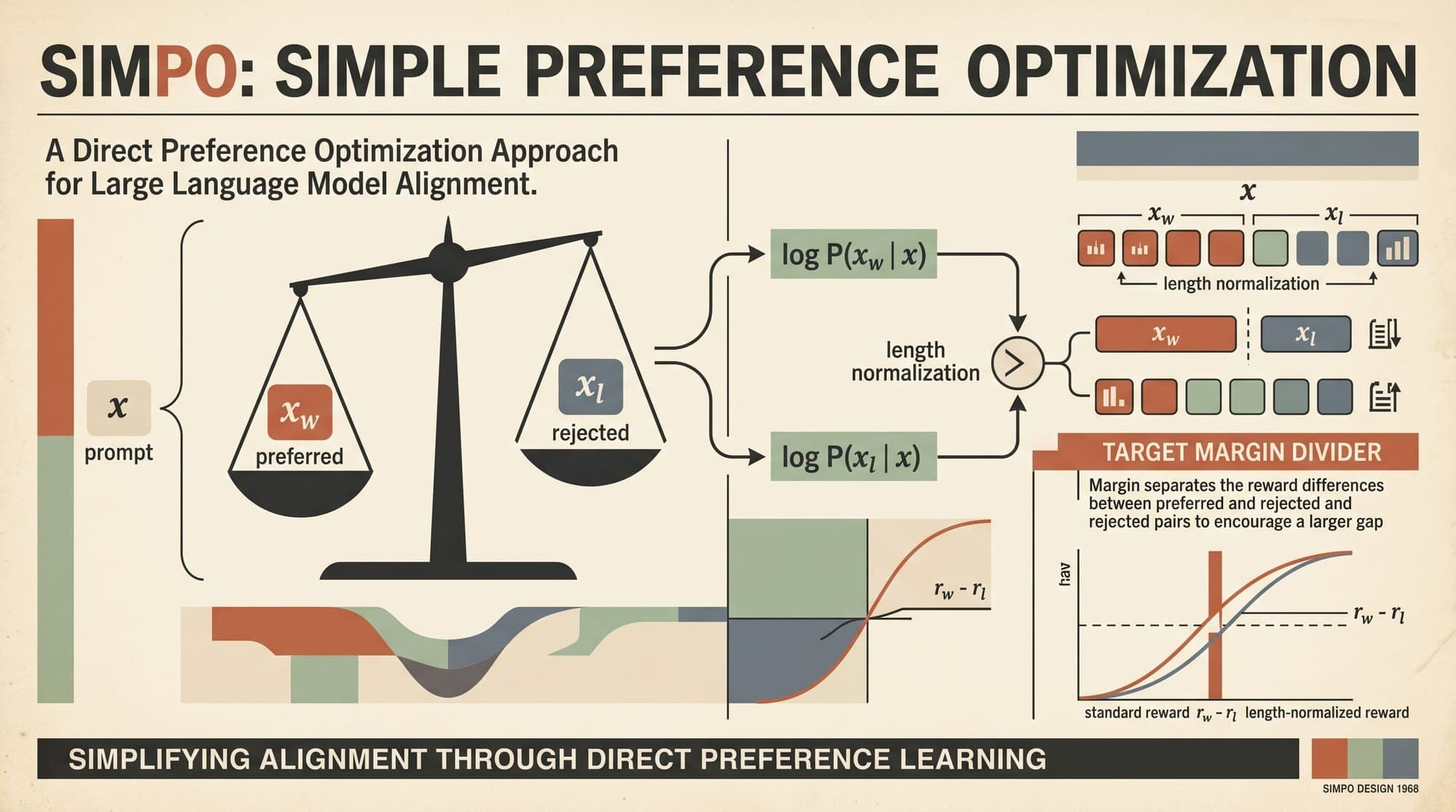
Simple Preference Optimization (SimPO): Mathematical Foundations, Reference-Free Implicit Reward, Length Normalization, and Target Margin Dynamics
Post-training preference alignment has become the definitive step in transforming raw pretrained large language models into instruction-following assistants. While Reinforcement Learning from Human Feedback (RLHF) via Proximal Policy Optimization (PPO) established the initial standard, its requirement to maintain actor, critic, reference, and reward models simultaneously created massive computational overhead. Direct Preference Optimization (DPO) simplified this paradigm by deriving a closed-form substitution that eliminated the reward and critic models.
However, standard DPO introduces its own structural liabilities. It requires retaining a frozen reference model in GPU memory, exhibits a mathematical discrepancy between its training reward and inference generation metrics, and remains vulnerable to length exploitation where models generate verbose responses to maximize unnormalized likelihood ratios.
Simple Preference Optimization (SimPO), introduced by Meng et al. (2024) at Princeton University, addresses these structural shortcomings. By formulating the implicit reward directly as the length-normalized average log-likelihood under the active policy and introducing a target reward margin, SimPO eliminates the reference model entirely, cuts GPU memory consumption, prevents verbosity exploitation, and achieves superior alignment performance across standardized benchmarks.

1. The Limitations of Direct Preference Optimization (DPO)
To understand the mechanics of SimPO, one must first examine how Direct Preference Optimization (Rafailov et al., 2023) operates and where its formulation diverges from generation dynamics.
In the standard RLHF framework, a policy is optimized against a learned reward model subject to a Kullback-Leibler (KL) divergence penalty against a reference policy :
DPO proved that under the Bradley-Terry preference model (Bradley and Terry, 1952), the optimal policy satisfies an exact analytical relationship with the ground-truth reward function:
where is the partition function. Substituting this parameterized reward directly into the Bradley-Terry pairwise preference loss yields the DPO objective:
While DPO eliminates the separate reward and value networks of PPO, it retains three fundamental limitations in production alignment pipelines:
1.1 Memory and Forward-Pass Overhead
DPO requires evaluating both the policy model and the frozen reference model on every training batch. In distributed training environments, storing alongside consumes substantial VRAM and requires an additional forward pass per sample pair, increasing training step latency.
1.2 The Reward-Generation Discrepancy
The implicit reward in DPO is defined by the probability ratio . However, during downstream inference, text generation (such as greedy decoding, beam search, or nucleus sampling) relies exclusively on the token probabilities assigned by , completely detached from .
This divergence introduces pathological edge cases: a response can achieve a high DPO implicit reward if is extremely low, even if the absolute generation probability is poor. Conversely, a high-probability completion under can receive a low reward if also assigned it high probability.
1.3 Length Exploitation and Verbosity Bias
Because DPO computes sequence-level log probabilities by summing token log-likelihoods over unnormalized sequence lengths :
the resulting objective is prone to length hacking. When preference data contains longer winning responses, models optimized with DPO tend to generate verbose, repetitive responses to artificially widen the probability ratio, degrading output conciseness and factual density.
2. Mathematical Formulation of SimPO
Simple Preference Optimization resolves these vulnerabilities by making two structural modifications: aligning the implicit reward with average log-likelihood and introducing a positive target reward margin.
2.1 Sequence-Averaged Implicit Reward
SimPO defines the implicit reward directly as the length-normalized average log-likelihood of the response tokens under the policy model :
where:
- is a scaling hyperparameter controlling reward magnitude.
- represents the total token count of the completion sequence.
- is the cumulative autoregressive log probability.
This formulation establishes direct concordance between the training objective and the decoding procedure. Since inference algorithms seek sequences with high per-token likelihoods, maximizing directly reinforces the tokens that greedy decoding will prioritize.
Furthermore, dividing by sequence length eliminates the mathematical penalty against shorter sequences. Under unnormalized log probabilities, each additional token adds a negative value () to the sum, causing longer sequences to have lower total log probability even if each individual token is high confidence. Average log probability measures density rather than total volume.
2.2 Target Reward Margin ()
In the standard Bradley-Terry preference framework, the probability that response is preferred over given prompt is modeled as:
where is the sigmoid function.
Under this formulation, the model reaches equilibrium whenever , even if the margin between winning and losing sequences is infinitesimal. Without a reference model to constrain policy drift, a model optimizing a reference-free objective could satisfy the loss by marginally nudging probabilities without developing robust preference separation.
To enforce meaningful separation between preferred and dispreferred completions, SimPO introduces a fixed positive target reward margin into the Bradley-Terry formulation:
Under this constraint, the model is penalized unless the reward of the winning response exceeds the reward of the losing response by at least the margin :
2.3 The Complete SimPO Objective
Combining the length-normalized implicit reward with the target reward margin yields the full SimPO loss function:
Expanding the inner term $\Delta r_\theta(x, y_w, y_l) = \frac{\beta}{|y_w|} \log \pi_\theta(y_w|x) - \frac{\beta}{|y_l|} \log \pi_\theta(y_l|x)$:
3. Gradient Dynamics and Optimization Mechanics
To analyze how SimPO updates transformer weights during backpropagation, we compute the gradient of the loss with respect to policy parameters .
Let and define the margin error term:
Using the derivative property of the logistic loss , the gradient evaluates to:
Expanding the parameter gradient of :
Substituting back into the full gradient expression:
Key Analytical Properties of the Gradient
- Adaptive Error Weighting: The scalar weight scales inversely with the policy margin. When the model has already learned to separate and by well over , the term becomes large and negative, driving and vanishing the gradient for that pair. If the model incorrectly ranks above , or fails to meet margin , the weight approaches , applying maximal gradient updates.
- Length-Invariant Token Gradients: In standard DPO, the unnormalized gradient $\nabla_\theta \log \pi_\theta(y|x) = \sum_{t=1}^{|y|} \nabla_\theta \log \pi_\theta(y_t | x, y_{<t})$ scales linearly with token count. Long sequences contribute massively larger gradient norms than short sequences. SimPO scales the token gradients by and , ensuring that every token contributes equally regardless of sequence length.
4. Architectural Comparison: SimPO vs Alternative Alignment Methods
The post-training alignment landscape has produced several distinct preference optimization objectives. The table below details how SimPO compares to alternative formulations:
| Alignment Method | Reference Model Required | Length Normalization | Explicit Margin () | Optimization Objective Type | Primary Failure Mode Addressed | | :--- | :--- | :--- | :--- | :--- | :--- | | PPO (Schulman et al., 2017) | Yes () | Value Normalization | No | Online RL with Value Network | Policy drift, unstable value fitting | | DPO (Rafailov et al., 2023) | Yes () | No | No | Pairwise Offline Likelihood Ratio | Critic instability, complex RL training | | IPO (Azar et al., 2023) | Yes () | No | Yes (Regularizer) | Pairwise Identity Policy Loss | Overfitting to deterministic preferences | | KTO (Ethayarajh et al., 2024) | Yes () | Implicit (Kahneman-Tversky) | Yes (Per-sample) | Unpaired Pointwise Utility | Expensive paired data requirement | | CPO (Xu et al., 2024) | No | No | Yes | Pairwise Direct Likelihood Loss | Translation quality degeneration | | ORPO (Hong et al., 2024) | No | Token Ratio | Yes (Odds Ratio) | Combined SFT + Odds Ratio Loss | Two-stage SFT and alignment overhead | | SimPO (Meng et al., 2024) | No | Yes (Explicit ) | Yes (Target Margin ) | Pairwise Length-Normalized BT | Reward-generation mismatch, length hacking |
5. Empirical Benchmarks and Ablation Dynamics
In extensive evaluations across open-weight models including Llama-3-8B-Instruct, Mistral-7B, and Gemma-2, SimPO consistently outperforms standard DPO and reference-based baselines across standardized benchmarks.
5.1 Benchmark Results
On AlpacaEval 2.0 (evaluating length-controlled win rates against GPT-4 Preview) and Arena-Hard-v0.1 (500 challenging real-world queries evaluated against baseline models):
- Llama-3-8B-Instruct: Applying SimPO on the UltraFeedback dataset boosted the AlpacaEval 2.0 Length-Controlled Win Rate from 22.9% (base instruct) to 44.7%, surpassing standard DPO (38.1%) by 6.6 percentage points.
- Mistral-7B-Base: SimPO achieved an Arena-Hard score of 38.6, outperforming DPO (34.2) and IPO (31.8) while training in approximately 60% of the wall-clock time required for reference-based methods.
- GSM8K & Math Reasoning: Unlike standard DPO, which frequently suffers performance degradation on structured mathematical tasks due to length inflation, SimPO retained high zero-shot reasoning fidelity without catastrophic forgetting.
5.2 Critical Ablation Findings
The Princeton team conducted systematic ablations to isolate the impact of both length normalization and target margin enforcement:
- Ablating Length Normalization (w/o LN): Removing the factor caused immediate degradation in generation quality. The correlation between learned reward differences and response length differences () spiked from in standard SimPO to without length normalization. The unnormalized model rapidly degenerated into generating repetitive, bloated paragraphs to game the loss.
- Ablating Target Margin (): Setting the margin reduced AlpacaEval 2 win rates by 2.5 to 4.0 percentage points across model sizes. Without the margin, the model frequently produced gradient updates that plateaued prematurely before establishing definitive preference separation.
6. Practical Implementation and Hyperparameter Guidelines
For practitioners implementing SimPO in frameworks such as Hugging Face TRL or Axolotl, several hyperparameter conventions differ substantially from standard DPO:
Hyperparameter Configuration
- (Reward Scaling): While DPO typically operates with small values (), SimPO computes rewards over normalized per-token probabilities, which are bounded within small negative values. Consequently, SimPO requires a much larger , typically between and (and up to in specific learning rate configurations).
- (Target Margin): The recommended value for ranges between and . A common heuristic is setting the ratio .
- Learning Rate Schedule: Because SimPO eliminates the reference model regularization, using a cosine learning rate decay with a small warmup (typically 5% to 10% of total steps) and peak learning rates between and for full-parameter tuning (or for LoRA) prevents gradient instability.
VRAM and Throughput Savings
In a multi-GPU training setup (e.g. 8x NVIDIA H100 80GB SXM5), training an 8-billion-parameter model with SimPO eliminates the memory footprint of storing the reference weights, KV activations, and forward passes. This enables:
- Up to 1.8x larger per-device micro-batch sizes.
- Approximately 35% reduction in total training wall-clock time per epoch compared to DPO.
- Support for longer sequence lengths (up to 32k context windows during alignment) without requiring deep activation checkpointing or memory offloading.
7. Conclusion
Simple Preference Optimization demonstrates that effective preference alignment does not require maintaining dual-policy memory footprints or complex divergence penalties. By anchoring the implicit reward to the sequence-averaged log-likelihood and establishing an explicit target reward margin, SimPO unifies the training objective directly with inference generation mechanics. The result is a post-training framework that is computationally lighter, mathematically consistent, and resistant to verbosity exploitation.
Sources
- Meng, Y., Xia, M., & Chen, D. (2024). SimPO: Simple Preference Optimization with a Reference-Free Reward. arXiv preprint arXiv:2405.14734 (NeurIPS 2024).
- Rafailov, R., Sharma, A., Mitchell, E., Ermon, S., Manning, C. D., & Finn, C. (2023). Direct Preference Optimization: Your Language Model is Secretly a Reward Model. NeurIPS 2023.
- Azar, M. G., Rowland, M., Piot, B., Guo, D., Calandriello, D., Valko, M., & Munos, R. (2023). A General Theoretical Paradigm to Understand Learning from Human Preferences. arXiv preprint arXiv:2310.12036.
- Ethayarajh, K., Xu, W., Muennighoff, N., Jurafsky, D., & Douwe, K. (2024). KTO: Model Alignment as Prospect Theoretic Optimization. arXiv preprint arXiv:2402.01306.
- Xu, H., Sharaf, A., Chen, Y., Tan, W., Shen, L., Van Durme, B., Murray, K., & Kim, Y. J. (2024). Contrastive Preference Optimization: Pushing the Boundaries of LLM Performance in Machine Translation. arXiv preprint arXiv:2401.08417.
- Hong, J., Lee, N., & Thorne, J. (2024). ORPO: Monolithic Preference Optimization without Reference Model. arXiv preprint arXiv:2403.07691.
- Schulman, J., Wolski, F., Dhariwal, P., Radford, A., & Klimov, O. (2017). Proximal Policy Optimization Algorithms. arXiv preprint arXiv:1707.06347.
- Princeton NLP SimPO Official Repository. GitHub.