Semantic Caching in Production LLM Systems: Architecture, Approximate Nearest Neighbor Matching, Cross-Encoder Verification, Invalidation Dynamics, and Serving Economics
Serving large language models at enterprise scale presents severe latency and cost bottlenecks. While frontier reasoning models and deep autoregressive decoders cost between $2.50 and $60.00 per million tokens and incur time-to-first-token (TTFT) delays ranging from 800 milliseconds to several seconds, a substantial fraction of production user queries exhibit redundant semantic intent.
Traditional exact-string caching using cryptographic hashes (such as SHA-256) fails in natural language environments. Trivial variations in phrasing, whitespace, casing, preamble boilerplate, or prompt template parameterization result in cache misses, keeping hit rates below 5% in high-volume conversational systems.
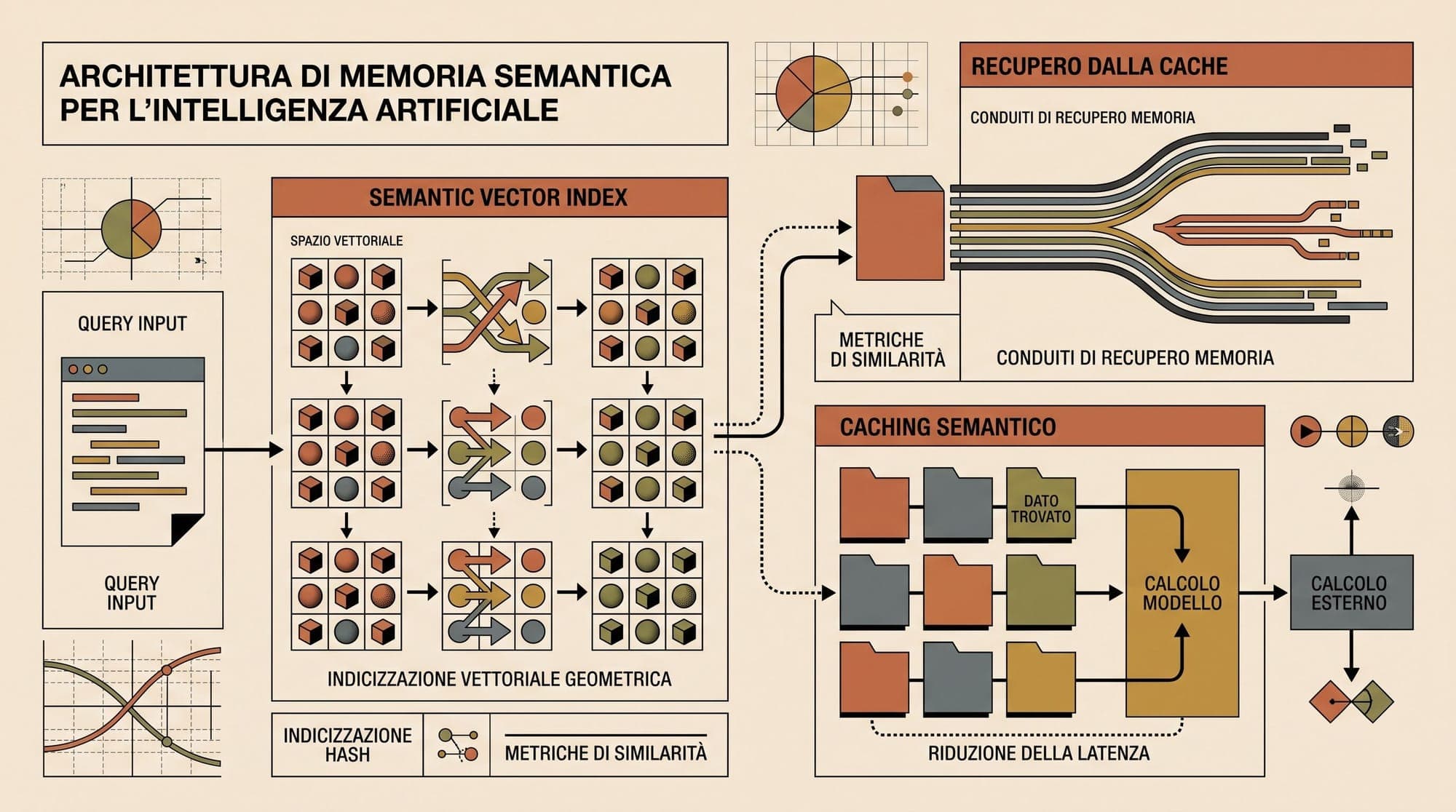
Semantic caching solves this by indexing prompt representations in high-dimensional vector spaces and retrieving cached completions when the semantic distance between an incoming query and a previously answered query falls within an acceptable threshold. However, deploying semantic caching in production introduces critical engineering trade-offs: false-positive drift, semantic ambiguity on negated queries, namespace leakage across multi-tenant boundaries, and cache invalidation staleness.
This analysis examines the architectural mechanics of semantic caching, compares leading production frameworks (GPTCache, RedisVL, Momento, and Cloudflare AI Gateway), details multi-tier validation pipelines, and formalizes the serving economics required to achieve net latency and cost reductions.
The Exact Caching Failure and the Geometry of Intent
In standard web architectures, deterministic responses are cached via key-value mappings over canonical request URLs or normalized body hashes. In LLM workloads, two distinct user prompts and can express identical intent while sharing minimal token-level overlap:
- Prompt 1: "What is the standard procedure to reset my AWS IAM access key?"
- Prompt 2: "How do I roll over access keys in AWS IAM console?"
Exact key matching treats these prompts as orthogonal requests, executing duplicate full-context autoregressive generations.
Semantic caching replaces string equivalence with vector proximity over an embedding manifold. Given an embedding model, the system computes normalized dense vectors for the incoming prompt and cached records. A cache hit occurs when the distance metric (typically cosine distance, ) falls below a predefined threshold .
While this geometric formulation captures semantic similarity, naive bi-encoder cosine matching introduces critical vulnerability to false positives.
Incoming Request: P_query
       │
       ▼
┌───────────────────────────────┐
│  Exact Key Hash (SHA-256)     │ ─── Hit (Latency: <1ms) ────► Return Cached Response
└──────────────┬────────────────┘
               │ Miss
               ▼
┌───────────────────────────────┐
│  Bi-Encoder Embedding Model   │ ─── (Latency: 10-20ms)
└──────────────┬────────────────┘
               │ Dense Vector e_q
               ▼
┌───────────────────────────────┐
│  ANN Vector Index Search      │ ─── Distance > tau (Miss) ──► Forward to LLM Pipeline
└──────────────┬────────────────┘
               │ Distance <= tau (Candidate Found)
               ▼
┌───────────────────────────────┐
│  Cross-Encoder Entailment /   │ ─── Contradiction / Divergence ──► Fallback to LLM
│  NLI Verification Gate        │
└──────────────┬────────────────┘
               │ Entailed Match (Confidence >= 0.95)
               ▼
   Return Verified Response (Total Latency: 25-35ms)
The False-Positive Dilemma and Bi-Encoder Limitations
Bi-encoder embedding models compress an entire sentence or document into a single fixed-dimension vector (typically 384, 768, or 1536 dimensions). This pooling operation causes loss of fine-grained syntactic modifiers, critical numerical values, and logical negations:
- Logical Negation and Sentiment Inversion: Consider Query A ("Why did our quarterly operating margin increase in Q3?") versus Query B ("Why did our quarterly operating margin decrease in Q3?"). Bi-encoder cosine similarity typically exceeds 0.94 due to shared tokens. Serving the cached answer of Query A to Query B results in a direct factual contradiction.
- Entity and Parameter Swapping: Consider Query A ("Provide Python code to upload a blob to Azure Storage") versus Query B ("Provide Python code to upload a blob to Google Cloud Storage"). High lexical overlap yields similarity scores above 0.91, yet the cached completion is invalid for the requested cloud target.
- Temporal Sensitivity: General prompts like "What are the current top-performing open-weight models?" risk serving completions that become obsolete as leaderboards update.
To prevent silent hallucinations, production semantic caching cannot rely solely on a single bi-encoder threshold.
Multi-Tiered Cascaded Verification Architecture
To balance sub-50ms lookup latency with high semantic precision, high-throughput systems implement a three-stage tiered verification cascade:

Tier 0: Deterministic Normalization and Exact Key Hashing
Before invoking embedding models, the raw prompt undergoes deterministic canonicalization:
- Strip leading and trailing whitespace; collapse redundant internal spacing.
- Standardize lowercasing for non-code inputs.
- Strip dynamic system tokens or user identifiers from the hashing payload.
- Compute an in-memory Redis or Memcached exact key lookup. If matched, the response is returned in under 1 millisecond, bypassing all vector calculations.
Tier 1: Bi-Encoder Approximate Nearest Neighbor (ANN) Retrieval
If Tier 0 misses, the prompt is embedded using a lightweight, optimized embedding model (such as bge-small-en-v1.5, text-embedding-3-small, or all-MiniLM-L6-v2) via ONNX Runtime or local microservices.
- Vector search is executed across an HNSW or Flat index partitioned by tenant and application domain.
- The index retrieves the top nearest neighbors within a conservative initial distance radius (such as cosine distance , corresponding to similarity ).
- If no candidates exist within , the request is immediately flagged as a cache miss and routed to the upstream LLM.
Tier 2: Cross-Encoder Entailment Verification
For candidates passing Tier 1 with intermediate similarity (0.88 to 0.96), a cross-encoder model (such as ms-marco-MiniLM-L-6-v2 or a distilled DeBERTa-v3 cross-encoder) performs joint token-level attention across the concatenated pair of the new query and cached prompt.
Cross-encoders evaluate full inter-token attention weights without independent vector pooling, enabling the detection of switched nouns, altered negation operators, or modified numerical constraints. If the cross-encoder classification score exceeds 0.95, the cache hit is confirmed; otherwise, it is rejected and sent to the LLM.
Production Framework Comparison
Production teams evaluate four primary architectural patterns for semantic cache implementation:
1. GPTCache (Open Source)
Developed by Zilliz, GPTCache provides modular client/middleware architecture. It decouples the caching lifecycle into distinct modules: Pre-Function (prompt extraction), Embedding Model, Vector Base (Milvus, Faiss, Chroma), Cache Storage, and Evaluation.
- Architecture: Python middleware library / process sidecar.
- Vector Index: Milvus, Faiss, Chroma, SQLite.
- Overhead: 25ms to 60ms depending on local embedding execution.
- Evaluation: Pluggable functions (exact distance, model evaluator, ONNX evaluators).
- Eviction: Configurable LRU, LFU, and FIFO policies.
2. Redis Semantic Cache (RedisVL)
RedisVL integrates semantic caching directly into the Redis ecosystem using native vector search capabilities. It supports both Flat (exact brute-force distance) and HNSW (hierarchical navigable small world graphs) indexing with cosine, inner product, or Euclidean metrics.
- Architecture: In-memory key-value vector database.
- Vector Index: Native Redis HNSW and Flat indices.
- Overhead: 8ms to 18ms for in-memory network retrieval.
- Evaluation: Distance threshold filtering combined with schema-level tag filters.
- Eviction: Native Redis key-level TTL expiration and memory maxmemory policies.
from redisvl.extensions.cache.llm import SemanticCache
from redisvl.utils.vectorize import HFTextVectorizer

# Initialize semantic cache backed by in-memory HNSW index
semantic_cache = SemanticCache(
    name="production_llm_cache",
    redis_url="redis://cache-cluster.internal:6379",
    distance_threshold=0.10,  # Redis Cosine distance (1 - cos_sim)
    vectorizer=HFTextVectorizer("sentence-transformers/all-MiniLM-L6-v2"),
    ttl=86400  # 24-hour expiration
)

# Query cache before dispatching to LLM provider
cached_match = semantic_cache.check(
    prompt="How do I configure IAM policies in AWS?",
    return_fields=["prompt", "response", "metadata"]
)

if cached_match:
    return cached_match[0]["response"]
3. Momento Cache + Vector
Momento provides a serverless semantic cache. It decouples data ingestion and query indexing into auto-scaling storage tiers, eliminating manual HNSW graph hyperparameter tuning (M, efConstruction, efSearch) and cluster sizing.
- Architecture: Serverless distributed key-value and vector index.
- Overhead: 12ms to 25ms over HTTP/gRPC.
- Evaluation: Configurable vector similarity thresholds.
- Eviction: Built-in per-item TTL management.
4. Cloudflare AI Gateway
Cloudflare AI Gateway implements semantic caching at the edge reverse proxy layer. By inspecting outbound requests to upstream LLM providers, Cloudflare intercepts calls before they leave the edge network, matching embeddings against regional Cloudflare Vectorize instances.
- Architecture: Edge proxy gateway.
- Overhead: 15ms to 35ms edge roundtrip.
- Evaluation: Tiered matching presets (
super_strict_match,close_enough,flexible_friend). - Eviction: Global edge cache TTL configurations.
Namespace Isolation, Template Decoupling, and Invalidation
Implementing semantic caching in production multi-tenant systems requires strict isolation, template separation, and dynamic cache eviction.
Incoming Request Payload:
┌──────────────────────────────────────────────────────────┐
│ System Prompt:  "You are a SQL expert for Tenant_104..." │ ─── Decouple & Strip
│ Template Vars:  Date: 2026-08-25 | Role: Analyst         │ ─── Metadata Tagging
│ User Prompt:    "Summarize yesterday's ingest errors."   │ ─── Extract for Embedding
└──────────────────────────────────────────────────────────┘
                              │
                              ▼
        e_q = Embed("Summarize yesterday's ingest errors.")
                              │
                              ▼
  Vector Search Filter: (tenant_id == "Tenant_104") & (role == "Analyst")
Template-Variable Decoupling
Modern LLM pipelines utilize structured prompt templates:
System: You are an enterprise support assistant for Acme Corp.
Context: User ID: {user_id}, Account Tier: {tier}, Current Date: {date}
User: {query}
If the entire prompt string is passed to the embedding model, the static system preamble and dynamic context variables dominate the vector representation. This creates false similarity between completely different user queries.
Production Pattern: Extract only the variable user payload for embedding generation. Pass system prompts, tenant IDs, and user roles as metadata filter tags in the vector query.
Multi-Tenant Namespace Isolation
To prevent cross-tenant data exfiltration, the vector index must enforce mandatory pre-filters:
- Require
tenant_idequality matches on every vector search. - Scope cache lookups by model identifier and system prompt version.
- Restrict caching to requests with deterministic sampling parameters (such as temperature ).
Cache Invalidation Dynamics
Semantic caches cannot rely purely on passive TTL expiration:
- Event-Driven Invalidation: When underlying RAG documents, product catalogs, or user permissions update, associated vector records must be pruned using metadata tags (for example, purging all records tagged
doc_source: policy_v1). - Negative Feedback Pruning: If a user submits a negative rating or thumbs-down on a completion, the application should delete the corresponding key from the cache to prevent persisting low-quality outputs.
Serving Economics and Latency Break-Even Calculus
Semantic caching introduces computational overhead on every request: embedding generation, vector distance computation, and optional cross-encoder evaluation. It is economically viable only if the amortized cost and latency of cache checks remain significantly lower than upstream LLM calls.
Cost Break-Even Formulation
Let represent the cost per LLM completion request, represent the cost of embedding generation and vector lookup, and represent the semantic cache hit rate ().
The average cost per served request is:
To achieve net financial savings (), the cache hit rate must exceed the economic break-even threshold :
For frontier models (where $C_{\text{LLM}} \approx \ per request) and optimized local embeddings (where $C_{\text{embed}} \approx \ per request):
Because is well below 1%, even modest hit rates (15% to 35%) generate substantial net cost reductions.
Latency Analysis
Consider typical operational latencies:
- : Embedding generation latency ()
- : Vector search latency ()
- : Cross-encoder verification latency ()
- : End-to-end LLM generation latency ()
On a cache hit:
On a cache miss:
The expected latency across all requests is:
At a 30% hit rate ():
This achieves a 28.3% overall reduction in mean response latency, with cache-hit requests completing in 31 milliseconds rather than 1200 milliseconds.
Production Engineering Checklist
Before deploying semantic caching to production environments, verify the following configuration gates:
- Deterministic Sampling Filter: Restrict semantic caching to queries where generation parameters specify low temperature (). Stochastic creative prompts should bypass the cache.
- Dedicated Small Embedding Models: Deploy compact embedding models () on dedicated CPU or lightweight GPU instances with ONNX Runtime to maintain .
- Threshold Calibration per Domain: Run offline sweeps across historical query logs to identify the optimal cosine distance threshold. Avoid universal thresholds; technical and code queries typically require strict thresholds (), whereas general FAQ queries tolerate looser thresholds ().
- Tenant and Access Control Isolation: Ensure all vector queries mandate strict metadata equality constraints matching the authenticated caller's security principal.
- Dynamic Pruning on Invalidation: Connect knowledge base updates and CMS publishing pipelines to cache invalidation webhooks to purge stale response keys instantly.
Sources
- Fu Bang. GPTCache: An Open-Source Semantic Cache for LLM Applications Enabling Faster Answers and Cost Savings. Proceedings of the 2023 Conference on Empirical Methods in Natural Language Processing: System Demonstrations, ACL Anthology.
- Redis. Semantic Caching for Large Language Models Documentation. Redis Vector Library (RedisVL).
- Redis. Semantic Cache Architecture and Solution Guide. Redis Official Documentation.
- Cloudflare. AI Gateway Caching and Similarity Configuration. Cloudflare Developer Documentation.
- Momento. How to Use Semantic Cache with Large Language Models. Momento Engineering Blog.
- AWS Database Blog. Lower Cost and Latency for AI Using Amazon ElastiCache as a Semantic Cache. Amazon Web Services.
- Portkey. Reducing LLM Costs and Latency with Semantic Cache. Portkey AI Engineering.