
Reranking Engines in Production RAG: Comparing BGE-Reranker, Qwen3-Reranker, Cohere Rerank, Jina, ColBERT, and FlashRank — Architecture, Latency, Quality, and Self-Hosted Economics
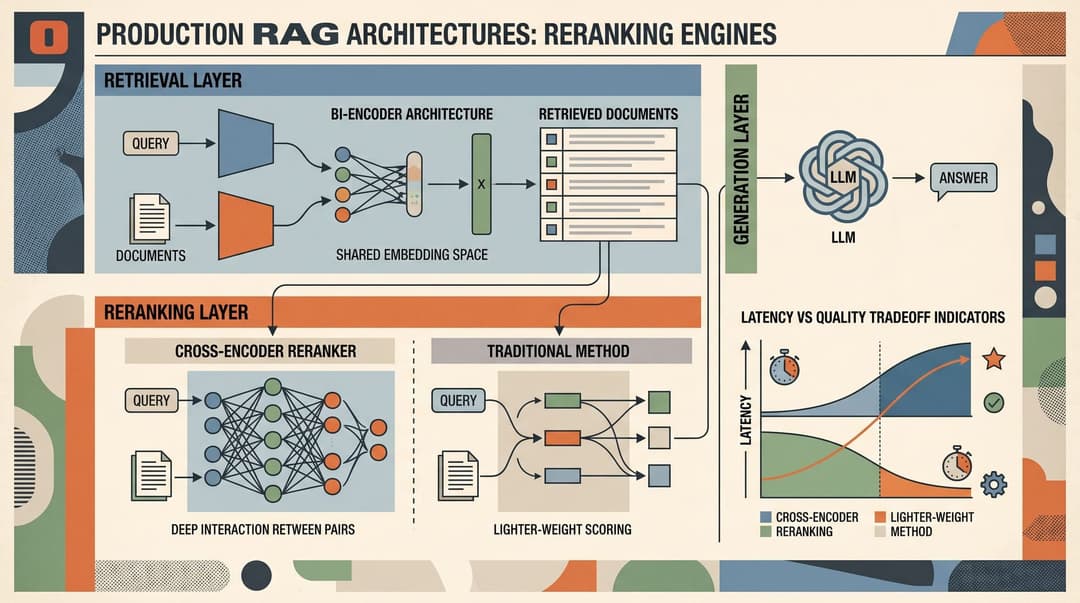
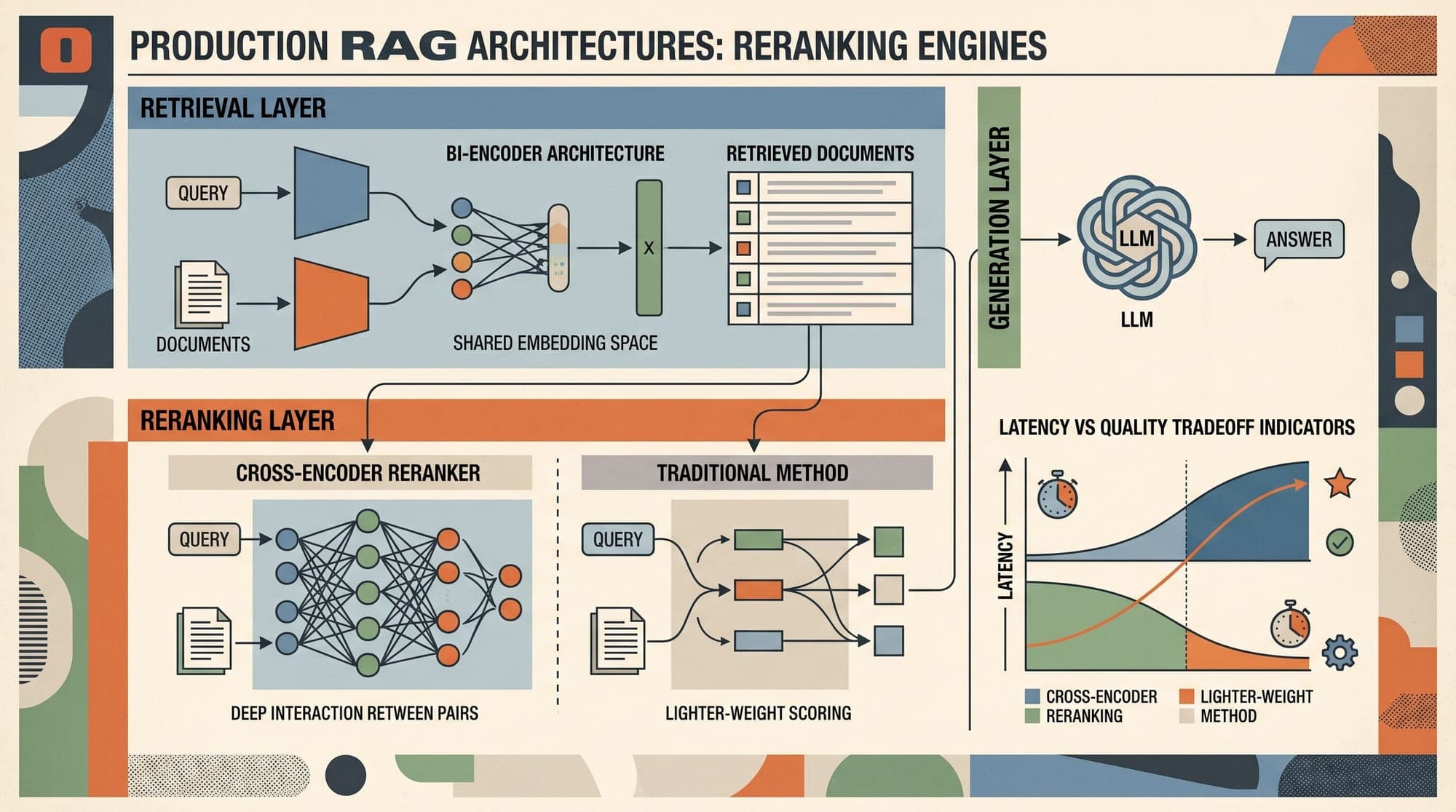
Reranking is the highest-ROI component most production RAG systems can add. A vector index retrieves 50–200 candidates in sub-millisecond time; a cross-encoder reranker jointly attends over each query-document pair and returns a precision-tuned top 10 for the LLM. The typical quality lift is +5 to +15 NDCG@10 points across BEIR and MTEB benchmarks — often the difference between a RAG system that hallucinates and one that answers correctly.
This comparison covers the reranker landscape in mid-2026: cross-encoders (BGE-Reranker-v2, Qwen3-Reranker, mxbai-rerank, Jina Reranker v2), late-interaction models (ColBERT v2), proprietary APIs (Cohere Rerank 3.5, Voyage rerank-2), and ultra-lightweight distilled models (FlashRank). We evaluate architecture, latency, quality benchmarks, licensing, and self-hosted economics.
Architecture Landscape
| Approach | How it works | Latency (per query) | Storage | Typical NDCG lift |
|---|---|---|---|---|
| Bi-encoder (first stage) | Independent embeddings, cosine similarity | <1 ms (index lookup) | 1 vector/doc (~3 KB) | Baseline |
| Cross-encoder | Joint [Q; D] attention, CLS pooling | 50–500 ms (top 100) | None (compute on-the-fly) | +5–15 NDCG |
| ColBERT (late interaction) | Token-level multi-vector similarity, max-sim | 5–50 ms | 1 vector/token (~30 KB/doc) | +3–8 NDCG |
| LLM-as-reranker (pointwise/listwise) | Prompted LLM scores or orders docs | 100–2000 ms | None | +6–10 NDCG |
The dominant production pattern remains bi-encoder retrieve (top 100) → cross-encoder rerank (top 10) → LLM generate. ColBERT replaces the bi-encoder for single-stage high-precision retrieval at higher storage cost. LLM-based rerankers are used only when budget allows and top-20 quality is critical.
Open-Weight Cross-Encoder Leaderboard (May 2026)
| Model | Parameters | BEIR Avg nDCG@10 | License | Best For |
|---|---|---|---|---|
| Qwen3-Reranker-8B | ~8B | ~77.0 | Tongyi Qianwen | Maximum quality |
| BGE-Reranker-v2-Gemma | ~9B | ~73.7 | MIT | Quality ceiling |
| BGE-Reranker-v2-Minicpm-Layerwise | ~2.7B | ~73.2 | MIT | Quality + speed |
| Qwen3-Reranker-4B | ~4B | ~75.2 | Tongyi Qianwen | Balanced |
| BGE-Reranker-v2-M3 | ~0.6B | ~71.5 | MIT | Default production |
| Qwen3-Reranker-0.6B | ~0.6B | ~71.4 | Tongyi Qianwen | Small-footprint quality |
| Jina ColBERT v2 | ~0.5B | ~70.1 | CC-BY-NC + Commercial | Late-interaction |
| Jina Reranker v2 base multilingual | ~278M | ~69.4 | CC-BY-NC + Commercial | Latency-critical |
| mxbai-rerank-large-v1 | ~435M | ~59.4 | Apache 2.0 | English; fast |
| ms-marco-MiniLM-L-12-v2 | ~33M | ~60.1 | Apache 2.0 | Legacy baseline |
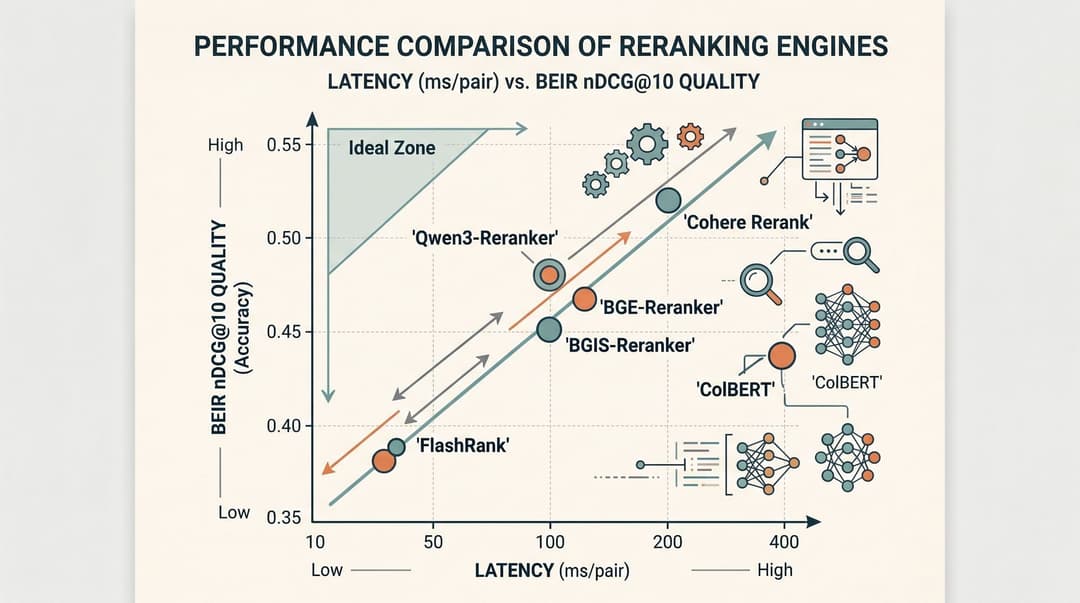
BGE-Reranker-v2-M3 (0.6B, MIT) is the right default for most teams in 2026 — best quality/latency/license combination. The 9B Gemma variant is the quality ceiling if you can absorb ~42 ms/pair latency. Qwen3-Reranker models lead BEIR but carry Tongyi Qianwen license restrictions (commercial use permitted with scale/competitive-use limits).
Latency Profile on Single L40S GPU (Batch 32, 512-token context)
| Model | Latency per Pair | Throughput (pairs/sec) | 100-pair rerank time |
|---|---|---|---|
| ms-marco-MiniLM-L-12-v2 | ~4 ms | ~250 | ~400 ms |
| mxbai-rerank-large-v1 | ~8 ms | ~125 | ~800 ms |
| Jina Reranker v2 | ~6 ms | ~165 | ~600 ms |
| BGE-Reranker-v2-M3 (0.6B) | ~12 ms | ~83 | ~1.2 s |
| Jina ColBERT v2 | ~10 ms (late-interaction) | ~100 | ~1.0 s |
| BGE-Reranker-v2-Gemma (9B) | ~42 ms | ~24 | ~4.2 s |
| Qwen3-Reranker-8B | ~38 ms | ~26 | ~3.8 s |
Source: Presenc AI latency benchmarks, L40S GPU, batch 32
For reference, Agentset's independent benchmark shows BGE-Reranker-v2-M3 at 2,383 ms average latency (P50 825 ms) vs Cohere Rerank 3.5 at 392 ms (P50 285 ms) on their test harness — the difference reflects self-hosted vs. optimized API infrastructure. On dedicated GPU with TEI dynamic batching, BGE-M3 is substantially faster.
Proprietary API Rerankers
| API | Model | Cost per 1K queries (100 docs each) | Latency (P50) | Context | Notes |
|---|---|---|---|---|---|
| Cohere Rerank 3.5 | rerank-v3.5 | ~$1–2 | ~285–373 ms | 4K tokens, 100+ langs | Best English quality; closed model | | Voyage AI rerank-2 | rerank-2 | ~$1–2 | ~300–400 ms | 16K tokens | Strong long-context |
| Jina AI Reranker v2 | jina-reranker-v2-base-multilingual | ~$1–2 | ~300–500 ms | 8K tokens | Open-weight equivalent available | | OpenAI (model rerank) | GPT-4o/mini via prompt | ~$5–15 | 500–2000 ms | 128K tokens | Listwise; expensive at scale |
Hosted APIs make sense for <10K queries/day or rapid prototyping. Self-hosted economics break even at approximately 1 million queries/day for most workloads — BGE-M3 on a single L40S handles ~7M pairs/day (~70K 100-pair reranks).
Ultra-Lightweight: FlashRank
FlashRank (TinyBERT-L-2-v2, ~67M params) runs in ~2–5 ms/pair on CPU with zero GPU dependency. On NQ/WebQ benchmarks it achieves Top-10 accuracy of 61.57% (NQ) and 60.62% (WebQ) — competitive with MiniLM but 10x faster on CPU. Use case: edge deployment, CPU-only servers, or as a pre-filter before a heavier cross-encoder.
Source: Abdallah et al., 2025 — Table 14 reranking results
Late Interaction: ColBERT v2
ColBERT computes token-level embeddings and uses max-sim scoring at query time. Quality approaches cross-encoders (+3–8 NDCG over bi-encoder) with 5–50 ms latency. The tradeoff: 30 KB/doc storage (vs 3 KB for bi-encoder) and more complex inference (PLAID/IVF indexes). Jina ColBERT v2 is the leading open-weight variant (CC-BY-NC + commercial license required). Use when you need single-stage retrieval with reranker-like quality, especially for multilingual or domain-shift workloads.
Production Deployment Patterns (Surveyed)
| Reranker Choice | Share of Production RAG Deployments |
|---|---|
| BGE-Reranker-v2 family | ~28% |
| Cohere Rerank 3 (proprietary API) | ~16% |
| Qwen3-Reranker family | ~12% |
| Jina Reranker / ColBERT | ~8% |
| ms-marco-MiniLM (legacy) | ~7% |
| Voyage AI rerank-2 (proprietary API) | ~6% |
| OpenAI top-k via model rerank | ~5% |
| No reranker (single-stage) | ~36% |
Source: Presenc AI cross-industry survey through Q1 2026
Over one-third of production RAG systems still run single-stage retrieval. The reranker pays off when recall@100 is materially above recall@5 on your eval set — the reranker exists to recover that gap.
Self-Hosted Stack: TEI + Vector DB
# Text Embeddings Inference (Hugging Face) for reranking
docker run -p 8080:80 --gpus all \
    -v $PWD/data:/data \
    ghcr.io/huggingface/text-embeddings-inference:1.5 \
    --model-id BAAI/bge-reranker-v2-m3
# Python client
import requests
resp = requests.post("http://localhost:8080/rerank", json={
"query": "what is RAG?",
"texts": ["doc1", "doc2", "doc3"],
"raw_scores": False
})
# Returns scored, sorted indices: [{"index": 0, "score": 0.94}, ...]TEI provides dynamic batching, ONNX runtime for CPU, CUDA/Metal/Vulkan for GPU, and an OpenAPI spec. Pair with Qdrant/Weaviate/Chroma for the vector stage; most now support native reranking processors (Qdrant rerank, OpenSearch ML Commons).
When to Use Each
| Scenario | Recommendation |
|---|---|
| Default production RAG, GPU available | BGE-Reranker-v2-M3 (TEI) |
| Maximum quality, latency budget >4s | BGE-Reranker-v2-Gemma or Qwen3-Reranker-8B |
| CPU-only / edge / <100ms budget | FlashRank (TinyBERT) or mxbai-rerank-base |
| Multilingual + domain shift, single-stage | Jina ColBERT v2 |
| <10K queries/day, no GPU ops | Cohere Rerank 3.5 API |
| Long-context docs (>4K tokens) | Voyage AI rerank-2 API |
| English-only, Apache 2.0 required | mxbai-rerank-large-v1 |
Quality on Novel Queries
The arXiv 2508.16757 study (Abdallah et al., 2025) introduces FutureQueryEval — queries absent from LLM training until May 2025. Key finding: LLM-based rerankers (RankGPT, RankLLaMA) generalize poorly to novel queries; lightweight cross-encoders (MonoT5, LiT5, FlashRank) maintain performance. This reinforces that fine-tuned BERT-style cross-encoders remain more robust for production RAG than prompted LLMs, especially in evolving domains.
Summary Decision Matrix
| Priority | Choose |
|---|---|
| Best overall (quality/speed/license) | BGE-Reranker-v2-M3 |
| Quality ceiling, GPU budget | BGE-Reranker-v2-Gemma / Qwen3-Reranker-8B |
| CPU-only, ultra-low latency | FlashRank |
| Single-stage, multilingual | Jina ColBERT v2 |
| No infra, fast start | Cohere Rerank 3.5 API |
| Apache 2.0, English | mxbai-rerank-large-v1 |
Sources
- LocalAIMaster Research Team, "Reranking & Cross-Encoders Complete Guide (2026): BGE, Cohere, Jina, ColBERT for RAG," May 2, 2026. https://localaimaster.com/blog/reranking-cross-encoders-guide
- Agentset, "BAAI/BGE Reranker v2 M3 vs Cohere Rerank 3.5 | Reranker Comparison," 2026. https://agentset.ai/rerankers/compare/baaibge-reranker-v2-m3-vs-cohere-rerank-35
- Presenc AI, "Best Open-Weight Reranker Models 2026," May 2026. https://presenc.ai/research/best-open-weight-reranker-models-2026
- Abdallah, Piryani, Mozafari, Ali, Jatowt, "How Good are LLM-based Rerankers? An Empirical Analysis of State-of-the-Art Reranking Models," arXiv:2508.16757v1, August 2025. https://arxiv.org/abs/2508.16757
