Open Weights14 articles

Open Weights

Articles

  • Liquid AI Ships LFM2.5-DSpark Draft Models for Up to 3.2x Faster Inference

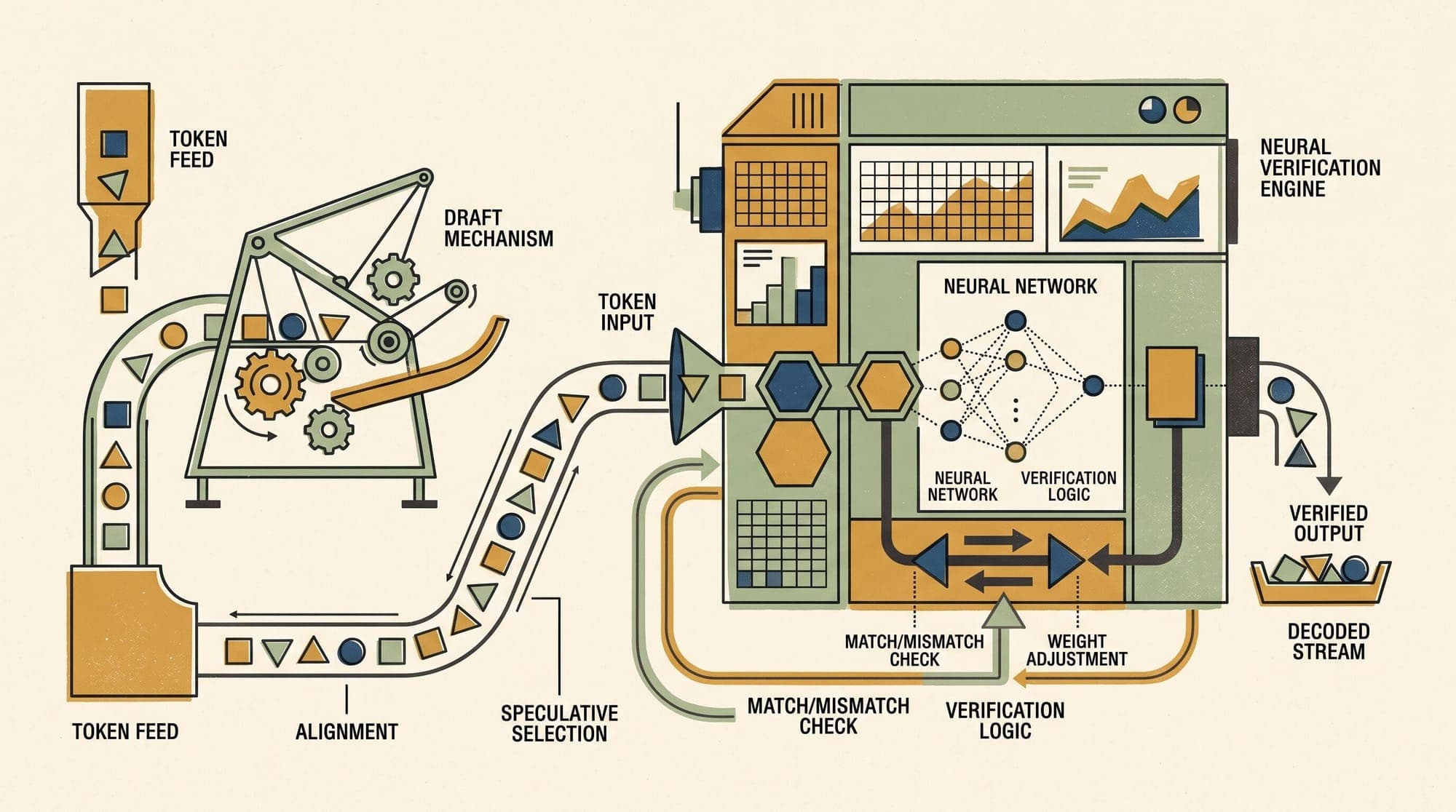
    Liquid AI has released speculative decoding draft checkpoints for three models across its LFM2.5 series: LFM2.5-1.2B-Instruct, LFM2.5-2.6B, and the mixture-of-experts model LFM2.5-8B-A1B. The release introduces small companion models designed to accelerate auto-regressive generation without altering final token distributions. The draft models are available in Safetensors and GGUF formats on Hugging Face, with immediate support implemented for SGLang and llama.cpp. Architecture and Draft Desig

    1 min
  • Unsloth Releases Dynamic V3.0 GGUFs for Qwen 3.8 27B with 1-Bit Mode and MTP

    Unsloth AI has published its Dynamic V3.0 quantization suite for Alibaba's Qwen 3.8 27B model family, releasing optimized GGUF and NVFP4 checkpoints alongside public calibration matrices. The release claims a greater than 10 percent increase in top-1 percent accuracy at identical file sizes compared to standard baseline quantizations, while introducing an ultra-low-bit dynamic tier that operates within 8GB of memory. Qwen 3.8 27B is a dense vision-language model utilizing hybrid attention layer

    1 min
  • Liquid AI Releases Quantization-Aware Distilled Q4_0 Checkpoints for LFM2.5 Models

    Liquid AI has released Quantization-Aware Distillation (QAD) Q4_0 GGUF checkpoints for its LFM2.5 model series, allowing edge runtimes to execute 4-bit quantized non-transformer architectures without the accuracy degradation typically associated with standard post-training quantization (PTQ). The release covers four models in the LFM2.5 family: LFM2.5-230M, LFM2.5-350M, LFM2.5-1.2B-Instruct, and LFM2.5-2.6B. The checkpoints are packaged in the standard GGUF format and run across llama.cpp and c

    1 min
  • Reference-Free Preference Optimization: How ORPO and SimPO Eliminate Reference Models in LLM Alignment

    Aligning large language models with human preferences has historically relied on two distinct stages after pretraining: Supervised Fine-Tuning (SFT) to establish instruction-following behaviors, followed by reinforcement learning from human feedback (RLHF) or Direct Preference Optimization (DPO) to maximize response quality. While DPO removed the need for explicit reward modeling and complex actor-critic policy loops (such as Proximal Policy Optimization, or PPO), it retained an architectural b

    1 min
  • Mistral Expands Platform to Host Third-Party Open Weights Starting with GLM-5.2

    Mistral AI has broadened its API platform to host external open-weight foundation models, beginning with Zhipu AI's GLM-5.2. The move marks a strategic shift for the Paris-based AI company from serving only in-house architectures (such as Mistral Small, Mistral Medium, Mistral Large, and Voxtral) toward operating as a sovereign managed inference hub for third-party open weights. The integration introduces GLM-5.2 under the model identifier zai-glm-5-2 in public preview. The model is hosted with

    1 min
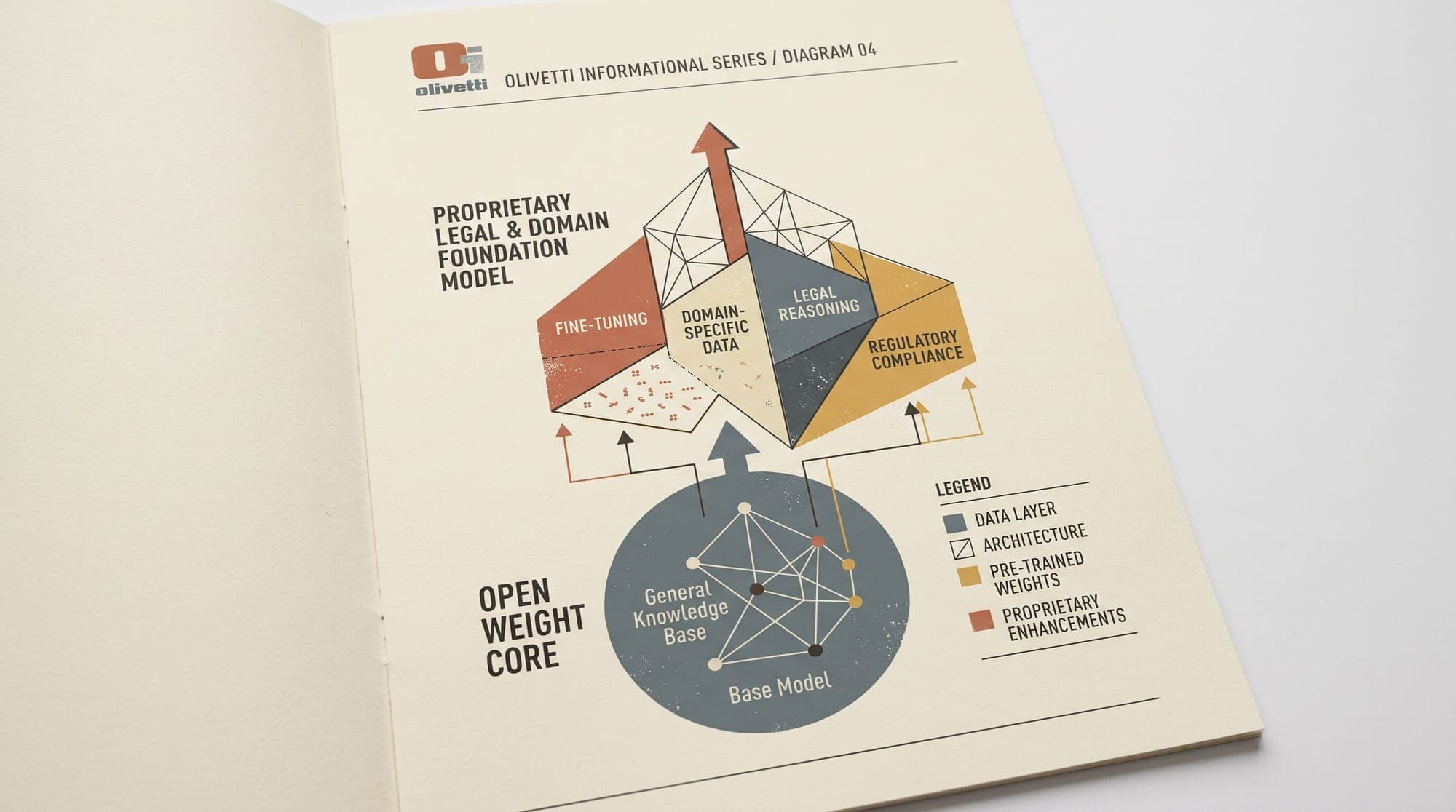
  • Harvey Introduces Tenet, Its First In-House Legal LLM Trained on Moonshot's Kimi K3

    Legal AI startup Harvey has announced Harvey Tenet, its first proprietary, in-house foundation model tailored for legal workflows. The release marks a strategic shift for the $11 billion legal tech company, which has historically relied on API access to third-party frontier models from OpenAI and Anthropic. Tenet is post-trained on top of Kimi K3, an open-weights model released in July 2026 by Chinese AI lab Moonshot AI. The initiative is part of a broader platform update titled Harvey II, whic

    1 min
  • Sentence Transformers v6.0 Adds Native Multi-Vector Late Interaction for ColBERT and ColPali

    Hugging Face has released Sentence Transformers v6.0, adding native multi-vector late-interaction retrieval to the library through a new MultiVectorEncoder interface. The update integrates ColBERT-style models and vision-language document retrieval systems directly into the standard Sentence Transformers workflow alongside dense bi-encoders, sparse models, and cross-encoder rerankers. Mechanics of Late Interaction and MaxSim Standard dense embedding models compress an entire passage or query

    1 min
  • Tencent Releases UI-Mate: Open-Weight Foundation GUI Agents with In-Context Demonstration Learning

    Tencent's HY Frontier team has released UI-Mate, an open-weight foundation GUI agent designed for autonomous computer operation across desktop environments. Available in 27-billion and 9-billion parameter configurations, the models pair environment-grounded reinforcement learning with an in-context demonstration pipeline that allows agents to reference structured human workflows during execution. Alongside model weights on Hugging Face, Tencent published a technical report, code repository, and

    1 min
  • Nvidia's Nemotron 3.5 Lightning bets on speed over size

    Nvidia has released Nemotron 3.5 Lightning, the first model in a new Nemotron 3.5 family, and it is playing a different game than most open-weight releases this year. Instead of chasing the highest intelligence score, Nvidia built a compact model that runs fast and cheap while still matching much larger rivals on standard benchmarks. A small model that keeps up Lightning carries 31.6 billion total parameters, but only 3.6 billion are active at any moment. It keeps the hybrid Mamba-Transformer

    1 min
  • Moonshot AI's Kimi K3 tops benchmarks as Chinese models reach the frontier

    A two-year-old Beijing startup has produced a model that sits closer to the American frontier than anything from Alphabet, Meta, or SpaceX. Moonshot AI's Kimi K3, released July 16, is a 2.8-trillion-parameter open-weight system that jumped to first place on Arena.ai's Frontend Code leaderboard within hours of release, scoring 1,679 points against 1,631 for Anthropic's Claude Fable 5. It was the first Chinese model ever to top that board. On the Artificial Analysis Intelligence Index, K3 debuted

    1 min
  • Zuckerberg argues superintelligence belongs in individual hands, not institutions

    Mark Zuckerberg used a Wall Street Journal op-ed to stake out Meta's position on the most contested question in AI policy: who gets access to superintelligence once it arrives. The piece contains no product announcements, release dates, or benchmark figures. It is a positioning argument, not a technical roadmap. Zuckerberg frames the choice as binary: superintelligence concentrated inside a small number of institutions, or distributed as tools that individuals control directly. He calls the lat

    1 min
  • Three open letters split the AI industry on open weights and development pacing

    In the span of one week in late July 2026, three open letters from different factions of the AI industry laid bare a fundamental disagreement about how to govern frontier model development. The letters address open weights, distillation, and whether the pace of AI progress should be deliberately slowed. Letter 1: Microsoft's open weights coalition (July 24) Microsoft organized a letter titled "Open Weights and American AI Leadership" signed by 235 companies including NVIDIA, Amazon, Y Combina

    1 min