Autoregressive generation in large language models exhibits an asymmetric computational profile between initial prompt processing (prefill) and subsequent incremental generation (decode). While prefill parallelizes across all prompt tokens and achieves high compute utilization on modern tensor accelerators, token-by-token decoding is heavily memory-bandwidth bound. Each generated token requires reading the entire accumulated Key-Value (KV) cache from High Bandwidth Memory (HBM) into on-chip SRAM to compute attention against a single query token.
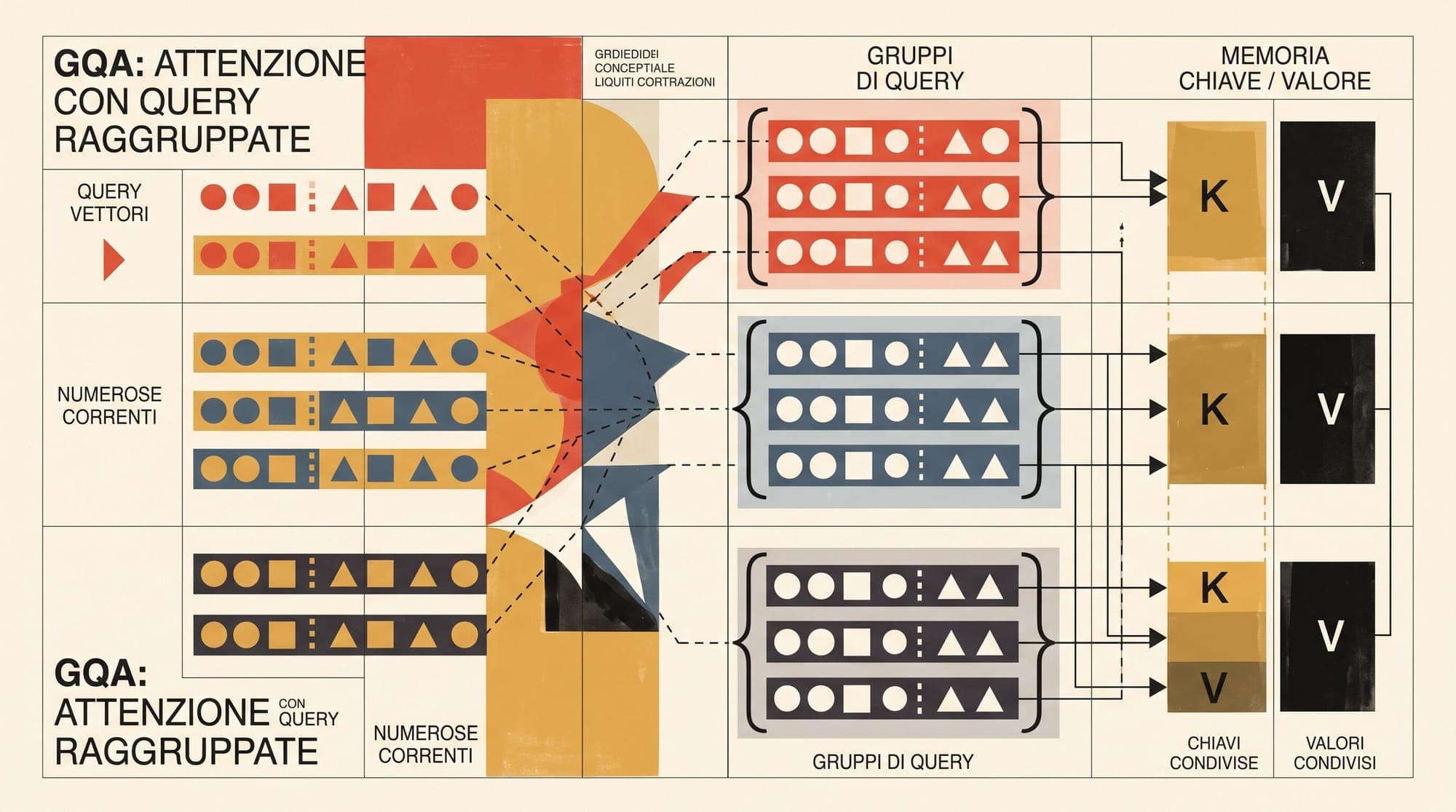
Standard Multi-Head Attention (MHA) allocates independent key and value projections for every attention head, causing the KV cache footprint and memory traffic to scale linearly with the number of query heads. To alleviate this memory wall, Multi-Query Attention (MQA) introduced extreme compression by sharing a single key-value head across all query heads, but often suffered from capacity degradation and optimization instability. Grouped-Query Attention (GQA) formalizes an intermediate parameterization where query heads are partitioned into groups that share key-value projections.
Standard Multi-Head Attention (MHA):
Query Heads (H): [ Q1 ] [ Q2 ] [ Q3 ] [ Q4 ] [ Q5 ] [ Q6 ] [ Q7 ] [ Q8 ]
Key Heads   (H): [ K1 ] [ K2 ] [ K3 ] [ K4 ] [ K5 ] [ K6 ] [ K7 ] [ K8 ]
Value Heads (H): [ V1 ] [ V2 ] [ V3 ] [ V4 ] [ V5 ] [ V6 ] [ V7 ] [ V8 ]

Grouped-Query Attention (GQA, G=2, Group Size=4):
Query Heads (H): [ Q1   Q2   Q3   Q4 ]   [ Q5   Q6   Q7   Q8 ]
Key Heads   (G): [        K1         ]   [        K2         ]
Value Heads (G): [        V1         ]   [        V2         ]

Multi-Query Attention (MQA, G=1):
Query Heads (H): [ Q1   Q2   Q3   Q4   Q5   Q6   Q7   Q8 ]
Key Heads   (1): [                  K1                  ]
Value Heads (1): [                  V1                  ]
Mathematical Formulation of Attention Variants
Consider a Transformer hidden state , where denotes batch size, denotes sequence length, and represents the model hidden dimension. Let be the number of query attention heads, and be the per-head projection dimension.
1. Multi-Head Attention (MHA)
In standard MHA (Vaswani et al., 2017), linear projection weight matrices transform input representations into query, key, and value tensors:
For each head :
Every query head maintains its own dedicated key and value representation in GPU memory.
2. Multi-Query Attention (MQA)
Introduced by Shazeer (2019), MQA collapses the key and value projections into a single shared head ():
The projection tensors produce distinct query matrices but only single key and value matrices:
For each query head , attention is computed against the shared and :
While MQA reduces the KV cache size by a factor of , the representational bottleneck can lead to performance degradation on reasoning-intensive benchmarks, synthetic retrieval, and long-context association tasks.
3. Grouped-Query Attention (GQA)
Introduced by Ainslie et al. (2023), Grouped-Query Attention partitions the query heads into uniform groups, where . Each group contains query heads that share a single key-value head pair:
Let group index . The projections yield:
For query head , attention is evaluated with the corresponding group key-value tensors:
When , GQA is identical to standard MHA. When , GQA reduces to MQA. Typical production configurations set with or , providing a 4x to 8x reduction in key-value memory while maintaining near-perfect benchmark parity with MHA.

Roofline Modeling and Arithmetic Intensity
To understand why GQA is the standard in modern LLM serving (e.g., Llama 2 and Llama 3), one must evaluate the operational arithmetic intensity during the autoregressive decode phase.
Decode Memory Traffic and Computational Complexity
In the decode phase, the model processes a single new token () for a batch of concurrent requests across a context of length .
For a Transformer layer with layers:
- Weight Matrix Memory Access:
Loading model weights requires reading the parameter matrices from HBM once per generated token: where is the parameter count.
- KV Cache Memory Access:
For each token in the batch, the entire historical KV cache of length must be loaded from HBM into SRAM: where the factor 2 accounts for both keys and values.
- Floating Point Operations (FLOPs):
The attention score computation and context aggregation require:
Operational Intensity Calculation
Arithmetic intensity is defined as the ratio of floating-point operations to memory bytes transferred across the memory bus:
Under standard MHA ():
On an NVIDIA H100 SXM GPU (3.35 TB/s HBM3 memory bandwidth, 989 TFLOPS BF16 tensor core throughput), the hardware balance point (ridge point) occurs at:
Because , MHA decoding is severely bandwidth-bound. The tensor cores spend over 99% of cycles stalled waiting for KV cache bytes to stream from HBM.
Under GQA with and ():
- KV cache memory transfer is reduced by 87.5% (8x reduction).
- Arithmetic intensity inside the attention kernel increases eightfold.
- For a fixed GPU memory budget, the maximum serving batch size increases by up to 8x, directly scaling serving throughput.
Checkpoint Conversion and the Uptraining Recipe
A crucial contribution of Ainslie et al. (2023) was demonstrating that existing MHA checkpoints can be converted into GQA or MQA architectures without training from scratch.
1. Mean-Pooling Weight Transformation
To convert an MHA checkpoint with key and value heads into a GQA checkpoint with groups, the projection slices corresponding to each group are averaged:
where represents the set of MHA head indices mapped to group .
Empirical evaluations showed that mean-pooling preserved substantial representation structure, outperforming first-head selection or random reinitialization.
2. Adaptation Pre-Training (Uptraining)
Following weight pooling, the model undergoes continued pre-training (uptraining) on approximately 5% of its original pre-training token budget. During uptraining:
- The query projections adjust their attention geometry to align with the shared subspace of the grouped key-value heads.
- GQA-8 (8 KV groups) achieved performance parity with the full MHA baseline across summarization (CNN/DailyMail, MultiNews), question answering (TriviaQA), and translation benchmarks (WMT14), while matching the high-throughput inference speed of MQA.
+------------------+-------------------+-------------------+-------------------+
| Architecture     | KV Cache Size     | Decode Bandwidth  | Benchmark Quality |
+------------------+-------------------+-------------------+-------------------+
| Multi-Head (MHA) | 100% (Baseline)   | High (Bottleneck) | Full Capacity     |
| Grouped (GQA-8)  | 12.5% to 25.0%    | Reduced (3-8x)    | ~100% of MHA      |
| Multi-Query(MQA) | 3.1% to 6.2%      | Minimal           | Slight Drop       |
+------------------+-------------------+-------------------+-------------------+
Architectural Evolution: GQA vs. Multi-Head Latent Attention (MLA)
While GQA has become the de facto standard across open-weight models (including Mistral 7B, Llama 3 8B/70B/405B, Qwen 2.5, and Gemma 2), architectural research has continued exploring KV cache compression.
DeepSeek-V2 and DeepSeek-V3 introduced Multi-Head Latent Attention (MLA), which compresses the KV cache through low-rank joint latent vectors:
where . During generation, only the compressed latent vector (along with a decoupled RoPE key) is cached in HBM. While MLA achieves even higher compression ratios than GQA, it requires matrix multiplications to project latents into per-head keys and values during computation, trading small compute overhead for maximum memory compression.
For general transformer architectures, GQA remains the standard because it requires zero decompression compute during kernel execution, seamlessly integrates with FlashAttention-2, FlashDecoding, and vLLM PagedAttention kernels, and enables multi-fold throughput scaling on enterprise inference clusters.
Sources
- Fast Transformer Decoding: One Write-Head is All You Need (Shazeer, 2019)
- GQA: Training Generalized Multi-Query Transformer Models from Multi-Head Checkpoints (Ainslie et al., 2023)
- Attention Is All You Need (Vaswani et al., 2017)
- Llama 2: Open Foundation and Fine-Tuned Chat Models (Touvron et al., 2023)
- DeepSeek-V2: A Strong, Economical, and Efficient Mixture-of-Experts Language Model (Liu et al., 2024)