Transformer4 articles

Transformer

Articles

  • Cross-Layer Attention: How Sharing Key-Value Tensors Across Transformer Layers Slashes KV Cache Memory

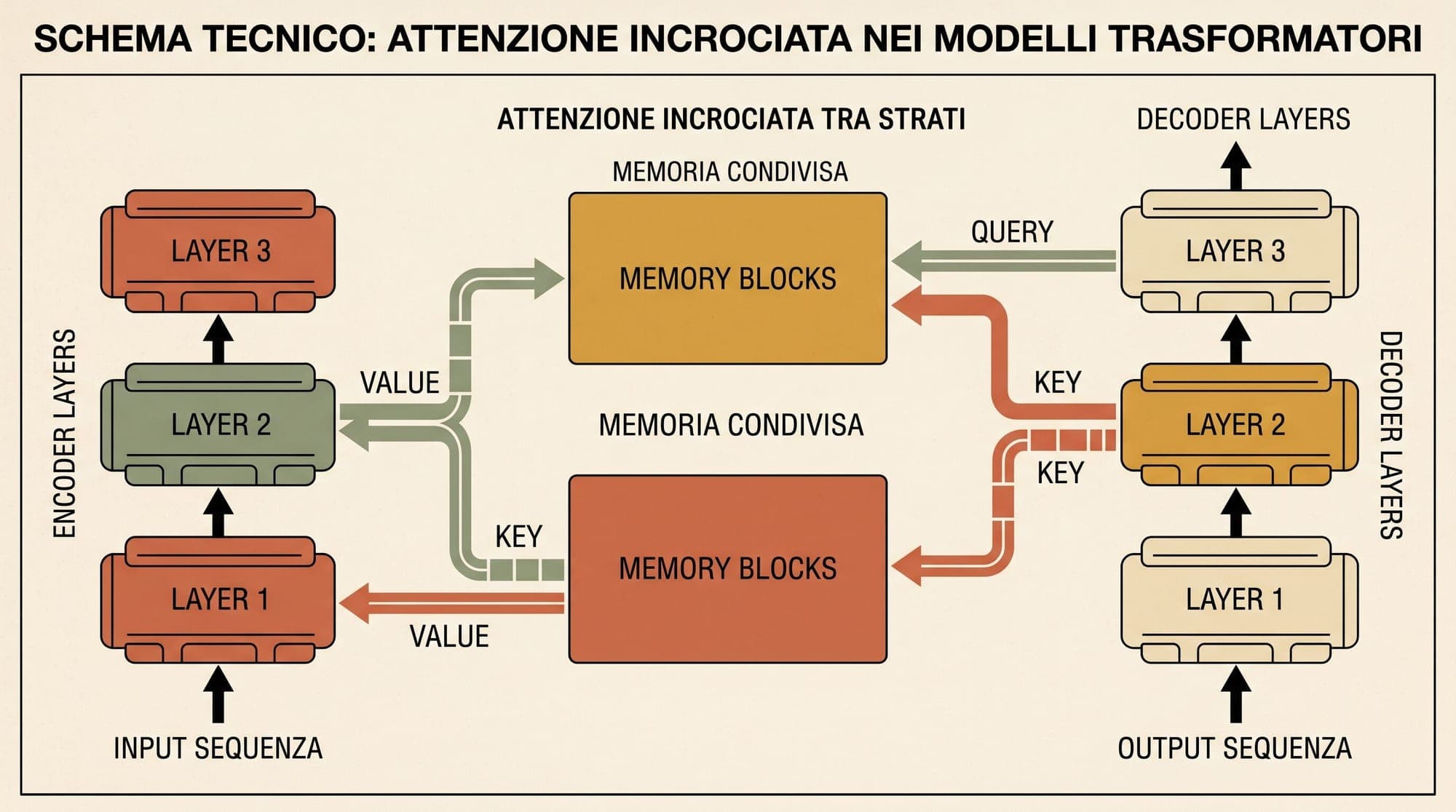
    In autoregressive large language models, the primary operational ceiling for serving long sequences and high batch concurrency is the Key-Value (KV) cache. During standard generation, every transformer layer computes and stores key and value activations for every token in the sequence to prevent quadratic recomputation during subsequent autoregressive decoding steps. While this mechanism transforms inference time complexity from $O(N^2)$ to $O(N)$ per generated token, it introduces a massive me

    1 min
  • Multi-Head Attention in Large Language Models: How Query, Key, and Value Projections Route Information Across Subspaces

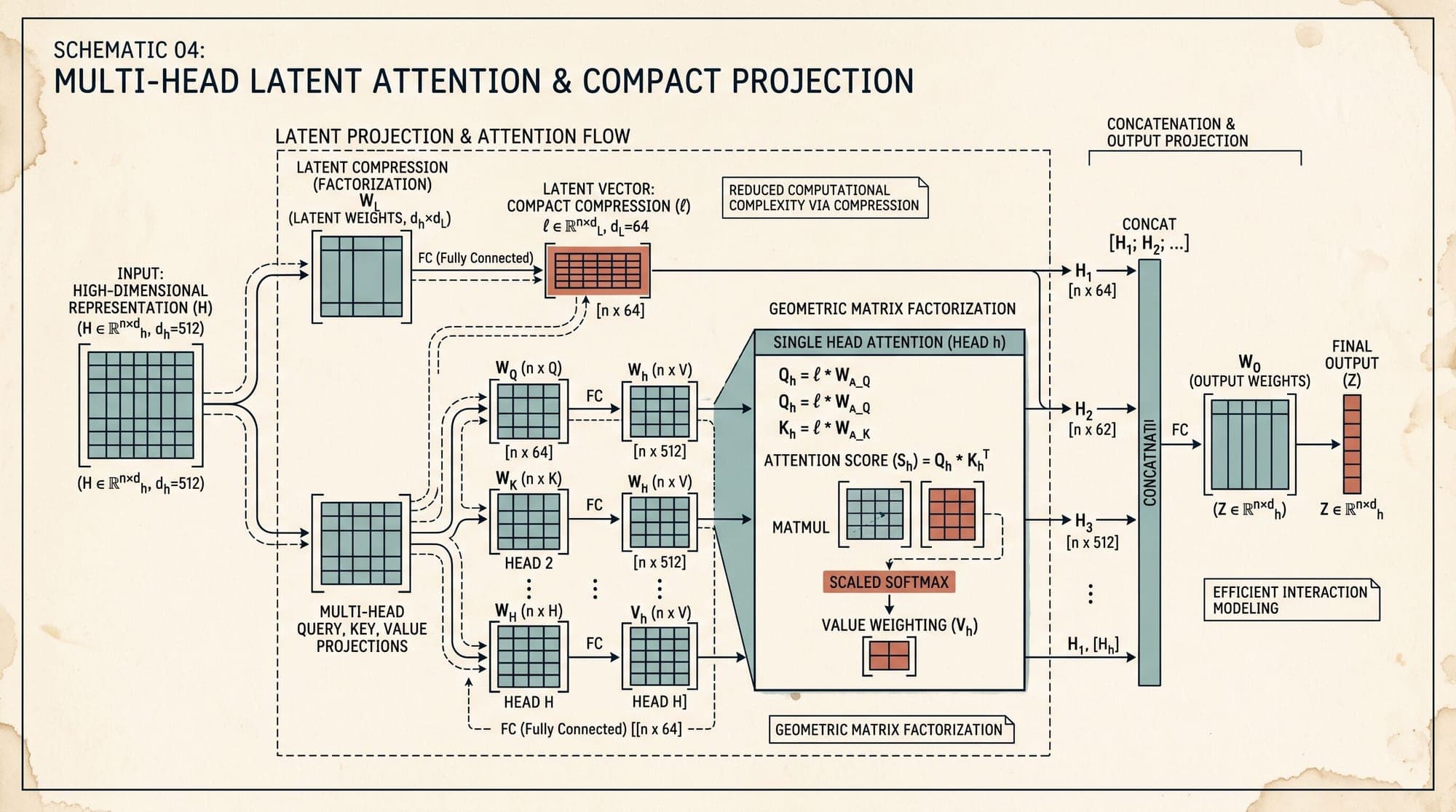
    Multi-Head Attention in Large Language Models: How Query, Key, and Value Projections Route Information Across Subspaces The attention mechanism serves as the computational core of modern Transformer architectures, providing a mechanism for tokens to dynamically exchange information across arbitrary sequence positions without recurrent state transitions or fixed convolutional receptive fields. While single-head attention computes a single set of attention weights per token pair, modern large lan

    1 min
  • Sliding Window Attention in Large Language Models: How Bounded Receptive Fields, Interleaved Layers, and Rolling KV Buffers Scale Contexts

    Standard causal multi-head attention imposes two severe computational constraints as sequence lengths expand into tens or hundreds of thousands of tokens. First, calculating pairwise query-key dot products scales quadratically with sequence length, requiring $O(N^2)$ floating-point operations. Second, autoregressive generation requires caching key and value projections for all preceding tokens, causing the key-value (KV) cache to grow linearly with sequence length $O(N)$ across all layers and at

    1 min
  • Attention with Linear Biases (ALiBi): How Static Positional Slopes Enable Zero-Shot Context Extrapolation

    Large language models process sequences by transforming discrete tokens into continuous vector representations. Standard dot-product self-attention is permutation-invariant: without explicit positional information, the attention operation treats a sequence as an unordered bag of tokens. Early transformer architectures addressed this limitation using Absolute Positional Embeddings (APE), either through fixed sinusoidal functions or learned lookup tables added directly to token embeddings. While

    1 min