Event-Driven AI Agent Architectures in Production: Kafka Streams, Webhook Ingestion, Idempotent Actor State Machines, and Dead-Letter Recovery
Early AI agent prototypes relied almost exclusively on synchronous HTTP request-response loops: a client dispatched a prompt, and a monolithic backend process held an open socket while an LLM reasoned, called tools, inspected results, and generated final responses. In production, this synchronous pattern collapses under the operational realities of autonomous agent workloads. Long-horizon agent trajectories span minutes or hours, involve non-deterministic latency spikes, require external asynchronous webhooks, and suffer from high network failure rates across multi-step tool invocations.
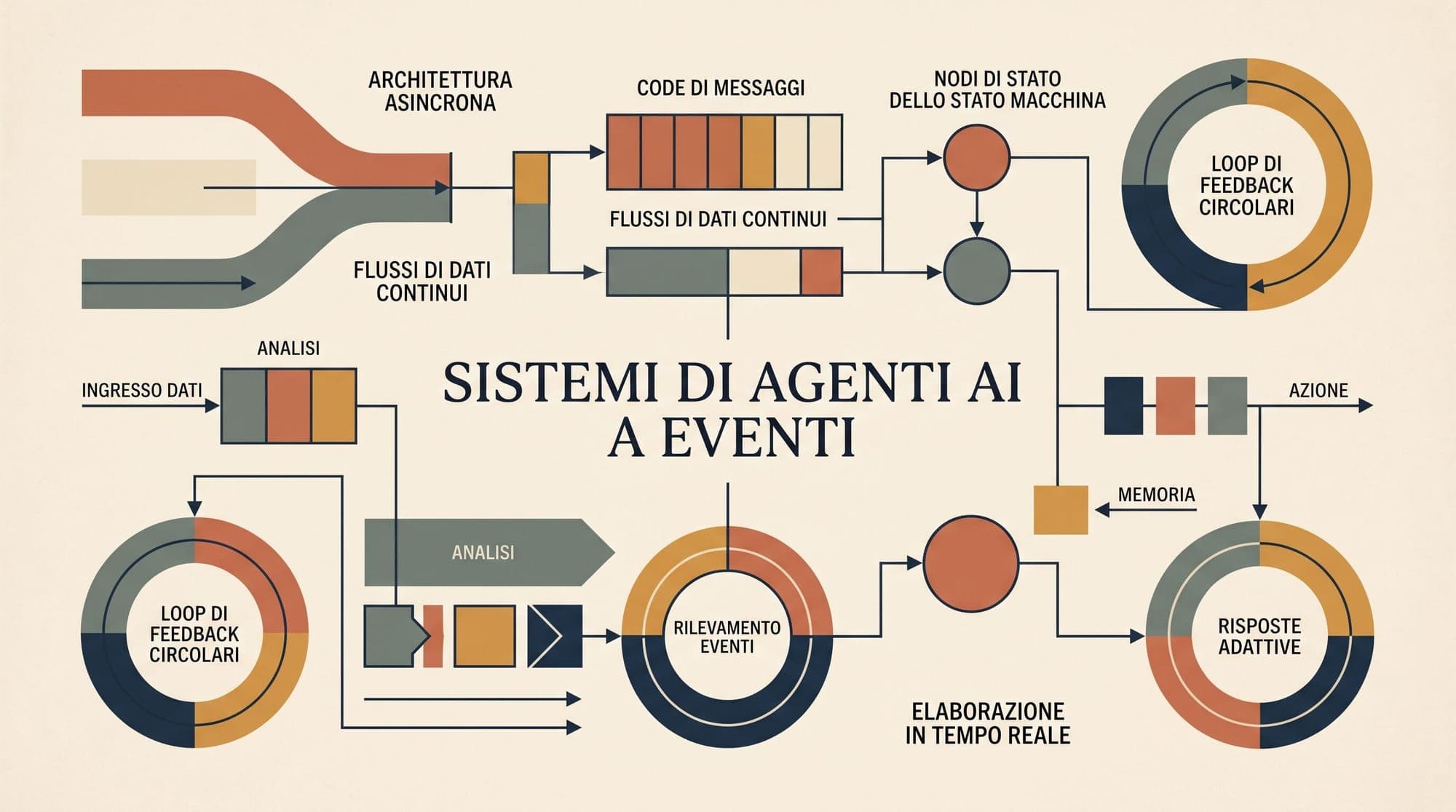
Production engineering teams are migrating agent orchestration to Event-Driven Architectures (EDA). By decoupling agent perception, reasoning, and tool execution across distributed event streams (such as Apache Kafka or NATS JetStream), systems achieve linear horizontal scalability, strict crash resilience, deterministic audit replayability, and safe human-in-the-loop intervention.
+---------------------------------------------------------------------------------------------------+
|                           EVENT-DRIVEN AI AGENT ARCHITECTURAL PIPELINE                           |
+---------------------------------------------------------------------------------------------------+
|                                                                                                   |
|  [ Inbound Events ]       [ Ingress & Gateway ]            [ Durable Event Log (Kafka / NATS) ]   |
|  - Webhooks (GitHub/Stripe) -> [ Signature Verification ]  -> Topic: `agent.tasks.incoming`       |
|  - User UI Prompts          -> [ CloudEvents Packaging  ]     (Partition Key: `session_id`)       |
|  - Cron Triggers            -> [ Token Rate Limiter     ]                                         |
|                                                                     |                             |
|                                                                     v                             |
|  [ Distributed Actor Engine (Dapr / Ray / Orleans) ] <--------------+                             |
|  +---------------------------------------------------------------------------------------------+  |
|  |  Virtual Agent Actor (Single-Threaded Execution per `session_id`)                           |  |
|  |  - Pulls context from persistent state store                                               |  |
|  |  - Formulates LLM inference payload (System Prompt + History + Event Stimulus)             |  |
|  |  - Dispatches non-blocking async LLM inference request                                      |  |
|  |  - Evaluates tool call intent vs. policy guardrails                                         |  |
|  +---------------------------------------------------------------------------------------------+  |
|         |                                                           |                             |
|         | (Side-Effect Tool Calls)                                  | (Direct Agent Response)     |
|         v                                                           v                             |
|  Topic: `agent.tools.execute`                               Topic: `agent.responses.completed`    |
|  (Partition Key: `tool_name`)                                       |                             |
|         |                                                           v                             |
|         v                                                [ Client Streaming Gateways ]            |
|  [ Isolated Tool Worker Fleet ]                          - Server-Sent Events (SSE)               |
|  - Sandboxed Container Execution (gVisor / Docker)       - WebSocket Emitters                     |
|  - Idempotency Key Validation                            - Webhook Push Notifications             |
|  - Executes API / DB / Shell Operation                                                            |
|         |                                                                                         |
|         v (Tool Result Event)                                                                     |
|  Topic: `agent.tools.completed` ------------------------------------+ (Re-enters Actor Mailbox)   |
|                                                                                                   |
+---------------------------------------------------------------------------------------------------+
The Synchronous Breakdown: Why Request-Response Fails
Synchronous HTTP architectures fail when applied to autonomous multi-step agents due to four core architectural constraints:
- Connection Fragility and Timeout Ceilings: Standard ingress controllers, load balancers, and reverse proxies (e.g., NGINX, AWS ALB, Cloudflare) enforce hard HTTP read timeouts typically bounded between 30 and 120 seconds. An agent performing multi-hop retrieval, code synthesis, and test execution easily exceeds these windows, resulting in severed connections and orphaned background execution threads.
- The Dual-Write Hazard: When an agent modifies local database state (e.g., updating conversation history) and simultaneously dispatches an external tool action (e.g., executing a Stripe charge or GitHub commit), a network drop or container crash between the two operations creates state divergence.
- Head-of-Line Blocking and Resource Contention: Holding synchronous compute threads open while awaiting external LLM inference responses (which often exhibit tail latencies of 5,000ms to 20,000ms) starves worker thread pools and exhausts connection sockets.
- Uncoordinated Concurrency: If a user submits follow-up instructions while an agent is actively running tools, synchronous handlers either drop the incoming message or spawn race conditions across mutable context states.
Decoupling the execution model into discrete event producers, immutable event topics, and asynchronous stateful consumers eliminates these structural failure modes.
Core Primitives of Event-Driven Agent Systems
1. Standardized Event Ingestion with CloudEvents
Production agent gateways standardize all inbound stimuli using the CNCF CloudEvents specification. A unified schema ensures that whether a stimulus originates from a user prompt, a GitHub webhook, or a cron scheduler, downstream agent actors process a homogeneous payload format:
{
  "specversion": "1.0",
  "id": "evt-9b1deb4d-3b7d-4bad-9bdd-2b0d7b3dcb6d",
  "source": "/integrations/github/webhook",
  "type": "com.company.agent.task.trigger",
  "datacontenttype": "application/json",
  "time": "2026-08-23T18:00:00Z",
  "subject": "session-prod-8842",
  "data": {
    "session_id": "session-prod-8842",
    "user_id": "usr_9912",
    "event_type": "pull_request.opened",
    "payload": {
      "repo": "enterprise/core-api",
      "pr_number": 1402,
      "diff_url": "https://api.github.com/repos/enterprise/core-api/pulls/1402"
    },
    "idempotency_key": "github-pr-1402-v1"
  }
}
2. Ordered Partitioning on the Event Backbone
To preserve deterministic conversation order without locking the entire queue, event topics in Apache Kafka or NATS are partitioned strictly by session_id or agent_id.
- Intra-Session Sequencing: All events belonging to a given session map to the identical partition, ensuring strict sequential processing of user inputs, tool responses, and model reasoning steps.
- Inter-Session Parallelism: Thousands of distinct agent sessions distribute evenly across partitions, allowing horizontally scaled consumer pods to process workloads in parallel without cross-session lock contention.
3. Stateful Virtual Actors for Agent Reasoning
Managing agent state inside stateless web handlers requires repeated database reads and writes on every turn. Modern frameworks address this by deploying agent logic onto Virtual Actor runtimes, such as Dapr Virtual Actors or Microsoft Orleans.
- Each agent instance exists as a distributed, stateful virtual actor identified by its
session_id. - The runtime guarantees that each actor processes messages sequentially from a dedicated mailbox, preventing race conditions.
- When an actor is idle, the runtime serializes its state to persistent storage (e.g., Redis, PostgreSQL, or DynamoDB) and reclaims memory. When a new event arrives for that
session_id, the runtime automatically reconstitutes the actor on an available node.
State Consistency: The Transactional Outbox Pattern
To prevent state corruption when an agent transitions between reasoning, database updates, and tool message publishing, production architectures deploy the Transactional Outbox Pattern.
+------------------------------------------------------------------------------------+
|                       TRANSACTIONAL OUTBOX PATTERN FOR AGENTS                      |
+------------------------------------------------------------------------------------+
|                                                                                    |
|  [ Agent Processing Step ]                                                         |
|         |                                                                          |
|         v                                                                          |
|  BEGIN TRANSACTION;                                                                |
|    -- 1. Mutate Agent Conversation State                                           |
|    UPDATE agent_sessions                                                           |
|    SET context_history = context_history || :new_turn, step_count = step_count + 1  |
|    WHERE session_id = :session_id;                                                 |
|                                                                                    |
|    -- 2. Insert Outbound Action Event into Outbox Table                            |
|    INSERT INTO agent_outbox (event_id, destination_topic, payload, created_at)     |
|    VALUES (:event_id, 'agent.tools.execute', :tool_payload, NOW());                |
|  COMMIT;                                                                           |
|         |                                                                          |
|         v (Write-Ahead Log Stream)                                                 |
|  [ Change Data Capture Engine (Debezium / Kafka Connect) ]                          |
|         |                                                                          |
|         v (Guaranteed At-Least-Once Delivery)                                      |
|  [ Apache Kafka Topic: `agent.tools.execute` ]                                     |
|                                                                                    |
+------------------------------------------------------------------------------------+
By persisting the updated agent trajectory and the outbound tool request within a single ACID database transaction, the system guarantees that an outbound event cannot be emitted if the state write fails, and conversely, state cannot advance without capturing the outbound event.

Enforcing Tool Idempotency
Because distributed message brokers provide at-least-once delivery semantics, tool consumers can receive duplicate events during network retries or consumer rebalancing. Every side-effecting tool worker must enforce strict idempotency:
import redis
import json

redis_client = redis.Redis(host='redis-cluster', port=6379, db=0)

def execute_tool_safely(event_payload: dict) -> dict:
    idempotency_key = event_payload["idempotency_key"]
    lock_key = f"lock:tool:{idempotency_key}"
    result_key = f"result:tool:{idempotency_key}"

    # Check if this exact action has already completed
    cached_result = redis_client.get(result_key)
    if cached_result:
        return json.loads(cached_result)

    # Acquire distributed mutex lock with a 60-second TTL
    acquired = redis_client.set(lock_key, "processing", nx=True, ex=60)
    if not acquired:
        raise RuntimeError(f"Concurrent execution detected for key {idempotency_key}")

    try:
        # Execute side-effecting operation (e.g., API mutation)
        output = perform_api_action(event_payload["parameters"])

        # Persist completed result with 24-hour expiration
        redis_client.set(result_key, json.dumps(output), ex=86400)
        return output
    finally:
        redis_client.delete(lock_key)
Failure Topologies, Dead-Letter Queues, and Human-in-the-Loop
In standard microservices, retrying a failed HTTP request with identical parameters often succeeds if the error was transient. In LLM agent systems, model-generated errors are frequently semantic defects (e.g., hallucinations resulting in malformed JSON or illegal SQL parameters). Blindly retrying these operations creates poison pill loops that exhaust compute budgets.
+-----------------------------------------------------------------------------------+
|               EVENT-DRIVEN DEAD-LETTER & HITL RECOVERY TOPOLOGY                   |
+-----------------------------------------------------------------------------------+
|                                                                                   |
|  [ Tool Worker receives `agent.tools.execute` ]                                   |
|         |                                                                         |
|         +---> Execution Fails (Schema Error / Auth Exception / System Crash)      |
|         |                                                                         |
|         v                                                                         |
|  [ Retry Interceptor (Exponential Backoff + Jitter) ]                             |
|         |                                                                         |
|         +---> Attempts < 3: Re-enqueue to retry queue with delay                  |
|         |                                                                         |
|         +---> Attempts >= 3: Emit to Dead-Letter Queue (DLQ)                      |
|                     |                                                             |
|                     v                                                             |
|         [ Topic: `agent.dlq.poison-pills` ]                                       |
|                     |                                                             |
|                     +---> Non-Critical Failure: Auto-generate Reflection Event    |
|                     |     Topic: `agent.tools.completed` (status: "error")        |
|                     |     (Actor receives error context and attempts alternative) |
|                     |                                                             |
|                     +---> Critical / Side-Effect Failure: Escalate to Human       |
|                           Topic: `agent.hitl.pending_approval`                    |
|                                 |                                                 |
|                                 v                                                 |
|                           [ Operations Dashboard ]                                |
|                           - Review original prompt & tool parameters              |
|                           - Manually approve, modify, or cancel action            |
|                                 |                                                 |
|                                 v                                                 |
|                           Topic: `agent.hitl.resolved`                            |
|                           (Actor resumes execution from saved state)              |
|                                                                                   |
+-----------------------------------------------------------------------------------+
1. The Dead-Letter Loop
When a tool execution exceeds its maximum retry threshold (typically 3 attempts), the message moves to agent.dlq.poison-pills. An automated supervisor analyzes the failure:
- Recoverable Execution Errors: If the error is an unrecoverable schema validation issue, the supervisor constructs a synthetic error response event and publishes it back to
agent.tools.completed. The agent actor consumes this event as a negative tool result and engages self-correction routines. - Critical Policy Violations: If the failure involves security boundaries, financial transactions, or unauthorized mutations, the supervisor routes the task to a human escalation topic.
2. Asynchronous Human-in-the-Loop (HITL) Routing
Synchronous architectures force an agent to freeze active threads while waiting for human authorization. In an event-driven system, the agent actor transitions its internal state machine to AWAITING_APPROVAL, flushes its state to the persistence tier, and unloads from memory.
When a human operator approves or amends the action in an operations console, an agent.hitl.resolved event is published. The event broker routes the message to the partition assigned to session_id, the actor runtime revives the virtual actor, and trajectory execution resumes seamlessly.
Production Architecture Comparison
| Dimension | Synchronous HTTP Chains | Worker Queues (Celery / BullMQ) | Event-Driven Actors (Kafka + Dapr/Ray) | | :--- | :--- | :--- | :--- | | Max Trajectory Duration | < 120 seconds | Hours (limited by job lock) | Unlimited (fully asynchronous) | | State Consistency | Memory-only / manual DB writes | Task payload passing | ACID Transactional Outbox + Virtual Actor state | | Concurrency Model | Thread / socket per agent | Process per task | Virtual Actor mailbox (single-threaded per ID) | | Human-in-the-Loop | Impractical (socket timeout) | Polling / external task pause | Native event pause / resume | | Audit & Replayability | Ephemeral logs | Task result backend | Deterministic Event Sourcing across log partitions | | Operational Complexity | Minimal (monolithic) | Moderate (Redis + workers) | High (Kafka/NATS + Actor control plane) |
Architectural Rules for Production Deployment
- Partition by Session ID: Always partition core agent task and response topics by
session_id. Never allow unkeyed fan-out on topics driving stateful agent reasoning. - Decouple Tool Execution from Reasoning Actors: Never execute long-running, CPU-intensive, or network-bound tools inside the virtual actor thread. Always dispatch tool execution requests to dedicated, autoscaling tool worker pools over isolated event topics.
- Impose Strict Event TTLs: Unprocessed agent events sitting in queues during downstream outages can become stale. Stamp every event with a
valid_untiltimestamp and drop or dead-letter expired tasks before invoking LLMs. - Mandate Outbox Pattern for Side Effects: Never execute dual writes between conversation databases and message brokers. Use transactional outbox tables combined with Change Data Capture (CDC) to guarantee event emission.
Sources
- How Apache Kafka and Flink Power Event-Driven Agentic AI in Real Time - Kai Waehner, 2025
- The Transactional Outbox Pattern - Confluent Developer
- Why Dapr Agents: Virtual Actors and Event-Driven Workflows - Dapr AI Documentation
- Transactional Outbox Pattern - AWS Prescriptive Guidance - Amazon Web Services
- CloudEvents Specification v1.0.2 - Cloud Native Computing Foundation (CNCF)
- Event-Driven Architecture for AI Agent Systems - Zylos Research