Autonomous AI agents deployed in production environments frequently fail when tasks require long-horizon reasoning across dozens of sequential tool calls. While single-turn tool calling is well-handled by modern frontier models, multi-step workflows introduce compounding failure modes: plan drift, unrecoverable tool exceptions, context window saturation, and premature task termination.
Building resilient agent systems requires moving beyond simple prompt-driven loops. Production engineering has converged on structured decomposition topologies, tool-mediated plan state machines, and dynamic replanning triggers.

The Core Tension: Pure Reactivity vs. Rigid Planning
The two foundational paradigms for autonomous execution represent opposing trade-offs in adaptability and global goal adherence:
- Reactive Step-by-Step Execution (ReAct): Introduced by Yao et al. (2023), the ReAct pattern interleaves reasoning traces ("Thought") with tool calls ("Action") and environment feedback ("Observation"). While highly adaptable to unexpected tool outputs, ReAct is myopic. As the conversation history expands beyond 8 to 10 turns, the model suffers from attention dilution, forgets original constraints, and frequently enters repetitive retry loops when encountering unexpected errors.
- Monolithic Upfront Planning (Plan-and-Solve): Proposed by Wang et al. (2023), Plan-and-Solve prompts the model to generate a complete step-by-step roadmap before executing any action. While this establishes a clear global trajectory, static plans are notoriously brittle. If step 2 returns unexpected data or an API error, steps 3 through 8 become invalid, leading the execution engine to carry out obsolete instructions.
Production systems solve this tension by decoupling global planning from local step execution, wrapping both within a deterministic state machine that triggers dynamic replanning only when explicit environmental pre-conditions fail.
Decomposition Topologies: Chains, DAGs, and Hierarchical Networks
Task decomposition breaks a complex objective into manageable sub-goals. Production systems deploy three distinct topological structures depending on task complexity:
1. Sequential Linear Chains
In simple workflows, tasks are decomposed into a linear array of sub-goals executed in strict order. Each step consumes the artifact generated by the previous step. While simple to implement, linear chains cannot exploit parallelism and fail completely if any intermediate node lacks an error recovery path.
2. Directed Acyclic Graphs (DAGs)
For tasks involving multi-source data gathering or independent sub-problems, planners emit a dependency graph. Nodes represent discrete actions and edges represent data dependencies. An orchestrator evaluates the topological sort of the graph, scheduling independent nodes concurrently across parallel worker pools.
3. Hierarchical Task Networks (HTN)
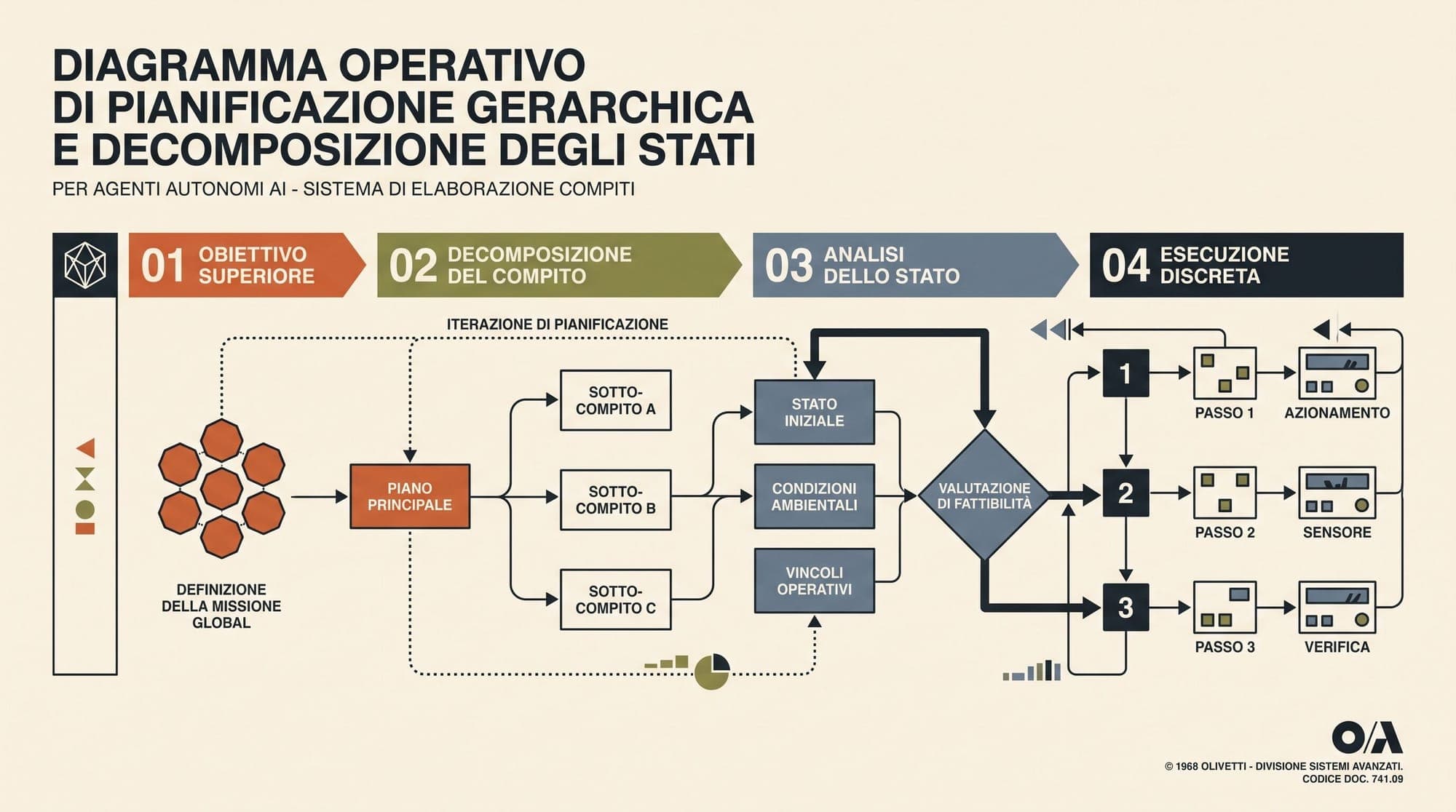
For open-ended tasks (such as writing an entire software module or conducting comprehensive research), flat plans fail due to excessive detail at early stages. Hierarchical architectures, explored in recent work on global planning and hierarchical execution by Zhang et al. (2025), employ a two-level hierarchy:
- Global Planner: Operates at a high level of abstraction, defining coarse phases (e.g., Environment Reconnaissance, Code Modification, Test Suite Verification).
- Local Executors: Ephemeral sub-agents instantiated per phase. Each sub-agent decomposes its specific phase into atomic tool calls, runs to completion, and returns a concise status report to the global planner.
+-------------------------------------------------------------------+
|                        Global Planner                             |
|          Decomposes User Goal into High-Level Phases              |
+---------------------------------+---------------------------------+
                                  |
         +------------------------+------------------------+
         |                                                 |
         v                                                 v
+-----------------------+                         +-----------------------+
|   Sub-Agent: Phase 1  |                         |   Sub-Agent: Phase 2  |
|  (Local Task Queue)   |                         |  (Local Task Queue)   |
+-----------+-----------+                         +-----------+-----------+
            |                                                 |
    +-------+-------+                                 +-------+-------+
    | Tool Executor |                                 | Tool Executor |
    +---------------+                                 +---------------+
Structured Plan State Machines vs. In-Prompt Text Plans
A common anti-pattern in early agent design was storing the plan as free-form markdown text inside the LLM prompt. As tool outputs flooded the context window, models routinely altered completed tasks, duplicated work, or lost track of pending items.
Production frameworks treat the plan as an external, structured state machine. The LLM interacts with the plan exclusively through explicit tool calls. Leading implementations, including the task tracking architectures described by Arize AI and agent harnesses like Claude Code, expose dedicated planning primitives:
plan_create(tasks: Task[]): Initializes a structured task list with unique identifiers and dependencies.plan_update(task_id: string, status: Status, notes?: string): Transitions a task through deterministic states:PENDING,IN_PROGRESS,COMPLETED,BLOCKED, orFAILED.plan_read(): Retrieves the current execution state and completed artifacts.
State Transition Invariants
The execution harness enforces runtime invariants outside the LLM:
- Single Concurrency: Exactly one task may be
IN_PROGRESSper worker thread at any given time. - Dependency Resolution: A task cannot transition to
IN_PROGRESSuntil all prerequisite tasks are markedCOMPLETED. - Immutability of History: Completed tasks cannot be silently removed; changes require an explicit replan operation that logs the modification reason.
{
  "tasks": [
    {
      "id": "task-01",
      "description": "Extract API endpoints from OpenAPI specification",
      "status": "COMPLETED",
      "output_summary": "Identified 4 endpoints: /auth, /users, /items, /checkout"
    },
    {
      "id": "task-02",
      "description": "Generate integration tests for /auth endpoint",
      "status": "IN_PROGRESS",
      "dependencies": ["task-01"]
    },
    {
      "id": "task-03",
      "description": "Run test suite and verify coverage",
      "status": "PENDING",
      "dependencies": ["task-02"]
    }
  ]
}
Dynamic Replanning and Tree Search
A static plan fails when the execution environment changes. Production agents implement dynamic replanning mechanisms to handle runtime variance without resetting the entire task context.
Replanning Triggers
Rather than querying the planner after every atomic action (which introduces severe latency and token cost), replanning is event-driven:
- Deterministic Tool Failures: An executor encounters repeated exceptions (e.g., 3 failed attempts to query an API) or a non-zero process exit code.
- Precondition Violations: A tool output contradicts an assumption made during the planning phase (e.g., an expected database table does not exist).
- Goal-Distance Divergence: An evaluation heuristic detects that intermediate outputs are not converging toward the target state.
Tree-Search Planning: LATS and RAP
For safety-critical or high-value tasks, deterministic single-path execution is insufficient. Advanced architectures integrate tree-search algorithms:
- Language Agent Tree Search (LATS): Formulated by Zhou et al. (2023), LATS combines Monte Carlo Tree Search (MCTS) with language model value functions. The agent samples multiple prospective action paths, evaluates environment feedback at each step, and uses backpropagation of reward scores to select optimal trajectories.
- Reasoning via Planning (RAP): Developed by Hao et al. (2023), RAP builds an internal world model where the LLM simulates the future state transitions of its proposed actions before executing them in the physical environment.
In high-throughput production serving, full tree search is often reserved for high-level phase planning, while low-level actions utilize bounded backtrack queues to limit latency.
Context Hygiene and Serving Economics
Long-horizon planning introduces severe token economics and context degradation challenges. When an agent executes 20 tool calls, raw tool responses (such as JSON payloads, terminal outputs, and file contents) can consume hundreds of thousands of tokens.
Empirical evaluations on complex benchmarks like TravelPlanner (Xie et al., 2024) show that standard LLMs suffer a steep degradation in constraint satisfaction when context windows become cluttered with raw tool telemetry.
Architectural Best Practices for Production:
- Asymmetric Model Tiering: Deploy frontier reasoning models (such as Claude 3.7 Sonnet or DeepSeek R1) for initial high-level task decomposition and replanning. Route atomic step execution and tool calling to smaller, highly optimized models (such as Qwen 2.5 7B or Llama 3.3 70B), cutting inference spend by 60% to 80%.
- Context Isolation via Sub-Agent Sandboxing: Never feed raw tool execution logs back into the global planning prompt. Sub-agents run inside isolated context windows, summarize their findings upon completion, and return only the structured outcome to update the central plan state.
- State Checkpointing: Store serializable snapshots of the plan state and environment variables after every completed task. If a fatal crash occurs, the agent resumes execution from the latest checkpoint rather than re-running the entire workflow.
Sources
- Yao et al. (2023) - ReAct: Synergizing Reasoning and Acting in Language Models (ArXiv)
- Wang et al. (2023) - Plan-and-Solve Prompting: Improving Zero-Shot Chain-of-Thought Reasoning by Large Language Models (ArXiv)
- Zhou et al. (2023) - Language Agent Tree Search Unifies Reasoning Acting and Planning (ArXiv)
- Hao et al. (2023) - Reasoning with Language Model is Planning with World Model (ArXiv)
- Zhang et al. (2025) - Enhancing LLM-Based Agents via Global Planning and Hierarchical Execution (ArXiv)
- Xie et al. (2024) - TravelPlanner: A Benchmark for Assessing Complex Planning in Language Models (ArXiv)
- Arize AI (2025) - How to Build Planning Into Your Agent: The Architecture That Actually Works