Activation-Aware Weight Quantization (AWQ): Mathematical Foundations, Salient Weight Protection, and INT4 Tensor Core Execution
Large language models have transformed AI applications, but their deployment remains constrained by memory and compute barriers. A 70B parameter model in FP16 occupies ~140 GB of VRAM — exceeding even the 192 GB of NVIDIA's flagship B200 GPU, let alone edge devices. Quantization addresses this by reducing weight precision from 16-bit floats to 4-bit integers, shrinking model size by ~4×. However, naive rounding (Round-to-Nearest, RTN) catastrophically degrades model quality, especially at INT4 and below.
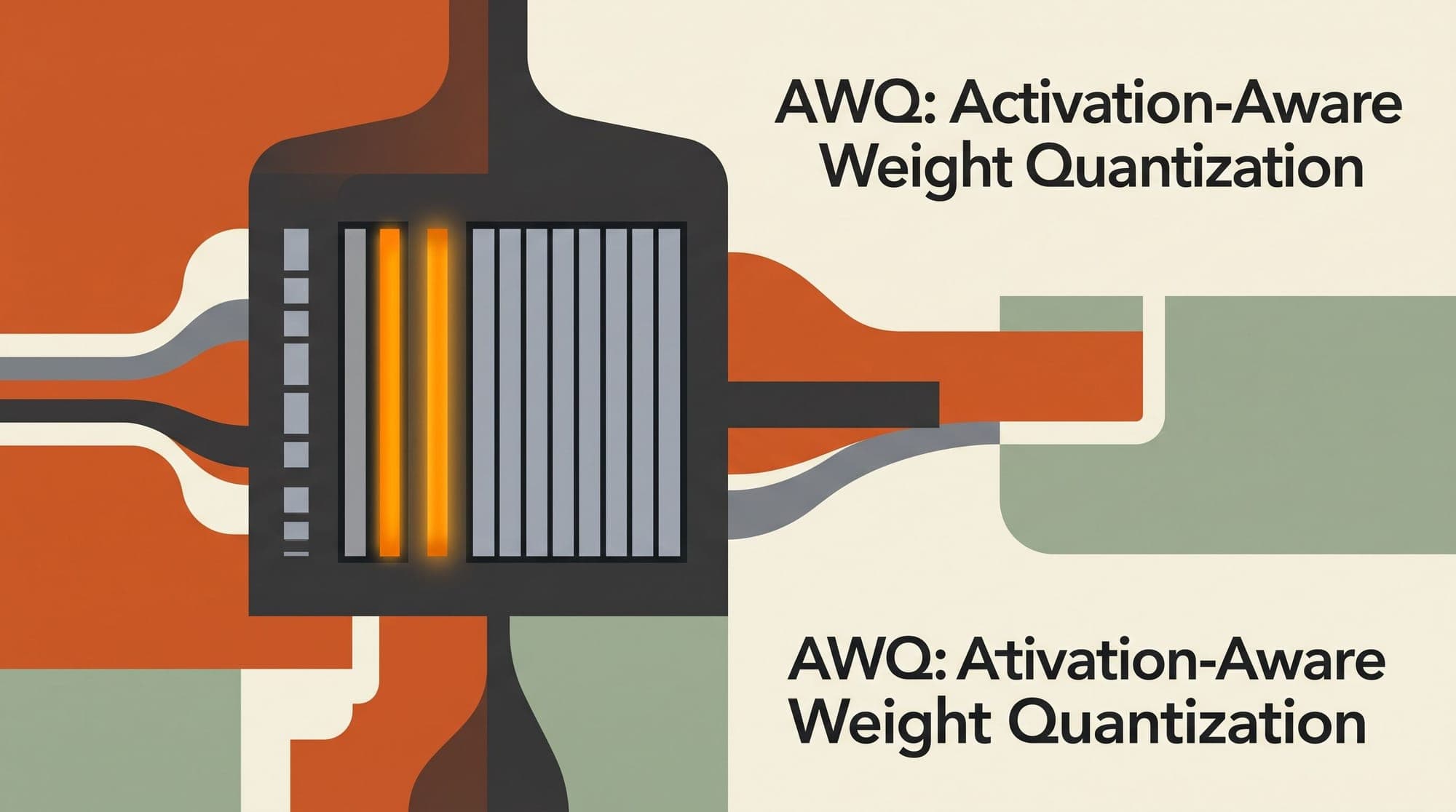
Activation-Aware Weight Quantization (AWQ), introduced by Lin et al. from MIT HAN Lab (arXiv:2306.00978, MLSys 2024 Best Paper Award), solves this through a simple but powerful insight: not all weights are equally important. By protecting only ~1% of "salient" weight channels — identified via activation magnitudes rather than weight magnitudes — AWQ achieves near-FP16 perplexity at INT4/INT3 precision without mixed-precision hardware overhead.
The Quantization Landscape
Quantization maps floating-point tensors to lower-bit integers. For LLMs, two settings dominate:
| Setting | Weights | Activations | Use Case | |---------|---------|-------------|----------| | W8A8 | INT8 | INT8 | Balanced compression, requires activation quantization | | W4A16 | INT4 | FP16 | Weight-only, maximum memory reduction, memory-bound decode acceleration |
AWQ targets weight-only grouped quantization (W4A16/INT3) — the only setting that simultaneously reduces memory footprint (enabling larger models on fixed hardware) and improves arithmetic intensity during autoregressive generation.
Why Weight-Only?
During autoregressive decoding, the model is memory-bound: arithmetic intensity (FLOPs/Byte) ≈ 1 on modern GPUs (peak ~165 TFLOPS / 1 TB/s bandwidth). Weight access dominates memory traffic by orders of magnitude over activation access. Quantizing weights 4× (FP16→INT4) raises arithmetic intensity to ~4 FLOPs/Byte, moving the workload toward compute-bound territory and unlocking 3-4× theoretical speedup.
Core Insight: Activation Magnitude Determines Weight Saliency
Standard importance metrics (weight L2 norm, magnitude) fail for LLMs. Lin et al. discovered that input activation magnitude identifies salient weight channels:
- Weight channels processing large-magnitude activations contribute disproportionately to layer output
- Quantization error on these channels is amplified by the activation magnitude
- Protecting ~1% of channels (by activation magnitude) recovers most of the FP16 perplexity
| Selection Method | 0.1% FP16 | 1% FP16 | 3% FP16 | |------------------|-----------|---------|---------| | Activation magnitude | ✓ Near-FP16 | ✓ Near-FP16 | ✓ Near-FP16 | | Weight magnitude | ✗ No improvement | ✗ Marginal | ✗ Marginal | | Random | ✗ No improvement | ✗ Marginal | ✗ Marginal |
Table: OPT-6.7B WikiText-2 perplexity under INT3-g128. Only activation-based selection works.
This is counterintuitive: weight-only quantization should look at activations, not weights, to determine which weights matter.
Mathematical Formulation: Per-Channel Scaling as Equivalent Transformation
Mixed-precision (keeping salient weights in FP16) is hardware-inefficient. AWQ instead applies an equivalent per-channel scaling transformation that reduces quantization error on salient channels while keeping all weights in INT4/INT3.
Quantization Error Analysis
For a weight group , standard symmetric quantization:
The quantization error for element with input :
where (uniform distribution).
Now scale the salient weight by and inversely scale the input:
Key observation: Scaling rarely changes the group maximum, so . The error ratio becomes:
Thus scaling up salient weights by reduces their relative quantization error by .
Optimal Scale Search
To balance salient vs. non-salient channels, AWQ searches for per-input-channel scaling factors minimizing output reconstruction error:
where = original FP16 weights, = cached activations from a small calibration set.
The quantization function is non-differentiable, so gradient-based optimization is unstable. AWQ constrains the search space using activation-awareness:
where = per-channel average activation magnitude, balances protection strength. A fast grid search (20 steps) over finds the optimum. Weight clipping further minimizes MSE.
AWQ vs. GPTQ vs. RTN: Key Differences
| Aspect | RTN | GPTQ | AWQ | |--------|-----|------|-----| | Method | Round-to-nearest | 2nd-order error compensation (Hessian) | Per-channel activation-aware scaling | | Calibration data | None | Large (128-192 sequences) | Tiny (16 sequences, 10× less) | | Backpropagation | No | No (but layer-wise reconstruction) | No | | Overfitting risk | Low | High (calibration-set dependent) | Minimal (activation stats only) | | Generalization | Poor at low bits | Domain-specific | Cross-domain, multi-modal | | Hardware format | Uniform INT4/INT3 | Uniform INT4/INT3 | Uniform INT4/INT3 | | Speed | Fastest | Slow (sequential layer processing) | Fast (parallelizable) |
Experimental Results
Base Models (LLaMA / Llama-2 / OPT)
| Model | FP16 | RTN (INT4) | GPTQ (INT4) | AWQ (INT4) | |-------|------|------------|-------------|------------| | LLaMA-7B | 5.68 | 5.96 | 6.22 | 5.78 | | LLaMA-13B | 5.09 | 5.25 | 5.23 | 5.19 | | LLaMA-30B | 4.10 | 4.23 | 4.24 | 4.21 | | LLaMA-65B | 3.53 | 3.67 | 3.66 | 3.62 | | Llama-2-70B | 3.32 | 3.46 | 3.42 | 3.41 |
WikiText-2 perplexity (↓). AWQ consistently beats GPTQ and RTN across scales.
Instruction-Tuned & Multi-Modal Models
AWQ is the first PTQ method to successfully quantize multi-modal LLMs without quality collapse:
| Model | Task | FP16 | RTN (INT4) | GPTQ (INT4) | AWQ (INT4) | |-------|------|------|------------|-------------|------------| | Vicuna-7B/13B | GPT-4 eval | — | ↓ | ↓ | ✓ Best | | CodeLlama-7B | MBPP pass@1 | 38.5 | 37.5 | 32.0 | 40.6 | | Llama-2-70B | GSM8K | 56.4 | 54.0 | 56.0 | 56.4 | | OpenFlamingo-9B | COCO CIDEr (32-shot) | 81.7 | 77.1 | 75.0 | 80.5 | | VILA-13B | 11 VLM benchmarks | — | — | — | Lossless |
Activation-aware scaling generalizes because it preserves the model's feature geometry, not just calibration-set statistics.
Data Efficiency & Robustness
- 10× smaller calibration set: AWQ reaches target perplexity with 16 sequences vs. GPTQ's 192
- Distribution shift resilience: Cross-domain calibration (PubMed→Enron) degrades AWQ by 0.5-0.6 PPL vs. GPTQ's 2.3-4.9
System Implementation: TinyChat — Realizing Theoretical Speedups
Quantization saves memory, but converting that to measured throughput requires systems work. TinyChat bridges this gap:
On-the-Fly Dequantization
Hardware lacks INT4×FP16 multiply instructions. TinyChat fuses dequantization into the GEMM kernel, avoiding DRAM writes of dequantized weights. Applied to both MM (prefill) and MV (decode) kernels.
SIMD-Aware Weight Packing
- ARM NEON (128-bit): Pack 32 INT4 weights per register using strided layout — 3 SIMD instructions vs. 96 scalar ops
- NVIDIA GPU: Pack 8 weights as for tensor core alignment
Kernel Fusion
- Fused LayerNorm (mul, div, sqrt in one kernel)
- Fused QKV projections + on-the-fly RoPE
- Pre-allocated KV cache with in-kernel updates
- Reduces kernel launch overhead (≈0.01 ms/kernel on RTX 4090)
Measured Speedups
| Platform | Model | FP16 (tokens/s) | AWQ INT4 (tokens/s) | Speedup | |----------|-------|-----------------|---------------------|---------| | RTX 4090 | Llama-2-7B | 52 | 162 | 3.1× | | RTX 4090 | Llama-2-13B | OOM | 99 | Enabled | | Jetson Orin | VILA-7B | 11.5 | 35.6 | 3.1× | | RTX 4070 (8GB) | Llama-2-13B | OOM | 33 | Enabled | | Raspberry Pi 4B | 7B model | — | 0.7 | Enabled |
Industry Adoption
AWQ has become the de facto standard for INT4 weight-only quantization across the inference stack:
- NVIDIA TensorRT-LLM: Native AWQ kernel support
- vLLM:
vllm/model_executor/layers/quantization/awq.py - Hugging Face Transformers:
AutoAWQForCausalLM,AwqConfig - AMD, Intel Neural Compressor, Google Vertex AI, AWS SageMaker, FastChat, LMDeploy, Hugging Face TGI
- 6M+ downloads of AWQ-quantized models on Hugging Face Hub
- Falcon-180B on single H200, Llama-2-70B on Jetson Orin 64GB
Limitations & When AWQ Isn't Enough
- INT2 and below: AWQ+GPTQ combination helps but quality degrades significantly
- Activation quantization (W4A4/W4A8): AWQ is weight-only; SmoothQuant / ZeroQuant address activation quantization
- Extreme compression: For <3-bit, QAT or distillation remains superior
- Non-transformer architectures: Designed for standard transformer linear layers
Conclusion
AWQ reframed LLM quantization from "uniform compression with error correction" to selective protection guided by activation statistics. Its contributions:
- Saliency via activations: Identified that ~1% of weight channels, detectable through activation magnitudes, dominate quantization error
- Hardware-friendly protection: Per-channel scaling achieves mixed-precision benefits in uniform INT4/INT3 format
- Generalization without overfitting: Calibration-set agnostic activation statistics preserve cross-domain, multi-modal capabilities
- Systems co-design: TinyChat demonstrates 3× real-world speedups on desktop, laptop, and mobile GPUs
AWQ established that intelligent quantization beats brute-force reconstruction — a principle now foundational to production LLM deployment at the edge and in datacenters.
Sources
- Lin, J., Tang, J., Tang, H., Yang, S., Chen, W.-M., Wang, W.-C., Xiao, G., Dang, X., Gan, C., & Han, S. (2023). AWQ: Activation-aware Weight Quantization for LLM Compression and Acceleration. arXiv:2306.00978v6. https://arxiv.org/abs/2306.00978
- MIT HAN Lab. AWQ Project Page. https://hanlab.mit.edu/projects/awq
- Frantar, E., Ashkboos, S., Hoefler, T., & Alistarh, D. (2022). GPTQ: Accurate Post-Training Quantization for Generative Pre-trained Transformers. arXiv:2210.17323. https://arxiv.org/abs/2210.17323
- Xiao, G., Lin, J., Seznec, M., Demouth, J., & Han, S. (2022). SmoothQuant: Accurate and Efficient Post-Training Quantization for Large Language Models. arXiv:2211.10438. https://arxiv.org/abs/2211.10438
- Dettmers, T., & Zettlemoyer, L. (2022). The Case for 4-bit Precision: k-bit Inference Scaling Laws. arXiv:2212.09720. https://arxiv.org/abs/2212.09720
- MIT HAN Lab. llm-awq GitHub Repository. https://github.com/mit-han-lab/llm-awq