Document parsing remains one of the primary failure modes in enterprise Retrieval-Augmented Generation (RAG) pipelines. While modern embedding models and vector databases offer sub-millisecond retrieval across millions of dense vectors, downstream generation quality remains bounded by the structural fidelity of upstream document ingestion. Naive text extractors like PyPDF or basic PDFMiner strip away structural metadata, flattening multi-column text into interleaved sentences, shredding table rows across unrelated chunks, and corrupting mathematical formulas.
To resolve these ingestion failures, four open-source document parsing frameworks have emerged as industry standards: IBM Docling, OpenDataLab MinerU, Marker, and Unstructured. Each engine implements distinct architectural trade-offs across layout detection models, table structure recognition networks, reading order heuristics, and hardware utilization.

Architectural Design and Model Backbones
Document parsers process visual layout and programmatic text tokens through multi-stage neural pipelines.
1. IBM Docling
Docling is engineered around a modular, document-native data model (DoclingDocument) that preserves hierarchical elements including headings, captions, formulas, and table structures.
- Programmatic Parser Backend: Docling utilizes
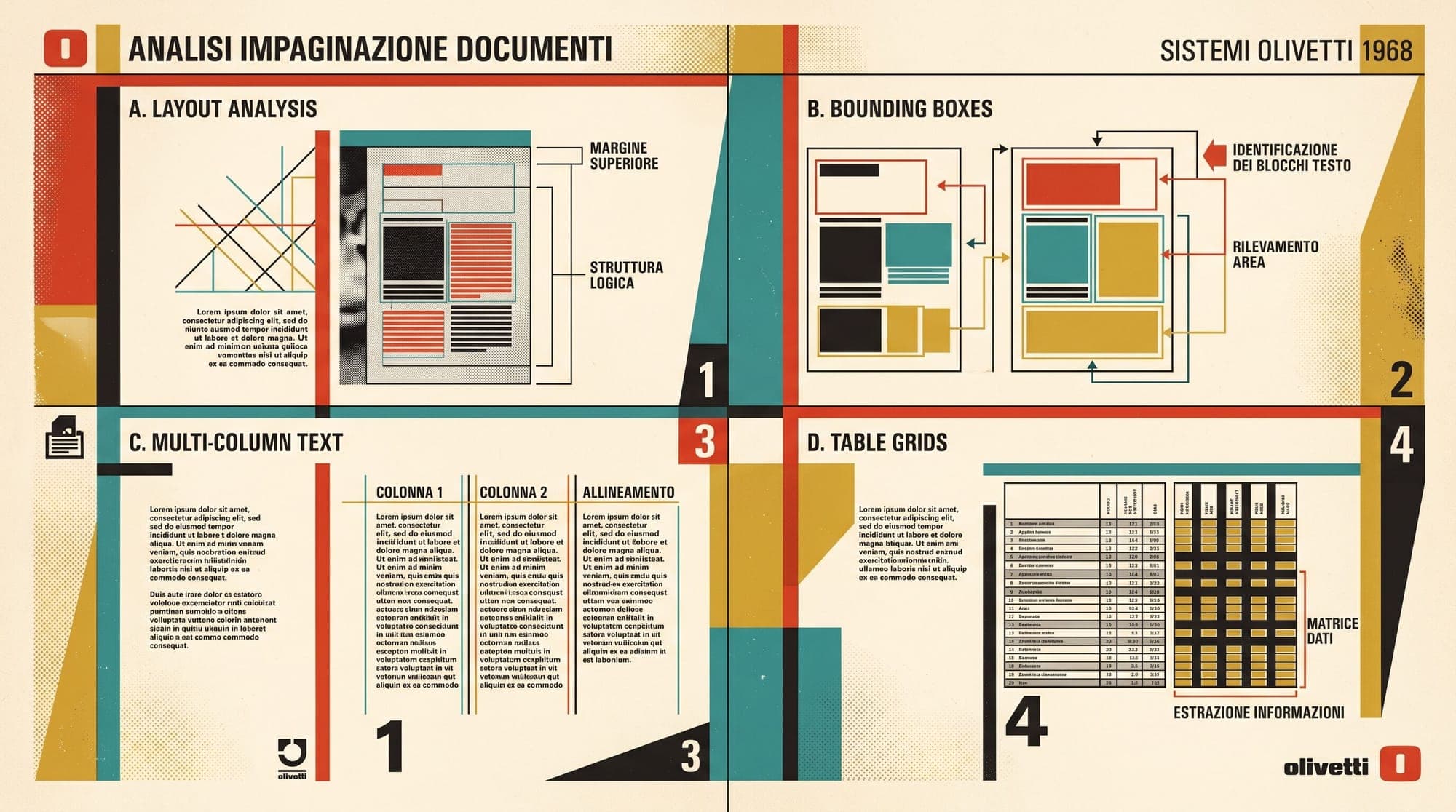
docling-parse, a high-throughput C++ library built on PDFium, to extract native vector paths, fonts, and text character bounding boxes in 40 to 80 milliseconds per page without invoking vision models. - Layout Analysis: For visual layout understanding, Docling deploys a lightweight RT-DETR (Real-Time DEtection TRansformer) model fine-tuned on the DocLayNet dataset (80,000 annotated document pages). It segments pages into bounding boxes for paragraphs, titles, section headers, tables, pictures, and code blocks.
- Table Extraction Backbone: Docling implements TableFormer, a specialized encoder-decoder transformer trained on structural table reconstruction that predicts both HTML table tags and cell bounding boxes. TableFormer operates in two configurations: Fast mode for standard grid tables and Accurate mode for complex financial tables with multi-level row and column spans.
- OCR Fallback: When pages lack embedded text layers, Docling routes image regions through RapidOCR, EasyOCR, or Tesseract.
- Licensing: Permissive MIT license across all core modules and trained weights.
2. OpenDataLab MinerU
MinerU (built upon PDF-Extract-Kit) is designed for high-density academic papers, scientific manuscripts, and technical textbooks.
- Layout Analysis: MinerU uses
DocLayout-YOLO, a modified YOLOv8 object detector optimized for dense academic multi-column layouts, figures, and inline or display mathematical equations. - Formula Recognition: Mathematical notation is parsed using UniMERNet and LayoutLM-based vision-language networks, translating visual formula bounding boxes directly into formatted LaTeX strings.
- Table Structure Recognition: MinerU pairs RapidTable with
StructEqTable, focusing on dense scientific tabular data and multi-page spanning tables. - Post-Processing Pipeline: MinerU automatically strips recurring running headers and page-number footers, merges split paragraphs across column boundaries, and reconstructs reading order through geometric graph traversal.
- Licensing: Apache 2.0 with custom terms for specific model checkpoint weights.
3. Marker
Marker, developed by Vik Paruchuri, converts documents directly into clean, GitHub-flavored Markdown and LaTeX with minimal runtime dependencies.
- Unified Surya Model Stack: Marker relies on the Surya OCR and layout toolkit. Surya uses specialized Vision Transformer (ViT) architectures for text line detection, language identification, reading order determination, and layout bounding box classification.
- Equation Parsing: Mathematical expressions are routed to
Texify, a lightweight vision encoder-decoder that converts equation crops into LaTeX. - Heuristic Table Parsing: Marker employs a hybrid table extraction method combining bounding box detection with rule-based cell alignment, with optional hooks for Vision-Language Model (VLM) post-processing on complex matrices.
- Licensing: GPL-3.0 copyleft license, with commercial dual-licensing options.
4. Unstructured
Unstructured operates as an enterprise ingestion gateway supporting 64 document and file formats (PDF, DOCX, PPTX, HTML, EPUB, and email archives).
- Partitioning Strategies: Unstructured provides distinct execution strategies via
partition_pdf: fast: Extracts raw text streams using PDFMiner without computer vision models, maximizing throughput on clean digital files.hi_res: Deploys Detectron2 or YOLOX object detection models to extract visual layout elements and coordinates.ocr_only: Forces full-page optical character recognition via Tesseract or PaddleOCR.auto: Dynamically selects between fast and hi-res based on detected digital text presence.- Element Abstraction: Parsed output is unified into an array of typed element objects (
Title,NarrativeText,Table,Header,Footer,ListItem). - Licensing: Apache 2.0 open-source library, complemented by commercial SaaS and hosted API options.
Table Structure Recognition: TEDS and Cell Integrity
Table extraction is the highest-variance component of document parsing. In financial services, regulatory compliance, and clinical research, misaligned cells directly corrupt numerical calculations during retrieval.
Table structure accuracy is measured by Tree-Edit-Distance-based Similarity (TEDS), which evaluates both the tree structure of HTML tags (<table>, <tr>, <td>, colspan, rowspan) and the OCR text content within each cell:
TEDS(T_a, T_b) = 1 - ( TreeEditDist(T_a, T_b) / max(|T_a|, |T_b|) )On the standard FinTabNet and PubTabNet benchmarks:
- Docling (TableFormer Accurate): Achieves 91.2% to 93.4% TEDS on FinTabNet. Because TableFormer explicitly models cell adjacency matrices and multi-column span coordinates, it preserves borderless accounting matrices where blank entries represent zero values.
- MinerU (StructEqTable): Delivers 90.5% to 92.8% TEDS on scientific tables, excelling at multi-line mathematical notation within table cells and cross-page table continuation.
- Marker (Surya Table): Scores 76.0% to 81.5% TEDS in standard local mode. Marker performs well on boxed, bordered tables with clear grid lines, but base heuristics can lose alignment on nested financial balance sheets unless paired with a secondary LLM refinement pass.
- Unstructured (Hi-Res Table Extraction): Scores 82.0% to 86.5% TEDS. It formats tables as HTML elements within its element stream, providing reliable parsing for standard enterprise reports.
Reading Order Recovery and Multi-Column Layouts
A critical failure mode in naive PDF processing is horizontal line scanning across multi-column layouts, which interleaves text from left and right columns.
- DocLayNet vs. Heuristic Graphs: Docling resolves reading order by combining RT-DETR visual bounding box classes with spatial topological sorting. It constructs a directed acyclic graph (DAG) representing parent-child relationships between section headings and paragraphs.
- Surya Reading Order Model: Marker deploys an explicit neural reading order detector that predicts ordering permutations directly from visual feature maps. This provides high stability on irregular multi-column layouts, sidebars, and callout boxes (reaching 96.1% layout accuracy on academic publications).
- Cross-Page Stitching: MinerU implements explicit multi-page state tracking. When a paragraph or table spans the boundary between page N and page N+1, MinerU detects unfinished sentence syntax and continuous table column coordinates to stitch the content into a single unified block before chunking.
Chunking Integration for RAG Architectures
Traditional RAG pipelines apply arbitrary character-window or token-window chunking (e.g., 512 tokens with 50-token overlap). This approach breaks section cohesion and splits tables across chunk boundaries.
Modern document parsing engines enable structure-aware chunking:
- Docling HybridChunker: Integrates directly with tokenizers from Hugging Face and OpenAI.
HybridChunkernavigates the parsedDoclingDocumenttree, ensuring that section headers remain attached to their descendant paragraphs, list items are kept intact, and complete tables are serialized as indivisible Markdown or HTML payloads within maximum token constraints. - Unstructured
chunk_by_title: Aggregates contiguous text elements under their nearest precedingTitleelement until a designated maximum character or token threshold is reached, automatically injecting section titles into chunk metadata. - MinerU and Marker Markdown Export: Both engines produce standardized Markdown headings (
#,##,###) and LaTeX delimiters ($$...$$), which plug directly into Markdown-aware splitters in LangChain, LlamaIndex, and Haystack.
Throughput, Compute Requirements, and Cost Economics
Deploying document parsing at enterprise scale requires balancing accuracy against compute latency and infrastructure costs.
Single-Page Latency by Hardware Tier
- x86 CPU (8 vCPU, Intel Xeon / AMD EPYC):
- Docling: 3.1 seconds per page (native PDF text); 6.8 seconds per page (full OCR).
- MinerU: 3.3 seconds per page (native PDF text); 7.5 seconds per page (full OCR).
- Unstructured Hi-Res: 4.2 seconds per page.
- Unstructured Fast (no vision models): 0.08 seconds per page.
- Marker: 16.2 seconds per page (PyTorch CPU execution of Surya models).
- Apple Silicon (M3 Max SoC):
- Docling: 1.27 seconds per page via MPS acceleration.
- Unstructured Hi-Res: 2.70 seconds per page.
- Marker: 4.20 seconds per page.
- Nvidia Cloud GPU (Nvidia L4, 24GB VRAM):
- MinerU: 0.21 seconds per page (4.76 pages per second).
- Docling: 0.49 seconds per page (2.04 pages per second).
- Marker: 0.86 seconds per page (1.16 pages per second, up to 6.1 pages/sec on multi-stream RTX 4090 / A100 setups).
- Unstructured Hi-Res: 3.80 seconds per page (limited GPU pipeline acceleration).
Ingestion Economics for 1,000,000 Document Pages
Processing an enterprise archive of 1,000,000 PDF pages illustrates the operational cost profiles across hosting models:
- Self-Hosted GPU Cluster (Nvidia L4 Instances at $0.70/hour):
- MinerU: ~58.3 GPU hours = $40.81 total compute cost.
- Docling: ~136.1 GPU hours = $95.27 total compute cost.
- Marker: ~238.8 GPU hours = $167.16 total compute cost.
- Self-Hosted CPU Cluster (32-core AMD EPYC at $0.80/hour, 4 workers/node):
- Docling: ~215 node hours = $172.00 total compute cost.
- Unstructured (Fast Mode): ~5.5 node hours = $4.40 total compute cost (minimal layout accuracy).
- Commercial Document AI APIs ($1.50 to $10.00 per 1,000 pages):
- Cloud Document APIs (AWS Textract, Azure Document Intelligence, Google Cloud Document AI, Unstructured Hosted API): $1,500 to $10,000 per 1,000,000 pages.
Self-hosting modern open-source parsers on commodity GPU or CPU instances delivers between a 10x and 100x cost reduction compared to proprietary cloud document extraction APIs, while providing full data privacy and zero vendor lock-in.
Architectural Decision Framework
Selecting the optimal document parser depends on document modality, formatting complexity, and licensing requirements:
- Select Docling when your workload involves complex financial tables, SEC filings, nested accounting disclosures, and strict enterprise licensing requirements (MIT). Its native C++ text extractor and
HybridChunkermake it the strongest end-to-end foundation for enterprise RAG pipelines running on hybrid CPU/GPU infrastructure. - Select MinerU when parsing dense scientific papers, mathematical textbooks, engineering specifications, or multi-column academic archives on dedicated Nvidia CUDA infrastructure. Its equation translation, cross-page table stitching, and high GPU throughput make it the premier choice for research repositories.
- Select Marker when converting published books, multi-column articles, and literature into clean Markdown for LLM pre-training corpora or lightweight retrieval systems where GPL licensing is acceptable.
- Select Unstructured when building an enterprise data connector layer that must ingest dozens of heterogeneous file formats (PowerPoint, Word, HTML, EML, PDF) through a unified API schema and element metadata abstraction.
Sources
- Docling Technical Report (arXiv:2408.09869)
- IBM Docling GitHub Repository
- OpenDataLab MinerU Repository
- Marker GitHub Repository (Vik Paruchuri)
- Unstructured Open Source Library
- DocLayNet: A Large-scale Dataset for Document Layout Analysis (arXiv:2206.01062)
- FinTabNet: Financial Table Benchmark (arXiv:2105.08521)
- PubTabNet: Scientific Table Benchmark (arXiv:1911.10683)