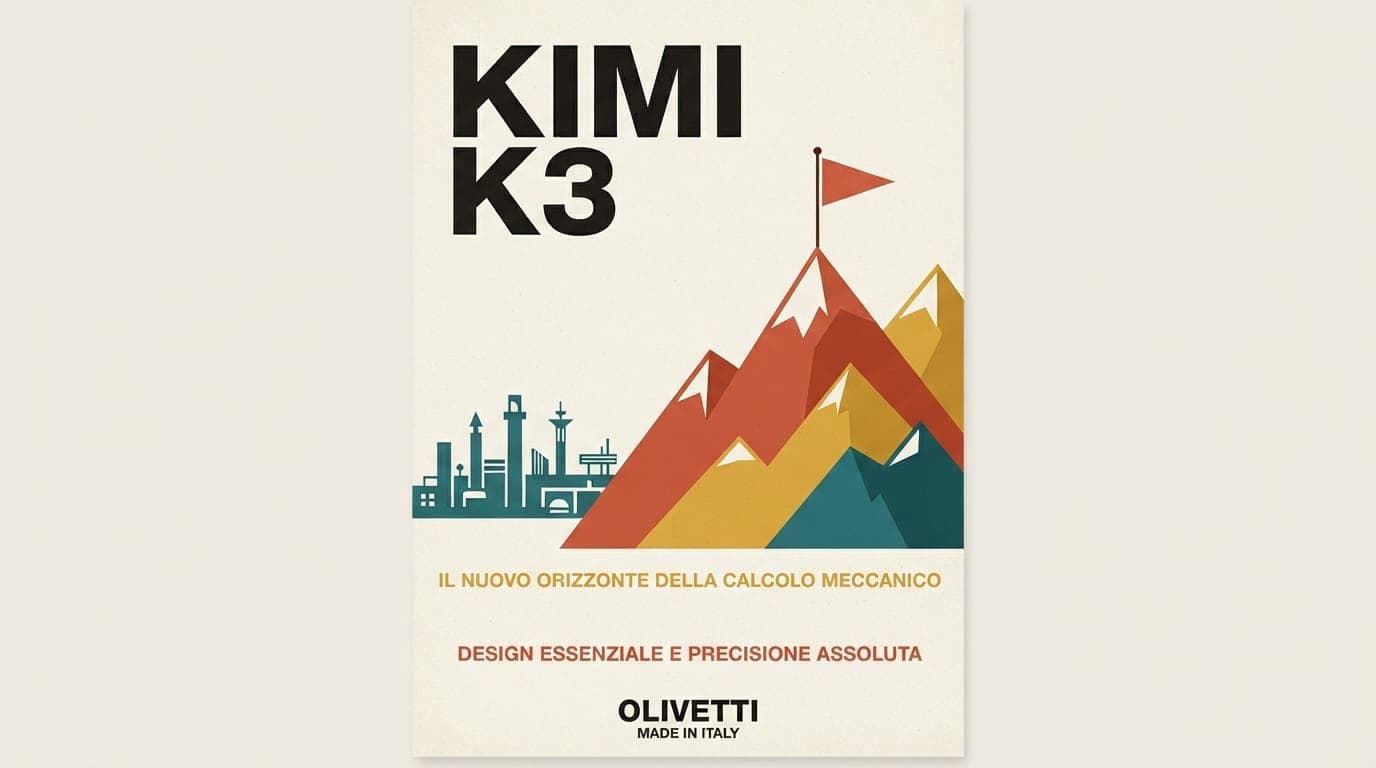
A two-year-old Beijing startup has produced a model that sits closer to the American frontier than anything from Alphabet, Meta, or SpaceX. Moonshot AI's Kimi K3, released July 16, is a 2.8-trillion-parameter open-weight system that jumped to first place on Arena.ai's Frontend Code leaderboard within hours of release, scoring 1,679 points against 1,631 for Anthropic's Claude Fable 5. It was the first Chinese model ever to top that board.
On the Artificial Analysis Intelligence Index, K3 debuted fourth overall, behind Fable 5 and OpenAI's GPT-5.6 Sol, and ahead of Claude Opus 4.8 and SpaceX's Grok 4.5. Moonshot concedes K3 trails Fable 5 and Sol on overall performance but claims wins on long-horizon coding and agentic benchmarks.
The distillation question
The launch was immediately overshadowed by a screenshot: when a user asked K3 to identify itself, the model replied it was "Claude, an AI assistant" made by Anthropic. In February, Anthropic published an investigative report alleging that three Chinese labs, Moonshot among them, had run industrial-scale distillation campaigns against Claude, generating more than 16 million exchanges through roughly 24,000 fraudulent accounts. Moonshot's alleged share was 3.4 million exchanges, including a phase targeting Claude's internal reasoning traces.
On July 22, White House science adviser Michael Kratsios accused Moonshot of building a purpose-built internal platform to distill Anthropic's Fable model for K3, the first time a senior U.S. official has named a specific Chinese lab copying a specific American model. Treasury Secretary Scott Bessent warned that sanctions and Entity List designations are "on the table."
Moonshot's technical blog credits its performance to architectural advances, including a sparse mixture-of-experts design activating just 16 of 896 experts per token. Skeptics note that if K3's training were truly that efficient, its inference costs should be dramatically lower than U.S. peers, and they are not.

Silicon Valley is already a customer
American companies did not wait for permission. Airbnb CEO Brian Chesky said last fall that his company relies heavily on Alibaba's Qwen models. Andreessen Horowitz partner Martin Casado estimates an 80% chance that any given startup pitching his firm is building on a Chinese open-source model. Chinese-origin models now account for nearly half the tokens routed through OpenRouter, a popular model marketplace, up from roughly 11% a year ago.
The driver is unit economics. Open weights let companies fine-tune and self-host at a fraction of U.S. frontier prices, with no API contract and no data leaving their infrastructure.
A Hong Kong IPO as geopolitical signal
Days after the K3 launch, Bloomberg reported that Moonshot had circulated a shareholder resolution to pursue a Hong Kong listing within roughly six months, targeting a valuation near $30 billion. The company is dismantling its offshore Cayman structure to qualify under Hong Kong's Chapter 18C regime for specialist technology companies. Rival DeepSeek is reportedly weighing its own listing.
The endorsement runs in two directions. Beijing is signaling that its AI champions may access global capital markets, a reversal after years of keeping strategic technology close to home. And public markets are about to referee the U.S.-China AI race with audited numbers. Moonshot, with reported annual recurring revenue around $300 million, will extend a data set that currently includes only Zhipu AI and MiniMax as publicly traded LLM developers.
The open-closed switcheroo
China's ascent was built on giving models away. Now success is breeding enclosure. MiniMax kept its latest model closed after two open flagship generations. Zhipu released its newest GLM flagship as proprietary. Alibaba keeps the Qwen family open while locking its best Max-tier models behind an API.
The United States is running the film in reverse. OpenAI shipped gpt-oss, its first open-weight release in six years. Meta, whose Llama models made "open weights" a household phrase, released its newest flagship closed. Nvidia released its 550-billion-parameter Nemotron 3 Ultra under an open license in June, and Mira Murati's Thinking Machines Lab launched Inkling, a 975-billion-parameter open-weight model, on July 15.
The pattern is a familiar one. Challengers open up to buy distribution, and leaders lock down to harvest it. The labels "open" and "closed" turn out to describe market position, not national character.
Sources
Chinese AI Models At The Frontier - Forbes, August 3, 2026: https://www.forbes.com/sites/drewbernstein/2026/08/03/chinese-ai-models-at-the-frontier
Moonshot AI releases Kimi K3 - VentureBeat: https://venturebeat.com/technology/chinas-moonshot-ai-releases-kimi-k3-the-largest-open-source-model-ever-rivaling-top-u-s-systems
Kimi K3 tops AI benchmark - NotebookCheck: https://www.notebookcheck.net/Kimi-K3-tops-AI-benchmark-in-a-first-for-Chinese-models.1347112.0.html
Anthropic distillation report: https://www.anthropic.com/news/detecting-and-preventing-distillation-attacks