Xiaomi Unveils Custom Silicon Roadmap with 6nm Xring O100 AI Accelerator and 3nm D100 Smart-Driving Processor

Xiaomi has unveiled details of its custom semiconductor roadmap, introducing two specialized AI processors alongside its next-generation mobile system-on-chip: the 6-nanometer Xring O100 near-memory AI accelerator and the 3-nanometer Xring D100 autonomous driving chip. Both processors are manufactured by TSMC and have completed hardware validation ahead of planned commercial rollouts. The announcements follow a reported investment of more than 21 billion yuan ($3.1 billion) by Xiaomi into in-ho

2 min
Xiaomi Unveils Custom Silicon Roadmap with 6nm Xring O100 AI Accelerator and 3nm D100 Smart-Driving Processor

Xiaomi has unveiled details of its custom semiconductor roadmap, introducing two specialized AI processors alongside its next-generation mobile system-on-chip: the 6-nanometer Xring O100 near-memory AI accelerator and the 3-nanometer Xring D100 autonomous driving chip. Both processors are manufactured by TSMC and have completed hardware validation ahead of planned commercial rollouts.

The announcements follow a reported investment of more than 21 billion yuan ($3.1 billion) by Xiaomi into in-house silicon design, backed by an engineering team of nearly 3,000 specialists.

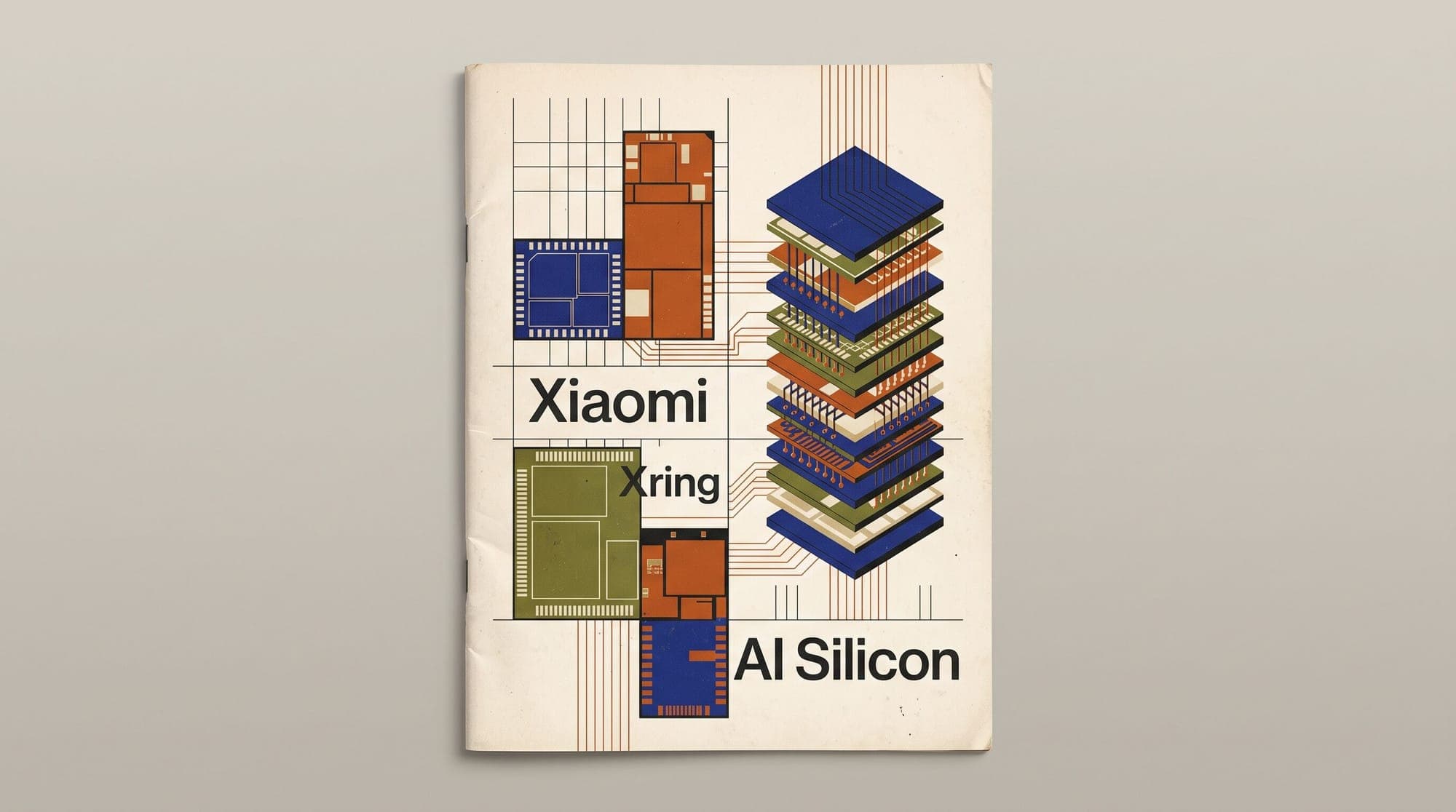
Xiaomi custom silicon architecture and near-memory stacking design

Near-Memory Architecture on the Xring O100

The Xring O100 is engineered as a dedicated coprocessor to accelerate large language models, including Xiaomi's proprietary MiMo model family, across smartphones, electric vehicles, and robotics platforms.

To address memory bandwidth bottlenecks common in local LLM inference, the 6nm processor utilizes a 3D near-memory packaging architecture. By vertically stacking silicon dies and memory layers connected through high-density vertical interconnect channels, the O100 achieves near-memory bandwidth of up to 1.22 terabytes per second (TB/s). This configuration is designed to reduce data transfer latency between compute units and memory during autoregressive token generation. Commercial integration of the O100 is scheduled for 2027.

3nm Xring D100 for Autonomous Driving and 200B Models

The Xring D100 represents Xiaomi's first custom 3nm automotive processor. Built for intelligent driving systems, the chip features:

  • A 20-core central processing unit (CPU)
  • A 16-core neural processing unit (NPU)
  • Support for up to 160 GB of unified system memory

The hardware architecture is designed to execute models up to 200 billion parameters locally within vehicles, eliminating cloud round-trip latency for perception, path planning, and multi-modal decision-making. Xiaomi currently relies on Nvidia Thor and Orin chips for its production electric vehicle fleet, and plans to introduce the D100 to commercial vehicles starting in 2027.

Desktop Demonstration on AI Cube Prototype

To demonstrate multi-chip coordination, Xiaomi showcased the silicon inside an engineering hardware terminal called the AI Cube Prototype. The desktop enclosure pairs the new Xring O3 flagship mobile processor (slated to launch in September with the Xiaomi 18 Fold) with the O100 and D100 chips.

In live tests, the integrated prototype executed 120-billion-parameter and 3-billion-parameter models concurrently on-device, supporting dynamic switching between fast lightweight routines and larger reasoning workflows.


Sources

Written by

More to read

  • Google Cloud Launches Gemini Enterprise for Legal with Domain Agents and MCP Connectors

    Google Cloud has launched Gemini Enterprise for Legal, a specialized vertical edition of its enterprise AI platform configured specifically for corporate legal departments and law firms. The product debuted in preview on August 25, 2026, alongside a parallel financial services edition, marking Google's initial push into industry-tailored enterprise AI packages. Launch law firms participating in early access include Cleary Gottlieb, Freshfields, Weil, and Williams & Connolly. Architectural Arc

    1 min
  • Perplexity and Nvidia Launch Portable Computer for Local AI Agents with Zero Token Fees

    Perplexity has partnered with Nvidia to launch Portable Computer, an integrated software stack that runs agentic AI workflows locally on consumer and workstation GPUs without incurring per-token API charges. The system packages model weights, an inference server, an agent harness, tool connectors, and an operating system sandbox into a unified application. It is available immediately on Linux for Pro, Max, and Enterprise subscribers, with Windows support scheduled for September. Hardware requir

    1 min
  • Apple Debuts M6 on 2nm and Quad-Die M5 Ultra with 512GB Memory for Local LLMs

    Apple has introduced two new silicon architectures aimed at local artificial intelligence workloads: the M6, manufactured on a 2-nanometer process, and the M5 Ultra, a quad-die processor offering up to 512GB of unified memory. The chips debut across updated desktop lines. The M6 powers an entry Mac mini starting at $899, while the M5 Ultra configures into the Mac Studio, where M5 Max base configurations start at $2,499. Both product lines are scheduled to begin customer deliveries on September

    1 min