Weight-Decomposed Low-Rank Adaptation (DoRA): How Decoupling Magnitude and Direction Closes the LoRA Gap
Parameter-efficient fine-tuning (PEFT) has become the standard operational paradigm for adapting large language models to domain-specific downstream tasks. Among existing PEFT methodologies, Low-Rank Adaptation (LoRA) remains the default implementation across industry and academia due to its minimal parameter footprint and zero inference overhead. However, empirical studies consistently reveal a persistent performance gap between LoRA and full parameter fine-tuning (FT), particularly on complex reasoning benchmarks and multi-turn instruction tasks.
Weight-Decomposed Low-Rank Adaptation (DoRA), introduced by researchers at NVIDIA and HKUST (Liu et al., 2024), addresses this discrepancy by diagnosing the fundamental mathematical difference between LoRA updates and full fine-tuning. By decomposing weight matrices into independent magnitude and directional components, DoRA applies low-rank updates strictly to directional adjustments while learning scalar magnitude vectors directly. This formulation recovers full fine-tuning learning capacity while retaining LoRA's parameter efficiency and zero-latency weight merging.

1. The Mechanics and Limitations of Standard LoRA
To understand why standard LoRA underperforms full fine-tuning on complex reasoning tasks, consider the standard parameterization of a dense linear projection layer in a Transformer:
where represents the frozen pre-trained weight matrix, represents the input activation vector, and represents the output activation.
Standard LoRA models the parameter update as the product of two low-rank factor matrices and , where the rank :
During training, remains frozen. Matrix is initialized via a Gaussian distribution , while matrix is initialized to zeros, ensuring that at step zero. The scalar is a constant scaling hyperparameter.
While this low-rank decomposition restricts parameter updates to an -dimensional subspace, scaling the rank yields diminishing returns and fails to fully close the gap with full fine-tuning. The bottleneck is not merely the intrinsic rank of the weight updates, but the geometric coupling between the magnitude and orientation of the adapted parameter tensors.
2. Diagnosing the Fine-Tuning Gap: Magnitude vs. Direction
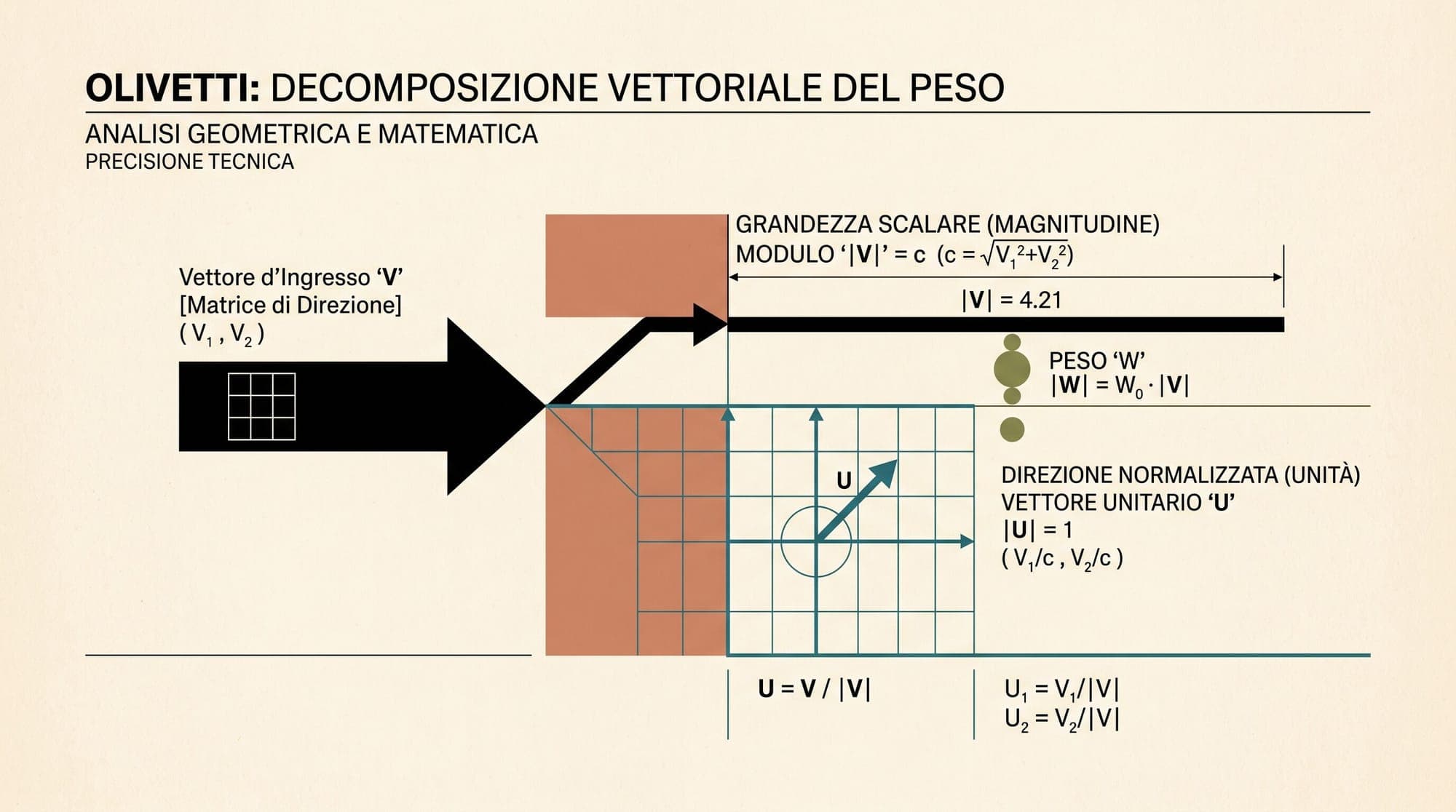
Drawing inspiration from Weight Normalization (Salimans and Kingma, 2016), any linear weight matrix can be uniquely factorized into two distinct geometric properties:
- Magnitude vector (): The column-wise Euclidean norm measuring the scale of each column vector:
- Directional matrix (): The normalized matrix where each column is a unit vector:
The original weight matrix is reconstructed via element-wise broadcast multiplication:
Analyzing Update Trajectories
When tracking parameter updates across training steps, researchers quantify two key metrics:
- Magnitude variation (): The absolute or relative difference between the column norms of the adapted weight and the pre-trained weight:
- Directional variation (): The angular displacement between the column vectors, measured via cosine distance:
Empirical analysis of weight trajectories reveals a striking contrast between full fine-tuning and standard LoRA:
- Full Fine-Tuning Dynamics: Full fine-tuning exhibits a distinct negative or near-zero correlation between and . The optimization process can make substantial directional adjustments with minimal magnitude alterations, or alter magnitudes while preserving directional alignment. This orthogonal flexibility allows the model to adjust feature selection (direction) independently of feature intensity (magnitude).
- Standard LoRA Dynamics: Standard LoRA exhibits a strong positive linear correlation between and . Because the update matrix is directly added to without normalization, any directional shift inevitably scales the column norm proportionally. LoRA lacks the degrees of freedom to execute subtle directional realignments without perturbing weight scales.
3. The DoRA Formulation
DoRA eliminates this coupling by reparameterizing the linear layer into an explicit trainable magnitude vector and a low-rank updated directional matrix.
Mathematical Formulation
Given pre-trained weight matrix , DoRA initializes:
- Initial magnitude vector: (trainable parameter).
- Directional component: (frozen).
- Directional low-rank update: , with and (trainable parameters).
The adapted weight matrix is defined as:
During forward propagation, the linear operation evaluates as:
import torch
import torch.nn as nn
import torch.nn.functional as F

class DoRALinear(nn.Module):
    def __init__(self, in_features: int, out_features: int, r: int = 8, lora_alpha: float = 16.0):
        super().__init__()
        self.in_features = in_features
        self.out_features = out_features
        self.r = r
        self.scaling = lora_alpha / r

        # Frozen base weight
        self.weight = nn.Parameter(torch.empty(out_features, in_features), requires_grad=False)

        # Trainable magnitude vector initialized to column/row L2 norm
        # For nn.Linear, shape is (out_features, in_features), norm computed across in_features
        self.magnitude = nn.Parameter(torch.empty(out_features, 1), requires_grad=True)

        # Trainable directional low-rank matrices
        self.lora_A = nn.Parameter(torch.empty(r, in_features))
        self.lora_B = nn.Parameter(torch.empty(out_features, r))

        self.reset_parameters()

    def reset_parameters(self):
        nn.init.kaiming_uniform_(self.weight, a=5**0.5)
        # Compute initial magnitude vector from base weight
        with torch.no_grad():
            self.magnitude.copy_(torch.linalg.norm(self.weight, dim=1, keepdim=True))

        nn.init.kaiming_uniform_(self.lora_A, a=5**0.5)
        nn.init.zeros_(self.lora_B)

    def forward(self, x: torch.Tensor) -> torch.Tensor:
        # Directional matrix with low-rank adaptation
        v = self.weight + (self.lora_B @ self.lora_A) * self.scaling

        # Unit directional normalization
        v_norm = torch.linalg.norm(v, dim=1, keepdim=True)
        norm_directional = v / (v_norm + 1e-8)

        # Re-scaled weight matrix
        adapted_weight = self.magnitude * norm_directional
        return F.linear(x, adapted_weight)
4. Gradient Dynamics and Stability
The gradient flow in DoRA illustrates why directional normalization stabilizes optimization. Let be the training loss objective. The gradient with respect to the magnitude parameter is:
The gradient with respect to the directional parameter evaluates via the chain rule of normalized projections:
This expression reveals two critical properties:
- Self-Stabilizing Gradient Scale: The directional gradient is inversely proportional to . If the directional component grows large in magnitude, the gradient updates automatically scale down, preventing runaway gradient explosion during high-learning-rate regimes.
- Orthogonal Gradient Projection: The term inside the parentheses projects the gradient onto the subspace orthogonal to . As a result, directional parameter updates cannot inadvertently change the norm of , enforcing a strict separation between magnitude and orientation.
5. Integrating Rank-Stabilized Scaling (rsLoRA)
In conventional LoRA parameterization, the scaling factor is defined as . In 2023, Kalajdzievski proved in Rank-Stabilized LoRA (rsLoRA) that scaling by causes learning collapse when scaling to higher ranks (), because the gradient updates shrink too aggressively.
rsLoRA replaces the scaling constant with:
When combined with DoRA, the directional adaptation becomes:
This hybrid configuration stabilizes learning across extreme rank variations (from up to ), allowing DoRA to extract maximal expressive capacity from wide low-rank adapters without encountering training instability.
6. Zero Inference Overhead via Weight Merging
A primary requirement for production deployment of PEFT adapters is zero-latency serving. Methods that introduce dynamic gating, prompt prefixes, or serial adapter layers add runtime computational overhead and memory latency.
DoRA incurs zero inference overhead because its mathematical operations can be completely pre-computed and folded into a single dense matrix prior to deployment:
The resulting matrix matches the exact memory layout and floating-point dimensions of the original pre-trained layer . Once merged, inference requires standard matrix-vector multiplications () without any runtime normalization or auxiliary branching.
def merge_dora_weights(model_layer: DoRALinear) -> torch.Tensor:
    """Folds DoRA magnitude and directional components into a standard dense weight."""
    with torch.no_grad():
        v = model_layer.weight + (model_layer.lora_B @ model_layer.lora_A) * model_layer.scaling
        v_norm = torch.linalg.norm(v, dim=1, keepdim=True)
        w_merged = model_layer.magnitude * (v / (v_norm + 1e-8))
    return w_merged
7. Memory, Compute, and Engineering Trade-Offs
While DoRA achieves performance on par with full fine-tuning, it introduces specific training trade-offs that practitioners must manage:
Computational Overhead During Training
Computing column-wise L2 norms and backpropagating through the normalization operator increases training compute by approximately 15% to 25% per step compared to standard LoRA. In terms of VRAM consumption, the intermediate tensors for increase activation memory slightly.
Quantized DoRA (QDoRA)
DoRA integrates natively with 4-bit and 8-bit base model quantization (such as bitsandbytes NF4 or FP4). In QDoRA:
- Base weights remain quantized in 4-bit representation in GPU VRAM.
- Dequantization occurs on-the-fly during the forward pass to compute directional updates.
- Trainable parameters (, , ) are stored and updated in 16-bit brain floating point (BF16).
Configuration in Hugging Face PEFT
In modern fine-tuning pipelines, DoRA is enabled directly within the Hugging Face peft library by setting use_dora=True:
from peft import LoraConfig, get_peft_model
from transformers import AutoModelForCausalLM

model = AutoModelForCausalLM.from_pretrained(
    "meta-llama/Meta-Llama-3-8B",
    torch_dtype=torch.bfloat16,
    device_map="auto"
)

peft_config = LoraConfig(
    r=16,
    lora_alpha=32,
    target_modules=["q_proj", "k_proj", "v_proj", "o_proj", "gate_proj", "up_proj", "down_proj"],
    lora_dropout=0.05,
    bias="none",
    task_type="CAUSAL_LM",
    use_dora=True,        # Enables Weight-Decomposed Low-Rank Adaptation
    use_rslora=True       # Enables Rank-Stabilized scaling (1/sqrt(r))
)

model = get_peft_model(model, peft_config)
model.print_trainable_parameters()
8. Architectural Comparison
| Fine-Tuning Paradigm | Trainable Parameters | Magnitude / Direction Coupling | Rank Scalability | Training Memory Overhead | Inference Latency Overhead | | :--- | :--- | :--- | :--- | :--- | :--- | | Full Fine-Tuning (FT) | 100% | Decoupled / Independent | Full Rank | High (3x-4x base weights for optimizer states) | None (0%) | | Standard LoRA | 0.1% - 1.0% | Strictly Coupled () | Poor at ( decay) | Minimal | None (via matrix fusion) | | rsLoRA | 0.1% - 1.0% | Strictly Coupled | Stable across () | Minimal | None (via matrix fusion) | | DoRA | 0.15% - 1.2% | Fully Decoupled (Weight Norm) | High | +15-20% activation memory | None (via matrix fusion) | | QDoRA | 0.15% - 1.2% | Fully Decoupled | High | Lowest (4-bit frozen base) | None (via matrix fusion) |
9. Key Takeaways
- Root Cause of LoRA Underperformance: Standard LoRA forces magnitude changes and directional changes to move in tandem. This prevents the model from making nuanced directional adjustments without altering overall weight norms.
- Decomposed Optimization: DoRA separates pre-trained weights into a learnable magnitude vector and a directional component updated via low-rank matrices , mimicking the update geometry of full fine-tuning.
- Zero Deployment Penalty: The magnitude and directional matrices merge into a single standard weight matrix prior to inference, preserving exact baseline serving throughput.
- Best Practices: Use DoRA with rank-stabilized scaling (
use_rslora=True) for complex reasoning tasks, code generation, and multi-modal alignment where standard LoRA exhibits performance ceilings.
Sources
- DoRA: Weight-Decomposed Low-Rank Adaptation (Liu et al., ICML 2024)
- LoRA: Low-Rank Adaptation of Large Language Models (Hu et al., 2021)
- Rank-Stabilized LoRA: Unlocking the Potential of LoRA Fine-Tuning (Kalajdzievski, 2023)
- Weight Normalization: A Simple Reparameterization to Accelerate Training of Deep Neural Networks (Salimans & Kingma, 2016)
- Hugging Face PEFT Documentation