Terminal and developer tools maker Warp has introduced Warp Factories, a turnkey infrastructure system designed to manage and orchestrate autonomous AI coding agents across the software development lifecycle. The platform aims to lower the barrier for engineering teams implementing multi-agent workflows by providing preconfigured orchestration pipelines, evaluation harnesses, and runtime observability.
Software Factory Architecture
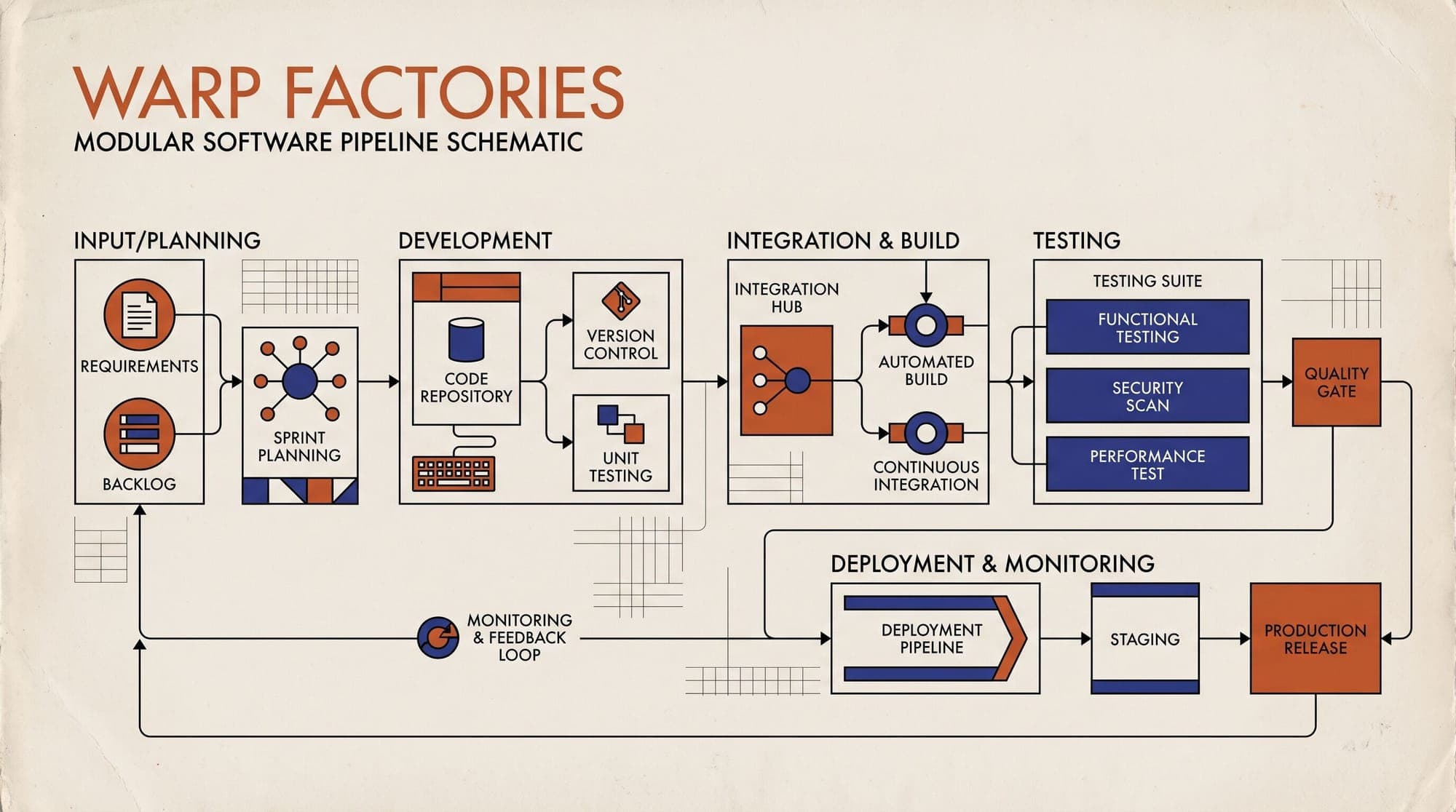
The "software factory" model structures development into five sequential phases typically handled by human software engineers:
- Triage: Analyzing issue queues, assessing reproducible bug reports, and assigning priorities.
- Specification: Defining implementation requirements, technical constraints, and interface contracts.
- Implementation: Generating code patches and localized refactors across target repositories.
- Code Review: Evaluating pull requests against codebase conventions, style standards, and architectural patterns.
- Verification: Executing test suites, linting, and regression checks in sandboxed environments.
Warp Factories packages these stages into an automated agent loop, allowing organizations to automate specific stages or chain them together end-to-end.

Model Agnosticism and Workflow Integrations
Rather than locking developers into a single proprietary model or execution harness, Warp Factories operates as an agnostic orchestration layer. It supports external coding agents and harnesses, including OpenAI Codex and Anthropic Claude Code.
To integrate with existing engineering processes, the system connects with:
- Issue Trackers: Direct synchronization with Linear and Jira for automated task pickup and status transitions.
- Collaboration Tools: Integrations with Slack and Microsoft Teams to provide status notifications and human feedback checkpoints.
- Environment Synchronization: Cloud-to-local synchronization that allows developers to pull agent branch states into local development environments for inspection and debugging.
Telemetry, Cost Governance, and Automation Limits
Running agent swarms across production codebases introduces operational complexity around cost management and performance tracking. Warp Factories includes centralized analytics to monitor token expenditure across teams, compare output quality between model harnesses, and implement automated evaluation benchmarks.
Warp CEO Zack Lloyd indicated that the platform is designed for progressive task automation rather than unattended end-to-end software delivery. Internal operations at Warp currently automate approximately 30% to 35% of engineering tasks weekly, using human oversight at specification and deployment boundaries.