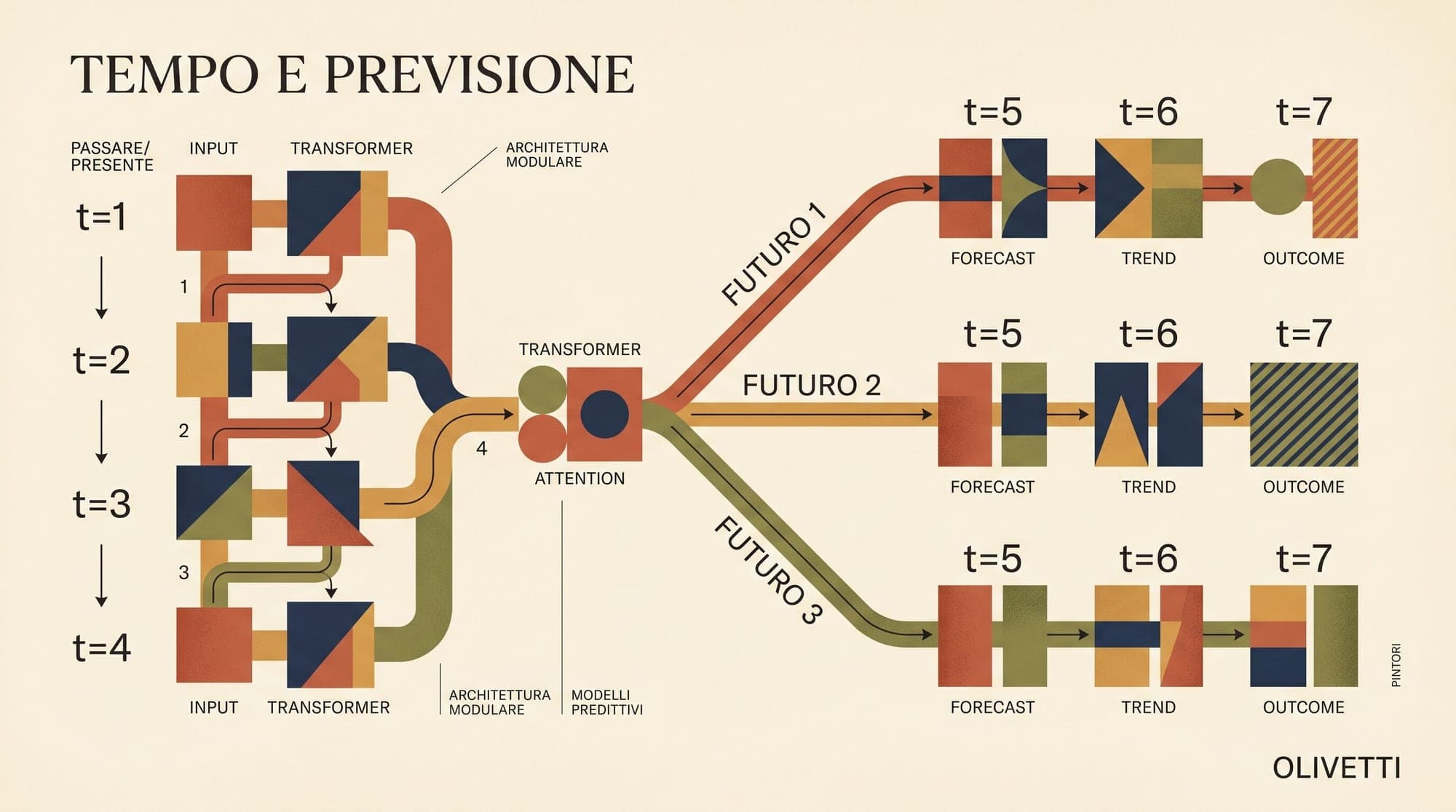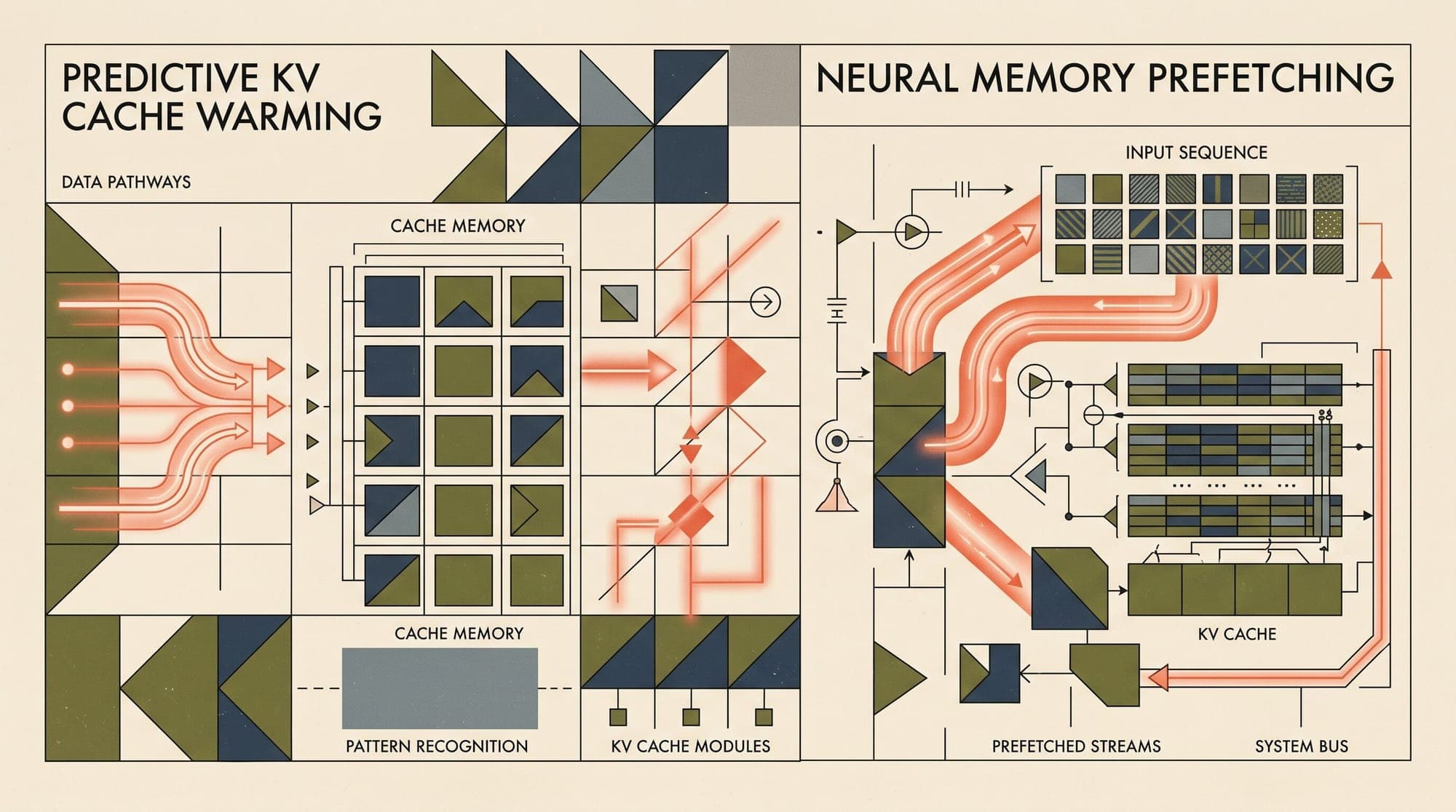
Predictive KV Cache Warming in Production LLM Serving: Architecture, Session Prefetching, and TTFT Latency Shaving
In long-context large language model (LLM) deployments, Time-to-First-Token (TTFT) represents the primary latency bottleneck. As input prompts scale from 8,000 tokens to 128,000 tokens in multi-turn coding agents, legal document analysis, and enterprise retrieval pipelines, prefill execution consumes between 85% and 95% of total GPU compute time per request.
Standard optimization strategies such as vLLM Automatic Prefix Caching and SGLang RadixAttention operate reactively: they retain Key-Value (KV) cache blocks only after an initial user request has completed a full prefill pass. On initial user turns, active file switches, or newly attached documents, users still face cold-start prefill delays ranging from 1.5 to 5 seconds.
To eliminate this cold-start tax, production inference systems are adopting predictive KV cache warming (also termed proactive prefetching or speculative prefill). By anticipating upcoming context payloads and computing KV tensors during idle GPU compute cycles or client think-time, serving engines can serve long-context requests with sub-200ms TTFT.
The Cold Prefill Bottleneck in Long-Context Serving
The prefill phase processes the entire input prompt in parallel, generating key and value tensors for every token across all transformer layers. For a prompt of length , the computational complexity of the attention mechanism scales quadratically with sequence length (), while feed-forward network computations scale linearly ().
+-------------------------------------------------------------------------+
|                        Traditional Reactive Serving                     |
|                                                                         |
| User Action ----> Submit Request ----> Full Cold Prefill ----> Decode   |
|                                        (1,500ms - 4,000ms)              |
+-------------------------------------------------------------------------+
|                    Predictive KV Cache Warming                          |
|                                                                         |
| User Action ----> Speculative Prefill (Idle Compute / Low-Pri Queue)    |
|                         |                                               |
| Submit Request --------> Hit Pre-Warmed KV Cache ----------> Decode     |
|                         (50ms - 150ms TTFT)                             |
+-------------------------------------------------------------------------+
When users interact with agentic tools or IDE assistants, the vast majority of context (system prompts, tool schemas, repository maps, open file buffers) remains predictable seconds before the user hits "submit." In standard reactive setups, this predictable context sits unindexed in memory until execution begins.
Architecture of Predictive KV Cache Warming

Predictive KV cache warming decouples prompt context preparation from the generation trigger. The architecture spans three core layers: client-side telemetry triggers, gateway scheduling, and tiered memory management.
+-------------------------------------------------------------------------+
| 1. Client & Gateway Signals                                             |
|    - IDE / App Events: Active tab focus, typing debounce (300ms)        |
|    - Multi-Agent State Machine: Speculative next-step branch prediction |
|    - Upload Handlers: Document ingestion background pipeline            |
+-------------------------------------------------------------------------+
                                    |
                                    v
+-------------------------------------------------------------------------+
| 2. Gateway & Low-Priority Scheduler                                     |
|    - Consistent Hash Ring: Target specific worker replica               |
|    - Chunked Prefill Scheduler: Low-priority execution queue            |
|    - Pre-warm Lock Bits: Ephemeral TTL assignment                       |
+-------------------------------------------------------------------------+
                                    |
                                    v
+-------------------------------------------------------------------------+
| 3. Tiered KV Storage & Transfer Engine                                  |
|    - GPU HBM (Active inference & hot prefix blocks)                     |
|    - Host DRAM / CXL Pool (Staged pre-warmed blocks via PCIe Gen5)      |
|    - Disaggregated Remote Pool (Mooncake / LMCache over RoCEv2/RDMA)    |
+-------------------------------------------------------------------------+
1. Triggering Mechanisms and Predictive Signals
Predictive warming relies on deterministic or probabilistic event streams that anticipate incoming prompts:
- Debounced Interactive Signals: In developer tools and chat interfaces, client telemetry emits pre-warm events after a brief typing pause (e.g., 300ms) or when an active file buffer changes. The client sends the static prefix (system prompt, repository outline, file contents) to the inference gateway with a
speculative_prefillflag. - Asynchronous Document Ingestion: When a user uploads a 50-page PDF or technical specification, the gateway triggers background prefill immediately upon document parsing, staging the computed KV blocks before the user types their first question.
- Agent Branch Prefetching: In multi-agent DAGs or Tree-of-Thoughts reasoning paths, execution graphs have predictable transition probabilities. While an orchestrator model evaluates step , background threads speculatively prefill KV tensors for the top candidate tools and subagent system prompts for step .
Scheduling and Chunked Execution
Executing speculative prefill must not degrade the latency of active, high-priority decoding streams. Because prefill passes saturate GPU compute cores (Compute-Bound), running large speculative prefills concurrently with decoding can introduce severe tail-latency spikes in inter-token latency (ITL).
To mitigate this, production engines apply chunked prefill techniques, formalized in research such as Sarathi-Serve and DistServe:
+--------------------------------------------------------------------+
| GPU Iteration Batch with Low-Priority Chunked Prefill              |
|                                                                    |
| [Active Decode Req 1] [Active Decode Req 2] [Speculative Chunk 1]  |
| <----- Token Generation (Memory-Bound) ----> <--- Compute-Bound -> |
+--------------------------------------------------------------------+- Chunk Splitting: Speculative prompts are split into fixed token chunks (e.g., 512 or 1,024 tokens).
- Co-Scheduling: Low-priority chunks are scheduled in execution batches only when available compute budget remains after scheduling active decode tokens.
- Preemption: If an incoming live generation request arrives, speculative prefill jobs yield execution immediately.
Disaggregated and Hierarchical KV Cache Storage
GPU High Bandwidth Memory (HBM) is expensive and constrained. Storing tens of thousands of speculative KV blocks directly in HBM risks causing out-of-memory errors or evicting active generation sessions.
Systems such as Mooncake and LMCache implement hierarchical and disaggregated KV caching architectures that utilize host DRAM and remote clusters:
- Host DRAM Staging: Computed KV blocks are offloaded to host CPU memory over PCIe Gen5 DMA, freeing GPU HBM for active batches.
- Disaggregated Remote Pools: KV tensors are distributed across dedicated cache nodes connected via 200 Gbps or 400 Gbps RoCEv2 or InfiniBand.
- Transfer vs. Compute Breakeven: Network transfer of pre-computed KV tensors is significantly faster than recomputing multi-layer attention projections when network bandwidth satisfies:
On modern clusters with 400 Gbps RDMA fabrics, retrieving 64K tokens of cached FP8 KV tensors takes under 40ms, compared to 800ms to 2,000ms for full GPU recomputation.
Consistent Hashing, Cache Pinning, and Eviction Policies
To benefit from predictive warming, the user's eventual generation query must land on the specific GPU instance or cache cluster holding the pre-warmed KV tensors.
Incoming Request (User ID / Session Hash)
                 |
                 v
   +---------------------------+
   | Consistent Hash Gateway   |
   +---------------------------+
          /             \
         v               v
   [Worker Node A]  [Worker Node B]
   (Warm Radix Tree) (Cold Radix Tree)
         |
Cache Hit (TTFT < 150ms)- Consistent Hash Routing: The API gateway routes requests using consistent hashing on session identifiers, workspace IDs, or Radix tree prefix hashes.
- Speculative Block Pinning: Pre-warmed blocks receive a temporary
speculative_lockbit and a short Time-To-Live (TTL), typically 10 to 60 seconds. - Decay and LRU Eviction: If the user does not submit a matching query before the TTL expires, the lock bit clears, allowing the Radix cache LRU eviction policy to reclaim the memory blocks for active requests.
Managing False Prefetches and System Trade-Offs
Predictive warming involves an engineering trade-off between latency reduction and redundant GPU FLOPs:
- Speculative Acceptance Ratio: The percentage of pre-warmed contexts that are subsequently matched by a user generation request.
- Resource Guardrails: Production systems maintain an adaptive threshold: if the speculative acceptance ratio drops below 70%, the gateway widens debounce windows (e.g., from 300ms to 800ms) or disables speculative prefill for non-deterministic sessions.
- Zero-Latency Race Condition Handling: If a user submits a prompt while its speculative prefill is 60% complete, the scheduler seamlessly promotes the job to high priority and executes only the remaining 40% of tokens, preserving all partially computed KV blocks.
Production Implementation Checklist
- Deploy Chunked Prefill Kernels: Enable chunked prefill (
--enable-chunked-prefillin vLLM or SGLang) to prevent background prefills from degrading active decoding streams. - Implement Consistent Prefix Routing: Ensure the load balancer routes requests with identical prefixes or session IDs to the same worker replica.
- Establish Tiered KV Storage: Configure host DRAM offloading or disaggregated transfer via frameworks like LMCache or Mooncake.
- Set Dynamic TTLs: Bound speculative KV blocks with conservative TTL limits (15-30s) to guard against GPU memory fragmentation.
- Monitor Speculative Goodput: Continuously track TTFT P95/P99 latency alongside the speculative hit rate to optimize debounce intervals.
Sources
- Mooncake: A KVCache-centric Disaggregated Architecture for LLM Serving (arXiv:2407.00079)
- LMCache: An LLM Engine for Non-Volatile KV Cache (arXiv:2410.14041)
- DistServe: Disaggregating Prefill and Decoding for Goodput-Optimized LLM Serving (arXiv:2401.09670)
- Sarathi-Serve: Efficient LLM Serving with Chunked Prefills (arXiv:2403.02310)
- SGLang: Fast and Expressive Language Model Serving with RadixAttention (arXiv:2312.07104)
- vLLM Automatic Prefix Caching Architecture