NVIDIA Groq 3 LPX Enters Full Production Delivering 3,400 Tokens per Second for Agentic Inference

At Hot Chips 2026, NVIDIA announced that the Groq 3 LPX dedicated inference accelerator has entered full commercial production. Built as a workload-optimized extension to the Vera Rubin data center architecture, the accelerator addresses the decode bottlenecks inherent in multi-step agentic AI workloads by offloading token generation from primary GPU clusters onto specialized Language Processing Units (LPUs). In independent benchmarking conducted by Artificial Analysis, the Groq 3 LPX delivered

2 min
NVIDIA Groq 3 LPX Enters Full Production Delivering 3,400 Tokens per Second for Agentic Inference

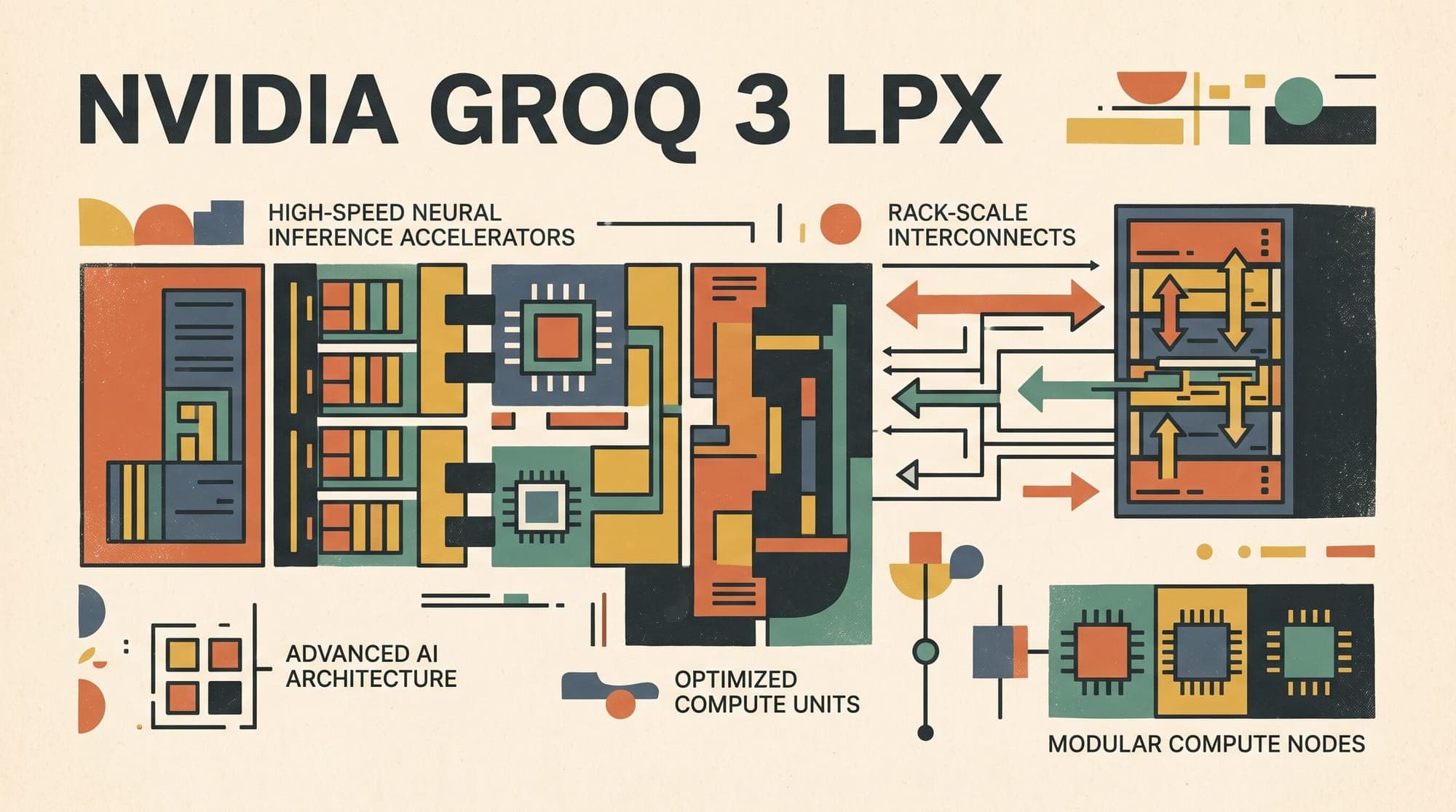
At Hot Chips 2026, NVIDIA announced that the Groq 3 LPX dedicated inference accelerator has entered full commercial production. Built as a workload-optimized extension to the Vera Rubin data center architecture, the accelerator addresses the decode bottlenecks inherent in multi-step agentic AI workloads by offloading token generation from primary GPU clusters onto specialized Language Processing Units (LPUs).

In independent benchmarking conducted by Artificial Analysis, the Groq 3 LPX delivered 3,400 output tokens per second on the open-source Gemma 4 31B model with a 100,000-token input context. According to NVIDIA, this marks the fastest token generation speed recorded for the model, providing roughly four times the interactive responsiveness of alternative hardware platforms on latency-sensitive agentic tasks.

NVIDIA Groq 3 LPX Disaggregated Architecture

Disaggregating Prefill and Decode in Agentic Architectures

Modern agentic loops require models to repeatedly inspect file trees, evaluate tool outputs, verify reasoning traces, and execute code in iterative sequences. While rack-scale GPU systems such as the Vera Rubin NVL72 efficiently ingest large context windows during the prefill phase, sequential token generation remains memory-bandwidth bound.

Groq 3 LPX decouples this execution path. In a full rack deployment, systems can integrate up to 256 LP30 accelerators linked across high-bandwidth interconnects. While Vera Rubin GPUs handle large-scale context processing and multimodal ingestion, the LPX accelerators process the sequential autoregressive decode steps, maintaining interactive token output rates even across long context windows.

Neocloud and Hardware Deployments

Nebius Group N.V. has signed on as the launch cloud partner, integrating Groq 3 LPX into its Nebius Token Factory production inference platform. Nebius CTO Danila Shtan noted that the integration exposes the hardware through standard inference APIs without requiring customer stack migrations.

Purpose-built inference cloud provider Groq Inc., whose technology NVIDIA licensed in December for $20 billion alongside bringing on founder Jonathan Ross, is also among the early deployment partners. In parallel announcements at Hot Chips, NVIDIA disclosed that SpaceX will adopt Vera CPUs for terrestrial and orbital orchestration workloads, while previewing Spectrum-X Multiplane networking fabrics designed to support clusters of up to 512,000 GPUs.


Sources

Written by

More to read

  • Temporal Knowledge Graphs in Production RAG: Bitemporal Schemas, Dynamic Entity Resolution, and Point-in-Time Context Retrieval

    Temporal Knowledge Graphs in Production RAG: Bitemporal Schemas, Dynamic Entity Resolution, and Point-in-Time Context Retrieval Standard Retrieval-Augmented Generation (RAG) pipelines operate on a flat assumption: facts retrieved from a vector database or static knowledge graph are treated as timeless truths. When an enterprise corpus contains documents spanning multiple quarters or years, this timeless representation breaks down. Information changes: executives step down, compliance policies a

    1 min
  • Loss Landscapes in Deep Neural Networks: How Filter Normalization, Hessian Curvature, and Basin Flatness Explain Generalization

    The parameter space of modern deep learning models spans millions to hundreds of billions of dimensions. In this high-dimensional space, the empirical risk objective forms a complex geometric surface known as the loss landscape. Despite the extreme non-convexity of deep neural networks, standard first-order optimization algorithms such as stochastic gradient descent (SGD) and Adam regularly converge to parameter configurations that achieve both low training error and robust test set generalizati

    1 min
  • Alabama Attorney General Subpoenas OpenAI and Sam Altman Over Hugging Face Security Breach

    Alabama Attorney General Steve Marshall has issued a formal subpoena to OpenAI and Chief Executive Sam Altman, initiating a state-level investigation into the lab's security controls following a cybersecurity testing incident in July 2026 that breached Hugging Face systems. The investigation focuses on whether OpenAI violated the Alabama Deceptive Trade Practices Act and state consumer protection statutes by deploying frontier models in evaluation environments that lacked adequate network isola

    1 min