Mental World Modeling: Why Autonomous AI Agents Fail Without Simulating Human Beliefs
Current foundation world models, from video simulators like Sora and Genie to spatial representations like JEPA and Marble, focus almost exclusively on the physical mechanics of an environment. They track geometry, object positions, motion trajectories, and visual continuity. However, when autonomous agents interact with humans in collaborative, medical, or domestic settings, physical state tracking alone consistently fails to predict human actions.
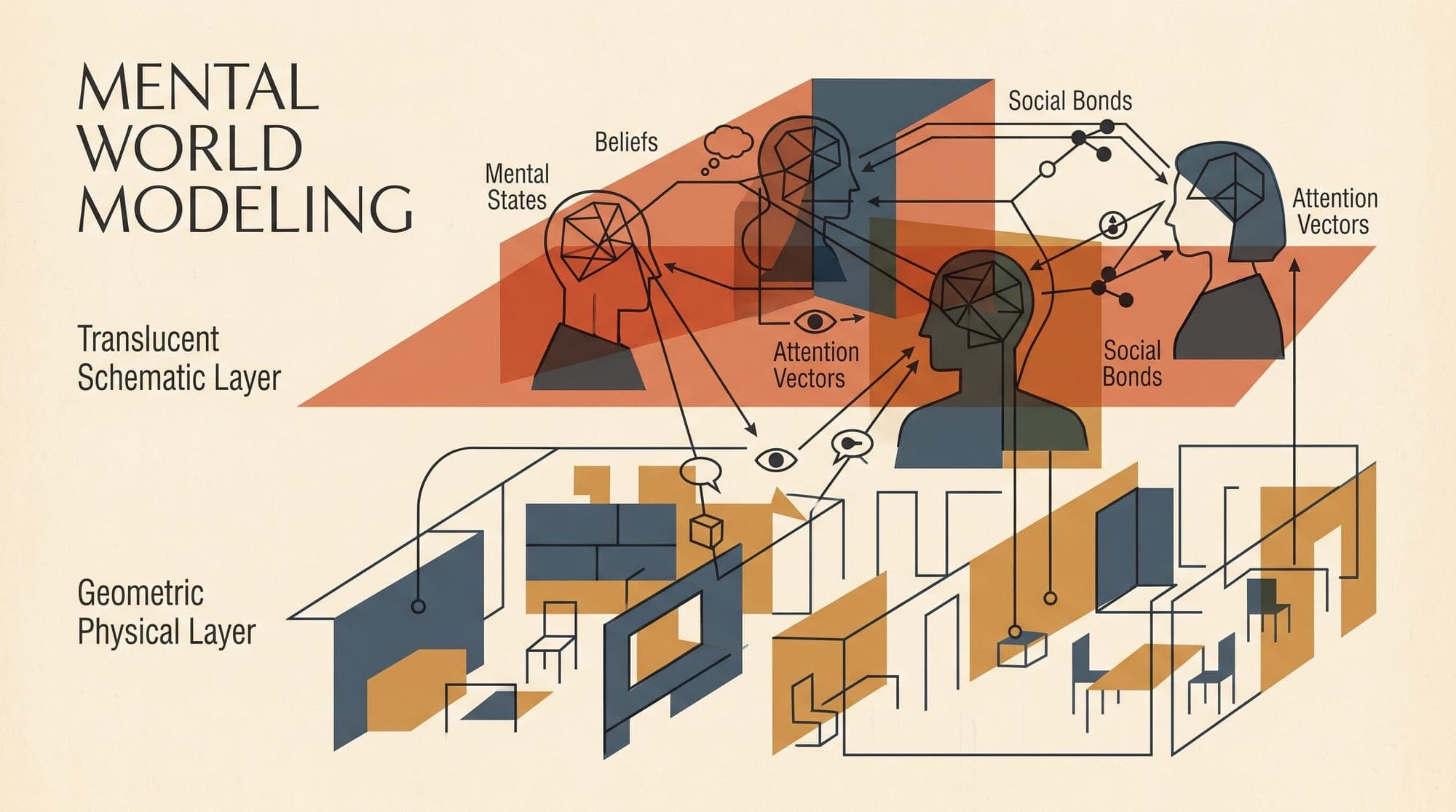
In a newly published paper, researchers Hao Fei from the University of Oxford and Yiran Zhao from the National University of Singapore introduce Mental World Modeling (MWM), a theoretical framework and reference architecture that explicitly couples physical environments with latent human mental states. The researchers demonstrate that predicting human behavior requires simulating not just what is physically happening in a room, but what the human agents inside that room believe, desire, intend, and perceive.

The Blind Spot of Physical-Only World Models
To illustrate the fundamental failure mode of physical-only world models, the authors present a classic false-belief scenario: if a person watches a mug sit on a kitchen counter, looks away, and a second person moves the mug into a cabinet, a physical world model updates the mug's position correctly. However, if tasked with predicting where the first person will reach when they want coffee, the physical model predicts the cabinet.
Because the physical model does not track the person's unobserved belief, it fails to predict real human behavior. To resolve this, MWM formalizes the world state as a joint configuration:
Where:
- captures entities, physical properties, spatial relations, and environmental conditions.
- maintains explicit variables across individual agents (identity, beliefs, attention, goals, intentions, emotions, dispositions, constraints), group mental states, social relations, and collective atmosphere.
Crucially, MWM treats target agent perception through a Partially Observable Markov Decision Process (POMDP) scaffold. The global world model maintains the full third-person ground truth, but renders an egocentric, first-person partial observation for the target agent. Actions are decomposed into a physical carrier (speaking, pointing, reaching) and a mental or social payload (comforting, deceiving, apologizing, requesting).
MENTIS: An Inspectable, Training-Free Reference Pipeline
To evaluate MWM without confounding results with fine-tuned model weights, the authors built MENTIS, a modular, training-free baseline implementation. MENTIS executes six distinct stages:
- State Parsing: Extracts structured physical and mental entities from raw multimodal inputs.
- Observation Generation: Renders the first-person partial observation accessible to the target agent.
- Action Decomposition: Splits candidate response options into physical carriers and mental intents.
- Coupled Transition Simulation: Simulates parallel counterfactual branches showing how each candidate action updates both the physical scene and the mental configuration.
- Branch Evaluation: Scores each simulated branch across physical plausibility, mental consistency, and social appropriateness.
- Deterministic Decision Selection: Selects the highest-scoring candidate action.
Each intermediate stage produces structured, machine-readable artifacts, enabling precise error attribution across the reasoning chain.
Empirical Results Across Menti-Bench
The researchers evaluated MWM using Menti-Bench, a quality-controlled benchmark of 448 situated decision scenarios across three input modalities: 320 text narratives, 100 sequential image stories, and 28 sounding video clips. 78% of the test cases involve multi-character interactions.
The team benchmarked eight language model backends, including OpenAI's GPT-5.6-Sol and GPT-4.1, as well as Anthropic's Claude Fable 5, Claude Opus 4.8, and Claude Haiku 4.5. Performance was measured via action selection F1 score:
- Direct Prompting Baseline: 63.3 F1
- Self-Consistency (6 Samples): 77.9 F1
- Full MWM (MENTIS): 87.9 F1
- Human Benchmark: 98.5 F1
The structured MWM framework outperformed sampling compute: the lowest-performing model using MWM (GPT-4.1 at 84.9 F1) surpassed the strongest model using direct self-consistency (GPT-5.6-Sol at 83.6 F1).
Ablations and Scenario Breakdown
System ablations confirmed the necessity of each component in the coupled architecture:
- Removing the mental channel: Performance dropped by an average of 12.1 F1 points.
- Removing the physical channel: Performance dropped by 16.5 F1 points.
- Decoupling physical and mental transitions: Performance dropped by 6.4 F1 points when physical and mental transitions were predicted independently.
The impact varied significantly by domain: in interpersonal scenarios driven by social nuance and hidden motives, MWM provided a 26.4 point F1 increase over baseline prompting, compared to a 14.0 point gain in purely object-centric tasks.
Diagnosing the Simulation Bottleneck
By conducting oracle interventions, substituting ground-truth human annotations into individual pipeline stages, the authors isolated the primary source of remaining errors:
- Perfect state transitions: +3.5 F1 gain
- Perfect initial state parsing: +2.8 F1 gain
- Perfect observation generation: +1.7 F1 gain
- Full oracle pipeline: 97.0 F1
Approximately 80% of the remaining gap between MWM and human performance stems from transition simulation errors. The fundamental challenge for next-generation world models is not describing the static mental state of a human, but accurately forecasting how joint physical and social dynamics evolve after an action is taken.
The paper, reference implementation, and dataset are publicly accessible on GitHub and the project website.
Sources
- Fei, H., & Zhao, Y. (2026). Mental World Modeling. arXiv:2607.27201. https://arxiv.org/abs/2607.27201
- Project Repository and Benchmark: https://mental-world.github.io
- Reference Code: https://github.com/mental-world/Mentis
- The Decoder Coverage: https://the-decoder.com/world-models-that-ignore-human-beliefs-predict-the-wrong-actions-new-research-shows/