LLM Inference Engines in Production: Comparing vLLM, SGLang, TensorRT-LLM, and TGI Architecture, KV Cache Topologies, Kernel Optimizations, and Serving Economics
Serving large language models in enterprise production has evolved beyond naive execution runtimes. As context windows expand to 128k+ tokens and agentic workloads generate complex multi-turn execution graphs, the efficiency of the underlying inference engine dictates both latency Service Level Objectives (SLOs) and hardware infrastructure costs.
Four primary open-source and vendor runtimes dominate high-throughput LLM serving: vLLM, SGLang, NVIDIA TensorRT-LLM, and Hugging Face Text Generation Inference (TGI). While all four frameworks have adopted foundational primitives such as continuous batching, paged Key-Value (KV) memory allocation, and FP8 precision, their architectural choices diverge significantly in KV cache topologies, scheduling strategies, compilation overhead, and hardware flexibility.

Core Architectural Pillars of Modern Inference Engines
High-performance LLM serving engines operate as specialized operating systems for GPU memory and compute. Three architectural components govern their performance:
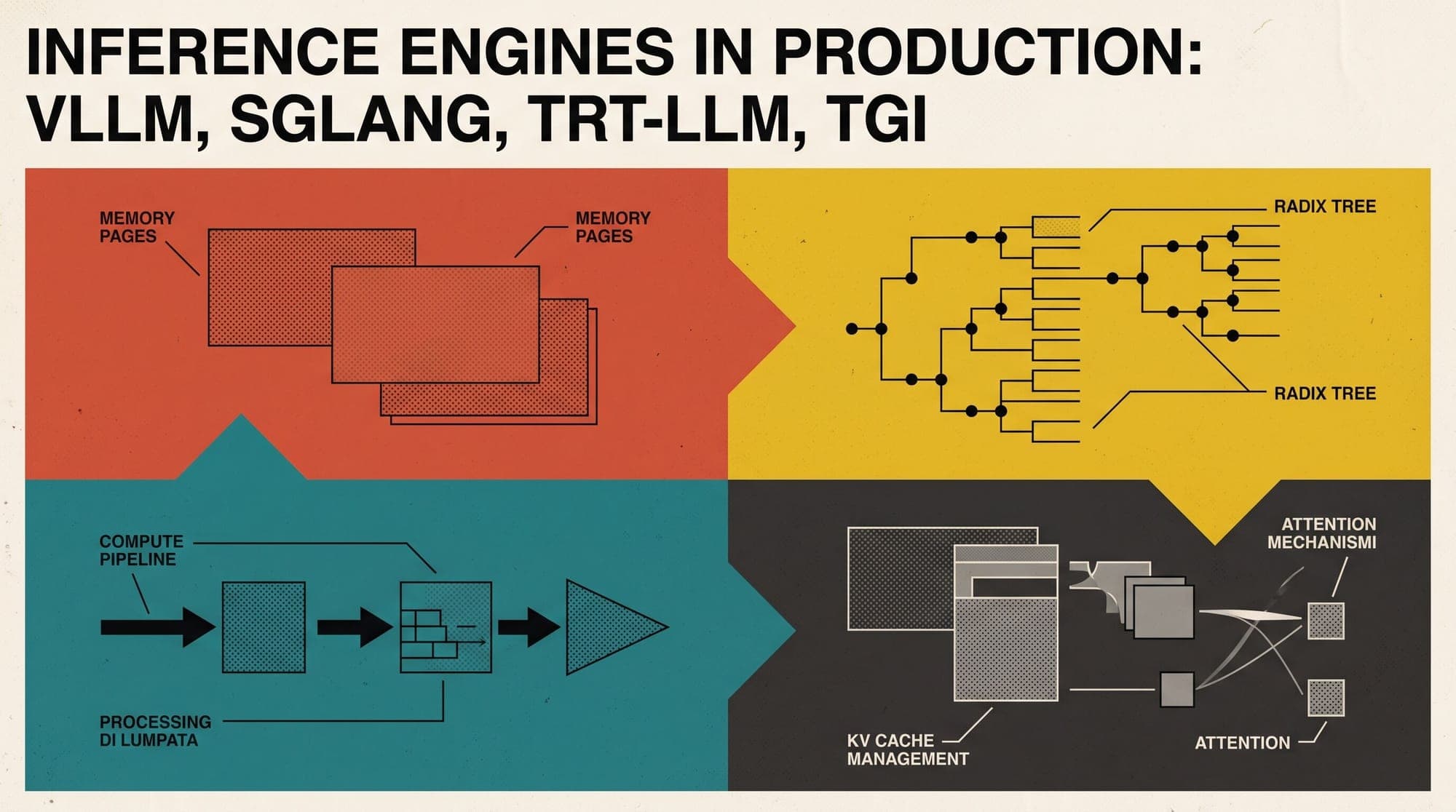
1. KV Cache Topologies: PagedAttention vs. RadixAttention
During autoregressive generation, storing previous token key and value tensors in High Bandwidth Memory (HBM) creates severe memory pressure. Standard contiguous memory allocation wastes between 60% and 80% of GPU memory due to internal fragmentation, over-allocation for maximum sequence lengths, and static batch reservations.
- PagedAttention (vLLM and TGI): Introduced by Kwon et al. (2023), PagedAttention manages the KV cache analogously to virtual memory pages in traditional operating systems. Memory is partitioned into fixed-size physical blocks (typically 16 or 32 tokens). Logical blocks are mapped to non-contiguous physical blocks via dynamic page tables, reducing memory fragmentation to under 4% and enabling dynamic request concurrency.
- RadixAttention (SGLang): Developed by Zheng et al. (2023), RadixAttention treats the entire KV cache as a radix tree (trie) data structure over token sequences. Unlike flat prefix caching that only reuses a single static system prompt, RadixAttention automatically matches, caches, and evicts arbitrary shared subsequences across independent requests, multi-turn dialogues, tree-search rollouts, and few-shot examples without manual developer annotations.
- Static Pre-allocated Pools (TensorRT-LLM): TensorRT-LLM uses fixed-block memory allocators optimized at compile time. Its memory manager minimizes allocation overhead by mapping paged blocks directly into custom fused attention CUDA kernels.
2. Request Scheduling and Chunked Prefill
LLM inference consists of two computationally distinct phases: the prefill (prompt processing) phase, which is compute-bound and saturates Tensor Cores through large General Matrix Multiplications (GEMMs), and the decode (generation) phase, which is memory-bandwidth-bound and processes one token at a time.
- Continuous (In-Flight) Batching: Formalized in systems like Orca, continuous batching schedules requests at the granularity of individual forward passes rather than waiting for an entire batch to complete generation.
- Chunked Prefill: When a request with an 8,000-token prompt arrives while other requests are actively decoding, executing the full prefill in a single step spikes Time-per-Output-Token (TPOT) for decoding requests. Chunked prefill (implemented in vLLM, SGLang, and TensorRT-LLM) slices large prompts into fixed token budgets (e.g., 512 or 1,024 tokens), co-scheduling prompt chunks alongside decoding tokens to maintain strict decode latency targets.
3. Kernel Execution and Hardware Acceleration
The execution backend determines how effectively an engine saturates GPU compute:
- Triton and FlashInfer: vLLM and SGLang rely extensively on FlashInfer and OpenAI Triton kernels, allowing rapid implementation of new attention variants (such as DeepSeek Multi-Head Latent Attention) and cross-platform compatibility across NVIDIA GPUs and AMD ROCm accelerators.
- Custom Fused C++ Kernels: TensorRT-LLM compiles model graphs into C++ runtimes utilizing proprietary NVIDIA Fused Multi-Head Attention (FMHA) and XQA kernels, achieving maximum hardware efficiency on NVIDIA Hopper and Blackwell architectures.
Engine-by-Engine Comparative Analysis
1. vLLM: The Production Standard for Ecosystem Breadth
vLLM has established itself as the default serving platform for open-weight models across enterprise infrastructure.
- Key Strengths:
- Unmatched model architecture coverage (over 100 model families supported immediately upon release).
- Broad hardware portability, including native support for NVIDIA GPUs, AMD Instinct accelerators (ROCm), AWS Inferentia/Trainium, and Google TPUs.
- Robust quantization formats, supporting AWQ, GPTQ, SqueezeLLM, Marlin, FP8 (E4M3), and FP4.
- vLLM V1 architecture overhaul, introducing a low-overhead C++ execution core, multi-step scheduling, and unified dynamic CUDA graph runners.
- Architectural Limitations:
- Prefix caching is block-aligned and historically less flexible than radix-tree hierarchical matching on complex branching agent traces.
- Higher Python orchestration overhead in legacy v0.x releases, though largely addressed in the V1 runtime redesign.
2. SGLang: Specialized for Complex Prompts, Agents, and Fast Decodes
Originating from LMSYS research, SGLang is engineered specifically for structured generation, multi-turn reasoning, and high-concurrency workloads.
- Key Strengths:
- RadixAttention Cache Efficiency: Delivers up to 2x to 4x higher throughput and 70% to 90% latency reductions on workloads with shared context (e.g., agent loops, RAG with common corpora, multi-agent debates).
- Optimized Attention Kernels: Early and aggressive optimization for non-standard architectures, such as DeepSeek-V3 / DeepSeek-R1 Multi-Head Latent Attention (MLA) and Data Parallelism (DP) Attention.
- Native Structured Outputs: Direct integration with XGrammar and compressed Finite State Machines (FSMs), achieving JSON and regex grammar enforcement with minimal token masking overhead.
- Architectural Limitations:
- Smaller hardware support footprint compared to vLLM, primarily focused on NVIDIA and AMD ROCm backends.
- Rapidly evolving codebase with frequent configuration updates.
3. NVIDIA TensorRT-LLM: Maximum Raw Performance on NVIDIA Hardware
TensorRT-LLM represents NVIDIA's specialized software stack designed to extract maximum compute density from Tensor Core architectures.
- Key Strengths:
- Peak Throughput: Yields 10% to 25% higher raw throughput than non-compiled runtimes on high-concurrency batch generation on H100 and B200 systems.
- Advanced Distributed Parallelism: Highly optimized combinations of Tensor Parallelism (TP), Pipeline Parallelism (PP), and Expert Parallelism (EP) with custom NCCL communication overlaps.
- Day-One Silicon Optimization: Immediate native support for new precision formats (FP8, FP4) and specialized hardware features on NVIDIA Blackwell and Hopper.
- Architectural Limitations:
- High Operational Complexity: Requires building and compiling engine binaries, introducing significant deployment pipeline complexity.
- Slow Cold Starts: Engine compilation can take from several minutes to over half an hour, making it ill-suited for dynamic serverless autoscaling.
- Complete Vendor Lock-In: Strictly restricted to NVIDIA hardware.
4. Hugging Face TGI: Standardized Enterprise Model Serving
Text Generation Inference (TGI) was developed by Hugging Face to power production Hugging Face Inference Endpoints and enterprise cloud integrations.
- Key Strengths:
- Polyglot Rust/Python Architecture: Uses a high-performance Rust webserver and scheduler coupled to Python workers via gRPC, ensuring predictable request queuing.
- Turnkey Deployment: Deep integration with Hugging Face Hub, AWS SageMaker Deep Learning Containers (DLCs), and Google Cloud Vertex AI.
- Memory Safety: Rust-based token streaming and request validation with native OpenTelemetry instrumentation.
- Architectural Limitations:
- Slower adoption of experimental kernel optimizations compared to SGLang and vLLM.
- Lower peak token throughput under high concurrency compared to modern vLLM V1 and TensorRT-LLM.
Architectural and Operational Trade-Offs
The following table summarizes the core technical specifications across the four engines:
- KV Cache Topology:
- vLLM: PagedAttention with Chunked Prefix Caching
- SGLang: RadixAttention (Radix Tree KV Cache)
- TensorRT-LLM: Fused Paged Memory Pool
- TGI: PagedAttention with Static Blocks
- Primary Kernel Stack:
- vLLM: FlashAttention-2, FlashInfer, Triton, CUDA C++
- SGLang: FlashInfer, FlashAttention, Triton, CUTLASS
- TensorRT-LLM: Proprietary TensorRT C++ FMHA / XQA Kernels
- TGI: FlashAttention-2, Custom CUDA Kernels
- Structured Decoding Engine:
- vLLM: Outlines, Guidance, XGrammar, llguidance
- SGLang: Native XGrammar and Compressed FSMs
- TensorRT-LLM: XGrammar and C++ Logit Processors
- TGI: Outlines and SynCode
- Hardware Portability:
- vLLM: NVIDIA, AMD ROCm, Google TPU, AWS Neuron, Intel GPU
- SGLang: NVIDIA, AMD ROCm
- TensorRT-LLM: NVIDIA GPUs Only
- TGI: NVIDIA, AMD ROCm, AWS Inferentia/Trainium, Intel Gaudi
- Cold Start Profile:
- vLLM: Fast (15 to 60 seconds weight load)
- SGLang: Fast (15 to 60 seconds weight load)
- TensorRT-LLM: Slow (10 to 30 minutes for engine compilation / warmup)
- TGI: Fast (Zero-copy Safetensors loading in 15 to 45 seconds)
Serving Economics and Latency Dynamics
Selecting an inference engine directly impacts infrastructure operating expenses (OpEx) through two primary mechanics:
- Prefix Hit Rate Economics in Multi-Turn Systems: In conversational agents, tool-calling loops, and multi-turn RAG applications, prompt prefixes frequently account for 70% to 90% of total input tokens. By utilizing RadixAttention (SGLang) or Chunked Prefix Caching (vLLM), compute for cached prompt segments is bypassed entirely. On an 8x H100 cluster, moving from 0% to 80% prefix cache reuse cuts Time-to-First-Token (TTFT) by over 75% and raises effective cluster throughput by 2.5x to 3.5x.
- GPU Utilization and Memory Saturation: Under heavy concurrency, engines with efficient paged allocators maintain GPU Tensor Core utilization between 80% and 92%. In contrast, runtimes lacking dynamic chunked prefilling experience GPU stall cycles where decodes are blocked by long prompt prefill passes, reducing overall cost efficiency per million tokens served.
Production Selection Guidelines
Engineering teams should structure their inference engine selection based on deployment topology and workload characteristics:
- Choose vLLM when: Deploying across heterogeneous hardware (NVIDIA, AMD, TPU), managing a wide catalog of diverse model architectures, or requiring a stable, widely adopted runtime with rapid out-of-the-box setup.
- Choose SGLang when: Serving multi-turn chatbots, multi-agent frameworks, reasoning models (such as DeepSeek-R1), or workloads with high prompt overlap where RadixAttention maximizes KV cache reuse.
- Choose TensorRT-LLM when: Serving a fixed, static model architecture at massive, steady-state scale on dedicated NVIDIA Hopper or Blackwell clusters, where the engineering overhead of engine compilation is amortized across high token volumes.
- Choose TGI when: Operating within the Hugging Face enterprise ecosystem, deploying via AWS SageMaker DLCs, or prioritizing a turnkey container setup with a memory-safe Rust ingress layer.
Sources
- vLLM: Efficient Memory Management for Large Language Model Serving with PagedAttention (Kwon et al., SOSP 2023)
- SGLang: Efficient Execution of Structured Language Model Programs with RadixAttention (Zheng et al., 2023)
- NVIDIA TensorRT-LLM Architecture and In-Flight Batching Documentation
- Hugging Face Text Generation Inference (TGI) Technical Repository
- Orca: A Distributed Serving System for Transformer-Based Generative Models (Yu et al., USENIX OSDI 2022)
- XGrammar: Flexible and Efficient Grammar-guided Generation for Large Language Models (MLC.ai, 2024)
- FlashInfer: High-Performance GPU Kernel Library for LLM Serving