
Meta announced on November 9, 2026 that it is expanding its AI age estimation technology on Instagram to users around the world. In a newsroom post, the company said: "Today, we're expanding our AI age-estimation technology globally to place millions more teens in Teen Account protections on Instagram."
The technology looks for people Meta suspects are teens, even if they registered with an adult birthday, and places them in Teen Account protections. The post did not say how many accounts the global rollout will capture beyond that description.
What changes for Instagram users
Teen Accounts on Instagram, Facebook and Messenger automatically limit who can contact teens, the content they see, and their time on the apps, Meta said.
Teen Accounts are private by default, limit content, and prevent strangers from DMing teens, according to The Verge.
Parents who also want controls inside AI chatbots can see our guide to AI chatbot parental controls in ChatGPT, Gemini and Character.AI.
Meta said it is continuing to roll the technology out on Facebook and, later this year, will begin launching similar technology globally on Threads.
This month, Meta said, parents in the US will begin to see an in-feed video on Instagram explaining the approach. The video will link to an article by Larry Magid, internet safety advocate and President and CEO of ConnectSafely. The article is available for parents worldwide.
In Australia, Meta has begun using Apple's age-range signal. When a parent sets up a phone for a teen, the parent has the option for the app store to confirm the user's age and assign an age range. Apple passes that range to developers like Meta when the teen downloads an app.
How Meta's AI guesses a user's age
The age estimation system launched first on Instagram in the US, Australia, Canada and the UK. In May 2026, Meta expanded it to 27 EU countries and Brazil, and to Facebook in the US, the company said in a post at the time.
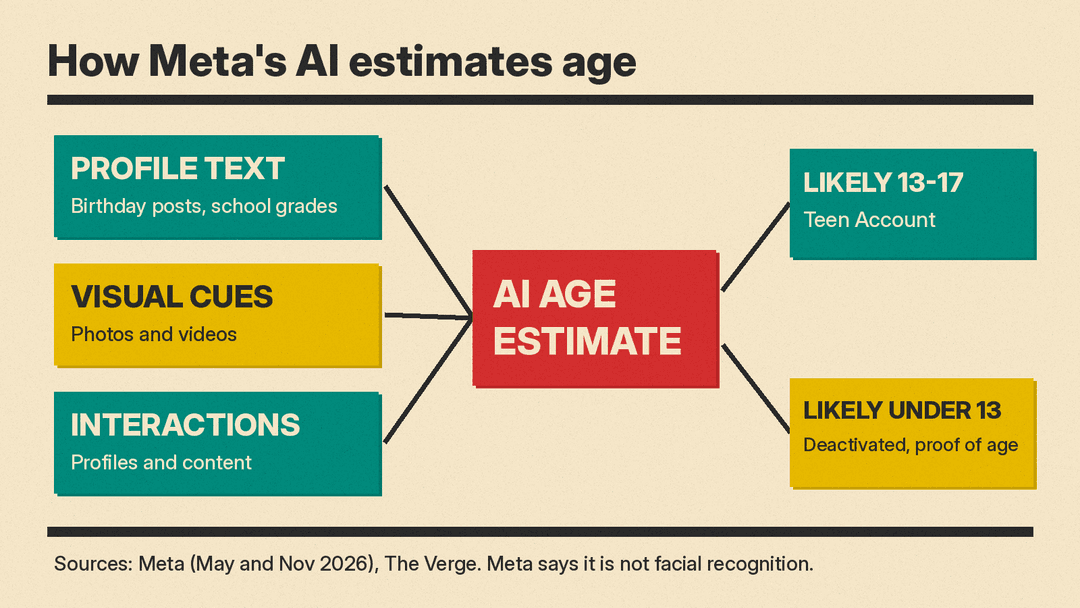
In that post, Meta described how its AI looks for underage accounts. It analyzes whole profiles for clues like birthday celebrations or mentions of school grades, in posts, comments, bios and captions. It also added visual analysis of photos and videos for clues about age, which Meta said was then available only in select countries. Meta said: "We want to be clear: this is not facial recognition." Meta said its AI does not identify the specific person in an image. In a July 31, 2026 correction to the same post, Meta added that its AI does not use biometric data to identify whether a person is underage and does not create facial fingerprints.
The signals also include the other profiles and content users interact with, birthday messages they receive, and visual cues from photos and videos including height and bone structure, The Verge said.
Suspected under-13 accounts are deactivated and must provide proof of age to avoid deletion, Meta said in the May post.
The November announcement does not include accuracy figures for the system. The clearest public error targets come from Meta's settlement with US state attorneys general, described below, and those apply in the states that joined it.
The settlement behind the expansion
The expansion builds on Meta's agreement with 52 bipartisan attorneys general, which the company cited in the announcement.
The California Attorney General's press release said the settlement with Meta includes robust age assurance measures to detect users under 18 and children under 13, an independent auditor, default daily time limits, and a monetary payment of up to $17 billion to the states over ten years.
U.S. District Judge Yvonne Gonzalez Rogers approved the settlement in a Consent Judgment dated August 26, 2026 (N.D. Cal.). A court order filed the same day granted the parties' motion to enter that judgment and vacated the trial.
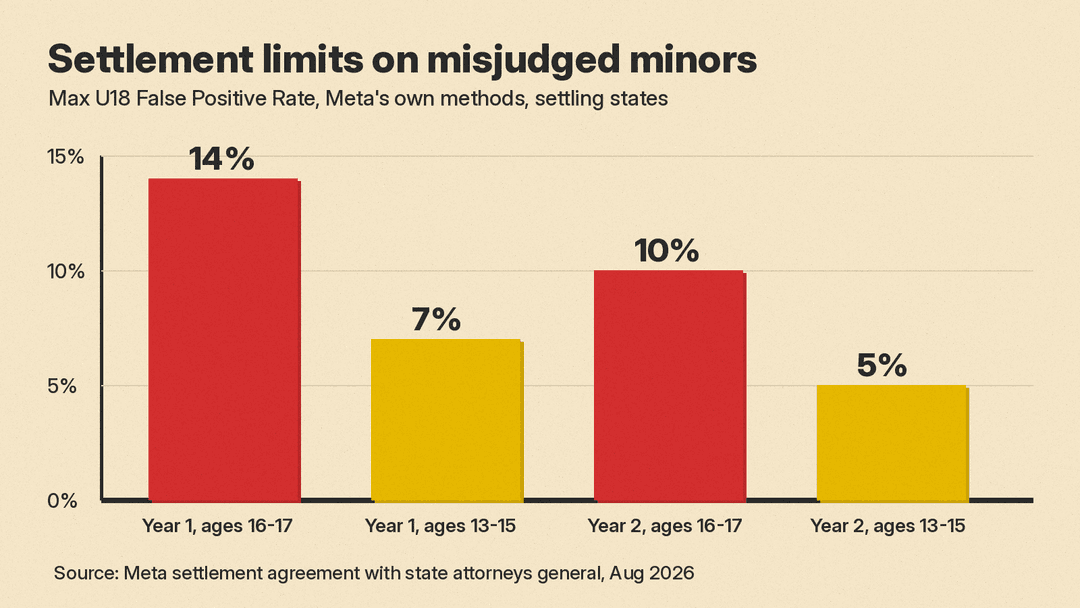
For Meta's own methods used on users in the settling states, the full text of the settlement agreement sets maximum "U18 False Positive Rates": the share of users aged 13 to 17 whom Meta wrongly judges to be 18 or older. Within one year of the agreement's effective date, the rate must be 14% for minors aged 16-17 and 7% for ages 13-15. Within two years, those limits fall to 10% and 5%.
Where should age checks happen?
Meta used the announcement to argue that age verification belongs at the app store level, with each app's own age estimation as a backstop that can correct mistakes. The company said it uses Apple's age-range signal voluntarily, and that as long as the signal stays optional for app stores and developers, teens get inconsistent protection. Meta says it supports legislation requiring age verification and parental consent at the app store level.
"One verified signal from people's devices, shared consistently with all apps, is far more effective and privacy-preserving than asking every platform to verify age individually," Meta said.
Meta said many new laws on teen safety don't explain how companies should determine age, and some require invasive checks for everyone. The company called on TikTok and YouTube to adopt the same practices.
Apple has separately told developers that App Store apps with a virtual companion that engages users in sexual or romantic content must carry an 18+ age rating, as we reported in our story on Apple's 18+ rating for AI companion apps.
The Electronic Frontier Foundation disputes the value of the settlement. In a September 2026 post, the EFF wrote about Meta's move away from self-reported birthdates: "This concession firmly embeds deeply flawed age estimation technology into the online experience of millions of people around the world." The EFF added: "First and foremost, the age verification setup seriously threatens online anonymity and privacy for everyone, as we've said before."
What to watch
The rollout leaves several questions open. Meta has not said which countries are newly covered by name, only that the expansion is global. It has not given a date for Threads beyond later this year. And the app store debate is unsettled: Meta says it has begun using Apple's signal in Australia, and it says teens get inconsistent protection while the signal is optional. For Instagram users, the practical change is simple. An adult birthday on the account no longer guarantees adult settings if Meta's AI thinks the person is a teen. Readers curious about how Meta labels AI content on the same app can see our explainer on why Instagram puts an AI label on real photos.
Sources
- Meta newsroom, November 9, 2026
- Meta newsroom, May 2026
- The Verge, Jess Weatherbed, November 9, 2026
- California Attorney General press release on the Meta settlement
- Settlement agreement (PDF)
- EFF, September 2026
- Consent Judgment / Indiana AG Meta settlement report (Aug. 26, 2026)
- N.D. Cal. Trial Order No. 3 granting motion to enter Consent Judgment (Aug. 26, 2026)
