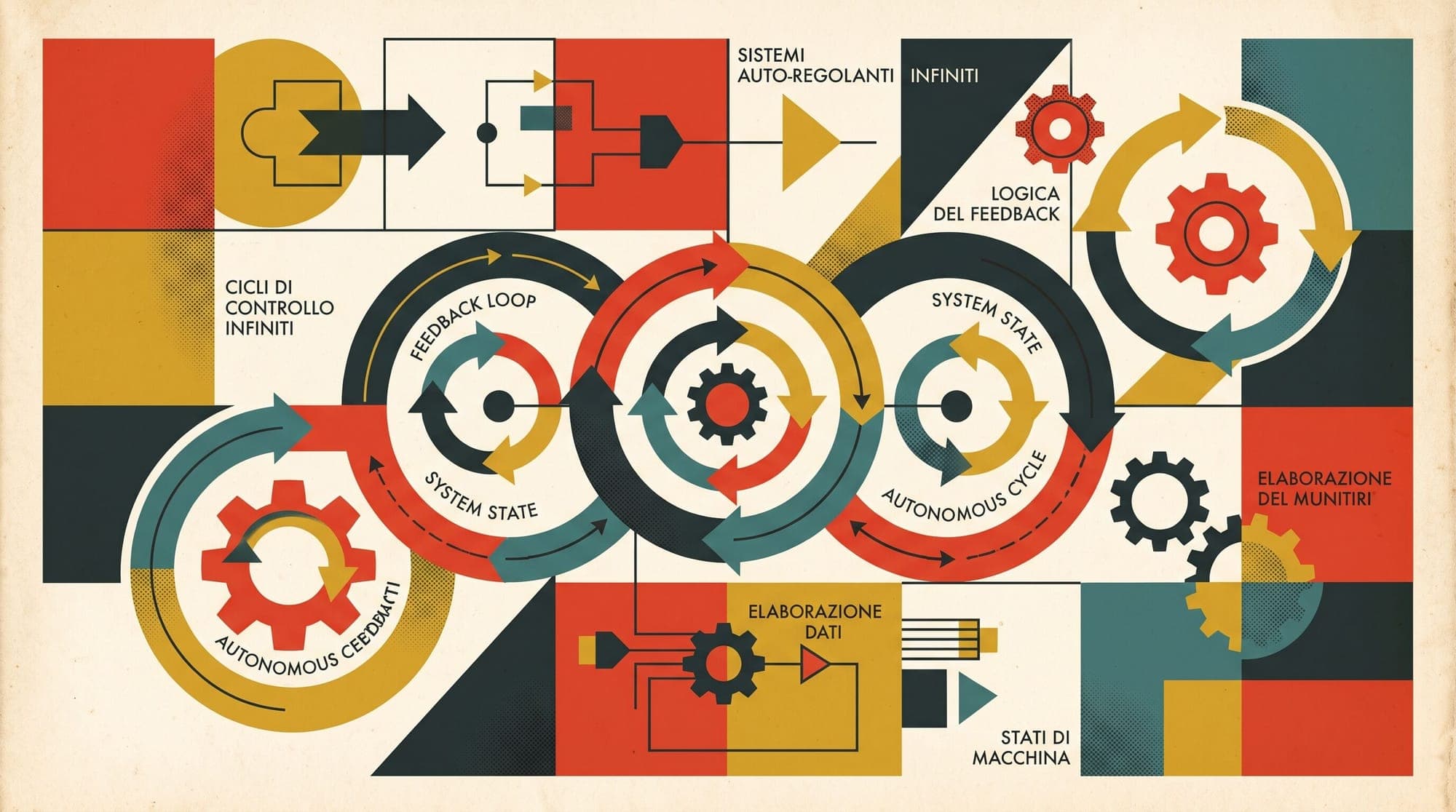
Autonomous AI agents have transitioned software architectures from static, single-turn request-response patterns into stateful, iterative execution loops. Built around foundational paradigms such as ReAct (Yao et al., 2022) and implemented across frameworks including LangGraph, CrewAI, AutoGen, and the OpenAI Agents SDK, agents repeatedly perceive environmental state, reason over intermediate goals, dispatch tool invocations, observe execution outputs, and append new observations back into their context window.
While iterative execution enables agents to resolve multi-step tasks, explore sub-problems, and self-correct from tool errors, it introduces a dangerous structural failure mode: Infinite Agentic Loops (IALs). Unlike conventional infinite loops in deterministic software that spin on static boolean predicates, an IAL is a distributed execution failure. An agentic feedback path repeatedly triggers expensive LLM inferences, external tool calls, database mutations, or multi-agent handoffs without reaching an effective termination boundary.
An empirical investigation of 6,549 real-world LLM agent repositories by Hou et al. (2026) identified 68 confirmed IAL vulnerabilities across 47 active open-source projects. These failures amplify a single user request into runaway infrastructure spend, prompt context blowouts, model denial of service, and cascading unauthorized external mutations.
Anatomy of an Infinite Agentic Loop
An infinite agentic loop occurs when an agentic feedback cycle can repeatedly execute model calls, tool dispatches, state updates, or workflow transitions without an invariant bound covering the entire execution path.
The standard execution lifecycle of an LLM agent contains five critical stages:
- Model Inference: The orchestrator invokes an LLM with the accumulated conversation and tool execution history.
- Continuation Evaluation: The orchestrator parses the model response to evaluate whether to terminate or proceed with tool dispatch (often evaluating flags such as
finish_reason == "tool_calls"). - Tool Dispatch: The system routes identified actions to local Python callables, sandbox execution environments, or external REST APIs.
- State Update: Tool results, error traces, and model rationales are appended to the working context buffer (
messages.append(...)). - Feedback Loop Re-entry: The enlarged context is submitted back to step 1 for the next iteration.
When any stage in this cycle lacks an explicit, monotonic bound that is independent of model output, the agent enters an unconstrained state machine loop.
Five Common Failure Topologies
Empirical analysis across production agent implementations reveals five primary failure topologies that produce infinite loops:
1. Semantic Continuation Traps
In many naïve implementations, loop termination is delegated entirely to the model itself. The outer loop continues executing while finish_reason == "tool_calls" or while not agent_done_signal.
Because LLM generation is non-deterministic and susceptible to hallucinations, formatting corruptions, or prompt injections, a model may repeatedly emit tool call tokens indefinitely. If the tool response fails to provide the exact semantic signal the model expects, or if the model becomes confused by ambiguous instructions, it continues emitting tool requests on every subsequent turn.
2. Context Growth and Attention Degradation
Every tool execution appends input parameters and return payloads into the active message history. As iterations accumulate, context window utilization expands linearly or quadratically.
This token accumulation triggers two compounding problems: first, API inference costs scale rapidly on every turn; second, attention dilution and "lost in the middle" degradation degrade the model's reasoning capabilities. As context grows, the model becomes less capable of synthesizing the accumulated evidence to produce a valid final answer, making termination increasingly unlikely with every additional turn.
3. Multi-Agent Delegation Ping-Pong
In multi-agent architectures (such as hierarchical supervisor-worker swarms or peer-to-peer collaboration graphs), agents route sub-tasks to specialized peers via handoff primitives.
When Agent A delegates an unresolvable query to Agent B, and Agent B encounters a missing parameter that prompts it to query Agent A, the system enters a cyclic delegation cycle. Without a globally synchronized, monotonic turn budget shared across the entire multi-agent swarm, individual agent turn limits fail to prevent runaway distributed execution.
4. Unbounded Exception and Error Recovery Re-entry
Agentic systems frequently wrap tool invocations in try...except blocks that catch runtime exceptions and feed the error string back to the model as an observation.
While designed to allow the agent to self-correct parameters, this pattern often devolves into an infinite repair loop. When an external API returns a permanent 404, 401, or schema validation error, the model repeatedly tweaks minor non-essential arguments and retries the same failing endpoint indefinitely.
5. Misplaced and Leaky Bound Scopes
A common structural bug in agent wrappers involves placing loop-breaking logic in the wrong execution scope. For instance, an inner break statement may successfully exit a tool batch loop over multiple tool calls returned in a single turn, but fail to terminate the outer model invocation loop.
Similarly, developers who construct custom model adapters or proxy classes frequently bypass framework-level guardrails (such as LangChain's max_iterations, LangGraph's recursion_limit, or OpenAI's max_turns), leaving the underlying network loop unbounded.

Static Verification: Agent IR and Loop Dependence Graphs
To systematically detect IAL vulnerabilities before deployment, researchers have developed static analysis frameworks designed specifically for agent execution semantics, such as IAL-Scan (Hou et al., 2026), AgentProof (Xavier et al., 2026), and Agent Audit (Zhang et al., 2026).
Static detection of agentic loops requires abstracting away framework-specific API idiosyncrasies and modeling the true feedback path:
Framework-Independent Agent Intermediate Representation (Agent IR)
Agent IR models agent programs as typed facts and relational edges:
- ExecutionUnit: Scopes defining functions, classes, and sub-agent boundaries.
- Controller: Control flow nodes representing loops, state graph routers, and termination predicates.
- Invocation: Calls to LLM endpoints, tools, sub-agents, or sub-processes.
- StateUpdate: Persistent mutations, such as message history appends and memory buffer writes.
- Bound: Concrete counters, recursion depth caps, wall-clock timeouts, and token budgets.
- ExitRecord: Deterministic termination edges, including
break,return, and raised exit signals.
Agentic Loop Dependence Graph (ALDG) Construction
The static analyzer builds an ALDG by stitching together call graphs, control flow graphs, and dataflow dependencies across both user code and framework abstractions.
Once the ALDG is constructed, the analyzer executes Strongly Connected Component (SCC) algorithms (such as Tarjan's algorithm) to identify all cyclic subgraphs. For each candidate cycle, the engine performs Bound Coverage Analysis:
- Does the cycle contain at least one costly invocation (LLM call or external tool)?
- Is the cycle's continuation condition controlled by non-deterministic data (model generation or tool observation)?
- Does an invariant Bound fact dominate every path within the SCC?
If an SCC contains model or tool invocations and lacks a dominating invariant bound, an IAL vulnerability is flagged.
Runtime Guardrail Architecture
Static verification must be paired with runtime defensive controls in production agent runtimes. A robust agent loop controller enforces four layers of defense:
1. Multi-Dimensional Resource Budgets
Every agent execution context must be initialized with immutable, hard limits across multiple resource dimensions:
- Maximum Iteration Budget: A hard ceiling on orchestrator turns (e.g., maximum 15 iterations).
- Wall-Clock Timeout: An external deadline (e.g., 60 seconds) enforced via asynchronous cancellation tokens.
- Cumulative Token and Cost Ceilings: A maximum spending limit per request across prompt and completion tokens.
- Per-Tool Call Quotas: Maximum allowable invocations for specific high-impact or rate-limited tools.
2. Content-Addressable Semantic Cycle Detection
To catch agents that repeat identical failing actions before hitting the hard iteration cap, orchestrators should track tool invocation fingerprints.
By computing a hash of the tool name combined with its canonicalized JSON arguments hash(tool_name, sort_keys(arguments)), the runtime can maintain an invocation frequency map. If the same tool is called with identical arguments three consecutive times, the controller breaks the loop immediately, returning a deterministic execution error.
3. State Delta and Progress Verification
In complex tasks, an agent may vary arguments slightly while still making zero forward progress (for example, ping-ponging between two search terms).
Runtime monitors compute embedding cosine similarity or string edit distance across consecutive agent thought rationales. If the rationale similarity exceeds 0.95 across multiple turns without new state variables being updated, the system triggers a progress-stall interrupt.
4. Deterministic Degradation and Fallback Handlers
When an agent hits an execution bound, the runtime must avoid throwing unhandled exceptions that crash the client session.
Instead, the orchestrator should invoke a deterministic fallback pipeline:
- Summarize Partial Progress: Pass the current accumulated state to a lightweight model instructed only to summarize completed actions and remaining blockers.
- Dead-Letter Queue Logging: Route the failed execution trajectory, ALDG path, and context snapshot to a dead-letter queue for offline analysis.
- Human-in-the-Loop Escalation: Suspend execution state and return an approval request to a human operator when privileged actions fail repeatedly.
Implementation Pattern: Bounded Agent Execution Controller
The following Python pattern illustrates how to construct a hardened, production-ready agent execution loop incorporating multi-dimensional bounds, semantic hashing, and deterministic fallback:
import hashlib
import json
import time
from typing import Any, Callable, Dict, List, Optional

class AgentExecutionError(Exception):
    """Raised when an agent execution bound is exceeded."""
    pass

class BoundedAgentController:
    def __init__(
        self,
        llm_client: Any,
        tools: Dict[str, Callable],
        max_turns: int = 12,
        max_cost_usd: float = 0.50,
        timeout_seconds: float = 45.0,
        max_repeated_tool_calls: int = 2
    ):
        self.llm = llm_client
        self.tools = tools
        self.max_turns = max_turns
        self.max_cost_usd = max_cost_usd
        self.timeout_seconds = timeout_seconds
        self.max_repeated_tool_calls = max_repeated_tool_calls

    def _hash_action(self, tool_name: str, args: Dict[str, Any]) -> str:
        serialized = json.dumps({"tool": tool_name, "args": args}, sort_keys=True)
        return hashlib.sha256(serialized.encode("utf-8")).hexdigest()

    def execute(self, user_prompt: str) -> Dict[str, Any]:
        start_time = time.time()
        messages: List[Dict[str, Any]] = [{"role": "user", "content": user_prompt}]
        action_history: Dict[str, int] = {}
        total_tokens_used = 0
        total_cost_usd = 0.0

        for turn in range(1, self.max_turns + 1):
            # 1. Wall-clock timeout check
            if time.time() - start_time > self.timeout_seconds:
                return self._fallback_summary(messages, "Execution timed out")

            # 2. Model invocation with cost tracking
            response = self.llm.generate(messages)
            total_tokens_used += response.usage.total_tokens
            total_cost_usd += response.usage.estimated_cost_usd

            # 3. Cost budget ceiling check
            if total_cost_usd > self.max_cost_usd:
                return self._fallback_summary(messages, "Cost ceiling exceeded")

            messages.append(response.message)

            # 4. Check model-indicated completion
            if not response.message.get("tool_calls"):
                return {
                    "status": "completed",
                    "output": response.message.get("content"),
                    "turns": turn,
                    "cost_usd": total_cost_usd,
                    "tokens": total_tokens_used
                }

            # 5. Tool execution with loop detection
            for tool_call in response.message["tool_calls"]:
                tool_name = tool_call["name"]
                tool_args = tool_call["arguments"]
                action_hash = self._hash_action(tool_name, tool_args)

                # Check duplicate invocation cycle
                action_history[action_hash] = action_history.get(action_hash, 0) + 1
                if action_history[action_hash] > self.max_repeated_tool_calls:
                    messages.append({
                        "role": "tool",
                        "tool_call_id": tool_call["id"],
                        "content": f"System error: Tool '{tool_name}' invoked repeatedly with identical parameters. Action aborted."
                    })
                    continue

                # Execute tool safely
                try:
                    tool_fn = self.tools.get(tool_name)
                    if not tool_fn:
                        tool_result = f"Error: Tool '{tool_name}' not recognized."
                    else:
                        tool_result = tool_fn(**tool_args)
                except Exception as exc:
                    tool_result = f"Tool execution failed: {type(exc).__name__}: {str(exc)}"

                messages.append({
                    "role": "tool",
                    "tool_call_id": tool_call["id"],
                    "content": str(tool_result)
                })

        # Reached turn ceiling
        return self._fallback_summary(messages, f"Exceeded maximum turn limit of {self.max_turns}")

    def _fallback_summary(self, messages: List[Dict[str, Any]], reason: str) -> Dict[str, Any]:
        return {
            "status": "bounded_exit",
            "reason": reason,
            "trajectory_length": len(messages),
            "output": "The agent was halted before completion because an execution safeguard was triggered."
        }
Architectural Takeaways
Autonomous agent design requires treating iteration not as a freeform while loop, but as a bounded, state-machine transaction.
Relying on LLM self-termination creates unpredictable latency, runaway API invoices, and security exposure. Production agent deployments require static verification of loop dependencies during CI/CD, complemented by multi-dimensional runtime guardrails that enforce turn, cost, and cycle bounds at the orchestrator layer.
Sources
- When Agents Do Not Stop: Uncovering Infinite Agentic Loops in LLM Agents (arXiv:2607.01641)
- ReAct: Synergizing Reasoning and Acting in Language Models (arXiv:2210.03629)
- AgentProof: Static Verification of Agent Workflow Graphs (arXiv:2603.20356)
- Agent Audit: A Security Analysis System for LLM Agent Applications (arXiv:2603.22853)
- LangGraph Documentation: Multi-Agent Loops and Recursion Limits
- OpenAI Agents SDK Architecture and Safety Boundaries