IBM Releases Granite 4.2 with Native Reasoning for Enterprise Agents
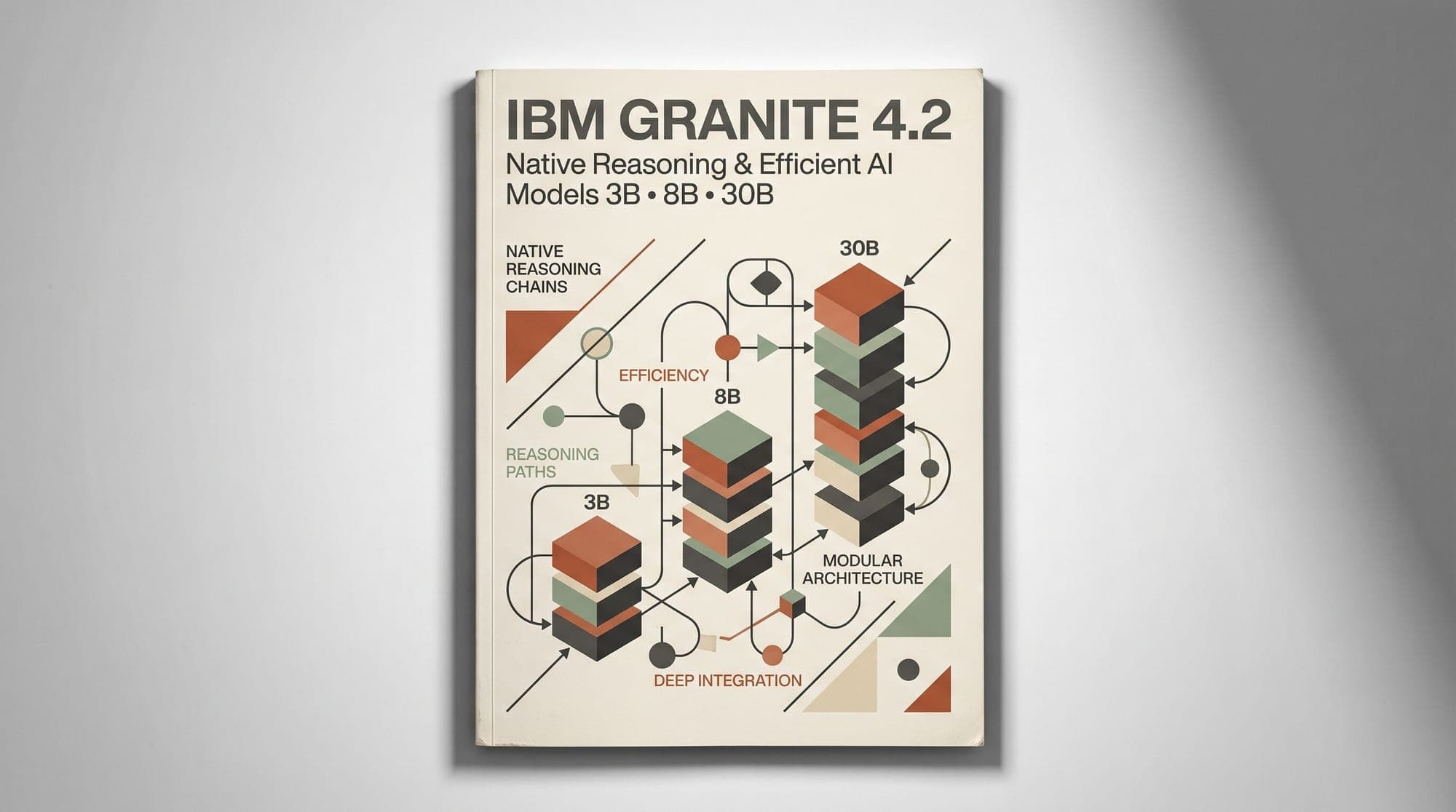
IBM has released Granite 4.2, a family of dense open-weight language models spanning 3B, 8B, and 30B parameters with built-in chain-of-thought reasoning, flexible thinking modes, and reasoning-augmented tool calling — all under the Apache 2.0 license.
Key Capabilities
The Granite 4.2 family introduces native reasoning inside questions...answer tags, significantly improving performance on complex math, coding, multi-step logic, and agentic tool-calling tasks. All three sizes support a 128K context window natively, with the 30B variant extending to 512K for long-context workloads.
Models are available in three tiers:
| Variant | Parameters | Target Use Case | |---------|------------|-----------------| | granite-4.2-3b | 3B | Edge deployment, resource-constrained environments | | granite-4.2-8b | 8B | General-purpose enterprise applications | | granite-4.2-30b | 30B | Complex reasoning, specialized coding workflows |
Thinking Modes
Granite 4.2 supports three thinking modes selectable via chat-template parameters:
- Thinking (default): Full chain-of-thought reasoning inside
questions...answer - Non-thinking: Direct answer with no reasoning overhead (
enable_thinking=False) - Low-effort: Brief reasoning for simpler queries (
enable_thinking=True, low_effort=True)
This allows users to balance depth versus latency on a per-query basis without switching models.
Agentic Reinforcement Learning
The 8B and 30B models undergo a specialized "agentic RL" phase after foundational RL, targeting enterprise-style tasks including software engineering, terminal-based coding, and search-driven workflows. Combined with RLHF alignment, this produces models better equipped for complex, multi-step agentic work.
Training also incorporates 1 trillion tokens of synthetic code generated via IBM's CodeAlchemy pipeline and an intermediate "mid-training" step shown to unlock additional reasoning capacity.

Speculative Decoding for Faster Inference
Granite 4.2 includes a speculative decoding layer that enables faster token output while serving more users concurrently — reducing inference latency and operating costs for enterprise deployments.
Speech Models for Edge Deployment
Alongside the language models, IBM released Granite Speech 5.0 Turbo CTC and 5.0 Turbo CTC NC — 470M parameter speech models with no LLM backbone, designed for high-throughput automatic speech recognition on laptops, smartphones, and edge devices. In testing, Granite Speech 5.0 Turbo CTC achieved ~12,600 RTFx on a single H200 GPU, roughly double the current Hugging Face Open ASR leaderboard leaders (~6,000 RTFx). The models can transcribe three hours of audio in one second.
Deployment
Granite 4.2 is optimized for vLLM (v0.20+) with the custom granite_thinking_parser for reasoning output and qwen3_coder for tool calling. The models expose an OpenAI-compatible API integrating with agentic coding harnesses including OpenCode, Pi, and OpenHands.
Model weights and documentation are available on Hugging Face (ibm-granite collection), Ollama, and GitHub.
Sources
- IBM Research Blog: "Granite 4.2 brings native reasoning to enterprise agents" — https://research.ibm.com/blog/introducing-granite-4-2
- IBM Granite Documentation: "Granite 4.2" — https://www.ibm.com/granite/docs/models/granite4-2