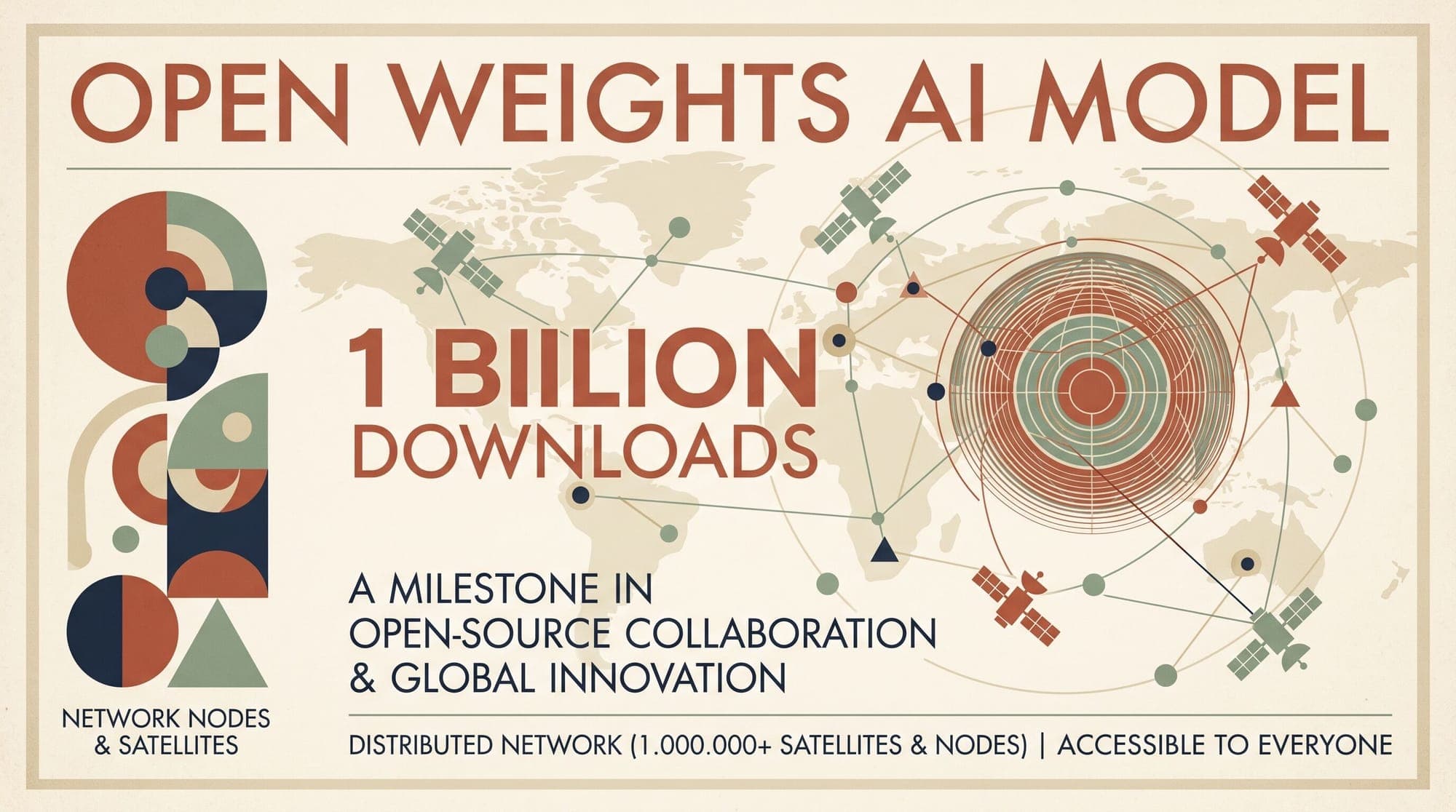
Google DeepMind announced that its Gemma family of open-weight models has surpassed one billion cumulative downloads since its initial launch in early 2024. Alongside the download milestone, the laboratory reported that third-party developers have published more than 100,000 distinct fine-tuned variants and derivative architectures across community model hubs.
The milestone marks the first cumulative adoption metrics released by Google for the Gemma ecosystem. To accompany the figures, Google launched the Awesome Gemma repository on GitHub, establishing a centralized directory for community projects, fine-tunes, and deployment tooling.

Edge and Spaceborne Deployments
The announcement highlighted operational deployments spanning constrained physical devices and space missions:
- Orbital Vision Processing: NASA's Jet Propulsion Laboratory deployed a 4-bit quantized variant of Gemma 3 4B aboard a Loft Orbital satellite under the NAVI-Orbital project. Running on an Nvidia Jetson Orin AGX module with an 8 GB memory ceiling, the model achieved 88% classification accuracy on a 7,960-image ground validation benchmark and conducted real-time image triage during orbital passes over France and Argentina.
- Satellite Communications: Orbital infrastructure startups Satlyt and Starcloud integrated Gemma variants into onboard satellite routing stacks to manage downlink bandwidth allocation and inter-satellite coordination.
Healthcare and Scientific Research Implementations
On the ground, Gemma derivatives have been integrated into large-scale public health infrastructure and laboratory pipelines:
- Aarogya Setu 2.0 Integration: India's National Health Authority incorporated Gemma 4 and Google's open Medical Data Toolkit into the Aarogya Setu 2.0 application (surpassing 100 million Android downloads) to parse and standardize medical diagnostic records into interoperable exchange formats.
- Clinical Triage and Diagnostics: Domain-adapted MedGemma models are operating in outpatient triage workflows at the All India Institute of Medical Sciences, as well as offline diagnostic support tools for rural health workers in Uganda.
- Single-Cell Biology: Researchers from Yale University and Google released C2S-Scale, a specialized Gemma derivative trained on single-cell biological assays that identified a candidate cancer therapy pathway subsequently validated in vitro.
- Bioacoustic Modeling: The Georgia Institute of Technology and the Wild Dolphin Project deployed DolphinGemma to model and predict structural sequences in cetacean acoustic communications.
Google also noted that its recent Gemma Challenge on Kaggle received more than 1,600 project submissions, with winning entries scheduled for publication in the coming weeks.