Fine-tuning foundation large language models on proprietary data is standard enterprise practice, but centralizing sensitive tokens into a single data lake is frequently prohibited. Regulatory frameworks such as HIPAA in healthcare, GDPR and Article 10 of the EU AI Act in Europe, and regional data residency mandates across APAC and North America prevent cross-border or cross-institutional data aggregation.
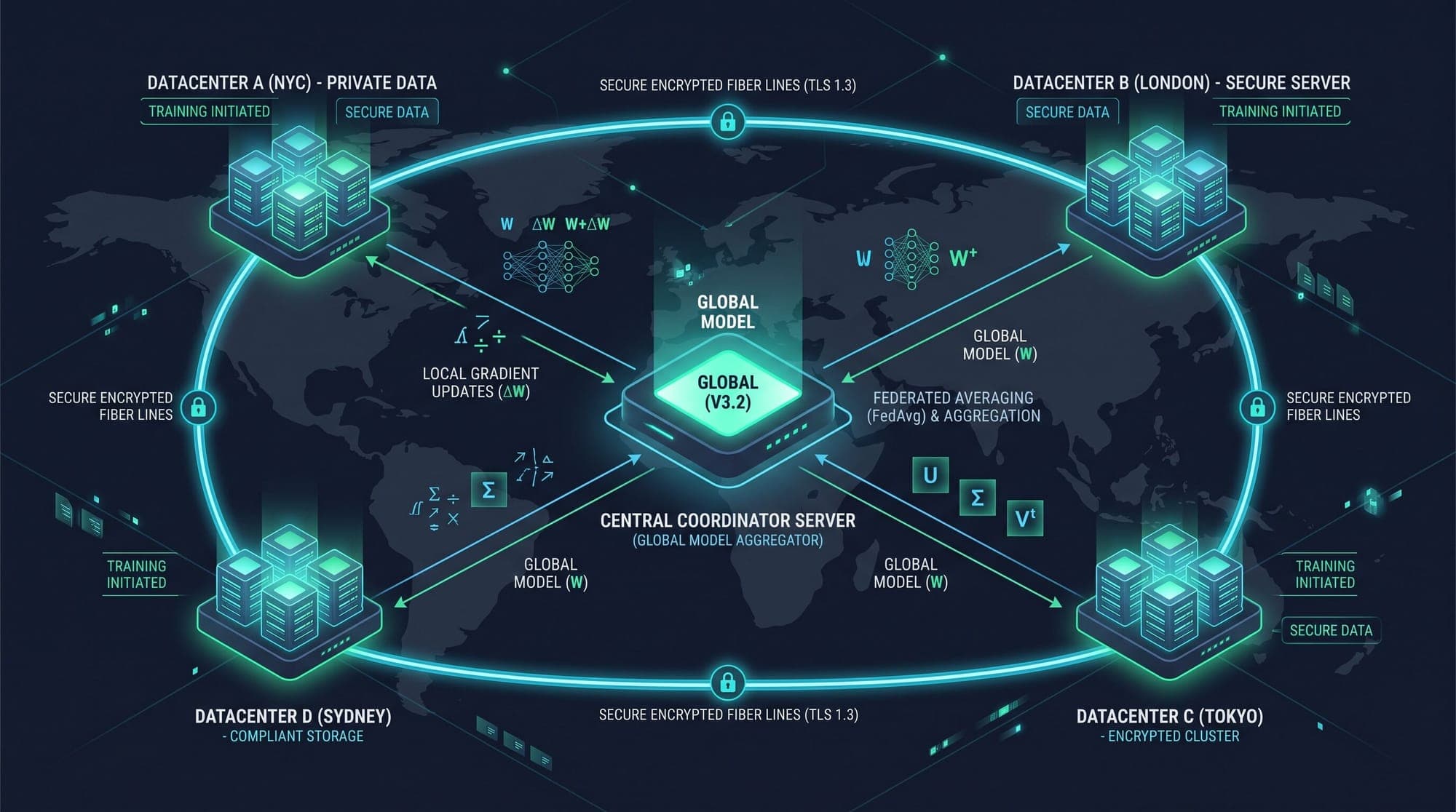
Federated Learning (FL) resolves this bottleneck by decoupling model training from data centralization. Instead of transmitting raw text, distributed client nodes execute local gradient steps on private infrastructure and transmit only parameter updates to a central coordinator.
While full-parameter federated fine-tuning remains bandwidth-prohibitive across wide-area networks (WAN), the combination of Low-Rank Adaptation (LoRA), robust aggregation protocols (FedAvg, FedProx, FedOpt), and cryptographic privacy layers has made federated LLM fine-tuning practical in enterprise production.

The Network Bottleneck: Why Full-Parameter FL Fails
In traditional distributed pre-training across co-located GPU clusters, high-bandwidth interconnects like NVLink (900 GB/s to 1.8 TB/s) and InfiniBand (400 Gbps to 800 Gbps) facilitate continuous all-reduce collective operations. In cross-silo federated learning, however, client nodes operate across public internet or corporate WAN connections where uplink bandwidth is constrained to 50 Mbps to 1 Gbps with variable latency and packet loss.
Transmitting full model weights for standard foundation models creates an impossible communication bottleneck:
- A 7B parameter model in FP16/BF16 requires transferring 14 GB per client per communication round. For 50 participating clients across 100 rounds, aggregate network transfer exceeds 70 TB.
- A 70B parameter model requires transferring 140 GB per client per round, resulting in 700 TB of network traffic across a standard training run.
Beyond bandwidth exhaustion, transmitting full weight tensors exposes organizations to gradient inversion attacks, where a malicious coordinator or eavesdropper reconstructs training prompts directly from unmasked full-parameter gradients, as documented by Zhu et al. (2019).
FedLoRA: Parameter-Efficient Federated Fine-Tuning
Low-Rank Adaptation (LoRA) freezes the pre-trained weight matrix W_0 in R^{d x k} and injects trainable rank-decomposition matrices A in R^{r x k} and B in R^{d x r}, where the rank r is much smaller than min(d, k). The forward pass computes:
h = W_0 x + Delta W x = W_0 x + (alpha / r) B A x
In the FedLoRA paradigm (Zhang et al., 2023), each client node downloads the shared global LoRA adapter weights, computes local gradients against its private dataset, and transmits only the low-rank matrices A and B back to the central server.
+-------------------------------------------------------------------------+
|                         Central Coordinator Server                      |
|  - Receives LoRA deltas: { (A_1, B_1), (A_2, B_2), ..., (A_K, B_K) }    |
|  - Executes Server Aggregation (FedAvg / FedProx / FedAdam)             |
|  - Broadcasts Updated Global LoRA Adapter (A_{t+1}, B_{t+1})            |
+-------------------------------------------------------------------------+
             ^                                      |
      LoRA   | Secure Masking /                     | Broadcast
      Deltas | DP Noise                             | Global Adapter
             |                                      v
+-----------------------------+        +-----------------------------+
|    Client Node 1 (Silo A)   |        |    Client Node 2 (Silo B)   |
|  - Frozen Base LLM (W_0)    |        |  - Frozen Base LLM (W_0)    |
|  - Local Private Dataset D_1|        |  - Local Private Dataset D_2|
|  - Local LoRA SFT (A_1, B_1)|        |  - Local LoRA SFT (A_2, B_2)|
+-----------------------------+        +-----------------------------+
Communication Payloads: Full-Weights vs. FedLoRA
The parameter reduction directly slashes per-round network payloads by over 99%:
===================================================================================
WAN PAYLOAD COMPARISON: FULL WEIGHTS VS. FEDLORA (RANK r=16, BF16)
===================================================================================
Base Model       Precision   Full Model Size   LoRA Adapter Size   WAN Reduction
-----------------------------------------------------------------------------------
Llama-3-8B       BF16        16.0 GB           28.8 MB             99.82%
Qwen-2.5-14B     BF16        28.0 GB           48.2 MB             99.83%
Llama-3-70B      BF16        140.0 GB          164.0 MB            99.88%
Mixtral 8x22B    BF16        282.0 GB          210.0 MB            99.93%
===================================================================================
Transmitting 28.8 MB per client round enables standard federated rounds to complete in sub-second network transfer windows even on modest 100 Mbps commercial uplinks.
Federated Aggregation Algorithms for LLMs
Standard federated learning relies on Federated Averaging (FedAvg), where the server computes a weighted average of client weights based on local sample counts n_k:
theta_{t+1} = sum_{k=1}^K (n_k / N) * theta_t^k
However, LLM fine-tuning across enterprise silos introduces severe statistical heterogeneity (non-IID data distributions), such as radiology reports in one hospital and pathology summaries in another. Under non-IID regimes, FedAvg suffers from client drift, where local models diverge into orthogonal sub-spaces.
===========================================================================
ALGORITHM COMPARISON: FEDERATED AGGREGATION FOR LLM FINE-TUNING
===========================================================================
Method      Core Mechanism                          Best Used For
---------------------------------------------------------------------------
FedAvg      Weighted parameter averaging            Homogeneous, balanced
            by sample size (n_k / N).               client datasets.

FedProx     Adds proximal regularization term       Severe non-IID data drift,
            (mu/2) * ||theta - theta_t||^2.         heterogeneous compute silos.

SCAFFOLD    Maintains client/server control         High variance in client
            variates to correct gradient drift.     local gradient steps.

FedOpt      Applies server-side momentum            Noisy client updates,
(FedAdam)   and adaptive learning rates (Adam).     sparse fine-tuning tasks.
===========================================================================
1. FedProx (Handling Non-IID Skew)
FedProx (Li et al., 2020) introduces a proximal regularization term to the local client objective function:
min_theta h_k(theta; theta_t) = F_k(theta) + (mu / 2) * ||theta - theta_t||^2
The proximal parameter mu restricts local LoRA parameters from migrating too far from the global server parameters theta_t. This stabilizes multi-epoch local training when client text distributions diverge sharply.
2. FedOpt and Server-Side Adaptive Optimizers
Instead of directly setting the new global weight to the average of client weights, FedOpt (Reddi et al., 2020) treats the difference between the aggregated client parameters and the previous global parameters as a pseudo-gradient:
Delta_t = sum_{k=1}^K (n_k / N) * (theta_t^k - theta_t)
The server updates the global LoRA checkpoint using an adaptive optimizer such as Adam (FedAdam) or Yogi (FedYogi) with server learning rate eta_s and momentum parameters beta_1, beta_2:
m_t = beta_1 * m_{t-1} + (1 - beta_1) * Delta_t
v_t = beta_2 * v_{t-1} + (1 - beta_2) * Delta_t^2
theta_{t+1} = theta_t + eta_s * (m_t / (sqrt(v_t) + eps))
Empirical benchmarks in OpenFedLLM (Ye et al., 2024) demonstrate that FedAdam accelerates convergence by 1.8x to 2.4x compared to vanilla FedAvg when fine-tuning Llama-2 and Mistral base models on domain-specific instruction datasets.
Privacy Architecture: DP-SGD and Secure Aggregation
Federated learning alone does not guarantee total privacy. Membership inference and gradient leakage attacks can extract raw training samples from transmitted LoRA weights. Enterprise production deployments require a layered defense combining Differential Privacy and Secure Multi-Party Aggregation.
Raw Client Tokens
       |
       v
[ Local LoRA SFT ] ---> Computes Adapter Gradients g_k
       |
       v
[ DP-SGD Layer ]   ---> Clips L2 Norm: g_k / max(1, ||g_k||_2 / C)
       |           ---> Injects Calibrated Gaussian Noise: N(0, sigma^2 C^2 I)
       v
[ Secure Aggregation ] ---> Encrypts masked vectors with Shamir secret sharing
       |
       v
Central Server Decrypts AGGREGATE SUM ONLY (Zero individual client visibility)
1. Differential Privacy with DP-SGD
To mathematically bound privacy leakage, client nodes implement Differentially Private Stochastic Gradient Descent (DP-SGD, Abadi et al., 2016). During local LoRA backward passes:
- Per-Sample Gradient Clipping: Gradients are clipped to a maximum L2 norm threshold C:
bar_g_i = g_i / max(1, ||g_i||_2 / C)
- Noise Injection: Calibrated Gaussian noise scaled by noise multiplier sigma is added to the clipped batch sum:
tilde_g = (1 / B) * ( sum_{i=1}^B bar_g_i + N(0, sigma^2 C^2 I) )
Using Rényi Differential Privacy (RDP, Mironov, 2017), the cumulative privacy budget (epsilon, delta) is tracked across training rounds, ensuring strict mathematical upper bounds on information disclosure.
2. Cryptographic Secure Aggregation (SecAgg+)
While DP protects the output distribution, SecAgg+ (Bell et al., 2020) prevents the coordinator from inspecting unaggregated client updates.
Using pairwise Diffie-Hellman key exchanges and secret sharing, each client node adds zero-sum masking vectors to its LoRA delta before transmission:
tilde_Delta_u = Delta_u + sum_{v > u} s_{u,v} - sum_{v < u} s_{v,u}
When the central coordinator sums all received vectors sum_u tilde_Delta_u, the pairwise masks cancel out exactly, revealing only the aggregated update sum_u Delta_u. The server never observes any individual institution's raw adapter weights.
Production Framework Comparison
Selecting the right federated orchestration stack depends on infrastructure constraints, regulatory requirements, and existing enterprise ecosystems:
========================================================================================
ENTERPRISE FEDERATED LLM FRAMEWORK COMPARISON
========================================================================================
Dimension          Flower (flwr)             NVIDIA FLARE (nvflare)    OpenFedLLM
----------------------------------------------------------------------------------------
Primary Focus      General FL Microservices  Enterprise HPC & Health   LLM Alignment Evals
Supported Backends PyTorch, HF, JAX, TF      PyTorch, NeMo, TensorRT   HF PEFT, TRL, Ray
Transport Layer    gRPC / Protobuf           gRPC / HTTP2 / S3         Ray / PyTorch RPC
PEFT / LoRA Native SuperLink + PEFT          NVFlare LLM Components    7+ FL Algos + PEFT
Privacy Tooling    Built-in DP-SGD, SecAgg+  Homomorphic Enc, DP       PyTorch Opacus
Enterprise RBAC    Basic Token Auth          PKI Certs, Role RBAC      Minimal (Research)
WAN Scalability    High (10,000+ nodes)      High (Multi-Cloud Silos)  Moderate (Clusters)
========================================================================================
Framework Recommendations
- NVIDIA FLARE: Recommended for regulated cross-institution consortia (hospitals, financial clearing houses) requiring enterprise PKI certificates, granular audit logging, and tight integration with NVIDIA NeMo.
- Flower (flwr): Recommended for cloud-native engineering teams building bespoke LLM microservices with Kubernetes, supporting dynamic node registration and heterogeneous hardware clients.
- OpenFedLLM: Recommended for research and evaluation teams benchmarking novel federated instruction-following algorithms and preference alignment (DPO, IPO) across non-IID splits.
Production Deployment Blueprint
A robust cross-silo federated LLM training pipeline follows a six-phase operational lifecycle:
[ Phase 1: Setup ]
  - Deploy base model checkpoints (e.g., Llama-3-8B-Instruct) across all client silos.
  - Distribute TLS certificates and mutual authentication keys.

[ Phase 2: Client Selection & Task Dispatch ]
  - Coordinator broadcasts round configuration: target LoRA rank, alpha, DP epsilon budget.
  - Selected clients acknowledge readiness and download current global adapter weights.

[ Phase 3: Local PEFT Execution ]
  - Clients run local instruction tuning (SFT) or DPO on isolated GPU clusters.
  - Apply DP-SGD per-sample gradient clipping (C=1.0) and Gaussian noise addition.

[ Phase 4: Secure Masking & Upload ]
  - Generate pairwise SecAgg+ masks with participating peer nodes.
  - Stream encrypted LoRA deltas to the coordinator over TLS/gRPC.

[ Phase 5: Server Aggregation & Momentum Update ]
  - Server aggregates masked updates; pairwise masks cancel out.
  - Apply FedAdam server optimizer to update global LoRA weights.

[ Phase 6: Validation & Early Stopping ]
  - Evaluate global adapter against held-out validation tasks.
  - If validation perplexity converges or privacy budget (epsilon) is exhausted, finalize model.
Trade-Offs and Architectural Failure Modes
- Client Dropout and Stragglers: In cross-silo setups, client compute varies from single RTX 4090 workstations to 8x H100 nodes. Using synchronous FedAvg causes the fastest nodes to stall waiting for slow stragglers. Mitigation: configure dynamic client quotas (e.g., proceed once 80% of clients complete) and apply asynchronous FedBuff scheduling.
- LoRA Rank Divergence in Heterogeneous Hardware: High-memory nodes can comfortably train rank r=64, while edge nodes are capped at r=8. Heterogeneous LoRA frameworks like FLoRA (Wang et al., 2024) dynamically slice and project variable-rank client matrices into a shared global representation using SVD basis alignment.
- Catastrophic Forgetting of Base Capabilities: Local instruction tuning on narrow domain data often degrades general reasoning. Mitigation: blend a synthetic general instruction replay buffer (10% to 15% of local batch size) into each client's training pipeline.
Sources
- Hu, E. J., et al. (2021). "LoRA: Low-Rank Adaptation of Large Language Models." International Conference on Learning Representations (ICLR). arXiv:2106.09685
- Zhang, J., et al. (2023). "Towards Building the Federated GPT: Federated Instruction Tuning (FedIT)." arXiv:2305.05644
- Ye, R., et al. (2024). "OpenFedLLM: Training Large Language Models on Decentralized Private Data via Federated Learning." Proceedings of the 30th ACM SIGKDD Conference on Knowledge Discovery and Data Mining (KDD). arXiv:2402.06954
- McMahan, B., et al. (2017). "Communication-Efficient Learning of Deep Networks from Decentralized Data." AISTATS. arXiv:1602.05629
- Li, T., et al. (2020). "Federated Optimization in Heterogeneous Networks (FedProx)." MLSys. arXiv:1812.06127
- Reddi, S., et al. (2020). "Adaptive Federated Optimization (FedOpt)." ICLR. arXiv:2003.00295
- Abadi, M., et al. (2016). "Deep Learning with Differential Privacy (DP-SGD)." ACM CCS. arXiv:1607.00133
- Bell, J. H., et al. (2020). "Secure Single-Server Aggregation with Constant Rounds of Communication (SecAgg+)." ACM CCS. Cryptology ePrint 2020/704
- Wang, Z., et al. (2024). "FLoRA: Federated Fine-Tuning Large Language Models with Heterogeneous Low-Rank Adaptations." arXiv:2409.05976
- Zhu, L., et al. (2019). "Deep Leakage from Gradients." NeurIPS. arXiv:1906.08935
- Mironov, I. (2017). "Rényi Differential Privacy." IEEE CSF. arXiv:1702.07476
- NVIDIA FLARE Documentation and Architecture. (2026). NVIDIA Developer
- Flower: A Friendly Federated Learning Framework. (2026). Flower.ai