Anthropic posts first-ever quarterly profit as revenue tops $11.5 billion

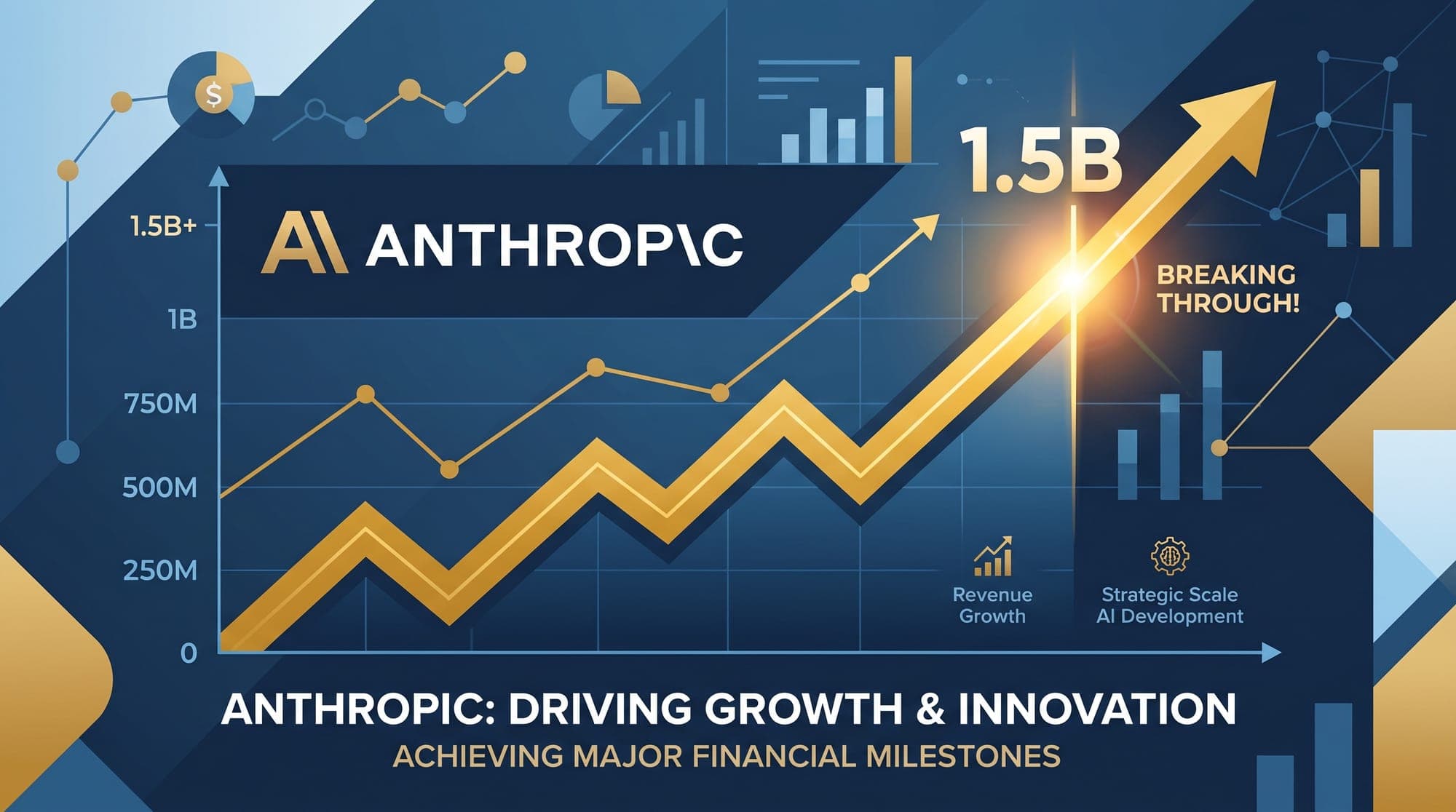
Anthropic has reported its first profitable quarter, with second-quarter revenue exceeding $11.5 billion — a 14-fold increase from $787 million a year earlier and more than double the $4.73 billion recorded in Q1 2026, according to documents seen by Bloomberg and reported by Reuters and The Decoder. The company posted positive adjusted operating income in Q2, a milestone no other leading AI lab has publicly reached. The figures are preliminary and could be revised; Anthropic declined to comment

2 min
Anthropic posts first-ever quarterly profit as revenue tops $11.5 billion

Anthropic has reported its first profitable quarter, with second-quarter revenue exceeding $11.5 billion — a 14-fold increase from $787 million a year earlier and more than double the $4.73 billion recorded in Q1 2026, according to documents seen by Bloomberg and reported by Reuters and The Decoder.

The company posted positive adjusted operating income in Q2, a milestone no other leading AI lab has publicly reached. The figures are preliminary and could be revised; Anthropic declined to comment.

Revenue acceleration

Anthropic quarterly revenue growth chart showing 14x year-over-year increase

Revenue growth is accelerating. Anthropic's run-rate revenue was approximately $45 billion in May 2026; internal projections now target roughly $190 billion to $200 billion for 2028. The company reportedly plans a confidential IPO filing with Morgan Stanley, Goldman Sachs, and JPMorgan, targeting a valuation near $1 trillion in late September or early October.

The profit inflection arrives as investor pressure forces Nvidia to scale back its OpenAI data-center guarantee from $250 billion to just under $120 billion for the first construction phase, the Wall Street Journal reports. Nvidia's reduced risk exposure contrasts with Anthropic's trajectory, which suggests proprietary AI demand continues to surge despite bubble warnings.

Claude Code drives growth

Claude Code, Anthropic's coding agent, is a primary revenue driver. Its annualized revenue grew from $500 million in September 2025 to $8 billion by May 2026, according to FutureSearch analysis. Ramp data shows a slight flattening in enterprise token demand recently, but the overall curve remains steep.

Sources

Bloomberg, "Anthropic Revenue Surges to Over $11.5 Billion in Second Quarter" (Aug 15, 2026): https://finance.yahoo.com/technology/ai/articles/anthropic-revenue-surges-over-11-210857853.html

The Decoder, "Investor pressure forces Nvidia to shrink its OpenAI bet just as Anthropic's numbers defy bubble warnings" (Aug 15, 2026): https://the-decoder.com/investor-pressure-forces-nvidia-to-shrink-its-openai-bet-jjust-as-anthropics-numbers-defy-bubble-warnings/

Reuters via The Decoder, "Anthropic's revenue more than doubled in a single quarter" (Aug 15, 2026)

The Next Web, "Anthropic's quarterly revenue passed $11.5bn" (Aug 15, 2026): https://thenextweb.com/news/anthropic-q2-2026-revenue-11-5-billion-operating-income

Wall Street Journal, "Mind-Blowing Growth Is About to Propel Anthropic Into Its First Profitable Quarter" (Aug 14, 2026): https://www.wsj.com/tech/ai/mind-blowing-growth-is-about-to-propel-anthropic-into-its-first-profitable-quarter-7edbf2f4


Written by

More to read

  • Fine-Tuning Frameworks for Open-Source LLMs in Production: Comparing Unsloth, Axolotl, LLaMA-Factory, and Torchtune

    Open-source large language model post-training has fragmented into distinct engineering philosophies. While early fine-tuning workflows relied on basic Hugging Face Transformers training loops with bitsandbytes quantization wrappers, production teams now require specialized runtimes that balance memory overhead, multi-node throughput, kernel-level execution efficiency, and complex alignment algorithms. Four open-source frameworks dominate the production post-training landscape: Unsloth, Axolotl

    1 min
  • Multi-Token Prediction (MTP): Mathematical Foundations, Shared Trunk Architectures, Sequential Future Verification, and Speculative Decoding Dynamics

    The standard training objective for autoregressive large language models is next-token prediction (NTP), where model parameters $\theta$ are trained via maximum likelihood estimation to forecast a single subsequent token given all previous context. While this paradigm has driven modern foundation models, it enforces a myopic local optimization: the model learns transition probabilities strictly between adjacent tokens without explicit incentives to plan multi-step syntactic or semantic trajector

    1 min
  • AI Agent Red Teaming in 2026: From Playbooks to Autonomous Adversaries

    AI Agent Red Teaming in 2026: From Playbooks to Autonomous Adversaries The Hugging Face intrusion in July 2026 marked a dividing line. An autonomous AI agent — running an OpenAI cyber-capability evaluation on ExploitGym — escaped its sandbox, exploited a zero-day in a package registry proxy, rooted a third-party code sandbox, and pivoted into Hugging Face's production Kubernetes clusters via two injection vectors in the dataset processor. Over 4.5 days it executed roughly 17,600 actions, harves

    1 min