Alignment and Uniformity on the Hypersphere: The Geometric Foundations of Contrastive Representation Learning
Contrastive representation learning serves as the foundational objective behind modern neural embeddings, powering dense retrieval systems, visual-language models such as CLIP, and metric learning pipelines. While early literature justified contrastive learning through the InfoMax principle (maximizing mutual information between augmented views), theoretical and empirical analyses have exposed fundamental discrepancies in that framework.
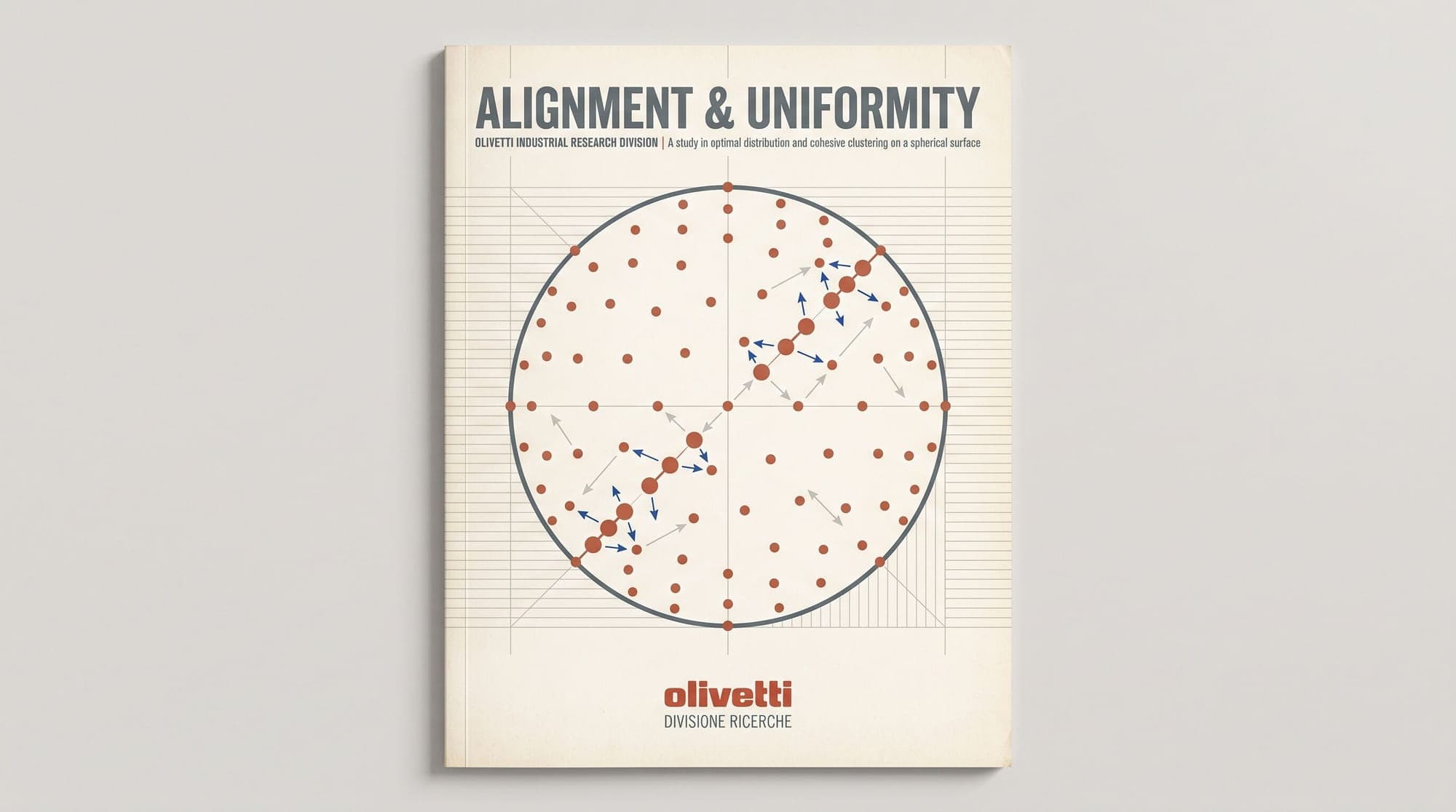
In a seminal study, Wang and Isola (2020) demonstrated that contrastive representation learning is governed by two distinct geometric properties on the unit hypersphere: alignment (mapping positive pairs to nearby vectors) and uniformity (distributing the overall feature distribution evenly across the spherical manifold to preserve maximal information). As the number of negative samples grows toward infinity, the standard contrastive loss asymptotically decomposes into these exact two objectives.
1. The Breakdown of the InfoMax Interpretation
Contrastive self-supervised learning algorithms (such as SimCLR (Chen et al., 2020), MoCo (He et al., 2020), and Contrastive Predictive Coding (Oord et al., 2018)) train an encoder to map high-dimensional data into -dimensional -normalized feature representations on the unit hypersphere .
Given a data distribution and a positive pair distribution generated via independent random data augmentations or multi-view sampling, the standard InfoNCE contrastive loss is formulated as:
where denotes the temperature hyperparameter and represents the number of negative samples per query.
The Mutual Information Paradox
Originally, was viewed as minimizing a variational lower bound on the mutual information . However, Tschannen et al. (2019) revealed that this mutual information framing fails to account for empirical behavior:
- Tightness vs. Representation Quality: Using more expressive critics or estimator bounds that yield tighter estimates of mutual information consistently degraded downstream classification and retrieval performance.
- Negative Sample Scaling: Mutual information bounds saturate at , yet scaling from to continues to improve linear probe performance on benchmarks like ImageNet well beyond the saturation threshold.
- Information Invariance: Maximizing true mutual information between views encourages the encoder to retain high-entropy superficial artifacts if shared across views, rather than learning semantically meaningful global features.
These findings confirmed that InfoNCE succeeds not because it estimates mutual information, but because of the specific geometric structure it enforces upon the latent space.
2. The Geometry of the Unit Hypersphere
Restricting feature representations to the unit hypersphere provides mathematical and optimization benefits that do not hold in unconstrained Euclidean space:
- Fixed-Norm Numerical Stability: Normalizing feature vectors eliminates scale variance, bounding the dot product and preventing gradient explosions in softmax calculations (Wang et al., 2017).
- Directional Statistics and Angle-Preserving Metrics: On , Euclidean distance and cosine similarity are monotonically linked by the exact identity:
- Linear Separability of Spherical Caps: In Euclidean space, clustered points can be surrounded or nested in configurations that prevent linear separation. On , if class clusters contract into compact spherical caps with angular radius , they become linearly separable from the remainder of the sphere via hyperplanes passing through the origin.

3. Formalizing Alignment and Uniformity
To isolate the mechanisms driving contrastive representation learning, Wang and Isola (2020) introduced two quantifiable, non-parametric geometric metrics.
3.1. Alignment
Alignment measures the expected distance between representations of positive pairs under the encoder mapping . An encoder is well-aligned if positive augmentations of the same underlying concept map to contiguous coordinates:
Under the standard distance formulation ():
An encoder achieves perfect alignment if almost surely for all . However, minimizing alignment alone produces catastrophic representation collapse: mapping all inputs to a single static vector yields .
3.2. Uniformity
Uniformity measures how evenly the overall data distribution is scattered across . A uniform distribution preserves the maximal entropy of the latent space, preventing dimensional collapse into low-dimensional subspaces.
Uniformity is quantified using the logarithm of the average pairwise Gaussian potential (Radial Basis Function potential):
where is a positive scaling parameter (typically ).
Connection to Energy Minimization on Spheres
The Gaussian potential formulation directly connects representation learning to classical physics and potential theory:
- The Thomson Problem: Minimizing electrostatic Coulomb potential among electrons constrained to a sphere (Thomson, 1904).
- Riesz -Potentials: Minimizing generalized potentials (Hardin and Saff, 2005).
- Universal Optimality: Cohn and Kumar (2007) proved that Gaussian potentials act as a completely monotonic potential basis. The normalized uniform surface area measure is the unique global minimizer of the expected pairwise Gaussian potential over all Borel probability measures on .
Furthermore, as the sample count , the empirical discrete counting measures associated with point configurations minimizing converge in the weak* topology directly to the uniform measure .
4. Asymptotic Convergence of the Contrastive Loss
The central theoretical insight of Wang and Isola (2020) is that the empirical InfoNCE loss directly optimizes alignment and uniformity in the asymptotic limit of infinite negative samples.
Theorem 1 (Asymptotics of InfoNCE)
For a fixed temperature , as the number of negative samples , the normalized contrastive loss converges almost surely to:
The rate of convergence for this limit satisfies an absolute deviation decaying in .
                InfoNCE Loss (M -> ∞)
                         │
        ┌────────────────┴────────────────┐
        ▼                                 ▼
   Alignment Term                  Uniformity Term
-1/τ E[f(x)ᵀ f(y)]            E_x[log E_x-[exp(f(x⁻)ᵀ f(x)/τ)]]
        │                                 │
        ▼                                 ▼
Pulls positive pairs             Repels all data points via
together on Sᵐ⁻¹                 vMF Kernel Density Estimation
(Minimizes distance)             (Maximizes latent entropy)
Analysis of the Decomposed Objectives
The asymptotic decomposition reveals two distinct mechanical forces:
- The Alignment Force: The first term, , is linear in the inner product of positive pairs. It is minimized if and only if the encoder achieves perfect alignment ( almost surely).
- The Uniformity / Entropy Force: The second term evaluates the log-partition function of negative representations. By substituting an empirical sample dataset , this term matches a non-parametric von Mises-Fisher (vMF) kernel density estimator:
where is the sample resubstitution differential entropy estimator and is the normalization constant for a von Mises-Fisher distribution with concentration parameter .
Minimizing the second term is mathematically equivalent to maximizing the entropy of the induced representation distribution on the hypersphere, forcing the embeddings toward the uniform distribution .
5. The Hardness-Aware Property of Temperature
The temperature parameter dictates how the uniformity force distributes repulsive gradients across negative samples on the sphere.
By taking the gradient of with respect to the query embedding , the repulsive gradient generated by negative embeddings is weighted by:
Wang and Liu (2021) analyzed this gradient dynamic, defining it as the hardness-aware property:
- Low Temperature (): becomes sharply peaked on the nearest negative samples (hard negatives where ). The repulsive force acts locally, pushing the closest neighbors apart while ignoring distant points on the sphere. This encourages fine-grained local uniformity and tight cluster separation, but increases sensitivity to false negatives.
- High Temperature (): approaches a uniform distribution . Every negative point exerts equal repulsive pressure regardless of distance. The objective reduces to matching the global center of mass to zero, failing to prevent local representation collapse.
       Low Temperature (τ = 0.07)               High Temperature (τ = 1.0)
       -------------------------                --------------------------
        (Local Hard Repulsion)                    (Global Weak Repulsion)

              Neg 1 (Hard)                              Neg 1
                ▲                                         ▲
                │  Large force                            │ Weak force
                │                                         │
    Anchor ─────┼─────► Neg 2 (Far)           Anchor ─────┼─────► Neg 2
                │                                         │
                │  Negligible force                       │ Weak force
                ▼                                         ▼
              Neg 3                                     Neg 3
6. Direct Alignment and Uniformity Optimization (DirectAU)
Because the contrastive loss asymptotically decomposes into alignment and uniformity, an alternative training paradigm is to optimize and directly:
where balances the alignment and uniformity objectives.
Advantages of Direct Optimization
- Elimination of the Softmax Denominator: Standard InfoNCE requires computing large denominator summations across all negative samples, necessitating memory banks (Wu et al., 2018) or large batch sizes (4,096 in SimCLR). DirectAU operates pairwise within mini-batches without explicit negative pairing.
- Independent Hyperparameter Control: In InfoNCE, the single parameter couples both the alignment pull strength and the negative repulsion radius. DirectAU decouples positive attraction () from negative dispersion (), allowing independent calibration.
- Computational Efficiency: Pairwise Euclidean matrices can be computed via vectorized operations ( for batch size ), avoiding distributed cross-device all-gather synchronization of softmax normalizers.
PyTorch Implementation
import torch
import torch.nn as nn
import torch.nn.functional as F

class DirectAULoss(nn.Module):
    """
    Direct Alignment and Uniformity Loss on the Hypersphere (Wang & Isola, 2020).
    Directly optimizes feature clustering for positive pairs and uniform dispersion.
    """
    def __init__(self, alpha: float = 2.0, t: float = 2.0, lam: float = 1.0):
        super().__init__()
        self.alpha = alpha
        self.t = t
        self.lam = lam

    def alignment(self, x: torch.Tensor, y: torch.Tensor) -> torch.Tensor:
        """Computes expected L2 distance between normalized positive pairs."""
        return (x - y).norm(p=2, dim=1).pow(self.alpha).mean()

    def uniformity(self, x: torch.Tensor) -> torch.Tensor:
        """Computes log expected Gaussian potential across all pairwise samples."""
        sq_pdist = torch.pdist(x, p=2).pow(2)
        return sq_pdist.mul(-self.t).exp().mean().log()

    def forward(self, x: torch.Tensor, y: torch.Tensor) -> dict[str, torch.Tensor]:
        # Normalize representations to lie on the unit hypersphere S^{m-1}
        x_norm = F.normalize(x, p=2, dim=-1)
        y_norm = F.normalize(y, p=2, dim=-1)

        l_align = self.alignment(x_norm, y_norm)
        l_unif_x = self.uniformity(x_norm)
        l_unif_y = self.uniformity(y_norm)
        l_unif = 0.5 * (l_unif_x + l_unif_y)

        total_loss = l_align + self.lam * l_unif
        return {
            "loss": total_loss,
            "align_loss": l_align,
            "uniform_loss": l_unif,
        }
7. Diagnostic Evaluation of Representation Quality
Evaluating self-supervised encoders typically requires training downstream linear probes on frozen representations. However, and function as unsupervised, non-parametric diagnostic metrics that predict downstream performance directly without requiring labeled linear classification probes.
| Encoder State | | | Downstream Quality | Geometric Failure Mode | | :--- | :--- | :--- | :--- | :--- | | Random Initialization | High | Low | Very Poor () | Unaligned noise scattered uniformly | | Complete Collapse | Zero () | High () | Nil () | All points collapsed to single vector | | Dimensional Collapse | Low | High () | Poor () | Embeddings trapped in narrow 1D/2D subspace | | Supervised Cross-Entropy | Very Low | Moderate | Moderate to High () | Tightly clustered classes, non-uniform background | | Optimal Contrastive / DirectAU | Low () | Low () | State-of-the-Art () | Well-separated spherical caps covering |
In empirical sweeps across vision (STL-10, ImageNet) and NLP benchmarks, plotting encoders on an coordinate grid reveals that downstream accuracy correlates inversely with distance to the lower-left origin.
       High Uniformity Loss (Collapse)
         ▲
         │   [Complete Collapse]
         │   f(x) = constant
         │
         │              [Dimensional Collapse]
         │              Anisotropic Cones
         │
         │                              [Random Init]
         │                              Scattered Noise
         │   [Optimal Encoders]
         │   Low Align + Low Unif
         └──────────────────────────────────────────────► High Alignment Loss
                                                          (Poor Cluster Cohesion)
8. Impact on Modern Foundation Models and Embeddings
The alignment-uniformity framework governs several core architectures in modern AI:
8.1. Dense Text Embedding Models (BGE, E5, OpenAI Text-Embedding-3)
Early BERT sentence embeddings suffered from representation degeneration and anisotropy, where all text representations collapsed into a narrow cone (Li et al., 2020; Gao et al., 2021). Modern embedding models (such as BGE and E5) use contrastive fine-tuning on billions of text pairs specifically to minimize , restoring full-rank spherical dispersion across the vector space.
8.2. Vision-Language Alignment (CLIP and SigLIP)
In OpenAI's CLIP (Radford et al., 2021), the image-text dual encoders are normalized to . The symmetric cross-entropy loss enforces cross-modal alignment (image-text pairs) while intra-batch negative samples drive uniformity across both modalities. Google's SigLIP (Zhai et al., 2023) replaces the global softmax with pairwise sigmoid loss, directly implementing pairwise alignment and repulsion without batch-wide denominator normalizers.
8.3. Graph and Recommendation Embeddings
In graph representation learning and recommendation systems (Wang et al., 2022), DirectAU loss functions allow user-item interaction modeling without requiring expensive negative mining heuristics, improving cold-start generalization and computational throughput.
Summary of Core Principles
- InfoNCE is Asymptotically Geometric: The contrastive loss does not merely maximize mutual information; it decomposes into an alignment term that minimizes intra-pair distance and a uniformity term that maximizes the von Mises-Fisher entropy on the unit hypersphere.
- Uniformity Prevents Collapse: Minimizing Gaussian potential forces representations toward the uniform surface measure , eliminating dimensional collapse and preserving maximal feature entropy.
- Temperature Controls Repulsion Locality: Low temperatures focus repulsive gradients strictly on hard negatives, creating tight spherical caps, while high temperatures average repulsion globally across the sphere.
- DirectAU Simplifies Optimization: Directly optimizing achieves competitive or superior representations while bypassing the memory overhead and synchronization bottlenecks of large-batch softmax operators.
Sources
- Wang, T., & Isola, P. (2020). Understanding Contrastive Representation Learning through Alignment and Uniformity on the Hypersphere. International Conference on Machine Learning (ICML).
- Wang, F., & Liu, H. (2021). Understanding the Behaviour of Contrastive Loss. IEEE Conference on Computer Vision and Pattern Recognition (CVPR).
- Tschannen, M., Djolonga, J., Rubenstein, P. K., Gelly, S., & Lucic, M. (2019). On Mutual Information Maximization for Representation Learning. International Conference on Learning Representations (ICLR).
- Chen, T., Kornblith, S., Norouzi, M., & Hinton, G. (2020). A Simple Framework for Contrastive Learning of Visual Representations (SimCLR). International Conference on Machine Learning (ICML).
- He, K., Fan, H., Wu, Y., Xie, S., & Girshick, R. (2020). Momentum Contrast for Unsupervised Visual Representation Learning (MoCo). IEEE Conference on Computer Vision and Pattern Recognition (CVPR).
- Oord, A. v. d., Li, Y., & Vinyals, O. (2018). Representation Learning with Contrastive Predictive Coding. arXiv preprint arXiv:1807.03748.
- Radford, A., Kim, J. W., Hallacy, C., Ramesh, A., Goh, G., Agarwal, S., ... & Sutskever, I. (2021). Learning Transferable Visual Models From Natural Language Supervision (CLIP). International Conference on Machine Learning (ICML).
- Zhai, X., Mustafa, B., Kolesnikov, A., & Beyer, L. (2023). Sigmoid Loss for Language Image Pre-Training (SigLIP). IEEE International Conference on Computer Vision (ICCV).
- Gao, T., Yao, X., & Chen, D. (2021). SimCSE: Simple Contrastive Learning of Sentence Embeddings. Empirical Methods in Natural Language Processing (EMNLP).
- Cohn, H., & Kumar, A. (2007). Universally Optimal Distribution of Points on Spheres. Journal of the American Mathematical Society.
- Hardin, D. P., & Saff, E. B. (2005). Minimal Riesz Energy on Spheres for Large Numbers of Points. Bulletin of the American Mathematical Society.
- Thomson, J. J. (1904). On the Structure of the Atom. Philosophical Magazine.