AI Agent Code Execution Sandboxes in Production: Comparing E2B, Modal, Daytona, and Firecracker MicroVMs
Autonomous AI agents that write, execute, and debug code represent a major architectural shift in production AI systems. From automated coding benchmarks like SWE-bench to autonomous software engineers, data analysis agents, and dynamic tool-use pipelines, modern Large Language Model (LLM) workflows frequently execute arbitrary, model-generated code.
Running arbitrary code generated by probabilistic models creates a fundamental security and operational challenge. Code produced by an LLM cannot be considered trusted. Prompt injection attacks, poisoned retrieval-augmented generation (RAG) contexts, and unpredictable hallucinations can instruct an agent to delete files, scan internal networks, or trigger privilege escalation exploits.
Simultaneously, agent architectures demand low latency. An interactive coding assistant or multi-turn reasoning agent cannot wait 30 seconds for a traditional virtual machine to boot between turns. Teams building agentic infrastructure must balance three competing requirements: hardware-level security isolation, sub-second cold starts with state preservation, and cost-effective multi-tenant scaling.

The Isolation Spectrum: Containers, User-Space Kernels, and MicroVMs
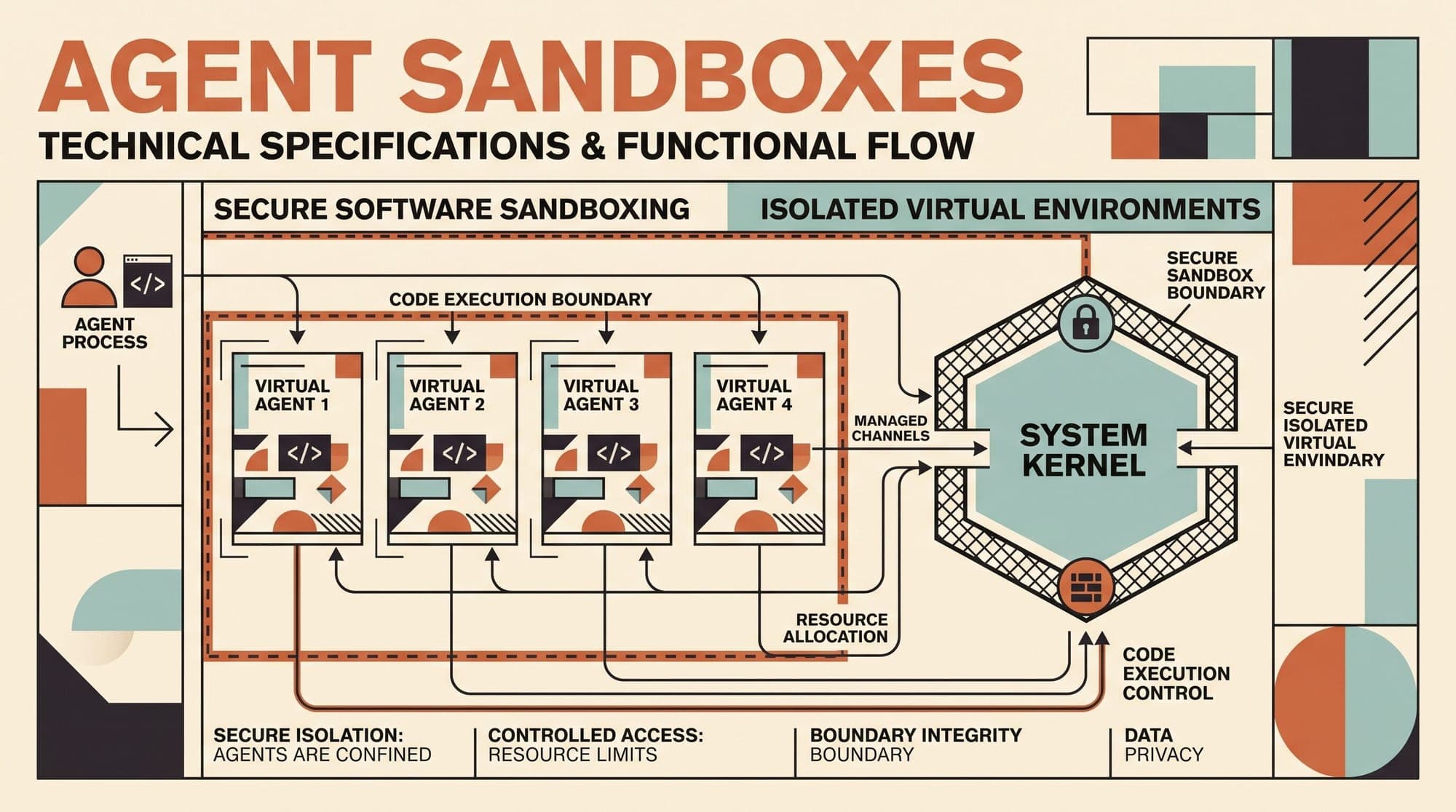
The fundamental architectural distinction between sandbox platforms lies in where the isolation boundary is enforced.
1. Shared-Kernel Linux Containers (Docker, OCI)
Standard container engines utilize Linux kernel primitives, specifically control groups (cgroups), namespaces (PID, mount, network, IPC), and seccomp filters.
- Security model: Containers share the underlying host Linux kernel.
- Failure modes: A container breakout vulnerability in the host kernel (such as privilege escalations or kernel memory corruptions) compromises all containers running on that physical node. If an agent executes hostile code or gains access to a mounted Docker socket, host integrity is broken.
- Operational profile: Container creation is extremely fast (typically 90ms to 200ms) with low memory overhead, but multi-tenant security for untrusted code remains insufficient without supplemental isolation layers.
2. User-Space Kernel Emulation (gVisor)
Developed by Google, gVisor provides a virtualization boundary by implementing a user-space kernel (called the Sentry) written in Go.
- Security model: Application system calls are intercepted via
ptraceor KVM and handled inside the user-space Sentry rather than reaching the host Linux kernel directly. Only a minimal, vetted subset of system calls is passed down to the host kernel (via the Gofer process). - Hardware flexibility: Because gVisor does not require nested hardware virtualization, it runs on standard cloud compute instances and supports GPU passthrough, making it popular for GPU-accelerated sandbox environments.
- Trade-offs: System-call-heavy workloads, such as extensive file system operations or multi-process compilations, incur measurable CPU translation overhead.
3. Hardware-Virtualization MicroVMs (Firecracker, Kata Containers)
Created by Amazon Web Services for Lambda and Fargate, AWS Firecracker is an open-source Virtual Machine Monitor (VMM) written in Rust that runs on top of Linux Kernel-based Virtual Machine (KVM).
- Security model: Each sandbox runs as an independent virtual machine with its own dedicated guest Linux kernel and virtual hardware devices. The hypervisor provides a strict hardware boundary; compromising the guest kernel does not yield host access.
- Minimalist design: Firecracker omits legacy PC devices, PCI buses, and unnecessary drivers, implementing only minimal virtio devices (virtio-net, virtio-block, virtio-vsock, virtio-balloon) and a minimalist serial console. Its code footprint is approximately 50,000 lines of Rust.
- Cold start and snapshotting: A cold Firecracker boot takes 125ms to 200ms. By serializing guest physical memory and vCPU register state to disk, snapshot-restore mechanisms allow pre-warmed microVMs to resume in 5ms to 30ms.
Platform Comparison: E2B, Modal, Daytona, and Self-Hosted MicroVMs
Different production platforms optimize for distinct developer workflows, infrastructure footprints, and isolation levels.
E2B: Dedicated Ephemeral MicroVMs for Agent Tool Execution
E2B is purpose-built for running untrusted LLM-generated code in ephemeral, isolated sandboxes.
- Underlying architecture: E2B runs managed Firecracker microVMs on bare-metal infrastructure, providing hardware-level KVM isolation for each tenant session.
- Lifecycle and latency: Sandboxes spin up in roughly 150ms for cold starts, while warm snapshot restores execute in 5ms to 30ms, as documented in Spheron's sandbox benchmarks.
- SDK ergonomics: E2B provides specialized Python and TypeScript SDKs designed for code execution, file system inspection, and long-running terminal processes, making it a standard choice for Code Interpreter and SWE-bench execution harnesses.
- GPU support: Managed E2B instances are CPU-only, though self-hosted open-source deployments on bare metal can configure GPU passthrough.
- Pricing structure: Managed tiers charge on per-second active execution duration (starting around $0.000014 per second per sandbox).
Modal: Serverless Compute with GPU-Accelerated Sandboxes
Modal is a serverless execution platform built for Python workloads, data pipelines, and AI inference.
- Underlying architecture: Modal utilizes gVisor container virtualization to isolate workloads without full microVM overhead.
- GPU integration: Modal's primary differentiator is native, programmatic access to NVIDIA GPUs (including T4, A10G, L4, and H100 units) directly within ephemeral sandboxes.
- Lifecycle and latency: Sandbox initialization ranges from 300ms to 500ms for lightweight containers, scaling up when large container images or machine learning weight checkpoints are mounted, according to MorphLLM's sandbox analysis.
- Best fit: Agent workflows that require GPU compute inside the execution boundary, such as local embedding generation, image processing, or fine-tuned model inference.
Daytona: Workspace Orchestration and Development Environments
Daytona began as an open-source development environment manager and has evolved into an infrastructure engine for AI agents and developer workspaces.
- Underlying architecture: Daytona defaults to standard OCI/Docker container runtimes, with configurable backend support for Kata Containers and system virtualization.
- Lifecycle and latency: Daytona achieves rapid container creation times (around 90ms) through container orchestration optimizations, as highlighted in Northflank's sandbox guide.
- Workspace statefulness: Daytona excels at persistent, stateful developer workspaces that require long-lived filesystems, multi-language LSP integration, and IDE connectivity.
- Security consideration: Because the default configuration relies on shared-kernel Docker containers, workloads handling untrusted or prompt-injected code require enabling Kata Containers or gVisor backends.
Self-Hosted MicroVM Stacks: PandaStack and Bare-Metal Firecracker
For high-throughput enterprise systems with strict compliance requirements, self-hosting microVM infrastructure avoids third-party API limits and vendor lock-in.
- Implementations: Open-source orchestration frameworks like PandaStack and custom Firecracker fleets run directly on KVM-enabled Linux hosts.
- Memory streaming and forking: Advanced microVM setups utilize Copy-on-Write (CoW) page streaming, restoring baked rootfs and kernel snapshots on demand in 150ms to 200ms without maintaining expensive idle memory pools.
- Economics: Self-hosted bare-metal clusters break even against managed API pricing once sandbox volume exceeds approximately 10,000 to 15,000 sandbox-hours per month.
Multi-Turn State Management and Environment Forking
Autonomous agents rarely execute in a single isolated step. A typical multi-turn workflow involves installing dependencies, inspecting a repository, modifying source files, running unit tests, and debugging errors over 10 to 30 sequential turns.
Re-initializing an execution environment from a blank state on every turn introduces heavy operational penalties:
- Package cache loss: Re-running
pip installornpm installconsumes seconds of network bandwidth and compute on every step. - Intermediate state: Preserving in-memory REPL variables, background processes, and filesystem changes requires durable session state.
To solve this, modern sandbox engines implement two distinct state strategies:
- In-Place Session Hibernation: The microVM remains paused in host RAM between agent turns, consuming zero vCPU cycles and resuming instantly when the agent issues the next command.
- Snapshot-and-Fork Branching: Platforms like PandaStack and Morph Cloud allow an agent to snapshot a microVM at a specific checkpoint and fork multiple parallel sandboxes from that state. This enables speculative agent execution, where an agent tests three distinct debugging strategies concurrently in separate sandboxes, merging only the successful branch.
Network Security and Exfiltration Defense
A secure hypervisor prevents an attacker from breaking into the host machine, but it does not prevent an agent from performing malicious network activity. If an untrusted script runs inside a sandbox with unrestricted Internet access, it can:
- Exfiltrate proprietary source code or environment variables to attacker-controlled external endpoints.
- Attack internal cloud metadata services (e.g., AWS/GCP instance metadata at
169.254.169.254) to steal IAM credentials. - Participate in distributed denial-of-service (DDoS) attacks or automated vulnerability scanning.
A robust production sandbox architecture enforces network isolation at multiple levels:
- Instance metadata protection: Drop all egress traffic destined for link-local and metadata address ranges (
169.254.0.0/16). - DNS filtering and allowlisting: Route DNS requests through a filtering proxy that restricts outbound connections to verified package registries (e.g., PyPI, npm) and explicit API endpoints.
- Ephemeral credentials: Never inject persistent production API keys or broad cloud credentials into the sandbox filesystem. Pass short-lived, narrowly-scoped tokens on a per-request basis.
Production Decision Framework
Choosing the right sandbox platform depends on three primary factors: security boundaries, GPU requirements, and operational scale.
- Choose E2B when building code interpreter tools, data analysis agents, or SWE-bench evaluation runners that require verified Firecracker hardware isolation with zero infrastructure management.
- Choose Modal when agent tasks require in-sandbox GPU acceleration, heavy parallel batch processing, or native Python serverless infrastructure.
- Choose Daytona when orchestrating persistent developer environments, long-lived multi-file codebases, or stateful agent IDE integrations.
- Choose Self-Hosted Firecracker / PandaStack when compliance mandates that proprietary data never leave your own VPC, or when high-volume continuous agent workloads justify managing bare-metal KVM infrastructure.
Sources
- Comparing AI Agent Sandbox Platforms: E2B, Modal, Daytona, and More - LogRocket
- AI Agent Code Execution Sandboxes on GPU Cloud: E2B, Daytona, and Firecracker - Spheron
- AI Code Sandbox Guide: E2B Alternatives - PandaStack
- Daytona vs E2B in 2026: Which Sandbox for AI Code Execution - Northflank
- Modal vs E2B vs Daytona vs Vercel Sandbox - Particula Tech
- Daytona Alternatives: 5 AI Agent Sandbox Platforms Compared - MorphLLM
- Firecracker MicroVM Documentation - AWS / Firecracker GitHub
- gVisor Application Kernel - Google Open Source