Adobe Firefly Expands Generative Audio Tools and Integrates Gemini Omni Flash

Adobe has broadened its generative production suite with the general availability of three dedicated AI audio generation modules in Adobe Firefly, alongside the integration of Google's multimodal Gemini Omni Flash model. The audio capabilities expand Firefly from static imagery and video synthesis into integrated soundtrack design, voice synthesis, and scene audio generation, fully cleared for commercial workflows. Generative Audio Modules and Commercial Licensing The expanded audio suite in

2 min
Adobe Firefly Expands Generative Audio Tools and Integrates Gemini Omni Flash

Adobe has broadened its generative production suite with the general availability of three dedicated AI audio generation modules in Adobe Firefly, alongside the integration of Google's multimodal Gemini Omni Flash model.

The audio capabilities expand Firefly from static imagery and video synthesis into integrated soundtrack design, voice synthesis, and scene audio generation, fully cleared for commercial workflows.

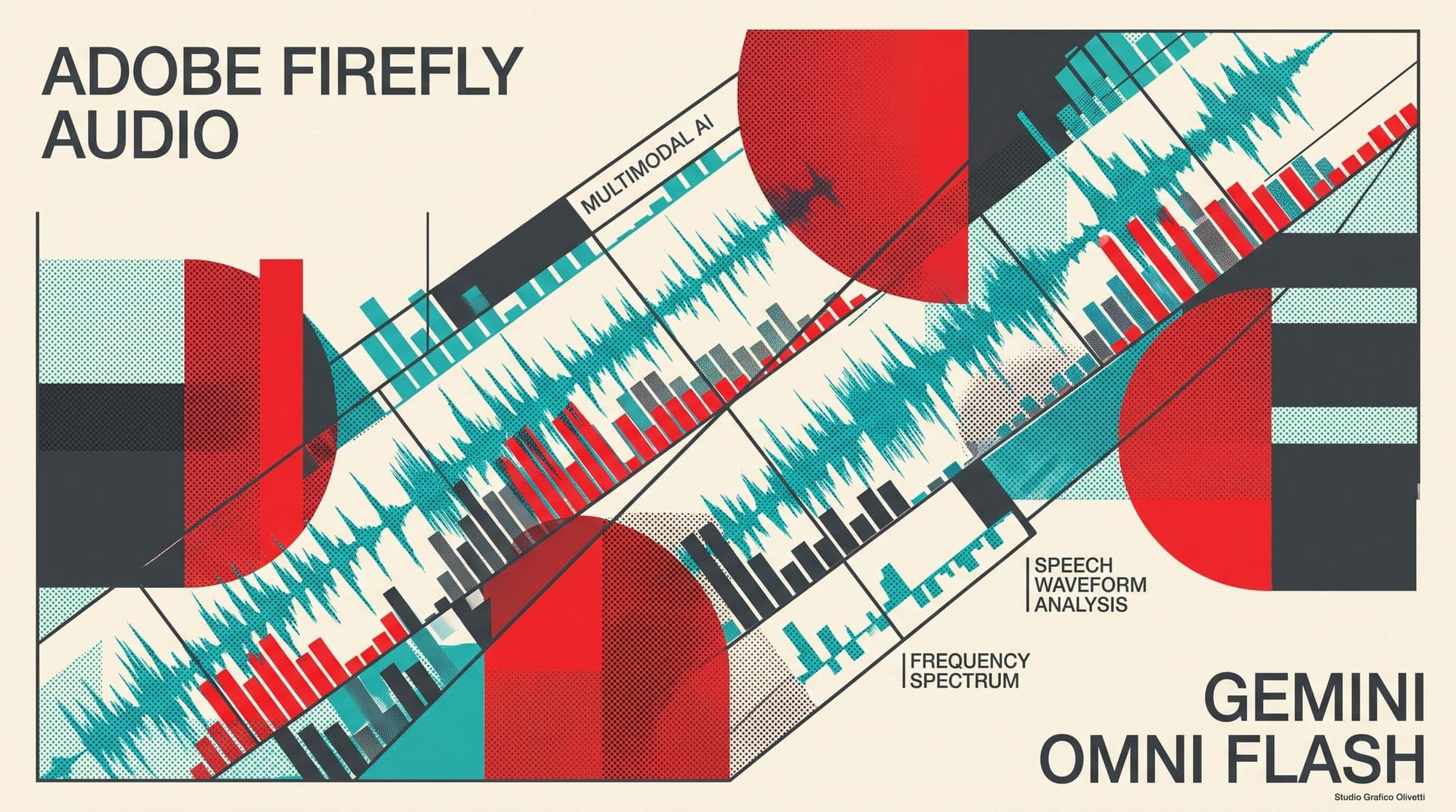
Adobe Firefly Generative Audio Pipeline and Model Architecture

Generative Audio Modules and Commercial Licensing

The expanded audio suite introduces three distinct generation pathways tailored to video and multimedia production:

  • Generate Music: Produces royalty-free, commercially cleared instrumental and background music tailored to user prompts, target durations, and tempo parameters.
  • Generate Speech: Converts written dialogue and scripts into natural synthetic voiceovers across varying vocal profiles and pacing options.
  • Generate Sound Effects: Synthesizes contextual foley, atmospheric layers, and scene-specific acoustic events directly aligned to visual edit markers.

Adobe maintains that all audio assets created within Firefly are commercially licensed and backed by the company's enterprise copyright indemnification policies, matching the legal assurances previously established for its image and vector models.

Multimodal Expansion with Gemini Omni Flash

In parallel with the native audio release, Adobe integrated Google's Gemini Omni Flash foundation model into the Firefly platform. Gemini Omni Flash processes interleaved inputs spanning video sequences, raw audio streams, static images, and text prompts within a single unified API pass.

The addition of Gemini Omni Flash extends Adobe's multi-model routing strategy within Firefly, joining previous partner integrations with Google, Kling AI, Luma AI, and Runway. This architectural approach allows users to select specialized foundation models for specific generation tasks within unified Adobe editing timelines.

Adobe also expanded access to the Firefly AI Assistant by introducing daily free generation allowances. According to Adobe, automated storyboard synthesis ("Create Storyboard") and centralized asset assembly ("Create Brand Kit") currently account for the highest volume of agentic workflows across the Firefly user base.

Sources

Written by

More to read

  • AI Workflow Startup Relay Shuts Down as Team Joins Google Chrome to Build Browser Agents

    AI-driven workflow automation startup Relay is shutting down its independent product operations, with founder and chief executive officer Jacob Bank and key engineering staff joining Google's Chrome division to develop browser-native AI agent capabilities. Relay, founded in July 2021 to compete with legacy workflow platforms like Zapier through generative AI integrations, raised $8.1 million across two venture funding rounds. The company phased out free tier access on August 15, 2026, and will

    1 min
  • Groq Secures 50M at .5B Valuation to Expand Nvidia-Powered AI Neocloud

    AI infrastructure provider Groq has raised $350 million in a Series A funding round at a $3.5 billion valuation, led by investment firm Disruptive with expected participation from Nvidia subject to customary closing conditions. The financing accelerates the company's structural pivot from developing custom inference silicon toward operating an enterprise-grade inference cloud powered by Nvidia accelerated computing systems. The round follows a $650 million capital raise completed in June 2026 a

    1 min
  • Infinite Agentic Loops in Production: Architecture, Feedback Topologies, and Bound Verification

    Autonomous AI agents have transitioned software architectures from static, single-turn request-response patterns into stateful, iterative execution loops. Built around foundational paradigms such as ReAct (Yao et al., 2022) and implemented across frameworks including LangGraph, CrewAI, AutoGen, and the OpenAI Agents SDK, agents repeatedly perceive environmental state, reason over intermediate goals, dispatch tool invocations, observe execution outputs, and append new observations back into their

    1 min