A Record Eight Pulitzer Awardees Disclosed AI Use This Year

A record eight Pulitzer Prize awardees disclosed using AI tools in their work this year, including five winners and three finalists, signaling a shift in how the journalism industry's top honor defines acceptable automation. The disclosures, required by the Pulitzer board since 2024, were reported by Nieman Lab. This year's entrants used AI and large language models primarily to search and analyze large document sets faster, rather than for writing or editing the stories themselves. Th

1 min
A Record Eight Pulitzer Awardees Disclosed AI Use This Year

A record eight Pulitzer Prize awardees disclosed using AI tools in their work this year, including five winners and three finalists, signaling a shift in how the journalism industry's top honor defines acceptable automation.

The disclosures, required by the Pulitzer board since 2024, were reported by Nieman Lab. This year's entrants used AI and large language models primarily to search and analyze large document sets faster, rather than for writing or editing the stories themselves.

The Wall Street Journal used an internal LLM to summarize thousands of public documents on Texas floods. The Associated Press deployed an LLM to search tens of thousands of leaked documents on Chinese surveillance technology. The New York Times used GPT-5 to verify its manual classification of SEC cryptocurrency enforcement cases.

The Minnesota Star Tribune reported the most unconventional application: using ChatGPT to translate a female shooter's diary written in faux Cyrillic, an alphabet that substitutes Cyrillic characters for Latin ones. The results were then checked by language experts.

Pulitzer administrator Marjorie Miller told Nieman Lab that the news industry now accepts AI is here to stay and has developed a clearer sense of where its use is appropriate, and "when it might not, such as in writing and editing stories in any format that might be considered for a Pulitzer Prize." The disclosure requirement will extend to book entries starting next year.

The eight disclosures represent a notable increase from previous years, though the board has not released exact historical figures for comparison. The requirement, introduced alongside guidelines that treat AI as a research tool rather than a replacement for journalistic judgment, appears to be normalizing disclosure rather than discouraging it.

Sources

Written by

More to read

  • Anthropic Implements Embedded Text Watermarks and C2PA Provenance Under EU AI Act

    Anthropic has begun embedding machine-readable watermarks directly into text generated by its Claude models alongside cryptographic provenance metadata in generated files. The rollout formalizes Anthropic's commitments under the European Union AI Act's Article 50(2) Code of Practice on Transparency of AI-Generated Content, applying universally across consumer and enterprise interfaces worldwide. The marking system operates at the model level rather than the application layer. For text generatio

    1 min
  • Disaggregated Prefill and Decode in Production LLM Serving: Architecture, Network KV Cache Migration, Chunked Prefill Trade-Offs, and Asymmetric Hardware Economics

    Large language model serving systems have historically treated transformer execution as a homogeneous sequence of forward passes over a single unified GPU pool. Under continuous batching engines, incoming requests execute their prompt evaluation (prefill) and autoregressive token generation (decode) on the exact same accelerators, co-locating both phases within shared iteration batches. While continuous batching improves GPU compute utilization compared to static batching, co-locating prefill a

    1 min
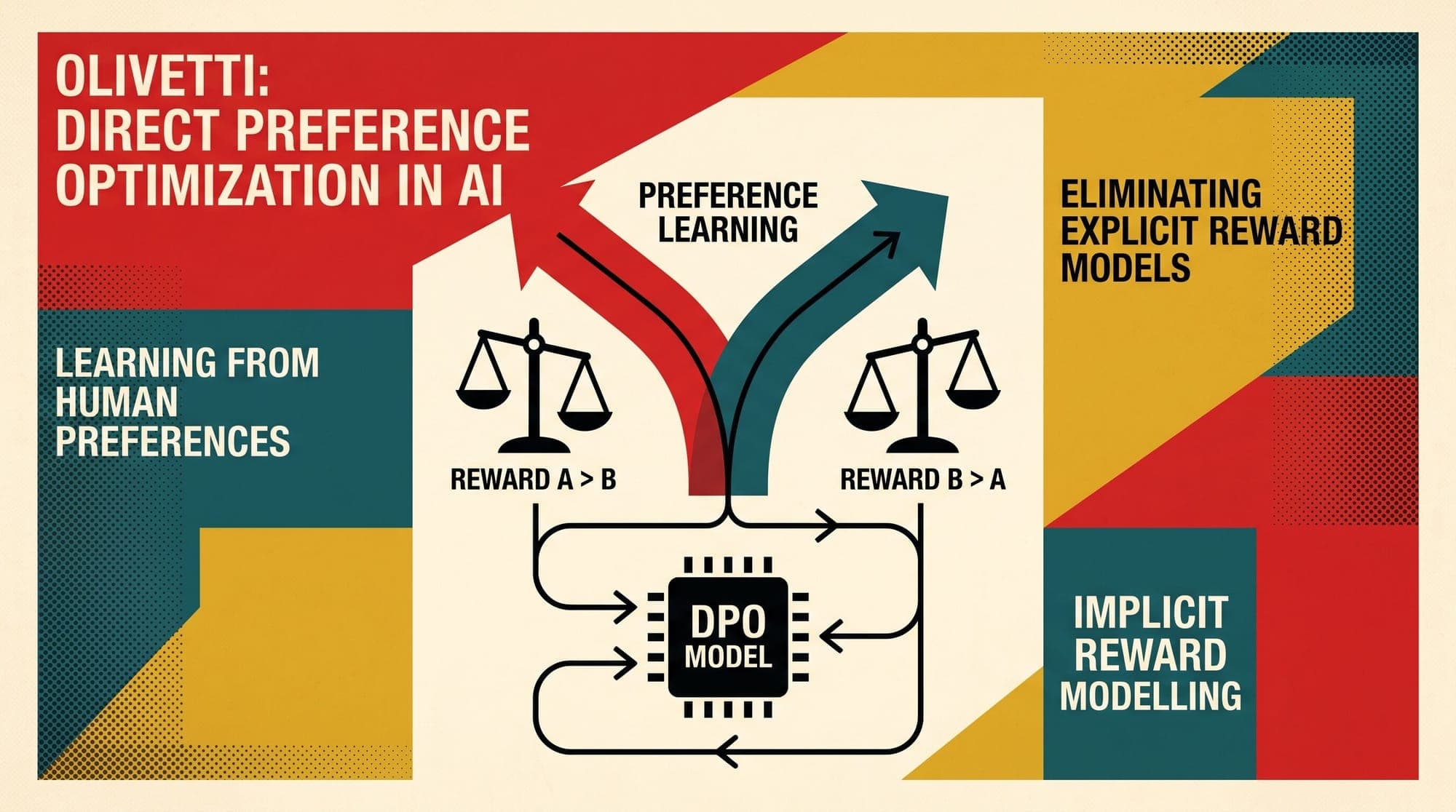
  • Direct Preference Optimization: Mathematical Derivation, Implicit Reward Formulation, and the Mechanics of RL-Free Alignment

    Direct Preference Optimization: Mathematical Derivation, Implicit Reward Formulation, and the Mechanics of RL-Free Alignment Aligning autoregressive large language models with human preferences has traditionally relied on Reinforcement Learning from Human Feedback (RLHF). In the standard formulation popularized by InstructGPT and related post-training regimes, alignment requires a multi-stage pipeline: supervised fine-tuning (SFT), training a separate reward model on pairwise comparison data, a

    1 min