Serving5 articles

Serving

Articles

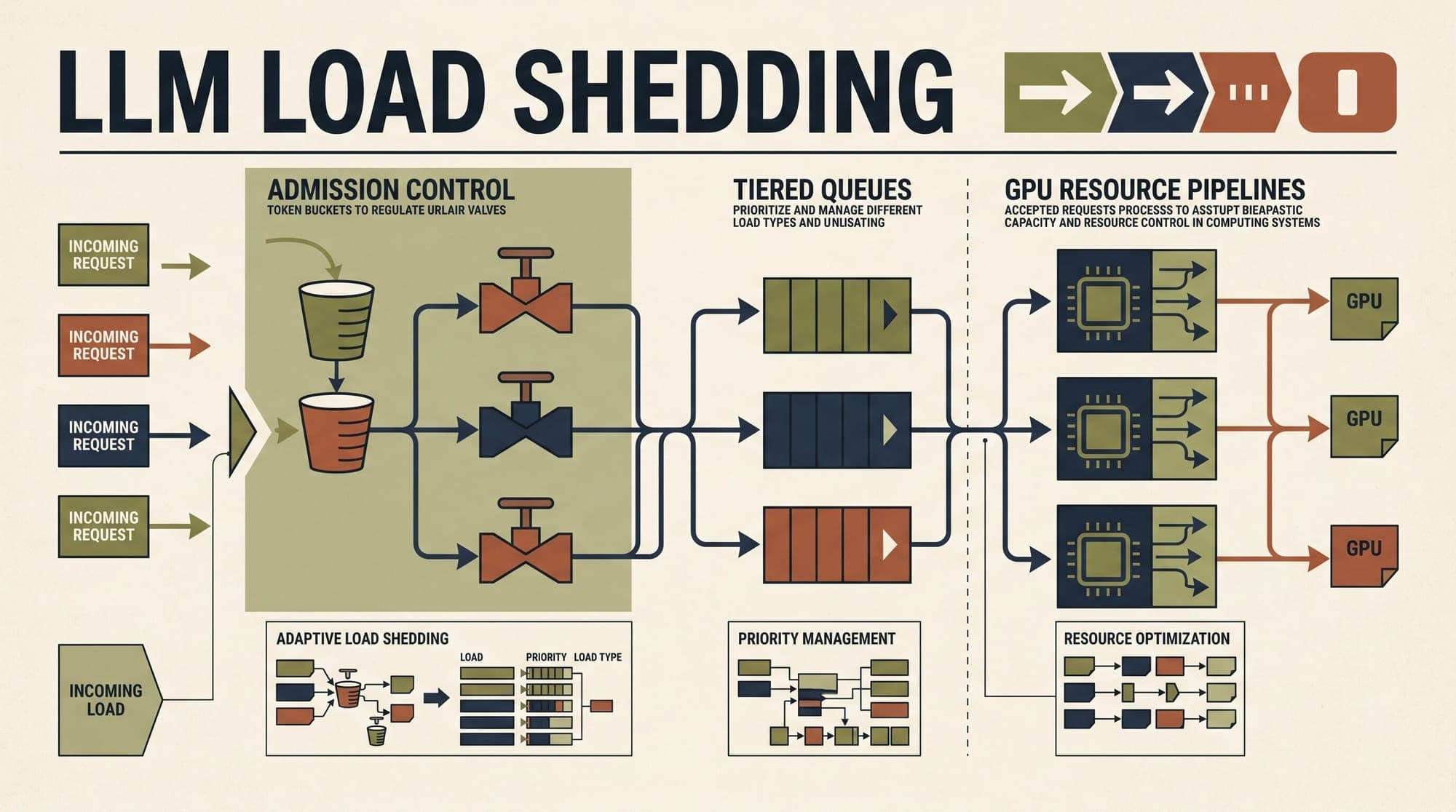
  • LLM Load Shedding and Overload Control in Production: Adaptive Admission, Preemption Economics, and Graceful Degradation

    LLM Load Shedding and Overload Control in Production: Adaptive Admission, Preemption Economics, and Graceful Degradation Standard web services rely on well-established overload protection patterns: reverse proxies monitor CPU utilization, memory thresholds, or static queue depths and reject excess HTTP requests with 429 Too Many Requests or 503 Service Unavailable status codes. When applied naively to Large Language Model (LLM) serving infrastructure, these conventional heuristics fail catastro

    1 min
  • Geo-Distributed LLM Inference in Production: Cross-Region Routing, Wide-Area KV Cache Dynamics, and Data Residency Architecture

    Serving large language models at enterprise scale quickly encounters geographic constraints. When users, microservices, and autonomous agents are distributed across North America, Europe, and Asia-Pacific, routing all traffic to a single centralized GPU cluster introduces significant wide-area network (WAN) round-trip times (RTT). An interactive request from Singapore to a US-East data center carries 180ms to 240ms of baseline network latency before the GPU executes a single token. However, dis

    1 min
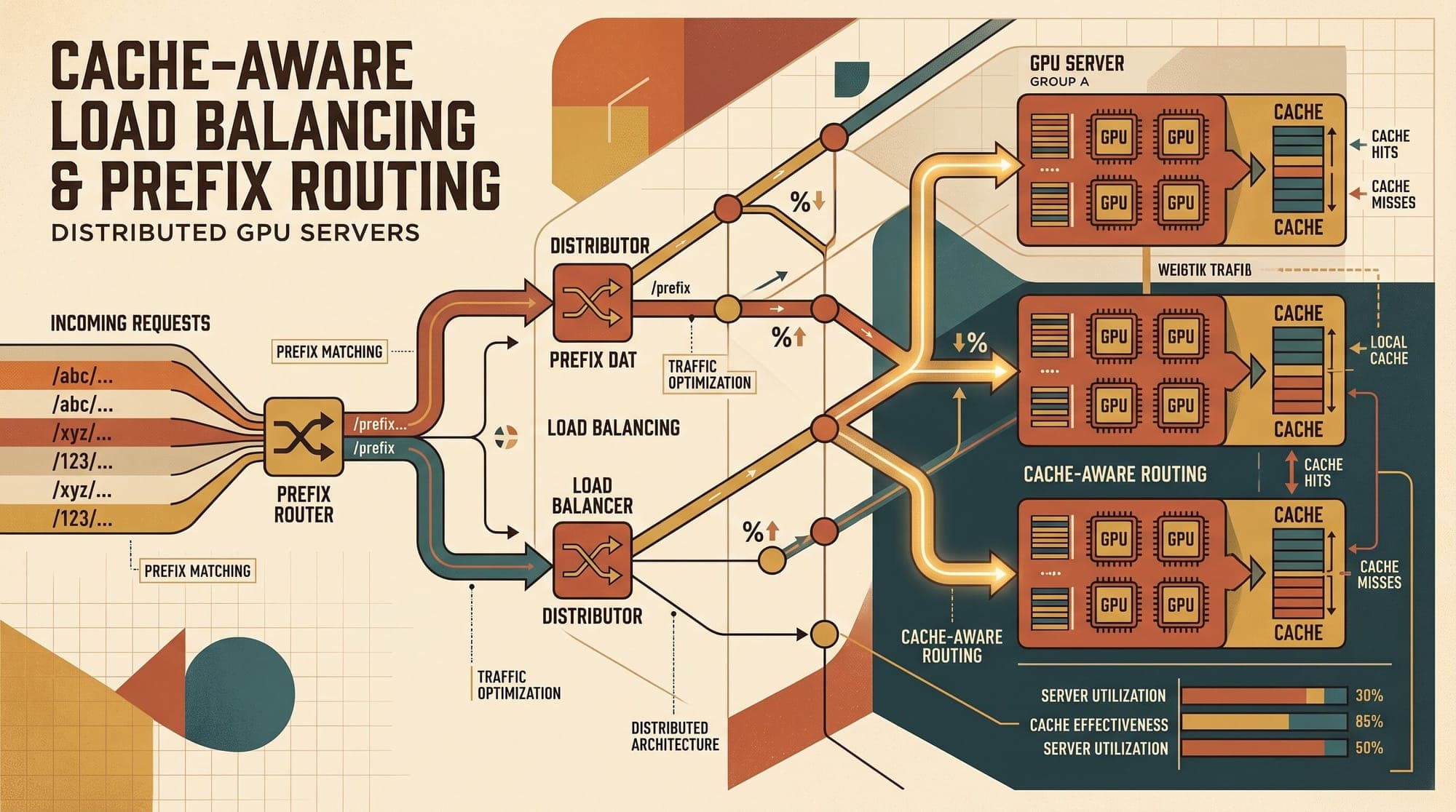
  • Cache-Aware Load Balancing in Production LLM Serving: Architecture, Prefix Affinity, and Multi-Replica Routing Trade-Offs

    Cache-Aware Load Balancing in Production LLM Serving: Architecture, Prefix Affinity, and Multi-Replica Routing Trade-Offs When scaling large language model inference across multiple GPU worker nodes, standard Layer-4 and Layer-7 load balancing algorithms create an unseen performance cliff. Round-robin, least-connections, and random routing distribute HTTP/gRPC requests uniformly across compute replicas. However, modern LLM inference engines rely on prompt caching mechanisms, such as vLLM Automa

    1 min
  • Quantized KV Caches in Production: FP8 vs. INT8 vs. INT4 Architecture, Kernel Backends, and Serving Economics

    In modern large language model serving, memory capacity and memory bandwidth are the two primary bottlenecks governing inference economics. While static model weights occupy a fixed footprint in GPU High Bandwidth Memory (HBM), the Key-Value (KV) cache grows dynamically with batch size and sequence length. In workloads with 32,000 to 128,000 token context windows, the KV cache quickly overtakes weight memory, consuming up to 70% of total VRAM and capping concurrency. During autoregressive gener

    1 min
  • Disaggregated Prefill and Decode in Production: Architecture, Economics, and KV Transfer Protocols

    In production large language model serving, the fundamental architectural tension lies between two computationally distinct phases: prefill (processing the input prompt) and decode (generating output tokens autoregressively). In standard co-located serving systems, both phases share the same GPU instances, memory pools, and execution batches. This co-location creates head-of-line blocking, degrades Time to First Token (TTFT), inflates Time Per Output Token (TPOT), and limits cluster-wide hardwar

    1 min