Algorithms3 articles

Algorithms

Articles

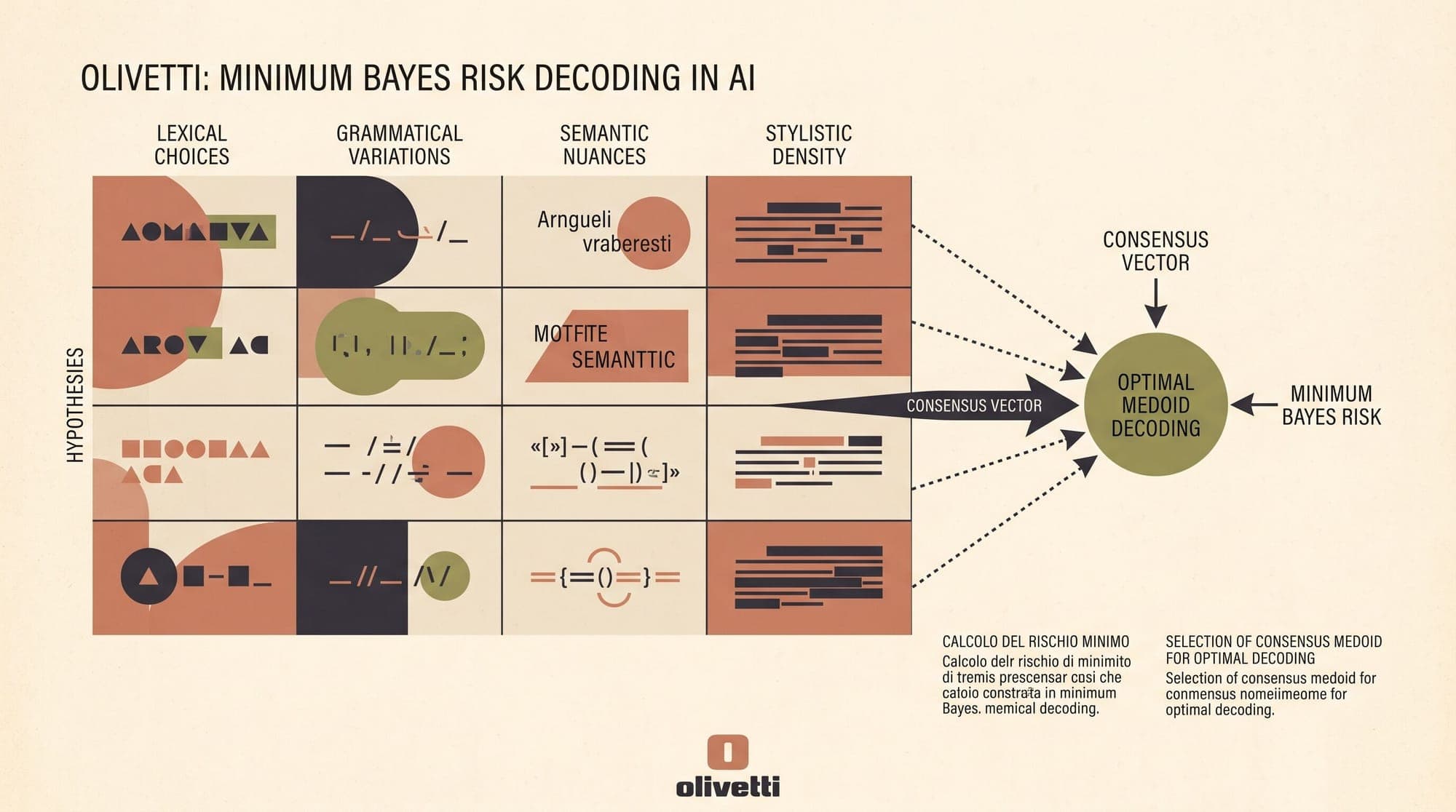
  • Minimum Bayes Risk Decoding: How Utility Consensus and Distributional Reranking Outperform Mode-Seeking in Large Language Models

    Autoregressive large language models generate text by estimating conditional probability distributions over token sequences. In conventional inference pipelines, generating the final output sequence relies almost entirely on search algorithms designed to locate high-probability trajectories: greedy decoding, beam search, or stochastic sampling with temperature and top-p filtering. However, theoretical and empirical analyses demonstrate that the most probable sequence under a model's distributio

    1 min

  • Jacobi and Lookahead Decoding: How Parallel Fixed-Point Iteration Accelerates Autoregressive Inference Without Draft Models

    Standard autoregressive generation in large language models operates as a strictly sequential process. To generate a sequence of $K$ tokens, an inference engine must execute $K$ successive forward passes through the network. In single-request serving regimes (batch size 1), each forward pass is heavily memory-bandwidth bound: the GPU must stream billions of model parameters from High Bandwidth Memory (HBM) into on-chip SRAM to process a single token, leaving tensor compute cores severely underut

    1 min
  • Tree of Thoughts in Large Language Models: How Search Trees, State Evaluation, and Backtracking Expand Deliberate Reasoning

    Standard autoregressive large language models generate text sequentially from left to right. At each step $t$, the network samples the next token according to a conditional probability distribution over the vocabulary: P(w_t | w_1, w_2, ..., w_{t-1}) While Chain-of-Thought (CoT) prompting (Wei et al., 2022) encourages models to output intermediate reasoning steps, the underlying computational process remains a linear path through token space. If the model makes an early logical error or choose

    1 min