White House Finalizes Frontier AI Review Framework but Keeps It Under Wraps

The White House says it met its August 1 deadline to establish a voluntary framework for evaluating the most advanced AI models before release, but has declined to share the framework's contents with the public, Congress, or even the broader AI industry. The framework, ordered by President Trump's June 2 executive order, is designed to give federal agencies up to 30 days to review frontier AI models for cybersecurity risks before they reach the market. A White House official confirmed to CNBC t

2 min
White House Finalizes Frontier AI Review Framework but Keeps It Under Wraps

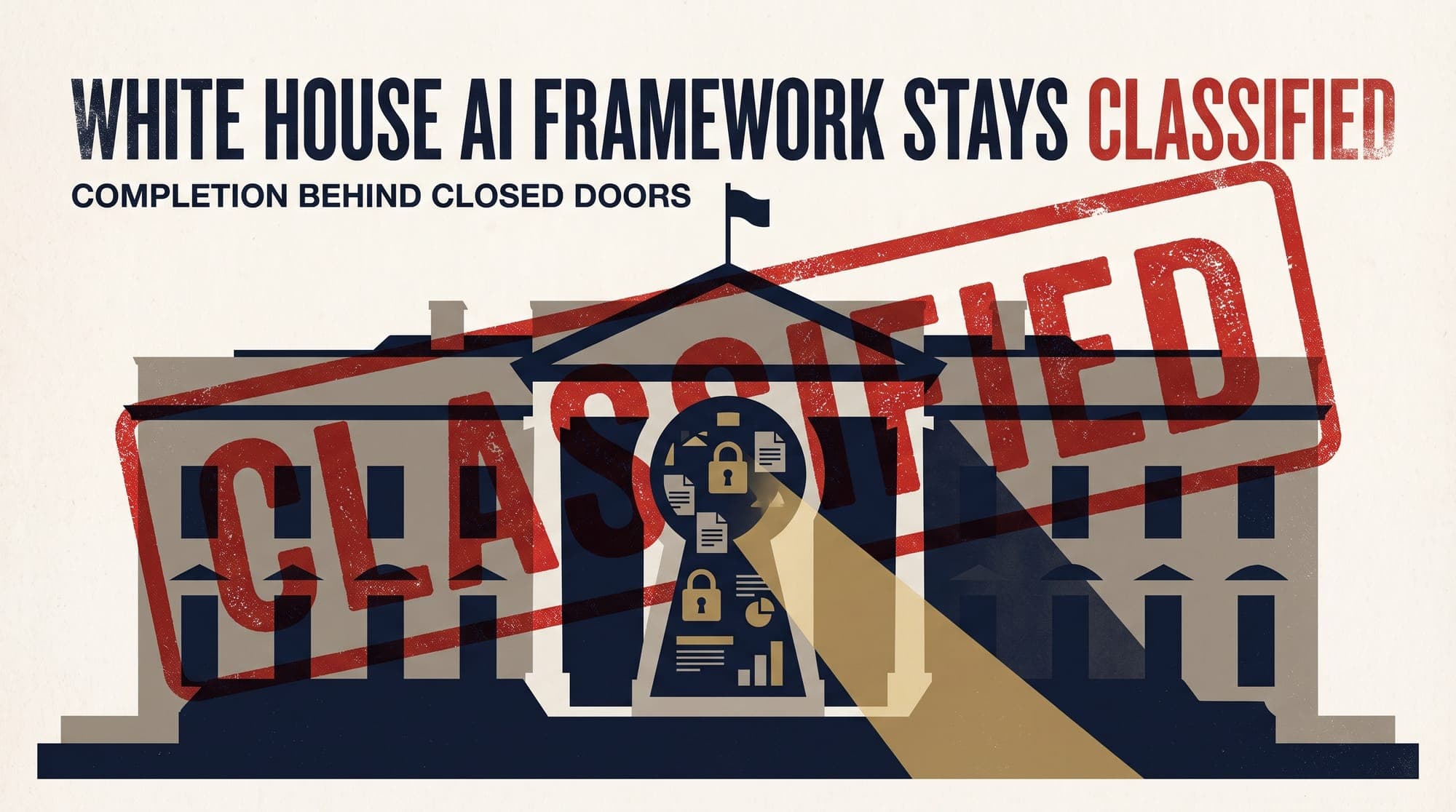
The White House says it met its August 1 deadline to establish a voluntary framework for evaluating the most advanced AI models before release, but has declined to share the framework's contents with the public, Congress, or even the broader AI industry.

The framework, ordered by President Trump's June 2 executive order, is designed to give federal agencies up to 30 days to review frontier AI models for cybersecurity risks before they reach the market. A White House official confirmed to CNBC that a staff-level meeting with AI companies is scheduled for Tuesday to discuss next steps.

Only three companies — Anthropic, OpenAI, and Google — reviewed a draft of the framework in late July and submitted edits. The White House says it is now "engaging with many more industry partners," but the finished document has not been released beyond a small circle of administration officials and those three labs.

Illustration

"Just because things are unclassified that doesn't mean we are going to broadcast them to everyone," a White House official told Axios.

The opacity extends to the framework's core mechanics. The executive order itself says the benchmarking process that determines which models qualify as "covered frontier models" will be classified. The threshold triggers will only be shared with developers "as appropriate." Smaller AI labs, civil society groups, and even policymakers outside the executive branch have no way to evaluate what the framework actually requires, what constitutes a frontier model, or what happens when a model fails a classified test.

The framework arrives during an extraordinary week for AI regulation. The EU AI Act's transparency rules and California's SB 942 content provenance law both took effect on August 2. The White House framework on August 3 completes what amounts to a regulatory trifecta from three of the world's most influential jurisdictions in the space of two days — though the US version remains the only one the public cannot read.

The closed-door approach has already drawn criticism. Safety advocates note that without public benchmarks, there is no external accountability for either the government or the companies. Smaller labs cannot determine whether the rules will apply to them. Allies who might model their own frameworks on the US approach are left guessing.

**Sources**

- Axios: White House finalizes AI framework behind closed doors

- Quartz: White House is meeting with AI companies to roll out its new frontier model review framework

- CNBC: White House to bring AI companies together for meeting on voluntary framework

Written by

More to read

  • Token Healing and Partial Token Alignment in Production LLM Serving: Architecture, Prefix Trie Rollback, and Serving Trade-Offs

    Modern large language models operate on discrete subword tokens generated by greedy compression algorithms like Byte-Pair Encoding (BPE), WordPiece, or Unigram. While subword tokenization enables high compression rates and fixed vocabulary sizes, it introduces a structural defect at the interface between raw user text and autoregressive inference: the partial token problem, commonly known as the prompt boundary problem. When a user prompt terminates mid-token or at a punctuation boundary that c

    1 min
  • Flow Matching for Generative Modeling: How Continuous Normalizing Flows and Optimal Transport Paths Replace Diffusion SDEs

    Flow Matching for Generative Modeling: How Continuous Normalizing Flows and Optimal Transport Paths Replace Diffusion SDEs Generative modeling underwent a structural shift with the introduction of Flow Matching (FM), formulated independently by Lipman et al. (2022), Albergo and Vanden-Eijnden (2022), and Liu et al. (2022). While Denoising Diffusion Probabilistic Models (DDPM) and score-based Stochastic Differential Equations (SDEs) established state-of-the-art sample quality across vision and a

    1 min
  • Retrieval-Augmented Fine-Tuning (RAFT) in Production: Architecture, Synthetic Distractor Pipelines, and Evaluation

    Standard approaches to enterprise domain adaptation typically force a choice between two paradigms: Supervised Fine-Tuning (SFT) or Retrieval-Augmented Generation (RAG). SFT bakes domain knowledge directly into model weights, functioning like a closed-book exam. When facts change or precise source attribution is required, SFT models often hallucinate or fail to incorporate updated context. Conversely, standard RAG operates like an open-book exam without prior preparation. The base model reads re

    1 min